Jaws 2 (1978)

JAWS 2 (1978) **1/2
I feel like I owe both Jaws 2 overall and specifically the killer great white shark in Jaws 2 a big apology.

Not a great big apology, though, but let’s go back in time.

When I reviewed Jaws 2 back in 2019, I gave the film two and the killer great white shark three stars, the former rating averaged from the shark’s three stars and the human characters’ one star. I wrote that review based on memory from having seen it so, so, so many times over the years, rather than a fresh viewing.

After revisiting Jaws 2 for the first time in several years, I have bumped the shark to three-and-a-half and the human characters to one-and-a-half, averaging out to two-and-a-half stars.

I still think Jaws 2 has the same fundamental strengths and weaknesses, though I found the strengths a little bit stronger and the weaknesses a little bit less weak this latest watch.

The great white shark in Jaws 2, plain and simple, it’s one bad mother- (Shut your mouth!) But I’m talking ’bout Bruce Two! (Then we can dig it!)

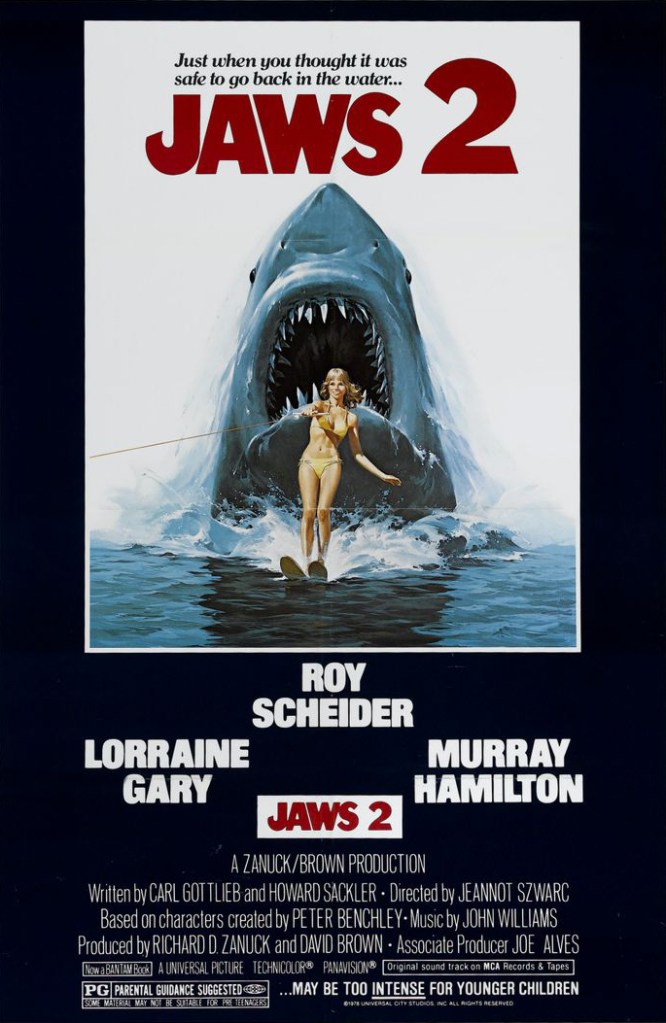
Though a major step down from the original in just about every conceivable way, Jaws 2 still made a strong killing financially because it had a hard sell advertising campaign centered around the immortal tagline Just when you thought it was safe to go back in the water; because, just as Yogurt said in Spaceballs, Merchandising, merchandising, where the real money from the movie is made; and because, let’s face it, people wanted more shark and more shark attacks.

Jaws obviously did not satisfy the public demand for shark attacks captured on celluloid.

Released nearly three years later to the day, Jaws 2 serves up a shark attack every 10-15 minutes, just so we’re not completely bored stiff by a plot that rehashes one of the worst elements of the original Jaws and substitutes adult characters for a steady procession of teeny boppers who together do not make up for Quint and Hooper.

Jaws 2 introduces a syndrome … called none other than the Jaws 2 Syndrome.

That’s where a sequel takes the worst or one of the worst plot elements of the original film and does it again, only even worse, usually a lot worse.

We remember the infuriating mayor and the infuriating small town businesspeople and their infuriating desire to keep the beaches open in Jaws.

They’re even more infuriating in Jaws 2, set four years after the events of the first movie, especially in the form of the super sleazy town official and all-purpose wheeler dealer Len Peterson (Joseph Mascolo). Peterson only compounds our dislike of this character with his obvious lusting after Sheriff Brody’s wife Ellen (Lorraine Gary).

We’re not even rewarded with a death scene for Peterson, because, generally speaking, business interests and power brokers survive Jaws films.

Presented with photographic evidence of a shark, Peterson and his cronies on the town council dismiss it as seaweed, mud, something on the lens and they fire Sheriff Brody (Roy Scheider) not long after his public meltdown on a crowded beach.

We all know too well that Sheriff Brody and the killer shark are destined for a final showdown, so it is very frustrating (and infuriating, once again) to see Sheriff Brody put through the proverbial ringer in the middle section of Jaws 2.

Scheider did not want to have anything to do with Jaws 2 whatsoever and reports have it the human star of the movie thought he would be overshadowed by the shark. He’s right, exactly right, because the shark and the shark attacks absolutely steal the show. The shark is the greatest character in Jaws 2, despite Scheider’s best efforts as Sheriff Brody.

Jaws gives us five great characters in Sheriff Brody, Hooper (Richard Dreyfuss), Quint (Robert Shaw), Mayor Vaughn (Murray Hamilton), and the shark.

Brody and Vaughn return in Jaws 2, but they are overshadowed by the shark, Hooper did not return, and Quint certainly did not return after that ending in Jaws.

Instead, we have a bunch of nattering (or screaming) teenagers, who are still better characters than any in Jaws 3 and Jaws: The Revenge.

The Wild Geese (1978)

THE WILD GEESE (1978) *
We’ve seen The Wild Geese many times before and we’ve also seen it done a lot better many times before — the rounding up of the mercenary troops for their new mission, the basic training, the jail break, the great escape, the big double cross, the death scenes, etc.

If we pool our collective resources, undoubtedly we could brainstorm 50 or 100 titles easily and recall their overall plots and specific individual developments.

Worse, far worse, infinitely worse even, how do I describe the pace of The Wild Geese?

I thought about saying it moves at a snail’s pace, but then I quickly realized that it more accurately moves like a three-toed sloth dipped in molasses. This is one action movie that does not require slow motion because it’s already slow enough.

In fact, I am hard pressed to come up with an action movie that moves slower than The Wild Geese. I just can’t do it and I don’t want to ever find out if any do exist in this great big universe.

Anyway, we have the first 30 minutes to meet our stars Richard Burton, Richard Harris, and Roger Moore, then around the 45-minute mark it’s basic training and finally around one hour in we get into the main action. I almost said jump, but that’s way too much activity for The Wild Geese. To be fair, The Wild Geese picks up the pace in the last hour to such a degree that only two of the three sloth toes are molasses drenched. Guess what, though, it’s still dull as dishwater.

Yes, indeed, there’s not an exciting moment to be found in The Wild Geese.

Of course, that incredible pace might have something to do with the fact Burton, Harris, and Moore were in their late 40s (Harris) and early 50s (Burton, Moore) when they made The Wild Geese. Harris and especially Burton are not the least bit convincing in their action hero roles. Moore was nearly halfway through his run playing British secret agent James Bond, so he’s more credible than his counterparts and looks much less a fool than either Harris or Burton.

It is ironic that Burton, Harris, and Moore are playing middle-aged mercenaries and the film drops mercenary dialogue routinely during a 135-minute spread, because the three main actors fit the adjective definition of mercenary — primarily concerned with making money at the expense of ethics.

It seems like they paid Burton, Harris, and Moore by the word during The Wild Geese, because they yap and yammer constantly, their barrage of banter only interrupted by the generic requirements of the action movie. Granted, it takes a (long) while before the prerequisite explosions and gunfire.

By my reckoning, a long, long, long, long, long, long while and The Wild Geese lives up only to the geese portion because it is something foul alright. Wild, however, it is most certainly not.

The Manitou (1978)

THE MANITOU (1978) *1/2
California is going to hell.

— Donald J. Trump on Twitter

Obviously, President Trump — a big movie fan, the biggest movie fan ever — forgot The Manitou from 1978, because then he would have known California, at least one San Francisco hospital, had already gone straight to Hell for one absolutely positively bloody ridiculous 103-minute horror movie.

The Manitou just might help explain what’s happening today in California and many other places, for that matter. Yes, that’s right, it’s another possession movie.

Tony Curtis plays a phony baloney psychic seen in movies upon occasion (normally bad movies) — one of them who reads Tarot cards to little old ladies and other suckers — and his former flame discovers a growth on the back of her neck. The foremost tumor expert calls it “malignant.” It’s definitely malignant, alright, it’s the reborn spirit of the most powerful 400-year-old medicine man on his fifth reincarnation. You think you’re having a bad day or a bad time, just wait until you see what happens to poor Karen Tandy (Susan Strasberg) in The Manitou.

This is yet another one of those movies where I am thankful every actor maintained a straight face reciting all their dialogue. To be honest, though, I want to learn their secret. The Manitou combines doctor talk, psychic talk, spiritual talk, and Indian talk into one concoction that’s overloaded and overheated with jive, like, for example, we all — even us White people — have a Manitou and that we includes all our possessions. I cannot help myself when I laugh at such dialogue like “Gichi Manitou? Harry, you don’t call Gichi Manitou. He …” and (in response) “Oh, yeah, well he’s going to get a person-to-person call from me … collect!”

The Manitou somewhat redeems itself with a spectacular psychedelic light show late in the picture. It comes in about 90-95 minutes to be a tad bit more precise and that display earned the picture a half-star bump in overall rating. By the way, I almost rescinded that half-star boost after The Manitou hits us with the following statement:

Fact: Tokyo, Japan, 1969.

A fifteen-year-old boy developed what doctors thought was a tumor in his chest. The larger it grew, the more uncharacteristic it appeared. Eventually, it proved to be a human fetus.

After 100 minutes of The Manitou, about the last thing in the world we needed was any claim to factual basis.

The Manitou is so bad that I hope it will not be reborn in 400 years, when it would be ever more powerful and worse.

Beyond and Back (1978)

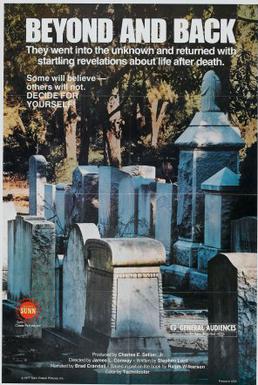
BEYOND AND BACK (1978) No stars

I am here to tell you about life after Beyond and Back.

I cannot believe that I finally watched a film that displaces The Star Wars Holiday Special as my selection for the worst film made in 1978.

Beyond and Back proved to be D.O.A. It showed no vital signs of cinematic life and brought me a micrometre closer to atheism with its faith-based and family-friendly agenda shoved down my throat, 90 minutes of bad actors monotonously gushing over near-death experiences, life after death, psychokinesis, Heaven and Hell, bright light, weighing souls, seeing dead relatives, ad nauseam.

Beyond and Back puts Benjamin Franklin, Elizabeth Barrett Browning, Eddie Rickenbacker, Thomas Edison, Louisa May Alcott, Ernest Hemingway, George S. Patton, and Harry Houdini on an equal plane with Anne Fleck, Dr. Stevens, Byron Temple, and Dr. Paul Kelly, since they’re all just cannon fodder for that agenda told through a pseudo-documentary approach with bad narration and bad reenactment.

Two of the worst films ever made (both from 1978) involve laughable disclaimers:

The African killer bee portrayed in this film bears absolutely no relationship to the industrious, hardworking American honey bee to which we are indebted for pollinating vital crops that feed our nation — The Swarm

The events you have just seen have been taken from actual accounts, but the names of the persons involved have been changed to preserve their anonymity. All such persons have been portrayed by professional actors and actresses — Beyond and Back

Of course, Beyond and Back is the same picture that starts with its narrator telling us, “You are about to see one of the most extraordinary movies of our time, a movie that dares to investigate the possibility of life after death.”

We can thank the folks at Sunn Classic Pictures for such classics, er, drivel as Beyond and Back, namely director, producer, novelist, and Sunn Classics founder Charles E. Sellier. Sellier (1943-2011) evolved from Cajun Catholicism to Mormonism and finally evangelical Christianity, but his product remained in the realm of quick-buck exploitation, whether it was Sunn Classic productions In Search of Noah’s Ark and In Search of Historic Jesus or the controversial killer Santa picture Silent Night, Deadly Night and the teenage comedy Snowballing (both directed by Sellier) or his later productions George W. Bush: Faith in the White House, Breaking the Da Vinci Code, The Search for Heaven, and Apocalypse and the End Times.

For obvious theological reasons and philosophical differences, Beyond and Back passed on many tales and famous last words.

Last words are for fools who haven’t said enough — Karl Marx

I hope the exit is joyful and hope never to return — Frida Kahlo

Dammit, don’t you dare ask God to help me — Joan Crawford

I’m bored with it all — Winston Churchill

I’m going, but I’m going in the name of the Lord — Bessie Smith (I do not recall a single black person in Beyond and Back)

My wallpaper and I are fighting a duel to the death. One or the other of us has to go — Oscar Wilde

Dear World, I am leaving because I am bored. I feel I have lived long enough. I am leaving you with your worries in this sweet cesspool. Good luck — George Sanders (a charming wit to the end)

As we depart this mortal review, I leave this joke: What’s the last thing that goes through a fly’s mind when I kill him? My fist (reporter’s notebook).

The Medusa Touch (1978)

THE MEDUSA TOUCH (1978) *1/2
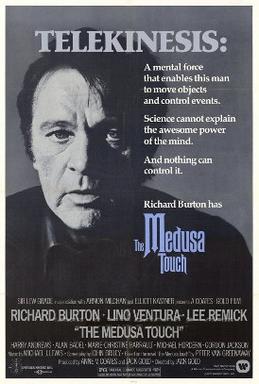
I could only empathize with Richard Burton’s character in The Medusa Touch in one way.

At some point during The Medusa Touch, I realized that I was seeing a cinematic disaster before my very eyes and I began staring right back at the screen especially when Burton’s John Morlar trotted out his telekinetic powers. Through my telecinematic eyes, I flashed back on Billy the Kid Vs. Dracula when the Old Count, played by veteran John Carradine, overacted with his eyes just like Burton did 12 years later. I laughed at both films more than I have at films that were aiming to make me laugh and failed.

Whether or not one appreciates The Medusa Touch boils down to how one feels about the film’s heavy flashback structure and the Burton lead performance.

I don’t know, personally speaking, I soured on the flashbacks by about the third time Lino Ventura’s French detective Monsieur Brunel encountered a character who recalled a past event, normally a disaster, involving John Morlar at various evolutionary stages in his telekinesis. We know, though, with dread certainty that whenever there’s a flashback, somebody’s going to die. Morlar’s parents, his wife and her lover, Morlar’s neighbor, Morlar’s enemies at school, et cetera. Of course, the deaths grow progressively in number and more sensational until Morlar crashes planes into buildings and reduces cathedrals to rubble.

As far as Burton’s performance, I never felt much of anything for John Morlar and that blame falls on the shoulders of the man who could be both one of the best and one of the worst actors in the world before his death in 1984. I feel even more admiration for Sissy Spacek’s work as the title character in Carrie, after watching Burton go down in flames in The Medusa Touch. Spacek creates such overwhelming empathy for her character that we get caught up in the predominantly teenybopper melodrama and we truly care about what happens to Carrie White. We don’t want to see any more misfortune befall this character, and we are on her side when the pigs’ blood flies late in the picture. Morlar could not even rouse me to a superficial hatred that immediately disappears at the end credits, and by all rights he should have. I just heard Burton mouthing dialogue and being guilty of worse overacting with his telekinesis.

Not only does Morlar have telekinesis, he’s apparently unstoppable. Nobody can kill him in this picture, though two main characters give it the old college try. Morlar takes a licking and keeps on ticking. Simply unbelievable. Morlar spends almost the entire movie in a hospital bed on life support and that helps explain why Burton gives his performance basically in flashback; it should be mentioned though Morlar’s brain occasionally causes the attached monitor to go schizoid. Nobody casts a star the stature of Burton and then have him bed ridden for the film’s duration.

Between telekinesis and invincibility, I found little to believe in during The Medusa Touch. I just wanted it to be over so I could quickly begin the healing process.

The Magic of Lassie (1978)

THE MAGIC OF LASSIE

THE MAGIC OF LASSIE (1978) *

Nostalgia became a dominant cultural force in the 1970s, between AMERICAN GRAFFITI, “Happy Days,” ANIMAL HOUSE, ROCKY, STAR WARS, SUPERMAN, and THAT’S ENTERTAINMENT I and II.

Nostalgia also explains THE MAGIC OF LASSIE, in everything from everybody’s favorite cinematic collie to genial old timers James Stewart and Mickey Rooney to the songs by Richard M. and Robert B. Sherman and especially the values implied and directly stated by Lassie, Stewart, Rooney, and their songs.

The picture opens, for crying out loud, with All-American cinematic icon Jimmy Stewart singing “That Hometown Feeling.” I came up with a couple quick reactions: Thankfully, Stewart rarely ever sang during his long entertainment career; They are laying it on awful darn thick real quick in this pic. Of course, paraphrasing Bachman-Turner Overdrive, I hadn’t seen nothin’ yet. Is BTO on the soundtrack? No, but Stewart, Mickey Rooney, Debby Boone, and the Mike Curb Congregation are instead … hot diggity dog!

I just moaned and groaned about the Sherman Bros. songs in the 1972 animated SNOOPY, COME HOME, a picture about 10 or 50 or 100 times better than THE MAGIC OF LASSIE even with them darn songs.

In addition to songs that might cause somebody to wish for temporary hearing loss, THE MAGIC OF LASSIE relies heavily on a couple of my least favorite plot devices: A shady businessman leans on a property owner to sell his property (in this case a vineyard) and (mostly) comic villains ineptly chase our heroes.

In some real cutthroat business practices, Jamison takes Lassie away from kind old Grandpa Clovis Mitchell (Stewart) and his feisty grandchildren Kelly (Stephanie Zimbalist) and Chris (Michael Sharrett) and that horrible man makes it all the way to Colorado Springs with the prized bitch. Lassie runs away, headed for California. Chris runs away, headed for Colorado. Clovis takes off to look for Chris and Lassie. Clovis and Chris should be thankful, eternally grateful that Lassie’s the absolute smartest character in the entire movie, although maybe she wished she wasn’t so smart because her name would not have been in the title. Then again, wasn’t Lassie’s name always in the title of her entertainment packages?

It would take approximately 20 hours by automobile to get from Colorado Springs back to Sonoma (filming location of THE MAGIC OF LASSIE) and walking amounts to a trip lasting 414 hours. There are moments when THE MAGIC OF LASSIE feels like it lasts that long.

They really burden Lassie with some indignities during THE MAGIC OF LASSIE, all within that glorious ‘G’ rating. At least three name changes. A nasty addiction to banjo. Lassie rescues a cat from a burning building. That last one, why that’s just going way, way, way too far. I hope they paid her owners very handsomely.

Believe it or not, centerpiece song “When You’re Loved” (seen and heard in by my count two would-be feel good montages during the 100-minute cinematic endurance contest) received a nomination for Best Original Song at the 51st Academy Awards. I really can believe it, though, that “When You’re Loved” lost to Donna Summer’s “Last Dance” from THANK GOD IT’S FRIDAY.

By the end of THE MAGIC OF LASSIE (or TGIF, for that matter), though, all I was saying was “Thank God It’s Over.”

Kill and Kill Again, Firecracker, Circle of Iron

KILL AND KILL AGAIN, FIRECRACKER, CIRCLE OF IRON

In his 1981 TV review of the South African martial arts spectacular KILL AND KILL AGAIN, Roger Ebert predicted action movie stardom for James Ryan and invoked the names Eastwood, Bronson, and Bruce Lee.

Well, in this business and life in general for that matter, you win some, you lose some.

James Ryan, who? Yeah, not exactly a household name.

Describing the plot, I would like to just string together a bunch of random words: martial arts champion for hire undercover government agent top secret rescue mission kidnapped scientist recruit colleagues alternative energy source megalomaniac uniformed cult mind control world domination bar fight mushy romance mushy talk middle-of-nowhere fight storming fortress explosions fisticuffs flips plot revelations not particularly revelatory.

There you go. KILL AND KILL AGAIN, the sequel to KILL OR BE KILLED, in a nutshell.

KILL AND KILL AGAIN works predominantly because it has a good sense of humor and it finds just the right tone to pull off being a successful action comedy.

There’s one especially fun supporting character and supporting performance, the diabolical genius’ assistant and (significant other) Minerva played by Marloe Scott-Wilson. She looks like she drifted over from ROCK ‘N’ ROLL HIGH SCHOOL or THE DECLINE OF WESTERN CIVILIZATION, especially with that ridiculous Day-Glo hairdo. She’s a lot of fun in every scene, especially when she calls residential madman Marduk (Michael Mayer) by these absolutely ridiculous pet names. She comes up with a fresh one every single time. And it rankles Marduk, because good old Minerva says her little terms of endearment right in front of everybody. At one point, Marduk tells her, “I said don’t call me Popsicle.” This running gag even has an explosive payoff in the end.

Guess we should mention that South African beauty queen Anneline Kriel — Miss World 1974 — does her own stunts in the movie. She has to overcome playing a character named “Kandy Kane.” I almost wish they would have named her character “Susan Alexander Kane” or “Emily Kane,” for all us CITIZEN KANE fans in the audience. Now, that would have been an impressive stunt.

Impressive stunts are at the heart of FIRECRACKER, especially during the film’s last 30 minutes.

We’re talking about topless kickboxing and what must surely be one of the weirdest love scenes ever committed to celluloid.

Two sicko creeps pursue our heroine Susanne Carter, played by the luscious Jillian Kesner, and they eventually shed her of her top and bra. She then proceeds to kick their asses viciously. Meanwhile, in the background, we have “Rack Master” boxes. Perfect!

“Rack Master” should have been Carter’s martial arts name and it also should have been a title for FIRECRACKER.

That’s not too much of a stretch, especially since FIRECRACKER traveled as NAKED FIST in Australia.

FIRECRACKER director Cirio H. Santiago plagiarized this topless kickboxing scene from his earlier New World Pictures extravaganza TNT JACKSON.

Now, let us consider that weird love scene. Oh Susanna and her love interest Chuck Donner (Darby Hinton) consummate their relationship, but not before they remove each other’s clothes stitch-by-stitch with a knife. Kinky. Chuck Donner and his incredible mustache, especially his incredible mustache, just scream “Creepy seducer of the ladies who killed Susanna’s sister.” Of course, Susanna does not learn of this fact until after their lovemaking.

Susanna exacts her revenge against Chuck in the ring and we all can be sure that he will never look at another woman ever again.

Kesner passed away in 2007 and she and her late husband Gary Graver (1938-2006) became known for their efforts to preserve the work and legacy of legendary director Orson Welles. I do believe it is time for another reference to CITIZEN KANE.

CIRCLE OF IRON attempts to be something bigger, greater than KILL AND KILL AGAIN and FIRECRACKER. It wants to be a transcendent exploitation film.

We are given the only clue we need as soon as the following title card appears on screen: “Prior to the death of the legendary Bruce Lee he helped to create a movie story that might capture not only the spirit of martial arts but a part of the Zen philosophy he lived by. He was aware that a film with these dynamics would cause controversy, particularly among those unfamiliar with Zen beliefs. But it was this very uniqueness that he believed wound enthrall the moviegoer. Bruce set the story in a land that never was and always is. It is to Bruce Lee that this film is posthumously dedicated.”

I was definitely not enthralled by CIRCLE OF IRON. Not very often.

It certainly did not help that Captain Hairdo, er, Jeff Cooper plays the lead character Cord and this character and performance never quite resonated with me because I kept seeing Roger Daltrey instead and I pretended it was TOMMY.

I kept waiting for Cooper’s cord to break out into song, “Listening to you, I get the music / Gazing at you I get the heat / Following you I climb the mountain / I get excitement at your feet!” and “See me, feel me, touch me, heal me.”

It never happened and I felt extremely disappointed.

David Carradine plays about four roles too many in CIRCLE OF IRON. Okay, I’ll say three roles too many, because we get one of the film’s most entertaining scenes when Carradine assumes the guise of “Monkeyman.” At one point, Carradine’s wig came off and I thought shit like that only happened in SAMURAI COP.

Christopher Lee passed on THE LEGEND OF THE 7 GOLDEN VAMPIRES, a joint venture between Hammer Studios and the Shaw Brothers, because he did not want to play Dracula for the millionth time … but he plays what turns out to be a role that sucks even more in CIRCLE OF IRON, Zoltar, er, Zetan. This is one of those quest movies where you’ll become irritated after hearing a certain name — Zetan, maybe — many, many, many, many, many, many times.

Orson Welles asked me not to reference a certain movie during this review of CIRCLE OF IRON. I must respect his wishes.


KILL AND KILL AGAIN ***; FIRECRACKER ***; CIRCLE OF IRON **

Goin’ Coconuts (1978)

GOIN’ COCONUTS (1978) 1/2*

In the distant future, one of the great mysteries of human behavior will be why there were so many teen idols after, oh, let’s say, 1955. Imagine trying to explain Tiger Beat, Joey Lawrence, Jonathan Taylor Thomas, NSYNC and the Backstreet Boys, and Justin Bieber to future generations.

I can only hope that future rational beings will reach the conclusion that many people (mostly girls, but also boys with such beacons of humanity as Britney Spears, Paris Hilton, Kim Kardashian, et cetera ) in the late 20th and early 21st centuries obsessed about the shallow and the superficial and the stupid and such attributes as perfect hair, perfect teeth, and dimples. “He / She has got such a perfect body. He’s so cute. She’s so hot.” All that jive can just go fuck off.

I thought about this “teen idol” angle during and after GOIN’ COCONUTS, the motion picture debut and finale of former teen idols Donny and Marie Osmond. Since I watched it after SLITHIS, I just might have survived the worst two movies I have ever seen back-to-back; I am blanking on whether or not I ever watched BATTLEFIELD EARTH after LEONARD PART 6 or vice versa.

Anyway, I hated just about every second of GOIN’ COCONUTS. Hated every musical number. Hated every bit of perfunctory dialogue. Hated every single attempt at humor. Hated the jewelry caper story and every single plot development that we have seen before from a million different movies and TV shows. Hated seeing legendary movie villains being reduced to buffoons for comedic purposes that miserably failed. Hated it the longer it went on. I rejoiced at the first sight of the end credits and turned off the movie. I didn’t even care all that much about the Hawaiian scenery, just because we had to watch this stupid movie take place within it.

I felt especially bad for actors like Kenneth Mars, Ted Cassidy, Khigh Dhiegh, and Harold Sakata. But, hey, not that bad, since they got paid and had the opportunity to make a movie in Hawaii. That sounds great right about now. I could go for that, even a movie as shitty as GOIN’ COCONUTS.

The reason I felt bad for them was they had to play cosmically inept. Like, for example, Sakata’s Ito could not take out Donny Osmond, for crying out loud. The filmmakers made the dread mistake of costuming Sakata (1920-82) in the same hat that he wore in GOLDFINGER as super henchman Oddjob. Sure we all remember what Oddjob did with his hat in GOLDFINGER; let’s just say that he wears the hat throughout GOIN’ COCONUTS and that’s that. It’s so insulting to see a World War II veteran and an Olympic silver medalist in weightlifting (Sakata represented the United States in the 1948 Summer Olympics in London) reduced to playing the fool, thwarted at every churn of the plot by a couple teen idols and their perfect teeth.

Dhiegh (1910-91) played a key role in THE MANCHURIAN CANDIDATE as brainwashing expert Dr. Yen. Yes, THE MANCHURIAN CANDIDATE, one of the most intelligent movies ever made. Then, 16 years later, Dhiegh appeared in GOIN’ COCONUTS, which should have borrowed from THE WIZARD OF OZ its musical theme … “If I Only Had a Brain.” Again, it simply defies all credibility that Dhiegh’s character would be outsmarted by a pair of coconuts.

In GOIN’ COCONUTS, Mars (1935-2011) more or less gives us a variation on his characters from the Mel Brooks comedies THE PRODUCERS and YOUNG FRANKENSTEIN, only without the laughs.

Cassidy (1932-79) played Lurch on “The Addams Family” and would it have been too much to ask director Howard Morris (who played Ernest T. Bass on “The Andy Griffith Show”) and screenwriters William Marc Daniels and Raymond Harvey to include a gag where Cassidy’s Mickey answers the phone with “You rang.” Yes, of course, it would have been too much to ask. That’s silly to ask if you’ve survived GOIN’ COCONUTS.

It was a pathetic sight every time watching these villains shoot their guns at Donny and Marie. They should have been sent back to marksmanship class or had their diabolical henchmen licenses revoked.

Aside from the end credits, there was something else great about GOIN’ COCONUTS. Since it failed at the box office, Donny and Marie made only this one movie rather than a series of Donny and Marie spectaculars. They returned to their variety show where they belonged with their aw shucks gee whiz nature and perfect teeth intact.

Slithis (1978)

SLITHIS (1978) 1/2*

SLITHIS is one of the worst movies ever made, I feel safe in saying that, and it did for radioactive mutant monsters what A*P*E did for giant apes.

Maybe I would feel a little better after watching it had I received a “Slithis Survival Kit” like viewers did back in 1978 when this cinematic plague called SLITHIS was unleashed on theaters and drive-ins.

I read about this survival kit in Roger Ebert’s review and I found images of the four-page document through the magic of the Internets.

WARNING!

SLITHIS A CREATURE SPAWNED FROM THE WASTE OF A NUCLEAR ENERGY PLANT … WANTS YOU TO SURVIVE.

FOLLOW THESE INSTRUCTIONS!

  1. REMOVE PICTURE OF SLITHIS BY CUTTING ALONG THE DOTTED LINE.
  2. KEEP PICTURE OF SLITHIS ON YOUR PERSON AT ALL TIMES.
  3. AT NIGHT, WHEN SLEEPING, PLACE PICTURE OF SLITHIS UNDER PILLOW.
  4. JOIN THE SLITHIS FAN CLUB … HE WILL REMEMBER YOU WHEN HE STALKS YOUR NEIGHBORHOOD.

SLITHIS FAN CLUB

FOR MY PERSONAL SAFETY AND SURVIVAL PLEASE SIGN ME UP FOR THE SLITHIS FAN CLUB … I SOLEMNLY SWEAR TO UPHOLD THE FOLLOWING RULES AND REGULATIONS.

  • TO HELP ESTABLISH THAT SLITHIS IS A VICTIM OF OUR SOCIETY.
  • TO PROMOTE A BETTER UNDERSTANDING OF THE SLITHIS AND THE ENVIRONMENTAL CONDITIONS THAT CREATED IT.
  • TO ASSURE OTHERS THAT WITH THE SURVIVAL KIT THEY NEED NOT FEAR THE SLITHIS.

NAME

ADDRESS

CITY STATE ZIP

PLEASE SEND ME MY FREE PHOTO OF THE SLITHIS AND MY OFFICIAL MEMBERSHIP CARD.

(SEE BACK OF CARD FOR FURTHER INFORMATION)

NOTICE

PLEASE DEPOSIT THIS PORTION OF THE OFFICIAL SURVIVAL KIT IN MEMBERSHIP BOX LOCATED IN THE LOBBY OR CONCESSION STAND OF THIS THEATRE … YOU MAY PICK UP YOUR FREE PHOTO AND MEMBERSHIP CARD 3 WEEKS FROM NOW AT THIS THEATRE … or enclose 25¢ FOR POSTAGE & HANDLING AND MAIL TO

SLITHIS FAN CLUB

SUITE 200

1024 WALNUT ST.

DES MOINES, IOWA 50309

That’s absolutely patently ridiculous and far better than the movie itself. I wish I had thought about the Slithis Fan Club when our family vacation stopped in Des Moines.

I am being perfectly blunt with you when I warn you that coffee or any strong stimulant (s) would be a better survival kit for SLITHIS. How about taking a drink every time a character says “Slithis”? No, wait, never mind, alcohol’s a depressant and SLITHIS has been known to create depression within its viewers for at least a few hours. Viewers in 1978 were reportedly incredibly slow in returning home, since they just sat inside their cars unable to move and they were even unable to speak for hours. Hundreds even thousands of people sat in their cars in silence. It took a long time to process SLITHIS.

Because SLITHIS is deadly dull. Deadly dull. It is quite possible that SLITHIS wiped out an entire population of drive-in denizens through its sheer dullness.

After all, dullness is one of the worst possible sins that a monster movie can commit and SLITHIS commits that sin in spades. Its 85 minutes surpass watching GONE WITH THE WIND or the final act of RETURN OF THE KING.

The dialogue is banal, no, wait, it is so beyond banal that we need to invent a new word for the dialogue in SLITHIS.

I know that Warner Bros. plans to unleash GODZILLA VS. KONG on the world at some point during 2020, but I hope that some quick-buck smooth operator can beat that release into theaters with SLITHIS VS. A*P*E. Given the beating that humanity’s taken so far in the first three months of the 20th year of the 21st Century, SLITHIS VS. A*P*E seems only fitting.

Thank God It’s Friday (1978)

THANK GOD IT'S FRIDAY

THANK GOD IT’S FRIDAY (1978) *1/2

Alternate title: PRAISE JESUS FOR STEREOTYPES.

Let’s enumerate them.

— The underage girls Frannie (Valerie Landsburg) and Jeannie (Terri Nunn) who sneak in.

— The awesome dancer Marv Gomez (Chick Vennera).

— The aspiring singer Nicole Sims who’s played by a superstar singer (Donna Summer).

— The fast-talking DJ Bobby Speed (Ray Vitte) who seemingly holds the fate of the world in his little hands, one record at a time.

— The straight married couple, Dave (Mark Lonow) and Sue (Andrea Howard), who are wanting to broaden their horizons. I believe they have the last name “Dullard.” Dave and Sue Dullard. Perfect.

— The swinging ladies man owner Tony (Jeff Goldblum) who makes a bet that he can conquer a married woman tonight. Sue Dullard, maybe?

— Two hopelessly polar opposite dates, Gus (Chuck Sacci) and Shirley (Hilary Beane), who have been set up by a computer dating service.

— Oh, there are more and more and more stereotypes in the cast, including Jennifer played by future star Debra Winger, but I’ll cut myself a little bit slack and cut this list very, very, very short.

— I should mention that it’s Friday night, of course, at the Zoo and the Commodores are slotted to play if Floyd (DeWayne Jessie) shows up with the instruments. I have a feeling that Floyd will let us down, but honestly, I believe that he flew the coop to go work on his scene in NATIONAL LAMPOON’S ANIMAL HOUSE (released two months after I LIKE SATURDAY MORE). You might remember Floyd as lead singer Otis Day of Otis Day and the Knights and their smash rendition of “Shout.” Floyd must fail at least long enough for Nicole to get her chance, though, because why else would Donna Summer be in the cast.

— Of course, the real stars of DEAR LORD IT’S DISCO are the songs: “After Dark” by Pattie Brooks, “Find My Way” and “It’s Serious” by Cameo, “Let’s Make a Deal” by G.C. Cameron & Syreeta, “Brickhouse” “Easy” and “Too Hot ta Trot” by the Commodores, “Romeo & Juliet” by Alec Constandinos, “You’re the Reason I Feel Like Dancing” by the 5th Dimension, “From Here to Eternity” by Giorgio Moroder, “Dance All Night” by Cuba Gooding, “Love Masterpiece” and “I’m Here Again” by Thelma Houston, “Disco Queen” and “Trapped in a Stairway” by Paul Jabara, “Do You Want the Real Thing” by D.C. LaRue, “Thank God It’s Friday” and “You Are the Most Precious Thing in My Life” by Love & Kisses, “I Wanna Dance” by Marathon, “Meco’s Theme” by Meco, “Floyd’s Theme” by Natural Juices, “Down to Lovetown” by the Originals, “Lovin, Livin’, and Givin’” by Diana Ross, “Sevilla Nights” by Santa Esmeralda, “Love to Love You Baby,” “With Your Love,” “Je T’aime (Moi Non Plus)” and “Last Dance” by Summer, “Take It to the Zoo” by Sunshine, “In Hollywood” and “I Am What I Am” by the Village People, and “Leatherman’s Theme” by Wright Brothers Flying Machine. This list should have been used to filibuster more than 40 years ago, but disco would seem to be outside the life experience of anybody in Congress then, now or tomorrow.

Nearly all those songs are from Casablanca Records, whose film division produced BLESS THE HIT SOUNDTRACK, and let’s just say the songs are far more memorable than any character. This is the case of a soundtrack in search of a movie.

Summer’s “Last Dance,” in fact, won Best Original Song at the 1979 Academy Awards, beating out “Hopelessly Devoted to You” from GREASE, “The Last Time I Felt Like This” from SAME TIME, NEXT YEAR, “Ready to Take a Chance Again” from FOUL PLAY, and “When You’re Loved” from THE MAGIC OF LASSIE. Not exactly the most inspired songs.

— It’s kinda sorta interesting to see Goldblum, Winger, and Nunn (future Berlin lead singer who earned an Academy Award for Best Original Song for “Take My Breath Away”) in the early stages of their careers, but really not all that interesting. A great title and a good soundtrack do not always make for a good movie. Exhibit A: THANK GOD IT’S FRIDAY.