Petey Wheatstraw (1977)

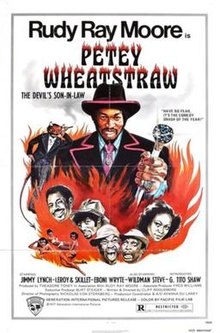
PETEY WHEATSTRAW (1977) ***
Rudy Ray Moore (1927-2008) created his own comedic universe on film, featuring outrageous characters with sped up chases and kung fu, stand up and musical interludes, and sexual exhibitions articulating his vision — basically party records brought to low-budget live-action cartoon.

Imagine a foul-mouthed, sexually-explicit Sanford and Son crossed with Benny Hill and Kung Fu and populated with pimps, madams, prostitutes, crooked cops, gangsters, and other larger-than-life figures designed to amuse or titillate.

I definitely had a strong negative reaction to Disco Godfather and then worked my way back through Dolemite, The Human Tornado, and finally Petey Wheatstraw, arguably the ultimate expression of the essence of Rudy Ray Moore and his iconic characters. Full title: Petey Wheatstraw, the Devil’s Son-in-Law.

Anyway, I now know that I should have started with Dolemite and then proceeded chronologically through Moore’s filmography. Maybe I’ll go revisit Disco Godfather and like it more because Moore as either Dolemite or Petey Wheatstraw grew on me to such a degree that I became more than willing to forgive him for Disco Godfather and his overindulgence in Put your weight on it. Maybe his rhyming abilities wore me down, or maybe I just find the idea of a middle-aged stand up comedian well-versed in kung fu greatly appealing.

Petey Wheatstraw is absolutely positively ridiculous and we’d not expect anything less or want anything else from Mr. Moore and gang. Moore plays our title character, a popular stand up comic nothing like the real Moore, and rival comics Leroy (Leroy Daniels) and Skillet (Ernest Mayhand) plot and scheme to get the more popular Wheatstraw to change the date of his show. Leroy and Skillet, not the most adept smooth talkers in the world and who are under extreme pressure for their enormous debt, finally resort to deploying their henchmen in street violence. They gun down a kid in cold blood and then an entire neighborhood — inc. Petey Wheatstraw — at the kid’s funeral. In the afterlife, Petey naturally makes a deal with the Devil (G. Tito Shaw) — he can return to life if he marries the Devil’s daughter, the world’s ugliest woman, of course, and provides Lucifer a grandson. Petey also takes control of the Devil’s cane that provides Mr. Wheatstraw incredible powers. Wheatstraw was taught the martial arts relatively early in his life — Petey Wheatstraw knows kung fu and Petey Wheatstraw knows crazy.

Petey Wheatstraw doesn’t fool around one bit — like Moore and his characters themselves — and it makes a leap straight for the joyously absurd with Petey Wheatstraw’s pre-credits narration and a flashback to Wheatstraw being born in the form of a 6-year-old child. The film goes on its merry little way from that point forward and I thought I had found myself in the midst of the most sublimely ridiculous sight I’ve ever seen when Wheatstraw and his associates have to fight off the Devil’s minions. Then, they did it again and I felt like I had died and gone to Heaven.
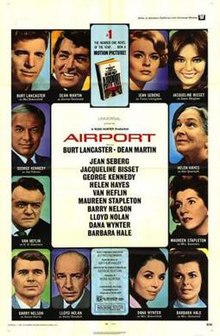
Auto Pilot Cinema: The Airport Movies

AUTO PILOT CINEMA: THE AIRPORT MOVIES
When thinking of the worst series in movie history, I am tempted to start with Saw and Fast and the Furious then move back through time with The Omen and Amityville Horror and finally go way way way back to the Dead End Kids, er, Bowery Boys.

In piecing through all this cinematic carnage, I should not leave behind the four Airport movies that were churned out by Universal Pictures from 1970 to 1979. Maybe I should leave them behind.

Airport, based on Arthur Hailey’s 1968 novel of the same name, made a killing at the box office upon its late May release in 1970 and it even received 10, yes, believe it or not, 10 Academy Award nominations, including Best Picture, and 70-year-old Helen Hayes won Best Supporting Actress.

The three subsequent films — helpfully labeled 1975, ’77, and ’79 — got worse and worse, naturally, and the last film in the series, The Concorde … Airport ’79, is so bad (and so aggressively stupid) in fact that it could kill off any series. That’s despite the fact that it reportedly made $65 million, a much better take than, for example, Irwin Allen productions The Swarm ($7.7 million), Beyond the Poseidon Adventure ($2.1 million), and When Time Ran Out ($3.8 million). Regardless, Universal stopped making Airport movies after The Concorde and I’m almost dumbfounded why there’s not been a remake or a reboot loaded with today’s stars.

Hey, wait, did somebody mention stars? Yes, stars, that’s what these Airport movies were about — speculating which ones would emerge at the end of the picture relatively intact and which ones would die spectacularly. Grand Hotel in the sky, not exactly, since none of the careers in the Airport movies were at their peak like the ones in Grand Hotel, but the idea of stuffing the screen with stars in every scene applies just the same.

Airport: Burt Lancaster, Dean Martin, Jean Seberg, Jacqueline Bisset, George Kennedy, Hayes, Van Heflin, Maureen Stapleton, Barry Nelson, Dana Wynter, Lloyd Nolan.

Airport 1975: Charlton Heston, Karen Black, Kennedy, Efrem Zimbalist Jr., Susan Clark, Helen Reddy, Linda Blair, Dana Andrews, Roy Thinnes, Sid Caesar, Myrna Loy, Gloria Swanson.

Airport ’77: Jack Lemmon, Lee Grant, Branda Vaccaro, Joseph Cotten, Olivia de Havilland, Darren McGavin, Christopher Lee, Robert Foxworth, Kathleen Quinlan, James Stewart.

Airport ’79: Alain Delon, Susan Blakely, Robert Wagner, Sylvia Kristel, Kennedy, Eddie Albert, Bibi Andersson, Charo, John Davidson, Andrea Marcovicci, Martha Raye, Cicely Tyson, Jimmie Walker, David Warner, Mercedes McCambridge.

More like Hollywood Squares in the Sky? Yeah, believe so, especially since Davidson hosted a Hollywood Squares revival in the late ’80s.

Beside Airport in the titles, Kennedy (1925-2016) proved to be the connective tissue between all four pictures, meaning he’s the inverse of the Brody boys (Jaws) and the Griswold children (Vacation). Kennedy played Joe Patroni — first as mechanic, then as vice president of operations (1975), a consultant (’77), and finally an experienced pilot (’79). Regardless of position or rank, the character got worse and worse over the course of the films, not that he or the films started out all that hot. I found even his cigar was guilty of overacting in the original film and Patroni was so odiously obnoxious in the fourth film, especially after he utters the line that articulates the sexism of the entire series, They don’t call it the cockpit for nothing, honey. George Kennedy as sex symbol? Sure, I’ll believe anything, nearly anything except for, oh, the entire plot of The Concorde.

I’ll talk more about The Concorde and the original because they’re fresher in my memory. To be honest, though, I probably won’t even feel like discussing the original because …

Movies rarely come any dumber than The Concorde: Let’s see, this is going to be fun, not really, anyway TV reporter Susan Blakely comes across some highly incriminating evidence against defense contractor (and covert arms dealer) Robert Wagner. Wagner decides that he’s going to attempt to blow up real good the plane she’s on en route from Washington to Paris. Okay, okay, his plot to blow up the Concorde real good fails and they have dinner together in Paris during the middle section of the movie, because, you know, they have a history together and they still love each other. She still has this incriminating evidence, naturally, she’s going to eventually go public with it, of course, and what does he do? Kill her? He lets her walk away safe and unharmed, so he’ll have to go after the plane again. That’s right, she gets back on the Concorde for the final leg of the flight from Paris to Moscow. Guilt stricken, Wagner commits suicide very late in the picture and I believe it’s not because his secret’s been discovered and will be exposed regardless of whether he’s alive or not, but more that he’s one of the worst villains in cinematic history.

The Concorde is so laughable in so many ways, as if that whole plot discussed in the last paragraph wasn’t enough. The Concorde stops over in Paris for a night, and every single passenger gets back on the plane the next morning. They all seem way too calm and collected after the events of the first half of the movie. I would love to have just heard one character say ‘Hell no, I’m not getting back on that damn plane!’ They all deserved to die, but we know that’s not happening.

At one critical point during the first attack on the Concorde, the Übermensch George Kennedy proves that he’s truly The Übermensch by sticking his hand out the window of the Concorde and throwing a flare. Unbelievable, utterly unbelievable even in this preposterous movie. If only the first Airport had been the in-flight movie on The Concorde, especially that scene where Patroni discusses the effects of a bomb on a 707 and concludes, When I was a mechanic in the Air Force, I was being transferred on a MATS plane. At 20,000 feet, one of the windows shattered. The guy sitting next to it was about 170 pounds. He went through that little space like a hunk of hamburger going down a disposal, and right after him coats, pillows, blankets, cups, saucers. That was just a MATS plane, not the fastest plane in the universe.

I’m done, I can’t take it anymore, and I’m bailing out on the Airport movies.

Airport (1970) **; Airport 1975 (1974) **1/2; Airport ’77 (1977) *; The Concorde: Airport ’79 (1979) 1/2*

Kingdom of the Spiders (1977)

KINGDOM OF THE SPIDERS (1977) ***
John ‘Bud’ Cardos’ Kingdom of the Spiders proved to be a pleasant surprise.

First, I remembered Cardos directed The Dark, one of the worst movies of 1979.

Second, I remembered the last time I saw Kingdom of the Spiders star William Shatner in a cowboy hat, yes, the absolutely ridiculous The Devil’s Rain, one of the worst movies of 1975.

Third, Kingdom of the Spiders starts out with the country number “Pleasant Verde Valley.”

Finally, Kingdom of the Spiders starts out slow, real slow, tipped off by No. 3.

Kingdom of the Spiders, though, kicks into high gear around the hour mark and it’s a whole lot of fun the final 35-40 minutes once the spiders attack Camp Verde, Arizona, and the tarantulas take complete control of the picture, hence being a pleasant surprise.

Kingdom of the Spiders borrows from such motion picture immortals as The Birds, Jaws, and Night of the Living Dead. That’s all part of the fun, when you enjoy something like Kingdom of the Spiders. Otherwise, it’s one more objection to a failure, like, for example, such bombs from the same era as The Giant Spider Invasion, Food of the Gods, and fellow 1977 release Empire of the Ants.

On the other hand, I have a weakness for Nature Attacks movies. There’s Frogs, starring killer amphibians, birds, insects, and reptiles, plus a crotchety old Ray Milland and a topless Sam Elliott. There’s Night of the Lepus, pairing a mutated killer rabbit infestation with a character actor infestation featuring Janet Leigh, Stuart Whitman, Rory Calhoun, and DeForest Kelley. There’s Squirm, where killer worms and a pair of redheads played by Don Scardino and the perky Patricia Pearcy wreak havoc on Fly Creek, Georgia, after one helluva storm. All of them are good fun and I’ve been known to call Frogs — great fun — better than The Godfather. Ditto for Godzilla vs. The Smog Monster.

Anyway, Kingdom of the Spiders works a thousand times more than The Giant Spider Invasion because it decides on real spiders — many spiders, how many exactly, how about 5,000, I mean that fact alone creates shivers down the spine — rather than a Volkswagen Beetle converted into a silly giant spider invasion. The Giant Spider Invasion doesn’t help itself when Alan Hale’s Sheriff exclaims, “You ever see the movie Jaws? It makes that shark look like a goldfish!” Giant mistake.

Also, the characters in Kingdom of the Spiders are far more likable than the ones in The Giant Spider Invasion. I mean, I eventually forgave Shatner for the cowboy hat — it’s better than the one he wore for The Devil’s Rain — and I even got over the fact that his character’s named “Rack Hansen.”

I remember an elementary school teacher calming the nerves of several pupils who were scared silly by a tarantula. She told us they’re harmless, they’re not poisonous anyway, they just look big and scary and very, very frightening indeed, and Kingdom of the Spiders brought me back 30 years to that moment in time. I’m just thankful our teacher did not show us Kingdom of the Spiders afterwards to counteract her moral lesson on tarantulas.

Rollercoaster (1977)

ROLLERCOASTER (1977) *
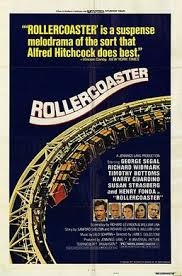
Rollercoaster, a thriller that combines Peter Bogdanovich’s vastly superior Targets, a disaster movie, and a mad bomber movie, marked the first time I returned to an amusement park since that fateful day on family vacation this past summer at Holiday World in Santa Claus, Indiana.

Everything was fine and dandy, we even maintained social distance and wore our masks as often as possible, until 16-year-old Emily wanted 12-year-old Isaac to ride on a roller coaster. She said he promised that he would try at least one roller coaster with her, he said that he made no such promise, she won’t ride on a roller coaster by her lonesome, he did not budge and refused to ride, and they eventually broke into hysterics and went their separate ways. Emily followed my wife Lynn and I back into the main body of the park and she frequently groused about her younger brother, while Isaac stayed behind and wept for the state of the world or something on a bench.

Two hours later, Emily decided to go to the car and she found Isaac sleeping on a bench just outside the park en route to the parking lot. No big deal, he said, he was tired, so he walked off, walked out, and took a nap. He did look a little refreshed.

I virtually walked the entire length of Holiday World twice over looking for Isaac to no avail and I lost count of every Beatles, every Beach Boys song the park blasted that day over the loud speakers. I had precise numbers, and they were gone. Lynn and I were obviously not pleased with either Emily or Isaac, and this is the first time I have spoken publicly about that Sunday afternoon in a place seven hours away from home.

The best thing about Rollercoaster, aside from the fact that it finally ended, is that it put that day in Santa Claus in perspective. I mean, yeah, at least we didn’t have happen to us what happened to the characters in Rollercoaster, especially at the 10-minute mark in the movie when our resident mad bomber (just call him The Mad Bomber with No Name who apparently represents something about our fears) played by Timothy Bottoms blows up a section of track and spectacularly derails a roller coaster. Needless to say, Universal Studios released Rollercoaster — in Sensurround, which Universal head Sidney Sheinberg called as big as any star in the movies — in June ’77 and a little release named Star Wars blew it away. Universal made just one more film in Sensurround. Big star?

Bottoms’ bomber presents one fundamental problem, because we never learn even his name or his motivation or much of anything ’bout him or even see that he enjoys being a mad bomber. He’s a cipher who’s not even mad enough in either way to justify being called a mad bomber. So when he meets his inevitable demise in the film’s grand finale, I felt no joy and only relief because it finally put this two-hour movie to pasture where it can rest in manure for eternity.

Here’s that perspective: Rollercoaster and that ordeal in Holiday World both lasted about two hours in real time, and both felt much longer. Yeah, I don’t much care for roller coasters in real life or captured on celluloid.

In closing, I should mention that Helen Hunt and Steve Guttenberg make their feature film debuts, iconic actors Henry Fonda and Richard Widmark appear here strictly for the money, and the eccentric rock band Sparks reportedly calls their cameo appearance in Rollercoaster — where they perform two songs from their 1976 LP Big Beat — the biggest regret of their career.

Charlie Brown, He’s No Clown: Snoopy, Come Home & Race for Your Life, Charlie Brown

CHARLIE BROWN, HE’S NO CLOWN: SNOOPY, COME HOME & RACE FOR YOUR LIFE, CHARLIE BROWN

Charlie Brown and the “Peanuts” gang first appeared as “Li’l Folks” in 1947, debuted as “Peanuts” Oct. 2, 1950, and launched into Sunday papers on Jan. 6, 1952.

Multiple generations came to love Charles M. Schulz’s creation through TV specials, movies, merchandise, and newspapers.

I learned to read at no later than the age of 4 by perusing copies of my grandparents’ Pittsburg Morning Sun and I remember “Peanuts” being at or near the top of the comics page along with “Garfield.” Then, it was (in no particular order) “Blondie,” “Alley Oop,” “Beetle Bailey,” “Doonesbury,” “Family Circus,” and “Calvin and Hobbes.” Sure, I missed a strip or two in this nostalgic reverie.

I later wrote for the Morning Sun (considerably downsized from 2009 through 2014 with sadly more considerable downsizing to come) and I scrapbooked a few strips that particularly tickled my funny bone. You might not believe how much feedback we received about our comics page, but I have found that obituaries, comics, and sports form the backbone of a small town paper. I remember editors grumbling about how readers were still upset years later about what happened with the Sunday comics not being in color and not having their own little section … and I said that I am one of those readers mad about that, as well as the Sun dropping a Monday paper.

Anyway, we have to ask one of the five W’s: What makes “Peanuts” so unique in the first place and even still today?

First and foremost, indelible characters who resonate with readers and viewers. Just as a little exercise, let’s rattle some of them off and I bet that we don’t even need to cheat and consult Google or Wikipedia. Let’s see, we have Schulz’s alter ego Charlie Brown, of course, Linus and his security blanket, Schroeder and his toy piano, Lucy Van Pelt, Peppermint Patty, Marcy, little sister Sally Brown, Snoopy, Woodstock, and Pig-Pen (the Walking Dust Bowl). Over the years, I myself have called a child or two “Pig-Pen.”

Recently, one quarantine afternoon I decided to watch Charlie Brown cinematic adventures SNOOPY, COME HOME (1972) and RACE FOR YOUR LIFE, CHARLIE BROWN (1977) back-to-back.

SNOOPY, COME HOME took me by surprise with its emotional punch and I’d rate it even higher were it not for the presence of so many songs written by Richard M. and Robert B. Sherman that feel like padding to inflate SNOOPY, COME HOME to a running time of 80 minutes.

Snoopy receives a letter from his previous owner Lila, who’s sick in the hospital, and Snoopy and Woodstock set out upon a grand adventure to reach her. Charlie Brown and his friends face the possibility that Snoopy will return to his first owner and that whole plot development provides the emotional sucker punch right to the guts. I’ll admit to getting a little misty-eyed when the gang throws a farewell party for Snoopy.

Meanwhile, throughout his adventure, Snoopy encounters “No Dogs Allowed.” We are talking libraries, beaches, buses, seemingly everywhere our favorite little beagle turns. That’s no way to treat a star the caliber of Snoopy. These people must be somehow unaware of “Peanuts” and they must have never heard the songs “Snoopy vs. The Red Baron,” “The Return of the Red Baron,” and “Snoopy’s Christmas.” What kind of people are these?

After being driven away from the library, Snoopy picks fights against Van Pelt siblings Linus and Lucy, and we are suddenly in Laurel and Hardy territory with big laughs from violent slapstick (though not as violent as say the Three Stooges and still within the ‘G’ rating). Fans have taken Snoopy vs. Lucy and scored MORTAL KOMBAT and ROCKY to it.

Also, during his adventure, Snoopy encounters his worst nightmare, a little girl named Clara who has the unmitigated audacity to call him “Rex.” Snoopy and Woodstock barely make it out alive.

In the end, “No Dogs Allowed” benefits Charlie Brown, Snoopy, etc.

RACE FOR YOUR LIFE, CHARLIE BROWN proved to be a mere meager diversion after SNOOPY, COME HOME.

That’s right, RACE FOR YOUR LIFE is nothing more than a pleasant way to spend 77 minutes with characters that we like.

It does not have the dynamic emotional range of SNOOPY, COME HOME and the river rafting race does not rank with the use of baseball and football in CHARLIE BROWN’S ALL-STARS and numerous gags in strips and TV specials, respectively.

Upon further reflection, the special appeal of the Charlie Brown TV specials and SNOOPY, COME HOME is that adults have the ability to take away more from them than children, without ever feeling that we are being lectured or hearing a sermon. That’s ironic, given the relative absence of adults in “Peanuts.”

SNOOPY, COME HOME ***; RACE FOR YOUR LIFE, CHARLIE BROWN **1/2

The Mighty Peking Man (1977)

THE MIGHTY PEKING MAN

THE MIGHTY PEKING MAN (1977) ***

The Shaw Brothers (Runme 1901-85 and Run Run 1907-2014) have rarely ever let me down and they provided some of the greatest entertainments of all-time, like THE ONE-ARMED SWORDSMAN, FIVE FINGERS OF DEATH, INFRA-MAN, THE 36TH CHAMBER OF SHAOLIN, and CLAN OF THE WHITE LOTUS.

The Shaw Brothers did not (and still do not, in death) cheat us.

For example, in THE MIGHTY PEKING MAN, their 1977 spin on King Kong, Mighty Joe Young, and Tarzan (not to mention Godzilla) that’s not quite peak but still good Shaw Brothers, we don’t have to wait very long whatsoever to see the title character. No, life is short, time is precious, so director Ho Meng-hua gives us our first monster encounter in the first minute of screen time. Okay, to be exact, it’s 1:45 into the movie, but that still beats most every other entry in this distinguished genre.

That establishes a tone for a very generous entertainment package. Find a copy and buy it for somebody, and it’s the gift that keeps on giving.

THE MIGHTY PEKING MAN not only provides a sympathetic monster in the grand tradition, but also (in no particular order) a plucky explorer hero (Danny Lee) who’s been betrayed by his lover with his playboy brother so he’s drowning his sorrows in booze when he’s recruited for a jungle mission, a scantily-clad leading lady (Evelyne Kraft, a regular Swedish Fay Wray) who’s grown up with the animals in the jungle after her parents died in a plane crash (she’s been raised by the Mighty Peking Man, in fact), an earthquake, elephants, tigers and leopards (oh my!), a fight between a leopard and a snake, quicksand, vine swinging, flashbacks to key moments in both the hero’s and the leading lady’s life, callous and shady businessmen, heartless authority figures, mucho destruction of miniatures galore, and a grand finale that boggles the mind even after everything that came before.

My favorite scene, however, begins around the 33-minute mark.

It involves the Semi-Obligatory Lyrical Interlude, a term made famous by the late Roger Ebert. Here’s the definition from Ebert: “Scene in which soft focus and slow motion are used while a would-be hit song is performed on the sound track and the lovers run through a pastoral setting. Common from the mid-1960s to the mid-1970s; replaced in 1980s with the Semi-Obligatory Music Video.”

The Simon and Garfunkel songs in THE GRADUATE epitomize the Semi-OLI.

The one in THE MIGHTY PEKING MAN rates below Louis Armstrong singing “We Have All the Time in the World” over George Lazenby and Diane Rigg in ON HER MAJESTY’S SECRET SERVICE and the foreboding use of Roberta Flack’s “The First Time Ever I Saw Your Face” in Clint Eastwood’s PLAY MISTY FOR ME. Ebert himself said Eastwood filmed the first Semi-OLI that works.

In THE MIGHTY PEKING MAN, our hero and leading lady embrace and lock lips for the first time (watch her eyes after this first kiss) and they unleash the awesomely banal love song “Could It Be I’m in Love, Maybe.”

This is one helluva old-fashioned love song and one helluva Semi-OLI.

I mean, I believe it’s the only Semi-OLI in the history of motion pictures to incorporate a leopard.

Not only that, but the leading lady seems more interested in the leopard than our poor, poor hero. You really sympathize for this guy even more after this scene.

Let’s get back to those lyrics for a second here.

“The love you gave me then showed me a thing or two / I guess I saw it in your eyes / And the look of love upon your face is too hard to disguise / Maybe just a smile will say [cannot make out, even after watching this scene 500 times] / Could it be I’m in love (Maybe? Baby?)” (To hell with it, I already chose “Maybe.” Why does life have to be so difficult?)

“I can’t begin to say what makes me feel like this / I never knew what love could do / But if this is love, it’s here to stay / [Don’t want to make this part out] / So all I have to hear is I’ll give it all to you.”

There’s more lyrics, but we all catch the drift and there’s not any need to drown in banality.

It all totals about 3:30 of pure junk food cinema bliss.

I definitely love it because it’s so utterly ridiculous.

Then again, utterly ridiculous describes THE MIGHTY PEKING MAN.

I should end this review with a consideration of the ending of THE MIGHTY PEKING MAN. Just imagine the ending of KING KONG times 10 times 10.

The Car (1977)

THE CAR

THE CAR (1977) *

The Devil and cars were huge in the movies of the 1970s.

Building on the momentum of ROSEMARY’S BABY in 1968, we saw THE BROTHERHOOD OF SATAN, THE EXORCIST (the biggest hit of them all that spawned many imitators and successors), THE DEVIL’S RAIN, THE DEVIL WITHIN HER, BEYOND THE DOOR, BEYOND THE DOOR II, THE OMEN and DAMIEN: OMEN II, and THE AMITYVILLE HORROR.

As far as cars, we had TWO-LANE BLACKTOP, DUEL, THE SUGARLAND EXPRESS, GONE IN 60 SECONDS, DEATH RACE 2000, THE GUMBALL RALLY, EAT MY DUST, GRAND THEFT AUTO, and SMOKEY AND THE BANDIT.

THE CAR, directed by Elliot Silverstein and distributed by Universal, combines The Devil and cars to make one stupefying, awful, patently ridiculous horror movie.

Yes, that’s right, a homicidal maniac automobile seemingly possessed … or just having a really, really, really bad day. Maybe the latter was just me watching THE CAR.

This movie just doesn’t know when to quit and it starts early with the murders of two bicycling teenagers in the majestic desert of Utah. We’re talking first few minutes and the film wastes absolutely no time in establishing its basic pattern. Maybe I should have turned off the subtitles, because they provided the evocative forewarning “Ominous instrumental music.” I knew the bludgeoning music was coming, though, because I’ve seen a movie or two before, especially a horror movie. Ominous instrumental music indeed, especially when it sounds like 50 horror film musical scores piled up into one super bad score. Forget the killer car next time, I want the movie about the killer musical score. Tagline: “They could not believe their ears, until it was too late. … THE MUSICAL SCORE FROM HELL will make your eardrums bleed. Coming soon to a theater near you.”

Every 10-15 minutes, at least, we are beaten with a ridiculous death scene or, barring that, a scene of peril just for variety. That ominous instrumental music, all them close-ups of the customized 1971 Lincoln Continental Mark III (built by George Barris, who previously brought us the Batmobile for the 1966 BATMAN), and Silverstein’s overall poor handling of action. At times, the vehicles look like they’re being artificially sped up.

Unfortunately, in between those violent scenes, we are served a steady diet of banalities and unpleasantries, only adding insult to injury.

For example, just about every scene with veteran character actor R.G. Armstrong (1917-2012) applies the unpleasant extra thick. He beats on his wife and insults just about everybody in sight. Never mind his slurs against Native American character Chas (played by Henry O’Brien in his final feature film). He’s a nasty old man. Honestly, why is his character Amos not killed? You’re right, it must have something to do with the explosives needed for the grand finale … and, before that, Sheriff Everett (John Marley) needs to be killed rather than Amos so Wade (James Brolin, who seems to be hired when Sam Elliott is unavailable), our main human protagonist, can take charge. It all makes sense.

Our title character is maddening to the nth degree and we have already touched on why, but let’s pursue it more.

Sure, it can kill a main character by driving through her house in the ultimate display of supernatural power. This character, Lauren (Kathleen Lloyd), the lover of the protagonist, turns her back to the window as she speaks to Wade on the phone. This means, however, that we can see the car coming straight for her through her window. This scene is supposed to be a highlight, a real heart breaker or at least a real tense moment since we see the murderous car well before her, but, like virtually every other scene in THE CAR, it’s laughably bad in a bad way.

Just like the scene that establishes the car’s need for revenge against Lauren. Safe on the hollowed grounds of a cemetery, Lauren really lets our title character have it, resorting to chickenshit and a son of a bitch. That’s obviously going too far, even before she tosses a tree branch at it. She asked for her auto demise. I should mention that she’s a school teacher whose marching band students were chased into that cemetery by you know who. We have seen that scene archetype before, namely in Alfred Hitchcock’s 1963 classic THE BIRDS. THE CAR just drags this entire sequence out.

Then again, dragging it out describes the entire movie.

Our title character is especially maddening because it wastes two perfect opportunities to flatten Wade like a pancake. What’s that all about? We get the feeling that were it any other character and not the protagonist, it would be “Sayonara, sucker!” The first opportunity even gives us a cut from Wade in danger in the desert to being safe in a hospital bed. I hate cheap tricks like that.

Was there anything I liked about THE CAR? Fleeting moments, like glimpses of the Utah scenery as seen through filming locations St. George, Snow Canyon, Zion National Park, Glen Canyon, Hurricane, the Mount Carmel Tunnel, and Kanab. I would have preferred a 96-minute nature documentary on this area over THE CAR.

I knew I was in trouble when THE CAR starts out with a quote from Church of Satan leader Anton LaVey (1930-97) and The Satanic Bible.

LaVey also previously had a hand in the making of THE DEVIL’S RAIN, another godawful horror movie.

Sometimes, it seems like even the Devil just can’t buy a break.

Grand Theft Auto (1977)

GRAND THEFT AUTO

GRAND THEFT AUTO (1977) Three stars

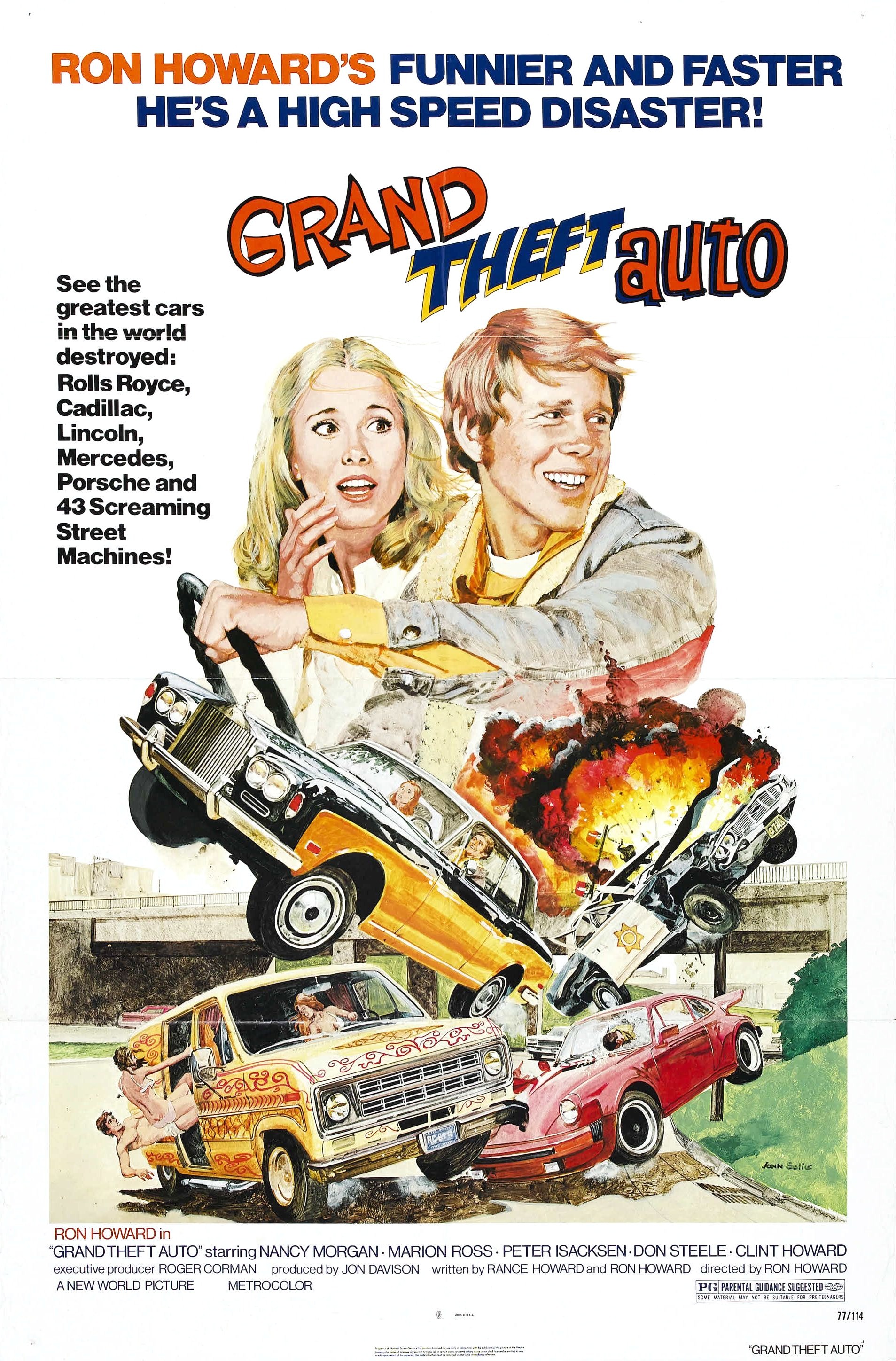
I just love the poster for GRAND THEFT AUTO, Ron Howard’s feature debut as director.

It advertises “See the greatest cars in the world destroyed: Rolls Royce, Cadillac, Lincoln, Mercedes, Porsche and 43 Screaming Street Machines.”

Sounds like my kind of picture.

RON HOWARD’S FUNNIER AND FASTER

HE’S A HIGH SPEED DISASTER!

A drawing of Nancy Morgan aghast and Howard with that All-American smile on his face and his left hand on the steering wheel. Below the young lovebirds are flames and crashes. Sure does resemble a drive-in movie from 1977.

Howard directed, starred in, and co-wrote this picture for New World, produced by Jon Davison and executive produced by Roger Corman. Howard kept some of GRAND THEFT AUTO in the family with father Rance a co-star and co-writer and brother Clint a co-star. It’s no small wonder that Howard earned a reputation for being one of the nicest guys in Hollywood.

Howard did not sell his soul to the Devil to get the picture made. No, instead, he made a deal with Mr. Corman. Howard agreed to star in EAT MY DUST! from 1976 if he could have a crack at directing. The rest is history and Howard’s directorial credits number 32, including Academy Award for Best Picture winner A BEAUTIFUL MIND. His other credits include NIGHT SHIFT, SPLASH, PARENTHOOD, FAR AND AWAY, THE PAPER, APOLLO 13, and FROST/NIXON.

Made for a reported $600,000 on down time for Howard from “Happy Days” (No. 1 show on TV in 1976-77 and No. 2 in 1977-78), GRAND THEFT AUTO tells a simple story.

Paula Powers (Morgan) loves her boyfriend Sam Freeman (Howard) and they want to get married, but her wealthy parents, especially her gubernatorial candidate father, oppose this pairing, taking Mr. Freeman for a gold digger. Paula’s parents want her to marry the wealthy Collins Hedgeworth (Paul Linke), who’s such a blasted tool he spends the movie in his jockey outfit. Paula steals her father’s Rolls Royce and Sam, and they plan to get married in Vegas. There ends up being a $25,000 reward for Paula and then a $25,000 price tag for Collins.

Seemingly all of California (and Nevada) pursues Paula and Sam, as well as Collins.

Collins alone goes through at least three cars in his first few minutes of screen time. What a schmuck! His overprotective mother, played by America’s Sweetheart and Howard’s TV mother Marion Ross, is the one responsible for the reward for Collins and it is one of the undeniable highlights of the movie to hear Marion Ross say “Piss off!” Even a preacher (Hoke Howell) goes after the money. Sleazy DJ Curly Q. Brown (Don Steele) eventually takes to the air in a whirlybird and he tells Mr. Freeman on the air, “Well, if you have it, I’m going to report it. Because every time you turn around and fart, it’s news.” The film especially picks up once Curly Q. Brown starts his play-by-play of the chase across California and Nevada.

The plot also includes a Helicopter vs. Rolls Royce showdown, a bridge blown up real good, and a Demolition Derby. The 1970s were the glory days for the car chase and GRAND THEFT AUTO belongs alongside DUEL, MAD MAX, CONVOY (both movie and song), SMOKEY AND THE BANDIT, THE FRENCH CONNECTION (chase scene), and several other pics.

Do Paula and Sam get married (and live happily ever after)? Well, I would never dream of revealing such an ending, although I told my wife after she asked me if they got married. I will compromise, though, and duly note GRAND THEFT AUTO saves its best demolition for last.

House (1977)

HOUSE

HOUSE (1977) Four stars

The year 1977 produced four of the definitive WTF movies in the history of cinema: ERASERHEAD, SUSPIRIA, EXORCIST II, and HOUSE, an item from the Japanese studio (Toho) responsible for Akira Kurosawa, Godzilla, Mothra, Rodan, and the H-Man.

Toho really outdid itself with HOUSE, which even surpasses GODZILLA VS. THE SMOG MONSTER in nonstop funky weirdness. Janus Films describes HOUSE as an episode of “Scooby Doo” directed by Dario Argento.

Bottom line: HOUSE just might be even weirder than ERASERHEAD, more colorful than SUSPIRIA, and more whacked out bat shit crazy than EXORCIST II. You have been warned.

First-time director Nobuhiko Obayashi pulls out all the stops in realizing a rather simple tale on the surface: teenage girl Gorgeous (Kimiko Ikegami) and her six friends Prof (Ai Matsubara), Melody (Eriko Tanaka), Mac (Mieko Sato), Kung Fu (Miki Jinbo), Sweet (Masayo Miyako), and Fantasy (Kumiko Oba) pay Gorgeous’ aunt (Yoko Minamida) in the country a visit. It just so happens that the aunt died in this house many years ago waiting on her fiancee to return from World War II and her spirit remains and feasts on unmarried girls. This is a haunted house movie where the house is hungry, very hungry indeed.

Obayashi’s at-the-time pre-teen daughter Chigumi Obayashi contributed ideas to her father. She came up with several childhood fears, her father relayed the fears to screenwriter Chiho Katsura, and they incorporated her ideas into the finished product. You’ll be able to recognize her contributions almost instantly and they contribute to the uniqueness.

Just as a fun exercise, I looked up the plot keywords for HOUSE on IMDb: “refrigerator,” “banana,” “watermelon,” “bloody spray,” “dismemberment,” “decapitation,” “full frontal nudity,” and “severed head” are some of the more interesting 75 keywords and they only scratch at the surface of the overall bizarre nature of the entire enterprise.

More than 30 years after its original release, HOUSE seemingly came from out of nowhere to develop a cult following in the United States, playing first as a midnight movie in Nashville and then at a film festival in Austin in 2009 before heading to DVD.

I first encountered HOUSE through its cover image for the Criterion Collection release on October 26, 2010. Maybe you remember seeing that artwork, as well. Nashville graphic designer and Ben Folds drummer Sam Smith came up with the distinctive image: “I used the first idea that came to me after watching a screener of the film — Blanche the cat’s psycho-screaming mug — and adapted it to stand alone as a symbol of the uncanny and over-the-top assault that our midnight-movie audience was in for,” Smith said. The poster first appeared for the film at the Belcourt Theatre in Smith’s hometown.

Then, I read the reviews for HOUSE and they’re nearly as over-the-top as the film itself.

Online reviewer Dennis Schwartz wrapped up his mixed review, “The director uses freeze-frames, jump-cuts, video effects to change dimensions, spiral effects, color tints, and assorted other techie tricks to play the scary pic card more for laughs than to be gruesome. It’s an experimental visual pic that becomes overwhelmed with low-brow slapstick comedy, a ridiculous killer house and garish visuals. But it’s a one-of-a-kind film that has its admirers, who just can’t resist such weird childish nonsense.”

Michael Atkinson opined in the Village Voice, “But though it plays like a retarded hybrid of ROCKY HORROR and WHISPERING CORRIDORS, it is, moment to moment, its own kind of movie hijinks. It even won a directorial-debut critics’ prize back in the day. Gigglers and cultists, pony up.”

I watched James Rolfe’s review for Monster Madness X from 2016. Rolfe started his review with a pause and a WOW! Of course, Rolfe picked HOUSE for one of the “WTF Wednesday” reviews.

I finally caught up with HOUSE in late summer 2019 and it lived up to expectations. It calls to mind a few pictures: EVIL DEAD II, THE SPIRIT OF THE BEEHIVE, THE 5,000 FINGERS OF DR. T, DAISIES, SUSPIRIA, and MY NEIGHBOR TOTORO. Like those films, though, HOUSE ultimately stands alone as an unique work because it creates its own world. I find that I respond more forcefully to fictional works that do that, rather than just rehash more of the same old already damaged goods. I want to be challenged, inspired, etc. I’ve never seen a haunted house movie quite like HOUSE.

HOUSE haunts one’s thoughts and gains in strength upon deeper reflection. At this moment of typing, I am thinking about Gorgeous’ aunt and how much time she spent waiting alone in that house for the love of her life to return from World War II. He never did, and they both died, she in that darn house and she’s cursed to haunt it for eternity because of her bitterness about the war. Then, I start thinking about the sheer enormity of the loss endured by the human race from Sept. 1, 1939 through Sept. 2, 1945: An estimated 70-85 million people died or three percent of the world’s population in 1940; 50-55 million civilians and 21-25 million soldiers no longer lived on this planet from a variety of causes, death on a mass scale that doubled World War I; the atomic bomb and the Holocaust two of humanity’s depressing advancements in death.

Obayashi was born in Hiroshima in 1938 and he lost all his childhood friends when the United States dropped an atomic bomb on Hiroshima on Aug. 6, 1945. Hiroshima and Nagasaki, as well as post-WWII nuclear testing, inform many Japanese films of the last almost 75 years.

Breaker! Breaker! (1977)

BREAKER! BREAKER!

BREAKER! BREAKER! (1977) Two stars

We all have to start somewhere, as they say, and Chuck Norris fittingly started his true movie career with BREAKER! BREAKER! (We’ll ignore WAY OF THE DRAGON, because Norris plays a villain defeated by Bruce Lee.)

Well, BREAKER! BREAKER! is not a very good movie: Norris himself admitted that he had no idea what he was doing, it was made on an extremely low budget ($250,000) and looks it, its plot defines simplistic and leaves no room for shades of grey, and it’s a time capsule of the 1970s.

Whether or not that’s good or bad, I will leave for you to decide.

Hairdos, that music, arm wrestling, greasy diners, truck driving vernacular and CB radio lingo, and high flying karate with or without slow motion.

Yes, it all screams 1977.

BREAKER! BREAKER! only needed child custody and it could have predated OVER THE TOP by a decade.

Film’s alternate title: ROUNDHOUSE! ROUNDHOUSE! Believe you me, Mr. Norris unleashes one roundhouse per every minute of the film’s running time. Keep in mind that his feet have to catch up between the dialogue scenes.

Thinking about it a little bit longer, I believe I know where I’ve seen BREAKER! BREAKER! before: John Sturges’ 1955 classic BAD DAY AT BLACK ROCK, when Spencer Tracy’s one-armed war veteran runs into Lee Marvin, Robert Ryan, Ernest Borgnine, and just about every Black Rock resident.

BREAKER! BREAKER! is a dumbed-down BAD DAY AT BLOCK ROCK (which also predated FIRST BLOOD) and director Don Hulette is definitely no Sturges, whose other credits include GUNFIGHT AT THE O.K. CORRAL, THE MAGNIFICENT SEVEN, and THE GREAT ESCAPE.

The plot: Truck driver J.D. Dawes (Norris) warns his younger brother to stay away from Texas City, a California municipality rather hostile toward truckers. Judge Joshua Trimmings, Sergeant Strode, Deputy Boles, and seemingly every Texas City resident in cahoots run a brutal racket and they rough up one of Dawes’ friends, hence the warning to the younger brother. Well, of course, the younger brother does not stay away from Texas City and older brother springs into action to rescue younger brother and bring down corrupt Texas City. You can fill in the rest.

BREAKER! BREAKER! could play as part of a marathon with DUEL, SMOKEY AND THE BANDIT, and CONVOY or merely a double feature with the far superior BAD DAY AT BLACK ROCK.

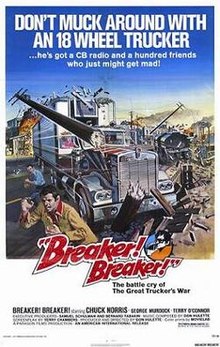
NOTE: The poster for BREAKER! BREAKER! gets four stars.