Bats, Bats, Bats & Jaws with Claws: Nightwing, Prophecy, Grizzly

BATS, BATS, BATS & JAWS WITH CLAWS: NIGHTWING, PROPHECY, GRIZZLY
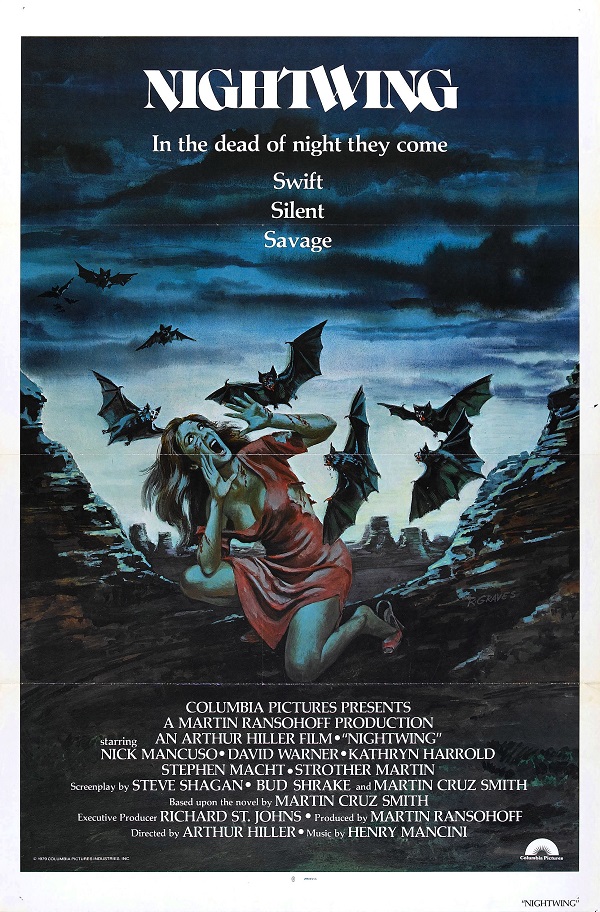
Distinguished character actor David Warner (1941-2022) almost redeems large portions of the 1979 killer vampire bat picture Nightwing, and he’s the reason that it rates out around two stars rather than one or possibly even worse.

Pardon the pun, but Warner truly bites into his dialogue and his monologues are the best moments in Nightwing. Phillip Payne comes across a little batty himself, more often delightfully so than not, and that batty quality would seem to come naturally with the territory of studying and killing plague-infested vampire bats.

The film’s best moments are definitely not the special effects and the vampire bat attack scenes, which almost had me laughing as much as The Bat People or Prophecy or perhaps the ultimate cinematic disaster disaster movie The Swarm.

Generally, I love the prerequisite genre scenes where the scientist explains the phenomenon on the rampage within the movie to a slack-jawed authority figure who usually downplays whatever threat it might be and decides to keep the park / town open.

It rarely ever lets me down, and I enjoyed Nightwing every time Phillip Payne goes all Dr. Sam Loomis on us about vampire bats.

Youngman Duran: It just doesn’t seem natural for a man to spend his life, his entire life, killing bats.

Phillip Payne: Not just bats. Vampire bats. I kill them because they’re evil. There’s a mutual grace and violence in all forms of nature; and each specie of live gives something in return for its own existence. All but one. The freak. The vampire bat alone is that specie. Have you ever seen one of their caves?

YD: No.

PP: I killed over 60,000 of them last year in Mexico. You really understand the presence of evil when you go into their caves. The smell of ammonia alone is enough to kill you. The floor of the cave is a foul syrup of digested blood. And the bats: up high, hanging upside down, rustling, fighting, mating, sending constant messages, waiting for the light to fade, hungry for blood, coaxing the big females to wake up and flex their nightwings to lead the colony out across the land, homing in on any living thing; cattle, sheep, dogs, children, anything with warm blood. And they feast, drinking the blood and pissing ammonia. I kill them because they’re the quintessence of evil. To me, nothing else exists. The destruction of vampire bats is what I live for.

Alrighty then.

Almost none of the small pleasures from Nightwing are to be found in Prophecy, films released only a week apart during June 1979.

Prophecy alternates between a serious, more ambitious movie about ecological concerns and land rights in a dispute between Native Americans and the polluting paper mill, domestic scenes involving a husband (Robert Foxworth) and his wife (Talia Shire), and silly monster attack scenes that belong in something like Food of the Gods or Bigfoot, two bad monster movies from earlier in the ’70s.

Rather, I meant laughably bad monster attack scenes.

None of the elements gel well together in Prophecy.

Prophecy gets awful preachy at times, maybe not too much of a surprise given the film’s title, and Foxworth’s Dr. Robert Verne makes for a rather lackluster and thus unlikable protagonist. Foxworth does not give Prophecy a jolt like Warner does in Nightwing, and his scientific explanatory scenes are pedestrian.

Dr. Verne and his wife Maggie do not have the relationship that, let’s see here, pugilist protagonist Rocky Balboa (Sylvester Stallone) and Adrian (Shire) do in Rocky and Rocky II, ironic considering that Rocky II and Prophecy were both released June 15, 1979.

Their domestic scenes are a drag, and I think less of Foxworth’s Dr. Verne from early on because of the way he treats his wife.

Veteran character actor Richard Dysart (1929-2015) gives the best performance in Prophecy, and it’s not even close. Dysart plays the role of the detestable paper mill company man Isely so effectively that it’s one of the film’s greatest disappointments when it cuts away from his graphic dismemberment by mercury mutant bear Katahdin late in the picture. We’ll have to settle instead for Dysart’s grisly death scene in John Carpenter’s The Thing.

The Katahdin we actually get in the finished product and the one in the promotional material (and dialogue) are not exactly one and the same, which hearkens Prophecy back to low-budget precursors like The Giant Claw and The Wasp Woman more than contemporaries like Alien and Dawn of the Dead, but without the fun of any of those movies.

Leonard Maltin described the monster as a giant salami, Isely said that it’s larger than a dragon with the eyes of a cat, Time reportedly said that it’s Smokey the Bear with an advanced acne condition, and Gene Siskel and Roger Ebert called it a cross between an earthworm and a bear (Siskel) and a grizzly bear and Godzilla (Ebert).

Given that it’s Kevin Peter Hall as the man in the monster suit, one might be tempted to call it a cross between Predator and Harry and the Hendersons.

Manbearpig!

Grizzly, a killer bear picture released three years before Prophecy, works a lot better than Prophecy because it succeeds at a much more modest level of ambition.

It’s required by law that every review mention Grizzly is a Jaws rip-off or we can go right on ahead and call it Jaws with Claws.

We have a law enforcement officer (park ranger), a military veteran (helicopter pilot), and a scientist (naturalist) on the hunt for a giant killer animal (grizzly bear). We also have a park supervisor who refuses to close down the national park despite a series of brutal deaths. The park supervisor allows hunters into the forest to hunt and kill the bear, while media converge on the scene for sensational coverage, but eventually our three main characters must try and do the deed themselves.

I honestly don’t mind too much that Grizzly follows the Jaws formula because Christopher George, Richard Jaeckel, and Andrew Prine are good in their roles and I care about them in their battle against a primal beast.

Honestly, it’s as simple as that, whereas I didn’t particularly care about the overwhelming majority of the human characters in Prophecy and did not care one way or another whether they lived or died just as long as the end credits rolled.

Grizzly, thankfully, is also not preachy, it’s endearing and entertaining on a basic level, and it’s a pleasant way to spend 90 minutes.

Granted, the three main actors and characters are not anywhere near the same level as Roy Scheider’s Sheriff Brody, Richard Dreyfuss’ Matt Hooper, and Robert Shaw’s Captain Quint, just like William Girdler’s no Steven Spielberg, but I still think Grizzly has earned a place right alongside such ’70s killer animal staples as Night of the Lepus, Frogs, Squirm, Kingdom of the Spiders, and Piranha.

Nightwing (1979) **; Prophecy (1979) *; Grizzly (1976) ***

The Human Tornado (1976)

THE HUMAN TORNADO (1976) **1/2
I have mixed feelings about this sequel to Dolemite
Sometimes it sucks and sometimes it is outta sight
Rudy Ray Moore returns as our title character and he’s fine
He’s truly one of a kind and his bluntness will blow yo’ mind
He’s grown on me since he made a terrible first impression
Both Dolemite and The Human Tornado a better expression
He’s not what earns The Human Tornado a mixed review
I promise that I like Dolemite and Rudy Ray, I really do!
It’s that rat soup eating motherfucker redneck racist sheriff piece of shit
He drags the movie into the mud and his every scene’s just like a cesspit
Character’s named Sheriff Beatty, played by J.D. Baron in his film debut
Somebody should have kung fu kicked him to death, but they never do
His all-out redneck assault often brings The Human Tornado to a halt
Not sure if that’s writer Jerry Jones or director Cliff Roquemore’s fault
Enough about that, how ’bout “Glorya De Lani” as Hurricane Annie
Her glorious breasts distract from Rudy Ray Moore’s big fat fanny
She contributes her fair share to some of the best nudity in screen history
I’d trade her nude for every redneck sheriff scene and it’s sure no mystery
Glorious Gloria Delaney and her breasts returned as Peaches in Penitentiary
What else can be said but yes, God bless the breasts of the Twentieth Century
Dolemite seeks out the sleazy crime boss’ sex pot wife and their sex wrecks the set
Nympho gives Dolemite the info he wants so many times none of us will ever forget
Dolemite takes out anonymous henchmen in a flurry of speeded up kung fu kicks
The Human Tornado truly has everything, a gay blade and a guy with karate sticks
We can’t neglect Ernie Hudson early in his career or Lady Reed and Lord Java in the cast
Funky music, funky hair, miles of nudity, loads of vulgarity, mostly a blast from the past

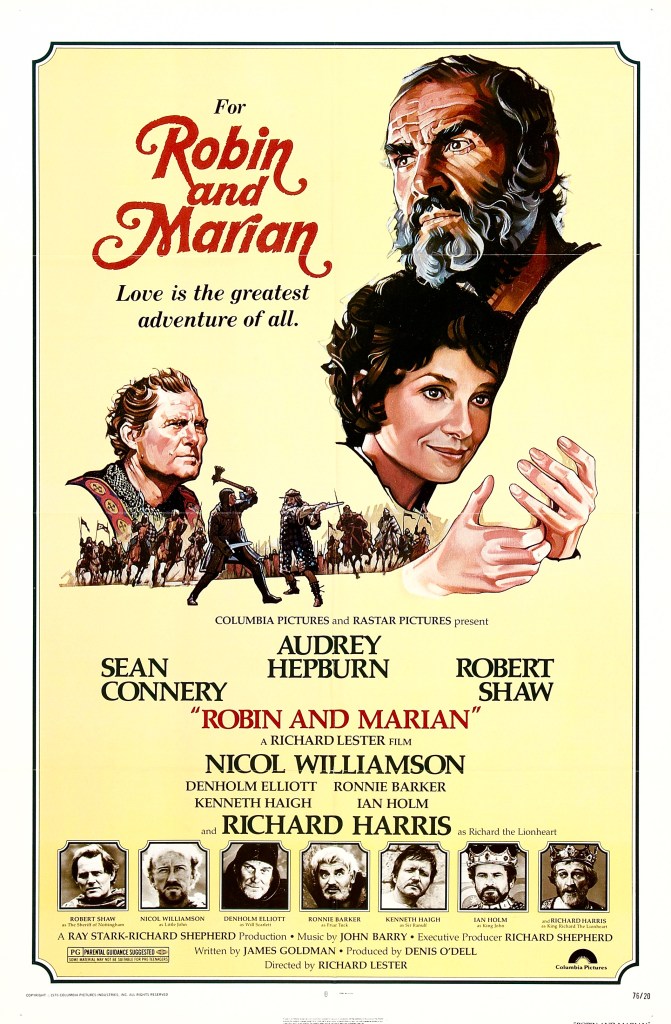
Robin and Marian (1976)

ROBIN AND MARIAN (1976) ****
Richard Lester’s Robin and Marian definitely made a strong first impression.

I placed it on my top 10 films list for 1976, based on just viewing it a single time on cable TV many years ago.

Granted, Robin and Marian crossed my mind several times in recent months, especially after Robin and Marian star Sean Connery died last Halloween and then after I watched both the Disney (1973’s Robin Hood) and the Mel Brooks (1993’s Robin Hood: Men in Tights) takes on the legendary old warhorse. Disney and Brooks both left me feeling often unimpressed and ultimately supremely disappointed, for very different reasons, and I started thinking instead about superior Robin Hood films The Adventures of Robin Hood and Robin and Marian, both of which I first encountered during childhood or teenage years.

The Adventures of Robin Hood remains my favorite take on Robin Hood and I’ve watched it numerous times over the years. Of course, it helped that The Adventures of Robin Hood ranked among the select few titles Grandma Sisney had on VHS and I played it — along with Indiana Jones and the Temple of Doom and Fun in Acapulco — so many times before Grandma took over her TV for a day of game shows and soap operas. There’s always been something so indelible about Errol Flynn’s Robin Hood that I judge all others portraying Robin Hood against Flynn’s standard, Claude Rains and Basil Rathbone make incredibly satisfying villains, and Olivia de Havilland’s Maid Marian simply radiates a MOST BEAUTIFUL WOMAN IN THE WORLD AT THIS VERY MOMENT glow. Plus, it’s hard to forget the colors (and costumes) that argue for three-strip Technicolor superiority.

Robin and Marian left a mark for similar reasons — Connery and Audrey Hepburn both carry some of the same appeal as Flynn and de Havilland do in their iconic roles. Flynn was just a month shy of 29 years old when The Adventures of Robin Hood first came out in May 1938 and similarly, De Havilland was two months shy of a mere 22. However, Connery and Hepburn play older Robin Hood and older Maid Marian — please consider both Connery and Hepburn were in their mid-40s during Robin and Marian and each had a solid 15-20 years of stardom behind them. Connery and Flynn both have an undeniable robust humor and physicality (both men seemed tailor-made for James Bond, for example) and Hepburn could make claims on de Havilland’s radiant MBWITW glow several times during her career, from Roman Holiday and My Fair Lady to Robin and Marian.

Anyway, I finally watched Robin and Marian for a second time and it holds up as a great movie, right behind only The Adventures of Robin Hood in the Robin Hood cinematic pantheon.

Because of centering around middle age characters, Robin and Marian plays different notes and takes on a greater emotional range than any other Robin Hood film I have ever seen.

It’s definitely not the lusty adventure like The Adventures of Robin Hood. Sure, Robin and Marian has sword fights and scenic vistas and soaring music and horses and romantic clinches and every prerequisite of the genre, as well as King John, King Richard the Lionhearted, the Sheriff of Nottingham, Little John, Friar Tuck, Will Scarlett, and Sherwood Forest, but they’re all — both people and places, and every plot event — suffused with melancholy.

To be fair, though, Lester and Connery inject enough good humor and spirit into Robin and Marian to help it avoid being a more downbeat experience like the 1991 Robin Hood starring Kevin Costner. And the scenes between Connery and Hepburn are simply flat-out appealing, rooted in seeing two of the most attractive, most ebullient performers to ever grace the screen share time with each other (and us audience members).

It should also be mentioned that supporting players Nicol Williamson, Richard Harris, Denholm Elliott, and Ian Holm contribute to an absolute dynamite cast.

Didn’t we always ponder how it all turned out for Robin Hood, Maid Marian, the Sheriff, Little John, Friar Tuck, and Will Scarlett?

Lester’s film, with a screenplay written by James Goldman (writer of the play, film adaptation, and TV movie version of The Lion in Winter), answers those very questions, but do we viewers feel comfortable with the answers? Are we prepared to see Maid Marian as a nun because Robin Hood, off on his damn crusades and holy wars with Richard and Little John, didn’t write her for the last 20 years? We also found out that she attempted suicide. He’s back, though, and it’s obvious that Robin Hood and Maid Marian are destined to be together. They might initially hate it and initially fight it, she invariably more than he, but they are pulled together rather than apart.

All roads lead toward a final showdown between Robin Hood and the Sheriff (Robert Shaw). They fight like two worn-out, downtrodden men with many, many battles behind them and none ahead of them, who have resigned themselves to their final destiny. They fight because it’s their duty, or their almost perverse obligation to each other as hero and villain. They really don’t want to be fighting each other at this precise historical moment, it feels like, BUT THEY MUST FIGHT TO THE DEATH. There’s none of the joy in this fight that can be found in great film sword fights like the one, for example, between Robin Hood (Flynn) and the Sheriff (Rathbone) in The Adventures of Robin Hood. This final showdown, just like Robin and Marian overall, gives us something that’s different from any other purely adventure movie. All the main players have lived through considerable pain, considerable disappointment, and the film serves a reminder (from early on and throughout) there’s flesh-and-blood and real-life experience behind every legend, every song, every ode, every hymn, every myth.

Maid Marian gives Robin Hood (and us) some final words, “I love you. More than all you know. I love you more than children. More than fields I’ve planted with my hands. I love you more than morning prayers or peace or food to eat. I love you more than sunlight, more than flesh or joy or one more day. I love you more than God.”

Let’s Dance! Let’s Sing! Let’s Nostalgia!: That’s Entertainment I, II, III

LET’S DANCE! LET’S SING! LET’S NOSTALGIA!: THAT’S ENTERTAINMENT I, II, III

I dutifully watched THAT’S ENTERTAINMENT, the 2-hour, 15-minute compilation of clips from MGM highlighting their hallowed “Golden Age of Musicals.” MGM, founded on April 17, 1924 by Louis B. Mayer and Marcus Loew, commemorated its 50th anniversary and then released THAT’S ENTERTAINMENT two months later commemorating it even more.

I have two immediate spoilsport thoughts, the first which originally occurred to me on June 22, 2004, watching the American Film Institute unveil the super bland “100 Years, 100 Songs.”

THAT’S ENTERTAINMENT brought it all back with a vengeance.

That night in 2004, I said aloud, “Are they going to put every single fucking song ever sung by Judy Garland on the list?” Ditto for Gene Kelly, Barbra Streisand, Julie Andrews, et cetera, who dominated the AFI list with their 20 or 25 songs seeming more like 80 or 100; Kelly and Garland, who passed away in 1969 at the age of 47, dominate THAT’S ENTERTAINMENT.

We get a double dose of heavy duty Judy in THAT’S ENTERTAINMENT, first through her Mickey (Rooney) and Judy “Hey gang, let’s put on a show” Era montage and then a tribute presented by her daughter Liza Minnelli, not long after CABARET. Garland also sings “You Made Me Love You” over a montage of Clark Gable that allows GONE WITH THE WIND (MGM’s most famous production) to be shoehorned into the song-and-dance ballyhoo.

Second spoilsport thought: Aside from THE WIZARD OF OZ and SINGIN’ IN THE RAIN, most of my favorite musicals are not from MGM. For example, Fred Astaire, who’s featured in THAT’S ENTERTAINMENT, did most of his best work at RKO — including TOP HAT and SWING TIME — in the 1930s paired with Ginger Rogers. Never mind alternative musicals like THE 5,000 FINGERS OF DR. T (Columbia and Stanley Kramer Productions) and ONE FROGGY EVENING and WHAT’S OPERA, DOC?, both famous Warner Bros. animated shorts.

What do I like about THAT’S ENTERTAINMENT?

Well, it’s always great seeing the usual suspects from THE WIZARD OF OZ and SINGIN’ IN THE RAIN no matter how many times I have seen them, especially Donald O’Connor’s showstopper “Make ‘Em Laugh.” Clark Gable singing “Puttin’ on the Ritz” from IDIOT’S DELIGHT. Jimmy Stewart’s jab at Robert “He tries his best” Montgomery. The Esther Williams montage. Somebody once said about Williams, “Dry, she ain’t much. Wet, she’s a star.” Madeline Kahn impersonating Marlene Dietrich in BLAZING SADDLES said, “It’s twue, it’s twue.”

We get more or less the same from PART 2, only we get token appearances from MGM employees Groucho Marx, Laurel and Hardy, Buster Keaton, and W.C. Fields and, of course, musical numbers that did not appear in PART I.

It would have been nice to see a musical number from the Marx Brothers or Laurel and Hardy or Fields, despite the fact they all did their best work somewhere else. I mean, would it have killed PART II director Gene Kelly to have aired Groucho’s “Lydia the Tattooed Lady” from AT THE CIRCUS … for example … instead of, I don’t know, one more variation on the song “That’s Entertainment” offered up by contemporaneous Astaire, contemporaneous Kelly together again and for the last time.

After watching PART II, I began hating Arthur Schwartz’s chestnut “That’s Entertainment” unlike ever before, although honestly I hardly ever gave it much thought until it was the (bludgeoning) recurring theme in a darn movie. They must have trotted it out 50 freaking times.

Eventually, to counterbalance the effects of cornball showbiz schmaltz, though, I started humming “That’s Entertainment” from the Jam. Let’s get all misty-eyed nostalgic over a song that starts “A police car and a screaming siren / A pneumatic drill and ripped up concrete / A baby wailing and stray dog howling / The screech of brakes and lamp light blinking.” I particularly love the second verse, “A smash of glass and the rumble of boots / An electric train and a ripped up phone booth / Paint splattered walls and the cry of a tomcat / Lights going out and a kick in the balls.”

I should just stop bitching and moaning and groaning about PART I and PART II of THAT’S ENTERTAINMENT, perhaps because life is short and also perhaps because I realize that I am not the target audience for these nostalgic entertainments. First and foremost, I was born in 1978 and my generation did not grow up on “classic” American musicals. In fact, a lot of us came to hate musicals in our teenage years, especially of the vintage celebrated endlessly by the THAT’S ENTERTAINMENT series. I have come to appreciate some of them corny old classics somewhat more in middle age, but I still prefer musical numbers from Monty Python, Mel Brooks, and “South Park” and I still grumble like nobody’s business at 21st Century schmaltz like FROZEN, MOANA, and THE GREATEST SHOWMAN, entertainment packages that give me fleas. I don’t even have to watch them to get fleas, because it seems like 90 percent of the people around me have memorized every single darn word of every single darn song and they don’t mind singing ‘em every single darn time they feel like singing in their darn glorious off-key melodramatic voice.

Recently, I conducted some independent research by watching MILLION DOLLAR MERMAID (a.k.a. THE ONE PIECE BATHING SUIT in the U.K.) from 1952 and starring Esther Williams, Victor Mature, and Walter Pidgeon. It was directed by Mervyn LeRoy, produced by Arthur Hornblow Jr., and replayed in at least one THAT’S ENTERTAINMENT. I watched it for Williams and the numbers choreographed by the legendary Busby Berkeley (who might be more fondly remembered today for being parodied in early 80s comedies CADDYSHACK and HISTORY OF THE WORLD). I enjoyed it and I realize that I probably would have enjoyed it for the same reasons at a younger age had I given it even half a chance. Now, that’s progress!

MGM returned to the vaults for a third time for THAT’S ENTERTAINMENT! III in 1994, only 18 years after PART II and 20 after the very first greatest hits-golden cinematic oldies compilation.

Anyway, who’d have ever thought that PART III tops both PART I and PART II and does it by including outtakes and unfinished numbers more than greatest hits and golden oldies.

We have Lena Horne’s “Ain’t It the Truth,” a sultry little number cut from CABIN IN THE SKY because a sexy black woman in a bathtub in 1943 would have spurred on a third American Revolution, yes, even in the middle of World War II.

We have two lip-sync takes on “Two-Faced Woman,” presented side-by-side, outtake Cyd Charisse from THE BAND WAGON and black face Joan Crawford from TORCH SONG (both dubbed by India Adams). Crawford’s scene made me think of Pauline Kael’s review of TROG, “Joan Crawford plays Stella Dallas with an ape instead of a baby girl. Some actors will do anything to be in movies: she probably would have played the ape.”

We have another Esther Williams montage and I must say that I am in favor of Esther Williams montages, especially ones that work in Tom and Jerry. Eat your hearts out, Frank and Gene, your movie (ANCHORS AWEIGH) only had Jerry dancing with Gene! In all honesty, the Esther Williams montages in PART I and PART III pushed me to seek out MILLION DOLLAR MERMAID and I have a feeling that I will be consuming Esther, Tom, and Jerry in DANGEROUS WHEN WET soon.

I also prefer PART III because it has much less of the elitist, self-congratulatory, self-important tone that marred the first two installments, as much as I enjoyed seeing all the “old” entertainers that have not been matched (let alone surpassed) since their heyday. PART III hints at the MGM that treated the cast of FREAKS like “freaks” and it at least delves beyond the surface glitz and glamour to the showbiz ugliness beneath.

That’s entertainment.

THAT’S ENTERTAINMENT PART I ***; PART II ***; PART III ****

Alice, Sweet Alice (1976)

ALICE, SWEET ALICE (1976) ***

They really tried hard with ALICE, SWEET ALICE, the horror film that’s best known for being Brooke Shields’ film debut.

It appeared in November 1976 at the Chicago International Film Festival, where it competed against such films as ALLEGRO NON TROPPO, GREY GARDENS, SMALL CHANGE, THE DEVIL’S PLAYGROUND, and Best Feature winner KINGS OF THE ROAD.

It received theatrical release (and mostly negative reviews) in 1977, 1978, and 1981. Viewers might have seen it as either ALICE, SWEET ALICE or COMMUNION (the original title) or HOLY TERROR depending on when they watched it.

The promotional forces especially played on the Brooke Shields angle in ‘78 and ‘81.

One of the ‘78 ALICE, SWEET ALICE ads proclaimed at its top, “PRETTY BABY Brooke Shields, America’s New Star,” a reference to Shields being in Louis Malle’s contemporaneous PRETTY BABY.

Three years later, the film returned as HOLY TERROR with a hard sell promotional campaign again built around exploiting Shields’ notoriety from her Calvin Klein advertisements and her film projects like THE BLUE LAGOON. Shields put up a fight, though, because she had more clout and ENDLESS SUMMER coming down the pike; “Brooke was concerned that film goers could only be disappointed if led into the theater with the promise that the film was of recent vintage or that she had a central part in it,” said her attorney. See, the original HOLY TERROR ads used a photo of Shields circa ‘81 rather than one of her from the film that was made during a different administration. Those naughty ad men, they did a bad, bad thing.

Roger Ebert made the advertising campaign for HOLY TERROR his “Dog of the Week.” “The ads promise that it stars Brooke Shields,” Ebert said. “That’s where the trouble begins, because HOLY TERROR was first released five years ago under the title of COMMUNION and then it was released three years ago as ALICE, SWEET ALICE. Now, when this movie was originally shot, Brooke Shields was a little girl, only 10 years old, and as Calvin Klein can tell you, she’s not 10 years old anymore. Shields has a supporting role in the movie as an apparently demented little girl and it’s an effective thriller alright, but how many title changes is it going to go through in an attempt to cash in on Brooke Shields’ recent popularity?” Gene Siskel replied, “Maybe they ought to try GONE WITH THE WIND.”

Truth in advertising: Shields, listed 10th in the cast in the end credits, appears in the picture for about the first 10 minutes. For those of us who think she’s one of the worst mainstream actresses ever committed to celluloid, that’s a major blessing in disguise. She’s not a demented little girl, though, but the first murder victim. Attending her first communion, her character Karen gets killed real good before she can receive it, strangled to death and then incinerated by a masked figure in a costume that should make one think back to the superior thriller DON’T LOOK NOW. Only this raincoat is yellow rather than red like DON’T LOOK NOW.

Deceptive promotional campaigns are not anything new. They’ve happened before and they will happen again. It happens all the time, and not only (but especially) during election years.

For example, John Travolta made his debut (briefly) in the ridiculous 1975 thriller THE DEVIL’S RAIN, which features Ernest Borghine, Eddie Albert, Ida Lupino, Tom Skerritt, William Shatner, and Keenan Wynn in the cast, as well as the special participation of Anton LaVey, high priest of the Church of Satan. Anyway, in the original 1975 ads, not a mention of Travolta. Instead, we have mug shots of “Satan on Earth” (Borghine), “Devil Destroyer” (Albert), “Demon Sacrifice” (Lupino), “Tortured Soul” (Shatner), and “Faceless Follower” (Wynn) right above the claim “Absolutely the most incredible ending of any motion picture ever!”

Preying on Travolta’s success in SATURDAY NIGHT FEVER and GREASE, THE DEVIL’S RAIN made a comeback. Siskel named it a “Dog of the Week” the same week in 1978 his colleague Ebert picked that awful monster movie SLITHIS. “My dog this week is a four-year old film named THE DEVIL’S RAIN that’s suddenly come back to a lot of theaters advertised as starring John Travolta,” Siskel said. “Well, that’s a complete lie. THE DEVIL’S RAIN stars Ernest Borghine as a Devil’s helper trying to hang on to some lost souls. Travolta is on screen for less than a minute, this was his first film. He had only one line of dialogue in it. Most of the time, he has red and green wax melting all over his face. Looks like he fell asleep on a pizza. … Beware of films you’ve never heard of promising big stars. One reason you’ve never heard of them, they’re lousy.”

These promotional campaigns definitely backfired in the case of ALICE, SWEET ALICE, because it’s a good little thriller often compared with the works of Alfred Hitchcock and called a prototype of the slasher film. That should have been more than enough to sell the film.

ALICE, SWEET ALICE involves a series of murders in 1961 in Paterson, New Jersey, around a church and an apartment building. Our title character, a 12-year-old girl played by a 18- or 19-year-old Paula Sheppard, becomes the first suspect and she’s sent to a psychiatric institution for evaluation. She was always mean to her little sister and besides, she’s just plain “weird.” Their parents are divorced and they live with their mother Catherine (Linda Miller) and attend St. Michael’s Parish Girls’ School. We also have the girls’ father Dom (Niles McMaster) and their aunt (Jane Lowry), Father Tom (Rudolph Willrich), his housekeeper Mrs. Tredoni (Mildred Clinton), the creepy obese landlord (Alphonso DeNoble), and assorted policemen and minor characters. Dom leaves behind his new wife to more or less become a detective on behalf of his oldest daughter, and that leads to his demise in a scene that echoes Donald Sutherland’s death at the end of DON’T LOOK NOW.

ALICE, SWEET ALICE reminds one of not only DON’T LOOK NOW, but also any number of giallos or Italian thrillers because of the anti-Catholic themes, dark humor, and familial dysfunction. Lucio Fulci’s DON’T TORTURE A DUCKLING and Dario Argento’s PROFONDO ROSSO quickly come to mind. Of course, all these films have their roots in Hitchcock.

Director, producer, and co-writer Alfred Sole, who shared the screenplay with Rosemary Ritvo, reveals the real killer around the two-thirds mark and that’s a departure from the modus operandi of the thriller.

ALICE, SWEET ALICE stands up long after the promotional campaign has become a faded memory. Anyway, I’ll still call it Brooke Shields’ best movie.

King Kung Fu (1976)

KING KUNG FU (1976) Three stars

The Empire State Building, completed just a couple years earlier, played a key role in the 1933 classic KING KONG. At this very moment, we can picture Kong fighting off them darn airplanes from the highest spot in the modern world. Very few endings in movie history can even approach the final minutes in KING KONG. Remains awesome nearly 90 years later.

Meanwhile, our gorilla King Kung Fu takes shapely Pizza Hut waitress Rae Fay to the top of the Holiday Inn Plaza, the tallest building in Wichita at a majestic height of 262 feet, for the grand finale of KING KUNG FU. King Kung Fu battles a stop-motion helicopter piloted by a police captain with a bad John Wayne impersonation. Awesome, in a completely different way.

You win some, you lose some, and often times it seems like Kansas loses on the cultural front, while New York City wins and wins again and again and wins forever more.

Both the Empire State and the Holiday Inn are no longer their cities’ tallest buildings. Heck, the latter is not even the Holiday Inn any more, it’s the 250 Douglas Place Apartments (a.k.a. the Garvey Center). They both are doing quite well for themselves, however, with the Empire State Building in the news in late 2019 for $165 million renovation and being a top tourist destination.

The duo of producer Bob Walterscheid and director Lance D. Hayes started filming KING KUNG FU in 1974 and finished in 1976, but it took another 11 years for Walterscheid to wrangle up the necessary funds to complete the editing on this half-King Kong, half-Kung Fu spoof that has its tongue planted firmly within its cheek. Hell, maybe every cheek in Wichita.

I watched the Korean KING KONG rip-off A*P*E and KING KUNG FU within basically the same 24-hour period.

Objectively, both are “bad” movies, but there’s a world of difference in what both achieve.

A*P*E plays exactly like a cheap, cynical KING KONG rip-off and it’s quite telling that its most famous scene is of the title character flipping the bird.

KING KUNG FU, meanwhile, feels more like a labor of love, an affectionate tribute to King Kong and Kung Fu. Plus, it has this undeniable goofball charm as it tries every lowbrow gag, at least one per minute. Most fail, others succeed, but that’s part and parcel with any sense of humor. I laughed out loud a few times during KING KUNG FU and that’s definitely far more than what I can say for A*P*E.

I laughed at the “Simian Scope” gag at the beginning of KING KUNG FU. This is the first and last movie filmed in “Simian Scope.” We’ve had many variations on CinemaScope over the years: The Shaw Brothers’ “Shaw Scope” being my all-time favorite. Also worth seeking out: The Shaw Brothers released their own take on KING KONG in 1977, MIGHTY PEKING MAN.

I laughed at the John Wayne impersonation, which eradicates the whole “bad” judgment I wrote a few paragraphs back about that impersonation since I believe it was intended to be funny … and … (for a third time) I laughed. We could have used even more scenes with this character played by Tom Leahy, a favorite in the Wichita area for his many years of work in radio and television. Since we have a subordinate officer surnamed Pilgrim, well, you can already guess about half of the dialogue from Mr. Leahy as Captain J.W. Duke. Leahy died in 2010.

The plot: Two would-be reporters Bo (Billy Schwartz) and Herman (Tim McGill) hatch a master plan to free King Kung Fu, a great big gorilla from China whose goodwill tour of the United States stops in Wichita and the Sedgwick County Zoo. Of course, having seen KING KONG, Bo and Herman bait King Kung Fu with Rae Fay (not Fay Wray or Link Wray, for that matter). Sounds like Bo and Herman want to make a movie, one with a happy ending.

Unfortunately, the movie drags just a little bit in the middle section. Plain and simple, it takes way too long for King Kung Fu to be unleashed on Wichita. We get too many scenes with Bo and Herman and their slapstick shenanigans, as the filmmakers seem to have forgotten their own title. Granted, Bo and Herman are likeable oddballs, but they do push endurance levels to breaking point with their schtick in this middle section.

Because we want to see King Kung Fu wreak good-natured havoc on the Old Cowtown Museum, the Joyland Amusement Park (no longer in operation), and Lawrence-Dumont Stadium (demolished for a new facility that will host a new Triple-A franchise named The Wichita Wind Surge, beginning 2020). These scenes are worth their weight in gold.

Never mind Bo’s line, “… Me as the karater and him as the karatee.”

Or the genius in Washington who says, “As you can see, Wichita is located in the center of this great country of ours and it means quite simply we have him surrounded.” That look on his face when he says “It means quite simply we have him surrounded,” I mean, wow, if you watch it now it would be great preparation for the next electoral season.

Guess it should be mentioned King Kung Fu utters dialogue like “I gotta make like a banana and split.” I once told somebody, “Why don’t you make like Michael Jackson and just beat it!”

Believe it or not, KING KUNG FU received a ‘G’ rating. Not many movies are ‘G.’ The Washington Post ran “Rated ‘G’ — For Gone?” in 1992, because a ‘G’ rating became at some point a kiss of death just like X or NC-17 on the other extreme of taste. Disney animated movies survive a ‘G,’ no problem, but little else can break through the stigma associated with ‘G.’

This ‘G’ rating was not a mistake for KING KUNG FU, like, for example, it was for the 1968 Hammer film DRACULA HAS RISEN FROM THE GRAVE. There’s no blood in KING KUNG FU.

You might never look at Wichita quite the same way again after seeing KING KUNG FU.

A*P*E (1976)

A*P*E (1976) One-half star

Finally, now I can mark this one off the bucket list.

I have wanted to watch A*P*E ever since I bought an used copy of John Wilson’s “The Official Razzie Movie Guide” more than 12 years ago. The infamous shot of the man-in-a-suit ape flying the middle finger graces the front cover of the book and of course, I surrendered the hardly-earned on that beautiful book. Wilson wrote of the ape suit, “(It) looks more like your grandmother’s lamb’s wool coat collar than an actual simian.”

On December 2, 2019, a date that will live in Internet infamy, I watched A*P*E and it was even worse than I thought possible, believe it or not. Not sure why it even received a half-star.

This joint South Korean and American production cost an incredible $23,000, including a reported $1,200 for miniatures, and they filmed this 87-minute craptacular in a mere 14 days. Please keep in mind that Robert Rodriguez made EL MARIACHI for $7,000, so I am not knocking A*P*E because of its budget.

It was a quickie exploitation picture designed to cash in on the much hyped KING KONG released in late 1976. A*P*E originally announced itself as THE NEW KING KONG, but RKO filed a $1.5 million suit against Kukje Movies, the Lee Ming Film Co., and Worldwide Entertainment, the producers of A*P*E. They changed the title to APE (we are no longer stylizing a title of a movie with very, very, very little style) and added the tag “Not to be confused with KING KONG.”

APE (a.k.a. “Attacking Primate monstEr”) is so bad that it makes KING KONG ‘76 look much, much, much better.

Let’s start taking down APE flaw by flaw.

Prerequisite screen ingenue Marilyn Baker (Joanna Kerns) and reporter Tom Rose (Rod Arrants) suck face through a lot of APE. I mean, get a room, for crying out loud. When they’re not sucking face, their mouths are utilized for uttering mushy-mouthed dialogue so bad that we prefer them sucking face.

There’s a scene where Miss Baker screams for what feels like an eternity. She probably screams more during this scene than Fay Wray, Jessica Lange, and Naomi Watts did in all their scenes combined in their respective KONG movies.

Between Miss Baker’s screams and two Korean children laughing for another eternity, I was blessed to not have a pencil nearby, because it’s quite possible that I would have grabbed it and jabbed both my eardrums until I could no longer hear.

I love how when they’re evacuating South Korean cities, the voice over the loud speakers speaks English. Guess that’s how imperialism works and this cheap KING KONG rip-off was the cinematic wing.

I shall regroup here and move away from imperialism. They filmed APE in 3-D and even if we did not know that coming in, we could figure it out for ourselves very quickly considering all the objects coming at us, including arrows, boulders, and that infamous middle finger.

The title character not only looks like a shoddy rug, but it is very distracting when he changes in size from scene-to-scene. He’s supposed to be 36 feet tall, but we don’t believe it for a single fleeting second.

In an early scene, the ape kills a shark, just another jab at JAWS. APE joins a club that includes GIANT SPIDER INVASION, THE HILLS HAVE EYES, and ORCA THE KILLER WHALE.

APE arrived in theaters in October ‘76, beating KING KONG by two months. That’s the only thing APE had on KING KONG.

The Bad News Bears (1976)

THE BAD NEWS BEARS

THE BAD NEWS BEARS (1976) Four stars

I can hear somebody out there shout that THE BAD NEWS BEARS is not an underrated movie.

Sure, it’s not an underrated comedy or an underrated baseball movie, but I believe THE BAD NEWS BEARS is underrated as a serious consideration of competition and the effects of winning both individually and collectively on a team. Perhaps it’s because of director Michael Ritchie (1938-2001), whose other credits include THE CANDIDATE, SMILE, DOWNHILL RACER, and both FLETCH movies, that we get a sports comedy that goes a little deeper.

It’s that additional level that makes THE BAD NEWS BEARS my favorite baseball movie.

The Bears are, of course, the worst team in a prestigious California Little League. They’re a motley crew of misfits or as their firebrand shortstop Tanner Boyle (Chris Barnes) puts it in his inimitable way, “All we got on this team are a buncha Jews, spics, niggers, pansies, and a booger-eatin’ moron.”

Of course, they’re not wanted in this elite league — in fact, city councilman and attorney Bob Whitewood (Ben Piazza) sued and won a lawsuit against that prestigious Little League to allow the least skilled athletes (including his son Toby) to play in the first place. The Bears are made up of those bottom-of-the-barrel players.

Whitewood hires Morris Buttermaker (Walter Matthau), a former Minor League pitcher who turned to a life of beer and cleaning swimming pools … but mostly beer. Whitewood pays Buttermaker under the table to coach the Bears.

Buttermaker and the Bears are opposed by Coach Roy Turner (Vic Morrow) and the Yankees, namely Coach Turner’s son and star pitcher Joey Turner (Brandon Cruz, later a punk rock singer), at every turn. The Yankees are a juggernaut, of course, and the assholes and the bullies.

Along the way the Bears pick up two critical acquisitions: 11-year-old tomboy pitcher Amanda Whurlizer (Tatum O’Neal) and local hoodlum Kelly Leak (Jackie Earle Haley), who joins the Bears to get back at Coach Turner and to pursue his crush on Amanda.

The Bears start winning and they make it to the championship game against the hated Yankees.

Please keep in mind THE BAD NEWS BEARS does not end like so many sports movies with the underdog winning the Big Game. It’s funny that both THE BAD NEWS BEARS and ROCKY end differently than all the movies they influenced.

It’s more important that Buttermaker and the Bears finally see the effects winning had on them and how they started becoming more and more like them damn Yankees.

By the final scene, when the Yankees sing an obligatory and condescending cheer for the Bears, they’ve already had it and Tanner speaks for the entire Bears team when he tells the Yankees, “You can take your apology and your trophy and shove ‘em straight up your ass!”

Honestly, that’s a more satisfying finish than a win in the big game.

THE BAD NEWS BEARS IN BREAKING TRAINING and THE BAD NEWS BEARS GO TO JAPAN followed in successive years for three movies in three years and both sequels are lesser movies, especially the latter as the Bears resembled a high school baseball team. Kelly Leak, in fact, looks ready to join the cast of BREAKING AWAY. Yeah, GO TO JAPAN should be titled LONG IN THE TOOTH.

Matthau is perfect for the role of Buttermaker and the sequels miss him dearly, as William Devane (BREAKING TRAINING) and Tony Curtis (GO TO JAPAN) lack both the comedic and dramatic touches of Matthau. They’re just not as good as Matthau, who takes on a wide range in THE BAD NEWS BEARS. Matthau (1920-2000) handles the scenes where Buttermaker’s drunk, the quiet moments with Amanda, the screaming matches against Turner, and the shift in his personality after the Bears start winning. Matthau gives a great performance. He’s one of those actors that we’ll follow all the way through a turn toward asshole. Buttermaker takes a major asshole turn.

For example, Buttermaker pitches Amanda into early retirement, instructs Kelly Leak to go chase down and catch every fly ball even the ones hit to the other fielders, and commands godawful hitter Rudi Stein (David Pollock) to purposely get hit by pitches to give the Bears a runner on base.

The younger actors do not wear out their welcome and they’re not too damn cute for their (and our) own good. Yes, thankfully, it’s not one of those movies where the younger actors mug so heavily that I have to check my back pocket for my wallet.

There are many big laughs and moments of truth in THE BAD NEWS BEARS and the film deftly maneuvers between farce and slapstick, satire, sentiment, and drama.

B.I.G. (Bert I. Gordon) Double Feature: The Food of the Gods (1976) & Empire of the Ants (1977)


B.I.G. (BERT I. GORDON) DOUBLE FEATURE: THE FOOD OF THE GODS (1976) & EMPIRE OF THE ANTS (1977)

Killer giant rat films (giant killer rat films) do not populate the landscape as much as bad romantic comedies, bad teenage sex comedies, et cetera, do. They only come along every few years and it’s amazing we’ve not seen more in the aftermath of hipster environmentalism.

THE FOOD OF THE GODS is a bad film. A really, really, really bad film. Not a “so bad it’s good” film, just a plain bad film of epic proportions. There’s absolutely no suspense and there’s no entertainment from watching this incompetent film directed by one Bert I. Gordon, main creative force of the companion piece EMPIRE OF THE ANTS, yet another bio-kill film loosely based on a classic H.G. Wells novel. EMPIRE OF THE ANTS stars Joan Collins. Imagine the possibilities of a horror film where characters battle Joan Collins’ ego.

Bio-kill films came out seemingly by the hundreds after JAWS. We had mutant frogs, worms, ants, wasps, and killer bees. The animal kingdom — led by insects — will make us human scum pay for our transgressions against the ecosystem. See, we’ve screwed around with Mother Nature long enough and now Mother Nature will screw us.

Fond memories of THE KILLER SHREWS (1959) came back during THE FOOD OF THE GODS. Yes, the vicious killer rats in THE FOOD OF THE GODS look a whole helluva lot batter than whatever passed for imitation vicious killer rats in THE KILLER SHREWS (coon dogs, I do believe) yet that’s missing the point completely. THE KILLER SHREWS proves a campy good time and THE FOOD OF THE GODS feels more like a soulless mechanical assembly line production.

For example, there’s no mad scientist talk in THE FOOD OF THE GODS. Baruch Lumet and Gordon McClendon provided that during THE KILLER SHREWS and it reminded me of classic 1930s horror films like BRIDE OF FRANKENSTEIN and THE DEVIL-DOLL.

Ralph Meeker shows up in THE FOOD OF THE GODS as a mad capitalist named Bensington and mad capitalists are bad substitutes for mad scientists. There’s precious little energy and precious little joy in THE FOOD OF THE GODS. Had the Skinners’ animals been fed the script, we’d have never had THE FOOD OF THE GODS because a single morsel of the script would have poisoned every farm animal on the prerequisite remote island. They’d especially gag on the line Pamela Franklin throws Marjoe Gortner’s character about she’d like to make love to him, a crazy notion since they’re surrounded by giant killer rats. Coitus interruptus by rattus enormous!

Meeker and Ida Lupino are devoured by these giant killer rats. Not sure this is what they mean by paying one’s dues in the earlier stages of a career so one can later be devoured in a bad, bad, bad film.

Meeker (1920-88) had major roles in THE NAKED SPUR, KISS ME DEADLY, and PATHS OF GLORY, three brilliant films made in the 1950s.

Lupino, who appeared in the awful THE DEVIL’S RAIN just before THE FOOD OF THE GODS, directed eight films (including THE HITCH-HIKER) and seven of them from 1949 through 1953. She was ahead of her time.

Lupino and Meeker join icons like Ray Milland (killed in FROGS) and Kevin McCarthy and Keenan Wynn (killed in PIRANHA), for example.

Belinda Balaski survived THE FOOD OF THE GODS, but she did not PIRANHA and THE HOWLING, for those keeping score at home.

Notice how I did not yet mention the plot of THE FOOD OF THE GODS. That’s because the plot construction will immediately remind movie veterans of THE KILLER SHREWS, THE BIRDS, and NIGHT OF THE LIVING DEAD, all three better films with better plots.

The giant rats are not bad special effects, but they’re not the least bit scary. Winston Smith loved himself some rats in 1984 and we fill in the scenes with our imaginations rather than seeing Orwell’s illustrations of rats on the written page.

That said, there’s some really, really, really bad special effect sequences in THE FOOD OF THE GODS, as the gigantic killer wasps are every bit as scary as the killer bees in THE SWARM and the killer flies in AMITYVILLE 3-D. There’s some mutant chickens who provide us bad laughs.

Some day we’ll see a film with giant mutant killer film critics. We’ll be headed first after M. Night Shyamalan, as revenge for enduring his LADY IN THE WATER and his other bad, bad, bad movies.

The first sensible question posed by any reader might be, “Why do you review so many old movies?” A sensible question deserves a sensible answer.

Just because they are “old” plays, do we give up serious discussion of Shakespeare, for example? Do intellectuals give up on Marx and Socrates and Plato and the like just because they never had a Facebook account let alone have a place on the Hollywood Walk of Fame?

So “old” movies have a lot of catching up to do to other mediums.

Just a year after THE FOOD OF THE GODS, Mr. B.I.G. himself, Bert I. Gordon, came back with THE EMPIRE OF THE ANTS, another bio-kill movie loosely based on H.G. Wells.

EMPIRE OF THE ANTS opens with a ponderous voice-over narration that’s written like a combination of Rodney Dangerfield, Rickey Henderson, and Adolf Hitler. Our narration, obviously under ant control, lays it down that ants get no respect and it’s about time we stupid humans admit our genetic inferiority in the face of the superior ant race. It’s about time we stupid humans serve the superior ant race and we best “Treat it with respect” or there will be ecological hell to pay for us stupid, egotistical humans.

Once again, a post-JAWS horror film gives us an evil real estate developer. If there’s one horror film with an evil real estate developer, there are at least a hundred. However, evil real estate developers rarely take the shapely (and developed) form of Joan Collins. Of course, she’s a real mean bitch — potential audition tape for both THE BITCH and “Dynasty” — and she’s obsessed with the Bottom Line like all business people in bio-kill movies. Unfortunately, for us and coincidentally for her, the sight of her perfectly coiffed hair strikes more fear in the heart of the audience than the ants.

These are not the average garden variety ants. They are the brand of ant who had the great misfortune of being in a killer ant picture 23 years after the 1954 science fiction classic THEM! We do see a classic movie formula in action in EMPIRE OF THE ANTS: Barrels Labelled Danger: Radioactive Waste + Evil Real Estate Person = Giant Killer Ants. Extremely slow moving giant killer ants who laboriously pick off their victims as if the exposition scenes are not already bad enough.

Back to Joan Collins. Disaster movies of the era recruited fading stars for their casts. It must be some measure of the intrinsic artistic value of EMPIRE OF THE ANTS that it wound up with Joan Collins as its marquee attraction. For crying out loud, even FOOD OF THE GODS included Ralph Meeker and Ida Lupino.

A film like EMPIRE OF THE ANTS entertains idle thoughts. Lots and lots and lots of idle thoughts.

I started taking incriminating notes on the guilty parties of the opening credits and I came across this familiar name (and bod): Pamela Shoop. My internal movie database flashed back on a Pamela Susan Shoop from HALLOWEEN II (1981) and after some intense cross-referencing, it turned out this would be the same actress. She fared better as Pamela Shoop because the addition of Susan earned her a sweet nude scene before decapitation by Michael Myers. In EMPIRE OF THE ANTS, Shoop lives through a slime ball creep’s failed seduction and survives her attack by phony looking giant killer ants. Don’t forget radioactive.

After the basic expository set-up, the ants finally attack and establish a basic scene pattern, which I have reduced to (not in this exact order) BLOOD and SCREAMS and RUNNING and BLOOD and RUNNING and SCREAMS and PADDLING and SCREAMS and PADDLING and PADDLING and BLOOD and SCREAMS. I may have forgotten an extra RUNNING.

We get extra special treats like repeat ant’s eye view shots as they zero in on stock monster movie characters. Victims who just stand there and watch and scream. A victim who falls over what appears to be a single branch and just waits for her death. Of course, nobody brought any weapons to a picnic and outing sponsored by a friendly local evil real estate developer. There’s no guns, no knives, no machine guns, and, most importantly, no flamethrowers ‘cause, guess what, these ants hate fire. Of course.

Just imagine Devo in EMPIRE OF THE ANTS, in their radioactive suits and flower pot hats, killing ants by electric guitar and dangerous synthesizer grooves like the one that later powered “Whip It.” Devo could have even given us a classic theme song like the Five Blobs did for THE BLOB almost 20 years before.

Devo adapted their classic “Jocko Homo” and its “Are we not men? We are Devo” chant from a classic H.G. Wells novel. American International, producer Samuel Z. Arkoff, and Gordon also raided the Wells source material for two films. Wells may have predicted a time machine and cloning Marlon Brando in miniature form yet even his visionary mind never foreseen Joan Collins. Regardless, Wells should have written FOOD OF THE GODS and EMPIRE OF THE ANTS under another name.

THE FOOD OF THE GODS (1976) One star; EMPIRE OF THE ANTS (1977) One star

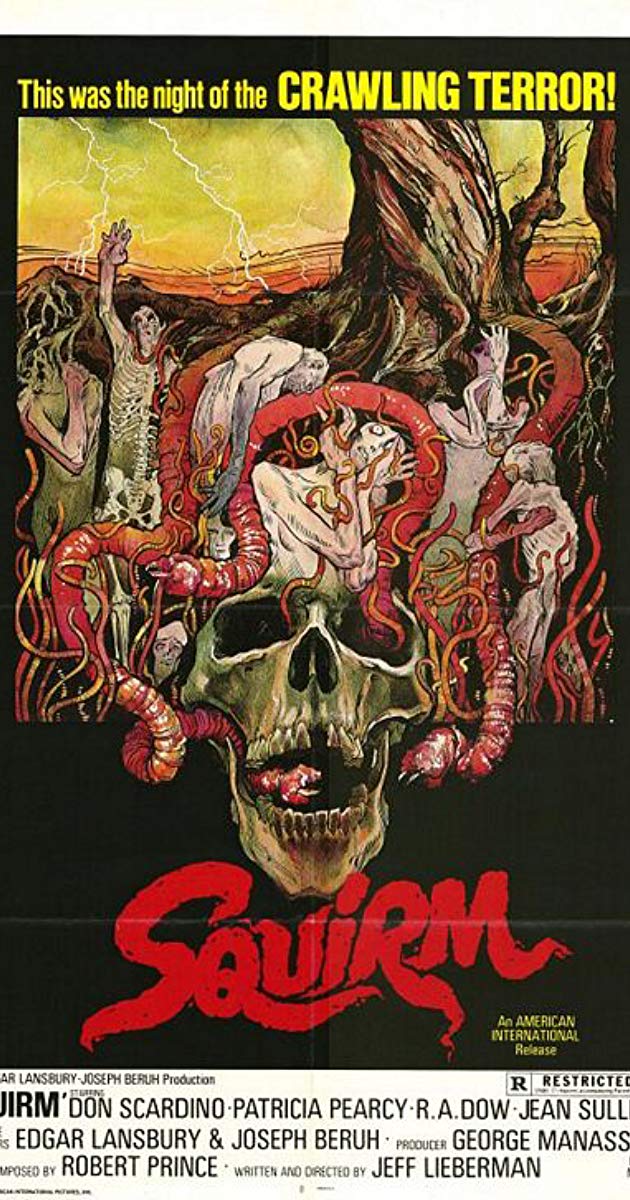
Squirm (1976)

SQUIRM

SQUIRM (1976) Three stars

You either have a predisposition for liking a silly creature feature like SQUIRM or you don’t.

I thankfully do.

Just a couple quick statements.

1) That’s a lovely title.

2) It’s produced by American International Pictures (1954-80), one of the best production outfits in the motion picture business.

3) I’d rate SQUIRM the second-best killer worm picture right after TREMORS.

Granted, I’m not exactly sure how many killer worm movies there are in existence.

SQUIRM, written and directed by Jeff Lieberman, reminds yours truly of the 1972 classic from American International, FROGS.

American International promoted FROGS with the immortal tagline “Today the pond, tomorrow the world.”

Meanwhile, SQUIRM received, “This was the night of the crawling terror!” Crawling terror in all caps! Like CRAWLING TERROR!

The opening title card informs us that SQUIRM is “based on a true story.” Are you gonna fall for that one?

Intense storms hit Fly Creek, Georgia and electricity from downed power lines + wet soil creates mad worms … and they develop an insatiable taste for human flesh. Of course, they do … or we’d not have much of a movie, at least not much of a one worthy of the title SQUIRM.

We have two gingers for our protagonists: Mick (Don Scardino), a no-count city slicker who seems to get on just about everybody’s bad side, especially good ol’ boy Sheriff Jim Reston (Peter MacLean) and creepy romantic rival Roger Grimes (R.A. Dow), and Mick’s romantic interest Geri (Patricia Pearcy).

Right off the top of the old noggin, I cannot think of another film headlined by a pair of redheads.

Mick starts off on the wrong foot real quick when he orders an egg cream. An egg cream in Fly Creek, Georgia? Only a city slicker would make such an order.

What’s an egg cream? Milk, carbonated water, and flavored syrup, apparently, and it does not contain eggs or cream. New Yorkers loved them some egg cream. Why do them old Pace Picante commercials leap to mind?

Mick encounters a worm in his egg cream and freaks out. Boy, oh boy, he’s not making friends very fast around here.

It all sort of reminds you of Dustin Hoffman’s work alienating the natives in Sam Peckinpah’s STRAW DOGS.

Many years ago, I brought in a DVD haul that included AFTER HOURS, ERASERHEAD, and FROGS.

Just from that day alone, I could have started the “So You’re Think You’re Having a Bad Day” Film Festival.

SQUIRM could make the cut, just based on what happens to Roger alone.

Shakespeare, “A coward dies a thousand times before his death, but the valiant taste of death but once. It seems to me most strange that men should fear, seeing that death, a necessary end, will come when it come.”

Roger “dies” a thousand times in SQUIRM. At least it seems that way. You can’t keep a good creep down.

He’s the SQUIRM character remembered most.

I read an interview with Lieberman where he recounted how most of the inner-city audience in a 900-seat theater rooted for Roger and wanted both redheads to die either by Roger or the worms.

SQUIRM amounts to a whole lot of fun, but take my word with a grain of salt especially since I have a predisposition to like this kind of movie.

squirm /skwərm/: wriggle or twist the body from side to side, especially as a result of nervousness or discomfort. Synonyms: wriggle, wiggle, writhe, twist, slide, slither, turn, shift, fidget, jiggle, twitch, thresh, flounder, flail, agonize.

“SQUIRM made late Atlanta Braves broadcaster Skip Caray squirm.”