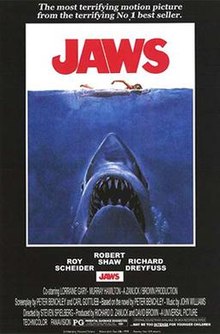
Jaws in 3D (1975 / 2022)

JAWS IN 3D (1975 / 2022) ****
When I first read the announcement Jaws 3D would be released to theaters in early September 2022, I mistook it for the Jaws 3-D from 1983 and I thought why in the bloody hell anybody would unleash that bloody awful movie once again … Just when you thought it was safe to go back in a movie theater … because there couldn’t be that much interest really in a third-rate Jaws movie.

I watched Jaws for the first time on the big screen in June 2020, sitting between my wife Lynn on the left and my mom on the right. We ate lunch beforehand at a place called Sharky’s Pub and Grub, and they might even have a Jaws poster. Just when you thought it was safe to go into a restaurant. My stepdaughter Emily and her friend watched E.T.

Jaws is another one of those movies that I would stop and watch every time I would come across it on cable TV, whether it played on TBS or TNT or part of a Jaws marathon 4th of July weekend on one of the premium channels.

Anyway, I decided to watch Jaws in 3D on Saturday, Sept. 3, which just happened to be National Cinema Day. $3 tickets for every showing, every showtime, every format. I had never seen the multiplex so busy; the theater had all hands on deck, and apparently 8.1 million people attended theaters across the nation on that day. Despite not being the biggest 3D fan, I thought why not bloody Jaws, of course a movie not originally in 3D, at that relatively budget price. There was a decent-sized crowd for this 47-year-old blockbuster pioneer, and they remained mostly quiet except for a couple of the most famous shock moments.

I thought it was a great experience, not only because I got to keep the glasses.

I long considered Jaws a very good movie, an ideal one to watch on cable TV when you just want to laze around and watch a movie, but after the last two times I’ve seen it in a movie theater, Jaws has dramatically increased in stature. It’s a great movie.

First and foremost, I appreciate Roy Scheider as Police Chief Martin Brody, Robert Shaw as Quint, and Richard Dreyfuss as Matt Hooper more every single time I watch Jaws.

Three great characters, three great performances, and they are something the other three Jaws films obviously lack. Scheider returns as Brody for Jaws 2, but it’s not the same.

George Burns (The Sunshine Boys) beat out Brad Dourif (One Flew Over the Cuckoo’s Nest), Burgess Meredith (The Day of the Locust), Chris Sarandon (Dog Day Afternoon), and Jack Warden (Shampoo) for Best Supporting Actor at the 1976 Academy Awards, but none of them approach Shaw’s work in Jaws.

Shaw makes an unlikable character likable by not even trying to be likable, and we feel his death scene more than just about any other in movie history. It is truly a horrifying moment, and despite the fact that I’ve watched Jaws 50, 75, 100, however many times, I still don’t want to see Quint lose his grip and slide right into the mouth of that great white shark.

Recently, I mentioned the incredible chemistry between Fred Ward and Kevin Bacon in Tremors. Scheider and Dreyfuss have a similar chemistry as Brody and Hooper, and I’m glad Jaws made Hooper infinitely more likable, excised Hooper’s extramarital affair with Brody’s wife, and let him survive along with Brody in the movie.

Shaw and Dreyfuss are great together, especially when they’re landing jabs and throwing shade at each other.

At one point in Jaws, Hooper describes the shark, and he could just as well be talking about Jaws itself and its capacity to make thrills, What we are dealing with here is a perfect engine, an eating (thrill) machine. It’s really a miracle of evolution. All this machine does is swim and eat and make little sharks (thrills), and that’s all.

Of course, that’s not all with Jaws, a truly scary classic that also generates lots of laughter and lots of emotion.

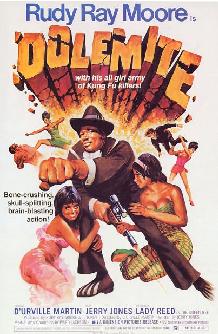
We Had Ourselves a Real Good Time: Blacula, Dolemite, TNT Jackson, The Devil and Max Devlin

WE HAD OURSELVES A REAL GOOD TIME: BLACULA, DOLEMITE, TNT JACKSON, THE DEVIL AND MAX DEVLIN
Max Schreck, Bela Lugosi, Carlos Villarias, Lon Chaney Jr., John Carradine, Christopher Lee, Klaus Kinski, George Hamilton, Frank Langella, Gary Oldman, and Leslie Nielsen.

That’s a lot of bared fangs, deadly stares, and spectacular deaths over the decades.

Fair warning: Best get outta here with that Tom Cruise, Gerard Butler, Robert Pattinson bull.

Blacula star William Marshall deserves his rightful place among the best screen vampires. For example, he’s definitely better than, oh, let’s say, Carradine, who played Dracula in House of Frankenstein, House of Dracula, and Billy the Kid vs. Dracula and often looked like somebody had squeezed some fresh lemon juice in his eyes. A few months after Marshall debuted as Black Dracula, Lee appeared in his sixth Dracula film — cleverly titled Dracula A.D. 1972 — and Lee’s spiraling lack of enthusiasm for the role that made him famous bites you right smack dab in the neck.

With his booming voice, commanding screen presence, and legitimate acting chops, Marshall (1924-2003) owns Blacula and makes it infinitely better than some cruddy hunk of cinematic junk like Blackenstein. He brings an unexpected dignity to what might otherwise have been a throwaway film.

Rating: Three stars.

— I enjoyed Dolemite a whole lot more than Disco Godfather, my first Rudy Ray Moore experience, and not only because I’m now calling the former picture Boom Mic Motherfucker.

Disco Godfather lost me by about the millionth or maybe it was by the billionth time Moore (1927-2008) exclaimed Put your weight on it, a slogan that needless to say would not be adopted or adapted by 1980 U.S. Presidential candidates Jimmy Carter, Ronald Reagan, and John B. Anderson. Despite the fact that it tried cultivating a social conscience, Disco Godfather needed some weight put on it, because it was the cinematic equivalent of an anorexic crackhead.

Moore has been called The Godfather of Rap and both Dolemite and the character himself almost instantly serve notice why. Jailbird Dolemite’s first lines are Oh, shit. What the hell does that rat-soup-eatin’ motherfucker want with me? One could play a reasonable drinking game with how many times Dolemite utters motherfucker in the movie, because it’s not every time Cheech & Chong say Man in Up in Smoke (reportedly 285 times) or everybody says Carol Anne in Poltergeist III (121). You won’t get wasted, best shit you ever tasted, from Dolemite. You’ll probably feel pretty good and the alcohol will help laughter.

The plot: Dolemite gets released from prison and fights the criminals and corrupt police officers who sent our favorite cinematic pimp up the river in the first place. Really, though, Dolemite is about the profanity, fight scenes, female (we’ll forget about the male) nudity, and complete utter ridiculousness, all of it done over-the-top. Never mind that it’s a time capsule into Bicentennial-Era America filed right alongside Dog Day Afternoon.

To be honest, though, I was distracted from the plot and everything else by the unpaid co-star Boom Mic Visible, who’s absolutely the funniest motherfucker in Dolemite. According to IMDb, The boom mic is visible in many shots of original Xenon VHS to DVD transfer from the 1980s. The film was originally transferred without the proper ratio ‘gate’ of 1:85.1, revealing more of the top and bottom of the frame than the film makers originally intended. The 2016 Vinegar Syndrome Bluray release was re-transferred from an archive print of the film, at the proper ratio, so the boom mics are hidden in many shots. The Bluray release also includes a ‘boom mic’ version of the new transfer, intentionally revealing the boom mics for comic effect.

Now we know.

The actor John Kerry (not that John Kerry) played Detective Mitchell in Dolemite and it’s a missed opportunity that nobody ever asked 2008 U.S. Presidential Candidate John Kerry about his experiences making Dolemite, what Rudy Ray Moore was really like, etc. That’s a real shame.

Rating: Three stars.

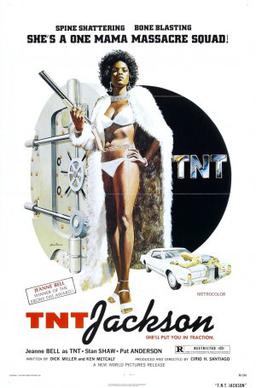
TNT Jackson is definitely not a good movie, but I am still feeling a certain lingering affection for it that other (better) movies wish they could make me feel for them.

What else could be said about some of the worst martial arts sequences ever committed to celluloid, from the very first fists and feet of fury scene all the way to the grand finale. Would you believe punches and kicks that do not connect but still inflict damage? Would you believe the heroine could punch right through the villain? Well, prepare yourself for TNT Jackson.

TNT Jackson falls short of the standard established by similar pictures Coffy and Cleopatra Jones, because, let’s face it, TNT Jackson star Jeannie Bell falls below Pam Grier and Tamara Dobson, respectively. Sure, former playmate and bunny Bell looks absolutely stunning with her great hair, great face, and great body, but she can’t act her way out of a paper bag and we don’t really believe that she could fight her way out of one if she wasn’t the star of the movie. Miss Jackson and her inevitable white chick nemesis (Pat Anderson) wage what’s possibly the worst cat fight ever in the history of the movies. It’s a doozy, and that describes the vast majority of the 72-minute TNT Jackson. Yes, that’s right, 72 minutes, a genuine throwback.

The late, great character actor Dick Miller (1928-2019) earned a screenwriting credit on TNT Jackson, but apparently producer Roger Corman had it rewritten by Ken Metcalfe, who plays the sleazy sub-villain Sid in TNT. Miller does not appear in TNT Jackson.

It’s amazing TNT Jackson romantic lead and main villain Stan Shaw did not get The Sensational, Smooth, Suave, Sophisticated, Stunning Stan Shaw for his screen credit, but maybe just maybe that’s because he overplays his smooth, suave, sophisticated ways so much that we’re tired of his jive real quick. Heck, even Shaw’s afro overplays it throughout TNT Jackson. I’ve not seen this much overacting by hair since, oh, let’s see, Chu Chu and the Philly Flash or maybe I’m mixing up Carol Burnett’s decorative head cover (wait, that’s just part of her costume) with her maracas.

Basically, I can’t hate too much on TNT Jackson like I do Chu Chu (more like Poo Poo and the Poopy Gas), since director Cirio H. Santiago remade TNT a few years later as Firecracker and substituted (white) Jillian Kesner for Bell in the title role. Both movies have similar plot elements, namely infamous topless fights, and Metcalfe in a similar role, but Firecracker does it better.

After watching TNT Jackson, I could not help but gravitate toward AC/DC’s song and the chorus ‘Cause I’m T.N.T., I’m dynamite / T.N.T., and I’ll win the fight / T.N.T., I’m a power load / T.N.T., watch me explode. Bonus points for TNT Jackson, ones that keep it from a two-star rating.

The best version of TNT Jackson is the two-minute promotional trailer put together by Joe Dante and Allan Arkush for New World Pictures circa 1974 or 1975. The voice-over narration takes it to greatness: TNT Jackson, Black Bombshell with a Short Fuse! This Hit Lady’s Charm Will Break Both Your Arms! She’s a One-Mama Massacre Squad! TNT’s Mad and That’s Real Bad! With That Dynamite Bod She’s a Jet Black Hit Squad! A Super Soul Sister and a Bad News Brother Under Cover and Out to Blast a Killer Army That’s Poisoning the People with Deadly China White! You Best Pay the Fine or She’ll Shatter Your Spine! Black Chinatown, Where Flesh is Cheap and Life is Cheaper! TNT Jackson, She’ll Put You in Traction!

Rating: Two-and-a-half stars. Trailer: Four stars.

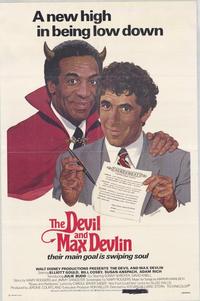
— Before The Devil and Max Devlin, it had no doubt been a long time since Walt Disney Studios depicted Hell in one of their films.

For example, Hell’s Bells from 1929 and Pluto’s Judgement Day from 1935 leap first to mind, two animated shorts that might blow people’s minds who normally associate animation with cute-and-cuddly innocuous fare at this late point in history.

To be fair to the older films, which are both far superior to the main film currently under consideration, feature length The Devil and Max Devlin doesn’t spend a lot of time in Hell.

Well, actually, according to some former President, right, aren’t California and Hell the same?

I wonder, given the subject matter and the presence of Bill Cosby in one of the starring roles, if The Devil and Max Devlin will go or has already gone the way of the controversial, divisive Song of the South — suppressed for seeming eternity by the folks at Disney. I found them both in the dark, dank recesses of the Internet and I hope that I won’t go to jail or Hell for either cultural sin.

Anyway, I like the locations (especially Hell) and I like the high concepts behind The Devil and Max Devlin like a slumlord trying to save his soul by giving the bad guys three unsullied souls and it turned out to be perfect casting to have Cosby in the role of the Devil’s helper, but the movie gets so bogged down in plot details that it evolves into a real slog and we just want more than anything else in the world at the moment for the movie to finally be over. At least, if nothing else, that’s how The Devil and Max Devlin made me feel watching it.

Rating: Two-and-a-half stars.

Phantom of the Paradise (1974)

PHANTOM OF THE PARADISE

PHANTOM OF THE PARADISE (1974) **

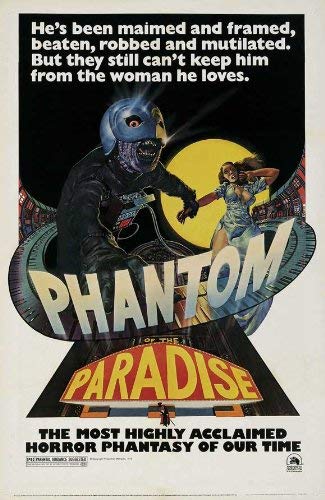
Brian De Palma’s PHANTOM OF THE PARADISE, a great big flop during its original release, is another cult film where I have to say, “I am glad you love this movie, but I don’t.” Big deal, it happens both ways on a regular basis.

It’s also one of those movies where I liked it less and less the more it was on, until I simply just wanted it to be over.

PHANTOM OF THE PARADISE gets called a “rock opera” and compared with THE ROCKY HORROR PICTURE SHOW, which came out about one year later.

Now, we’re getting to the heart of the problem. Both PHANTOM OF THE PARADISE and ROCKY HORROR are limp-wristed rock if they are in fact rock at all. Paul Williams, the songwriter and star of PHANTOM, he’s best known for writing Three Dog Night’s “An Old Fashioned Love Song,” the Carpenters’ “Rainy Days and Mondays,” Barbra Streisand’s “Evergreen” from A STAR IS BORN, and Kermit the Frog’s “Rainbow Connection” from THE MUPPET MOVIE. Not exactly the most rocking credentials.

Singer-songwriter and show tunes, with a little Sha Na Na and Meatloaf thrown in for extra measure, are not my idea of rock and that’s what PHANTOM and ROCKY HORROR offer listeners and viewers.

I already wrote a review comparing ROCKY HORROR against ROCK ‘N’ ROLL HIGH SCHOOL, a 1979 film that centers around the music of the Ramones.

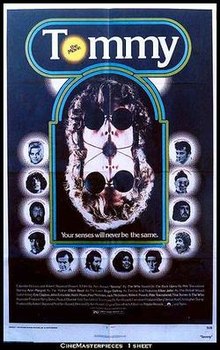
This whole rock opera angle initiated my brilliantly engineered mind to recall Ken Russell’s TOMMY from 1975, another musical contemporaneous with both PHANTOM and ROCKY HORROR that’s far more deserving of being called a “rock opera.” That’s definitely true, because at one time The Who — the band responsible for the music for both the 1969 album and 1975 movie — owned the rights on “loudest rock band in the world.” They lived rock, long before they wrote a song like “Long Live Rock,” “Be it dead or alive.”

Russell, who’s every bit as good as De Palma at capturing wretched excess on celluloid, gives us non-singers Oliver Reed and Jack Nicholson, natural born entertainers Ann-Margret and Tina Turner, a Marilyn Monroe-themed cult led by “The Preacher” (Eric Clapton), and Elton John’s centerpiece “Pinball Wizard” number, taking advantage of a $5 million budget. Hell to the yes, I love me some pinball and Sir Elton’s melodramatic demise. Never mind what Ann-Margret does with champagne, beans, chocolates, and bubbles. What’s that Beach Boys line about excitation?

PHANTOM OF THE PARADISE (reportedly made for $1.3 million) takes on classic novels “Phantom of the Opera,” “The Picture of Dorian Gray,” and “Faust.” It also predates the Black Sabbath compilation album “We Sold Our Soul for Rock ‘N’ Roll.”

I prefer the 1925 silent PHANTOM OF THE OPERA because of Lon Chaney’s brilliant performance (his 1974 counterpart William Finley gives the best performance in the movie), the fact that melodrama works better in silent rather than sound films, and the fact that we do not hear the opera music. Yeah, that’s right, I do not particularly care for opera, rock or not. PHANTOM OF THE PARADISE does not rock enough.

I would have greatly preferred Robert Johnson’s music over Paul Williams’ tunes. Here I am and I can’t remember any of Williams’ songs from the film. Not a good sign.

I would not be surprised, though, to find out that Dario Argento cast Jessica Harper in SUSPIRIA (1977) because of her performance in PHANTOM OF THE PARADISE.

I’ll take SUSPIRIA.

TOMMY (1975) ***

TOMMY

A Boy and His Dog (1975)

A BOY AND HIS DOG

A BOY AND HIS DOG (1975) ***

Forgive me for giving away the ending of A BOY AND HIS DOG: The Boy chooses The Dog over The Girl.

Then again, I am not sure I gave away the ending any one bit more than a title like A BOY AND HIS DOG. Yeah, right, it’s not called A BOY AND HIS GIRL.

Character actor L.Q. Jones, a favorite of the director Sam Peckinpah (1925-84), wrote, directed, and produced A BOY AND HIS DOG, adapted from Harlan Ellison’s 1969 short story “A Boy and His Dog.” Just take a look at the film’s poster: “The year is 2024 … a future you’ll probably live to see” and “a boy and his dog: an R rated, rather kinky tale of survival.” That part about A BOY AND HIS DOG being kinky, it’s no lie. Jones, in fact, makes a cameo in the porno movie within the movie.

In post-apocalyptic times, it quickly becomes apparent that a boy and his dog need each other more than ever before.

Especially this boy. He’s named Vic (Don Johnson). He’s 18 years old. He’s obsessed with sex and food, in just that order. Both his parents are gone. He lacks formal education and his ethics and morality are naturally twisted by the world he lives in. He’s a survivor, by any means necessary.

Meanwhile, his telepathic dog named Blood (voiced by Tim McIntire) is one helluva smart and savagely witty canine. He’s better than Benji! Benji, when he was voiced by Chevy Chase in OH! HEAVENLY DOG, never uttered anything like “I hope the next time you play with yourself, you go blind” or “Pull up your pants, Romeo.”

Vic and Blood have worked themselves out a nice little survival pact, at least until the lovely and sassy lass Quilla June Holmes (Susanne Benton). She knows how to appeal to Vic, but good old hound Blood knows a no-count hooch when he sees (and smells) one.

She’s been sent above ground by her powerful father from another world (Jason Robards) to scout talent for a sperm donor to perpetuate the species of underground survivors. Of course, Vic has got the super sperm necessary for the job, a fact Miss Holmes finds out firsthand. She ditches the boy and his dog and returns below ground, proving that Blood definitely sniffed out her wily ways.

Blood advises Vic not to chase the girl and go below ground, but the perpetually horny Vic lets his libido be his guide. Vic asks Blood to wait above ground for his return.

After boy and girl escape the underworld in harrowing fashion, they find Blood and he’s barely alive. That’s when The Boy faces his choice between The Dog and The Girl. Feed her to the dogs, indeed.

A BOY AND HIS DOG makes a strong case that dames are a dime a dozen even in a post-apocalyptic world, but dogs like Blood are truly a rare breed.

Picnic at Hanging Rock (1975 / 1998)

PICNIC AT HANGING ROCK (1975 / 1998) Four stars

Imagine a mystery ending unsolved.

That’s the challenge for readers of Joan Lindsay’s original 1967 novel and viewers of the 1975 Australian film adaptation by screenwriter Cliff Green and director Peter Weir.

Lindsay’s editor Sandra Forbes made the suggestion to remove the final chapter and Lindsay did so before publication. In 1987, three years after Lindsay’s death, “The Secret of Hanging Rock,” the infamous final chapter, Chapter 18, finally appeared.

Weir’s 1998 Director’s Cut trimmed eight minutes from the original film, 115 down to 107 minutes.

In turn of the 20th Century Australia, three Appleyard College school girls and one teacher do not return from their picnic at former volcano Hanging Rock near Mount Macedon in Victoria. The girls’ curiosity about exploring Hanging Rock obviously gets the best of them. One of the girls, Irma, returns every bit as mysteriously as she disappeared one week earlier and she’s no good for answers in the heart of the picture, “I remember — nothing! Nothing! I remember nothing!” Irma’s fellow characters become every bit as frustrated with her as we do in the audience, because all of us (they and we) demand a solution and an explanation. People desperately want rationality in an often irrational world.

School girls Miranda (Anne-Louise Lambert) and Marion (Jane Vallis) and Miss McGraw (Vivean Gray) remain missing, despite the best efforts of both official and unofficial search parties. For example, there’s Michael Fitzhubert (Dominic Guard), a young man who becomes obsessed with finding Miranda.

Seems like virtually everybody’s obsessed with this Miranda, who Mlle. De Poitiers (Helen Morse) describes as a Botticelli angel before her disappearance. The film is very suggestive and hints at terrible, unspeakable events. Imaginations may run wild, as they do within the film.

Miranda provides a line vital to understanding PICNIC AT HANGING ROCK, “What we see and what we seem are but a dream, a dream within a dream,” a quote from Edgar Allan Poe’s 1849 poem “A Dream Within a Dream.” It is quite possible that Poe (1809-49) would have admired PICNIC AT HANGING ROCK.

Take this kiss upon the brow!

And, in parting from you now,

Thus much let me avow —

You are not wrong, who deem

That my days have been a dream;

Yet if Hope has flown away

In a night, or in a day,

In a vision, or in none,

Is it therefore the less gone?

All that we see or seem

Is but a dream within a dream


I stand amid the roar

Of a surf-tormented shore,

And I hold within my hand

Grains of the golden sand —

How few! yet how they creep

Through my fingers to the deep,

While I weep — while I weep!

O God! can I not grasp

Them with a tighter clasp?

O God! can I not save

One from the pitiless wave?

Is all that we see or seem

But a dream within a dream?


Guess we should discuss this Hanging Rock, which becomes a character and even more of an impenetrable mystery in its own right than the central mystery. Australian New Wave films — like PICNIC AT HANGING ROCK — received (and deserved) much praise for their depictions of the natural landscape.

Hanging Rock quickly becomes mythical, powerful, before we even take one look.

Mrs. Appleyard (Rachel Roberts) builds it up within our minds in an early scene, “The rock itself is extremely dangerous. You are therefore forbidden of any tomboy foolishness in the matter of exploration, even on the lowest slopes. I also wish to remind you, the vicinity is renowned for its venomous snakes and poisonous ants of various species. It is, however, a geological marvel.”

Miss McCraw contributes, “The rocks all round — Mount Macedon itself — must be all of 350 million years old. Siliceous lava, forced up from deep down below. Soda trachytes extruded in a highly viscous state, building the steep sided mamelons we see in Hanging Rock. And quite young geologically speaking. Barely a million years.” These dialogue passages remind one of how Dr. Sam Loomis (Donald Pleasence) played up Michael Myers in HALLOWEEN.

The watches of coachman Mr. Hussey (Martin Vaughan) and Miss McGraw both freeze at the stroke of noon. They speculate about the magnetic powers of Hanging Rock.
That’s before the girls decide to go explore Hanging Rock.

PICNIC AT HANGING ROCK derives considerable power from the juxtaposition of the young women and Hanging Rock. Also, Hanging Rock itself cannot be interrogated about what happened on that fateful day or explain how one girl returned. What did Hanging Rock do to and then with these women?

Hanging Rock remains a marvel and tourist hot spot today.

Check out the sales pitch: “Where else in Australia will you find the Black Hole of Calcutta, The Eagle, The Chapel and Lover’s Leap … let the secrets of Hanging Rock unfold before your eyes as you wind your way up to the pinnacle where spectacular views await” and “The unexplained disappearance of a group of schoolgirls at Hanging Rock in 1901 is just one of the legends of this mysterious area, and many visitors say they can feel the spirit of the girls as they climb the Rock. Joan Lindsay’s book and Peter Weir’s film about the ‘Picnic at Hanging Rock’ ensures that the mystery lives on. …”

No evidence has been found to prove the novel and the movie are based on a true story.
PICNIC AT HANGING ROCK sticks with many viewers, just like the surviving characters are haunted.

The technical aspects are first-rate: cinematographer Russell Boyd, editor Max Lemon, art director David Copping, costume designer Judith Dorsman, makeup artist Elizabeth Mitchie and makeup supervisor Jose Luis Perez, composer Bruce Smeaton, and musician Gheorghe Zamfir, in particular.

Zamfir’s pan flute later influenced Ennio Morricone’s work for Sergio Leone’s ONCE UPON A TIME IN AMERICA.

After writing this review, I know that I want to watch PICNIC AT HANGING ROCK again.

The Rocky Horror Picture Show vs. Rock ‘N’ Roll High School

THE ROCKY HORROR PICTURE SHOW VS. ROCK ’N’ ROLL HIGH SCHOOL

I’ve never understood the appeal of THE ROCKY HORROR PICTURE SHOW and how it became the ultimate cult film.

Lord knows I’ve tried, but it’s still neither good nor bad enough to be any good for me.

First time I watched it was late-night TV during my early teenage years. This same late-night program later showed WOLFEN and those are the only two films I can remember watching from that program. (Upon further reflection, I also recall watching HOWARD THE DUCK and THE BREAKFAST CLUB under such circumstances.) Who would have ever guessed that I liked ROCKY HORROR most on this first viewing.

Second time I saw it was part of Starz’ “Midnight Movies” circa 2005. Starz presented a documentary called MIDNIGHT MOVIES based from the book written by film critics J. Hoberman and Jonathan Rosenbaum, then played the movies featured in the doc. I remember watching THE HARDER THEY COME and ROCKY HORROR.

Third time did not prove to be a charm. Two of my ex-girlfriend’s friends could not believe that she had never seen ROCKY HORROR, so they immediately rushed out to the nearest video store and snagged a copy. My ex-girlfriend and I sat there in stunned disbelief at ROCKY HORROR.

The second and third viewings of ROCKY HORROR turned out to be washes and I liked it less each viewing.

I don’t know, I’ve always expected something more outrageous, something more shocking than GREASE in drag.

In fact, I’ve long equated ROCKY HORROR with GREASE: They’re both downright positively absolutely wholesome in dealing with the source material of transgressive art.

Hip to be square, indeed.

Next to FREAKS, BEYOND THE VALLEY OF THE DOLLS, ERASERHEAD, and SHOWGIRLS, for example, ROCKY HORROR especially seems like a lame little song-and-dance picture.

As a social phenomenon, ROCKY HORROR is undeniable.

As a stand-alone film without the cult audience in the living room, it’s not so hot.

Feed me THE LITTLE SHOP OF HORRORS (1986) instead.

Hell, give me ROCK ’N’ ROLL HIGH SCHOOL, a 1979 production from the Roger Corman factory.

It’s a teenage rebellion picture and as the late, great Joey Ramone (1951-2001) once said, we haven’t had one of those since the Revolution. Think he meant the American Revolution, not the Industrial or the Television or the Rocky Horror.

ROCK ’N’ ROLL HIGH SCHOOL benefits greatly from a pair of fun fun fun performances at the heart of the picture: P.J. Soles as Ramones loving Riff Randell, who introduces herself as rock ’n’ roller, and Mary Woronov as the fascist Principal Togar, who’s the type to burn rock ’n’ roll albums and crush any individuality. She’s the Principal of Vince Lombardi High, and Riff Randell is her nemesis. Togar hates the Ramones, and I believe she point blank asks them, “Do your parents know you’re Ramones?”

In her quest to quash rock music, Togar introduces a nifty little device that I don’t remember seeing anywhere else: The Rock-O-Meter, which measures, I do believe, the comparative loudness of rock bands. The meter starts with Muzak at the bottom and proceeds through Pat Boone, Debbie Boone, Donny & Marie, Kansas, Peter Frampton, Foreigner, Jethro Tull, Led Zeppelin, Ted Nugent, the Rolling Stones, the Who, and, finally, the Ramones at the very top. Yeah, it’s a long way to the top, if you wanna rock ’n’ roll. When you reach that level, it’s not a good time to be a lab mouse (it’s just as bad as being a drummer in Spinal Tap).

Oh, it would have been a nifty little joke to have ROCKY HORROR between Donny & Marie and Kansas.

There’s also a role in ROCK ’N’ ROLL for cult film director Paul Bartel (1938-2000), who evolves from a rock ’n’ roll hater to a Ramones lover. It’s a great moment in dance and cinema when Bartel’s Mr. McGree shakes a tail feather to the Ramones’ cover of “Do You Wanna Dance?” after band and students have taken over the halls of Lombardi High.

That guy Dick Miller (1928-2019) shows up late, late in the pic as a scull-cracking would-be fascist police officer. Roger Corman once named Miller “the best actor in Hollywood” and he’s a favorite of fans of flicks like A BUCKET OF BLOOD, GREMLINS and GREMLINS 2, and PIRANHA. Arnold even blew him away in THE TERMINATOR.

Clint Howard plays Eaglebauer, a procurer at Vince Lombardi who sets up shop in a Brownsville Station dream.

Over the years, I began to notice the majority of my favorite movies are blessed with a multitude of great supporting characters and great character actors. BOOGIE NIGHTS and THE BIG LEBOWSKI, for example, leap quickly to mind.

Guess it goes to show the overall quality of ROCK ’N’ ROLL HIGH SCHOOL when I have mentioned five performers — Soles, Woronov, Bartel, Miller, and Howard — and not gone into detail about the Ramones.

Delving into the Ramones’ song catalog became one of the enduring pleasures of my life and their songs from “Beat on the Brat” and “Rockaway Beach” to “Rock ’N’ Roll High School” and “The KKK Took My Baby Away” have earned a place inside my punk rock heart alongside the Clash, the Sex Pistols, the Buzzcocks, et cetera.

It’s the punk rocker (and the antisocial free spirit) inside me that prefers ROCK ’N’ ROLL HIGH SCHOOL over THE ROCKY HORROR PICTURE SHOW.

THE ROCKY HORROR PICTURE SHOW (1975) One-and-a-half stars; ROCK ’N’ ROLL HIGH SCHOOL (1979) Three-and-a-half stars

Profondo Rosso (1975)

DAY 25, DEEP RED.jpg

PROFONDO ROSSO (1975) Four stars
Giallo is the Italian word for yellow.

In fiction terms, though, quoting from Wikipedia, giallo means “a 20th century Italian thriller genre of literature and film. Especially outside Italy, giallo refers specifically to a particular Italian thriller-horror genre that has mystery or detective elements and often contains slasher, crime fiction, psychological thriller, psychological horror, exploitation, sexploitation, and, less frequently, supernatural horror elements. In Italy, the term generally denotes thrillers, typically of the crime fiction, mystery, and horror subgenres, regardless of the country of origin.”

An Italian publishing company named Mondadori began releasing crime and mystery novels in 1929 and the series became known as “Il Giallo Mondadori,” distinguished by their heavily yellow front covers. Especially popular were the works of Agatha Christie, Dashiell Hammett, and Raymond Chandler. Mondadori still prints “Il Giallo Mondadori” novels today.

Giallo movies started appearing in the mid-1960s and became a fixture especially in the late 1960s and 1970s through directors like Mario Bava, Dario Argento, and Lucio Fulci, who achieved the greatest international notoriety.

Argento’s PROFONDO ROSSO, also known as DEEP RED or THE HATCHET MURDERS, was the director’s fifth movie and it’s a transitional film, before Argento’s work verged on the fantastical like SUSPIRIA and INFERNO. It and THE BIRD WITH THE CRYSTAL PLUMAGE, his first film, are his best giallos.

Watching PROFONDO ROSSO for the first time, one will be struck by how much you feel like you’ve seen this movie before through later films it influenced such as John Carpenter’s HALLOWEEN and David Cronenberg’s SCANNERS. For example, Goblin’s main theme for PROFONDO ROSSO and Carpenter’s for HALLOWEEN are first cousins. Cronenberg modeled the lead-in to the famous head explosion scene after the early lecture sequence in Argento’s film. Rick Rosenthal’s HALLOWEEN II (produced by Carpenter) featured a death by scalding water scene inspired by Amanda Righetti’s death in PROFONDO ROSSO.

Like the best Argento films, PROFONDO ROSSO sticks with you.

Argento films usually give us a protagonist who’s a writer, a musician, a creative person of some form. In THE BIRD WITH THE CRYSTAL PLUMAGE, it’s American writer Sam Dalmas. In CAT O’NINE TAILS, it’s reporter Carlo Giordani. In FOUR FLIES ON GREY VELVET, it’s rock drummer Roberto Tobias. In PROFONDO ROSSO, it’s pianist Marcus Daly. In SUSPIRIA, it’s American dance student Suzy Bannion. In INFERNO, it’s music student Mark Elliott.

These characters provide us a rooting interest and keep us hanging on through all the convolutions of the plot. They become our surrogate, because they’re normality (just like us) in a mad, mad, mad world. They (and we) are just trying to survive another day. They live out our detective fantasies.

In any mystery, it’s vital that we find that rooting interest.

Argento protagonists normally get in way, way, way over their heads like the ones in Hitchcock films so often do … of course, we see David Hemmings playing Marcus Daly and we cannot help but think of Michelangelo Antonioni’s BLOW-UP, where Hemmings’ very Swinging London photographer believes he may have accidentally photographed a murder in a park. There’s no doubt, though, in PROFONDO ROSSO.

On his way home early in the film, Marcus sees psychic medium Helga Ulmann (Macha Meril) being attacked in her apartment. They live in the same building. He rushes up the stairs and down the hall to her apartment and finds her dead body.

The chief witness becomes the star witness, thanks to female reporter Gianna Brezzi (Daria Nicoladi) and her coverage of the murder, and the reporter and the pianist become partners, both in the romantic and detective sense.

PROFONDO ROSSO is one of those mysteries that rewards our interest to the very end.

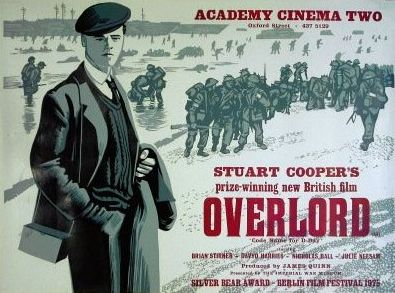
Overlord (1975)

day 73, overlord

OVERLORD (1975) Four stars
American director Stuart Cooper did something very interesting for his fourth film, 1975’s OVERLORD.

Cooper integrated archival footage of British training missions and the D-Day Invasion (a.k.a. Operation Overlord) into a fictional film about a young man’s journey from call up to the grave. Cooper and his very talented cinematographer John Alcott (he won the Academy Award for Best Cinematography for his work on Stanley Kubrick’s BARRY LYNDON, another 1975 film) did their best to make a consistent look so one could not tell any difference between the archival footage and the fictional story.

The Imperial War Museum granted Cooper access to its vaults and that’s where he found all that historical footage. Cooper had originally planned to make a documentary on the Overlord Embroidery, which commemorates scenes from wartime photos housed by the Imperial War Museum. Sandra Lawrence designed it and the Royal School of Needlework provided the handiwork.

Cooper told The Guardian in 2008, “I spent approximately 3,000 hours in that dark cell between 1971 and 1975, briefly interrupted by a couple of other projects. It was during the archival research that I developed the idea of a dramatised feature film about an English soldier who sees his first action on D-Day, interweaving the archive footage to expand and tell the story. …

“A major concern for my cinematographer, John Alcott, was how to match the texture of the archive footage. In an unprecented move, the museum granted us access to the original nitrate negatives. The quality of the original nitrate negatives was pristine. After Alcott examined them, we decided to film OVERLORD on period lenses. Alcott scoured England and found two sets of 1936 and 1938 German Goetz and Schneider lenses. Alcott then applied a lighting style in keeping with the war photography, seamlessly blending the archive and dramatised story. Seventy percent of the film is live action, which was completed in 10 days of filming.”

OVERLORD, though it won the Silver Bear at the 25th Berlin International Film Festival, seemed to have fallen through the cracks of history for many, many years.

Cooper again in The Guardian, “In spite of OVERLORD’s festival success, it never gained distribution in the U.S., which I suspect hurt its chances of being properly remembered. It may also have been because it was made during the tail end of the Vietnam War, as well as being a black-and-white film with a very British story. The only airing the film received in the U.S. was on Jerry Harvey’s Z Channel in 1982, a forerunner to U.S. cable stations. Twenty-two years later, Xan Cassavetes, John Cassavetes’ daughter, included several clips of OVERLORD in her 2004 documentary, Z CHANNEL: A MAGNIFICENT OBSESSION. As a result, OVERLORD was invited to the Telluride Film Festival, where it was a surprise success. Shortly afterwards, it was belatedly picked up for U.S. distribution.”

Better late than never, for sure.

I found out about the film from Roger Ebert’s 4-star review in 2006.

Ebert first wrote about the film at Telluride in 2004, “The most remarkable discovery at this year’s Telluride is OVERLORD, an elegiac 1975 film that follows the journey of one young British soldier to the beaches of Normandy. … Unlike SAVING PRIVATE RYAN and other dramatizations based on D-Day, OVERLORD is an intimate film, one that focuses closely on Tom Beddoes (Brian Stirner), who enters the British army, goes through basic training and is one of the first ashore on D-Day. Beddoes is not a macho hero but a quiet, nice boy, who worries about his cocker spaniel and takes along ‘David Copperfield’ when he goes off to war.”

Christopher Hudson’s screenplay built scenes based on diaries and letters from real servicemen, again providing something unique from the average war film.

Unique is definitely one word for OVERLORD.

You sometimes feel like you’re watching a real young man’s life, as if Tom Beddoes had been a real person and had been followed around by a documentary film crew who managed to conceal themselves from the real people being filmed.

That’s a different feeling than just about every other fictional war movie.

Of course, OVERLORD includes all the standard issue scenes: Tom’s call up, his basic training, his meeting a young woman whom he falls in love with (she’s called “The Girl” in the credits), his journey overseas, and finally his death on D-Day.

OVERLORD reminds us that clichés have their roots in things commonly happening to people.

Who knows how many Tom Beddoes there have been and will be throughout the pages of history.

I drift back to the following lyrics from the Clash’s “The Call Up,” “There is a rose that I want to live for / Although, God knows, I may not have met her / There is a dance an’ I should be with her / There is a town unlike any other.”

Jaws (1975)

day 23, jaws

JAWS (1975) Three-and-a-half stars
Steven Spielberg’s JAWS wanted to do for sharks what Alfred Hitchcock’s PSYCHO did for showers 15 years earlier.

Like PSYCHO, JAWS became a game-changing motion picture and it’s been analyzed, overanalyzed, parodied, and satirized, and it spawned many clones and rip-offs with just about every animal turned into a relentless killer.

It’s known as the first summer blockbuster film (released on June 20, 1975), I mean it even says so in the Guinness Book of World Records, “Not only did people queue up around the block to see the movie, it became the first film to earn $100 million at the box office.”

Before 1975, summers were traditionally reserved for dumping insignificant fluff.

Based on Peter Benchley’s best-selling novel, JAWS tells a pulp story: a great white shark terrorizes Amity Island, a summer resort community, and transplanted city policeman Sheriff Brody (Roy Scheider) wants to close off the beaches but he runs into much resistance from Mayor Larry Vaughn (Murray Hamilton), who of course fears the loss of tourist revenue more than he does a great white shark. Eventually, though, Brody, along with preppy Ichthyologist Matt Hooper (Richard Dreyfuss) and grizzled old man of the sea Quint (Robert Shaw), attempts to hunt down and kill the great white aboard Quint’s ship, the Orca.

The film and the novel are different in several fundamental ways: Hooper and Brody’s wife do not have an affair in the film; Mayor Vaughn’s squeezed by the mafia in the novel and not simply local business interests; newspaper man Harry Meadows plays a bigger role in the novel; Quint’s made a survivor of the World War II USS Indianapolis; Hooper escapes death in the film; Quint dies by drowning in the novel; in the film, Brody kills the shark by shooting a compressed air tank inside the creature’s jaws, of course.

Spielberg said that he rooted for the shark the first time he read Benchley’s novel because he found the human characters unlikeable.

Normally, books are credited for having stronger characterizations than their screen adaptations.

That’s not the case with JAWS.

In fact, none of the subsequent JAWS films could match the characterizations of Brody, Hooper, and Quint and performances by Scheider, Dreyfuss, and Shaw. We have three indelible characters who stay within our hearts and minds just as much as the image of the great white shark.

Scheider and Dreyfuss appeared to have great chemistry together, just like there seemed to be real tension between Dreyfuss and Shaw.

Universal had Scheider bent over a barrel after he dropped out two weeks before filming started on THE DEER HUNTER, due to “creative differences,” and so they forced Scheider into starring in JAWS 2. Scheider’s performance in JAWS 2 suggests a very, very unhappy person and his conflicts with director Jeannot Szwarc must have only contributed to Scheider’s apparent misery.

Dreyfuss passed on JAWS 2 because Spielberg did not direct it; they made CLOSE ENCOUNTERS OF THE THIRD KIND together instead. Of course, there were obvious difficulties in Quint returning for JAWS 2.

JAWS 2 gives us a bunch of teeny boppers and repeats the basic plot of the first movie, JAWS 3-D sinks even more into a morass of mediocrity (how bad must you be to be disowned by the next JAWS film), and JAWS THE REVENGE, well, it gives us the first shark movie designed for geriatric consumption. To be honest, JAWS THE REVENGE defies the suspension of disbelief beyond belief and becomes one of the worst bad movies ever made.

Necessity became the mother of invention for JAWS, because of the numerous technical difficulties with the mechanical shark that became known as Bruce, named after Spielberg’s lawyer, or alternately “the great white turd.” Spielberg wanted to show the shark a lot sooner, but instead the film took on more Val Lewton proportions than the average horror movie. JAWS relies heavily on John Williams’ famous musical score to substitute for the shark.

The JAWS sequels utilized the mechanical shark far more often and much earlier on, honestly to their detriment. Less is more and more is less.

I always love it when horror movies take on more than just being a horror movie. At times, especially when our three protagonists are stuck on that damn boat together, JAWS becomes grand adventure and an unexpected comedy.

Infra-Man (1975)

day 36, infra-man

INFRA-MAN (1975) Four stars
I just looked at DRUNKEN MASTER, one of the most entertaining movies ever made, and here we are back with INFRA-MAN, another one.

Roger Ebert wrote an enthusiastic review in March 1976: “And so we’re off and running, in the best movie of its kind since INVASION OF THE BEE GIRLS. I’m a pushover for monster movies anyway, but INFRA-MAN has it all: Horrendous octopus men, a gigantic beetle man with three eyes who sprays his victims with sticky cocoons, savage robots with coiled spring necks that can extend ten feet, a venomous little critter that looks like a hairy mutant footstool, elaborately staged karate fights, underground throne rooms, damsels in distress, exploding volcanoes, and a whip-cracking villainess named Princess Dragon Mom.”

Believe it or not, Ebert originally gave INFRA-MAN only two-and-a-half stars and later changed his star rating to three after the re-release of MIGHTY PEKING MAN, another incredibly goofy movie by the same studio.

However, obviously, I don’t think Ebert went far enough, because INFRA-MAN should be four stars.

I just called DRUNKEN MASTER “sublime ridiculousness.”

That’s an understatement for INFRA-MAN.

No, seriously.

Not just because I’ve seen the movie in a print with a Mandarin soundtrack and Spanish subtitles.

It really is the most ridiculous movie I have seen, especially in the English dub.

This Shaw Brothers production combines super heroes, Kung Fu, and science fiction into one explosive 90-minute entertainment package influenced by the Japanese TV shows ULTRAMAN and KAMEN RIDER that were popular in Hong Kong.

It’s not only explosive because shit blows up real good throughout INFRA-MAN.

Seriously, there might be a land speed record for explosions in the movie.

Everything blows up.

Not convinced yet?

The short plot summary from IMDb: “Princess Dragon Mom and her mutant army have arisen, and only Infra-Man can stop them!”

A longer plot summary: “The ten million year-old Princess Dragon Mom (Terry Liu) attempts to conquer the Earth with her legion of mutant monsters. In response, Professor Chang (Wang Hsieh) creates Infra-Man, turning a young volunteer into a bionic superhero to save the world. However, the Princess kidnaps Chang’s daughter. Can Infra-Man save her and the planet before it’s too late?” (IMDb)

Princess Dragon Mom is one of the great villains of all-time, definitely ahead of her time in having cones on her breasts well before Madonna.

Not only that, which is no small feat, but when Infra-Man tries decapitating her when she’s in her dragon form with his energy blades, Princess Dragon Mom regenerates a new head. Every single time, and I mean every single time. Finally, he must use his solar beam to destroy her forever.

Princess Dragon Mom leads one of the more interesting groups of villains. Her minions include Witch-Eye, second-in-command who shoots great beams from eyes on her palms, and Skeleton Ghosts, who have explosive metal spears and wear black and white suits with a lovely skeleton decor that really holds it all together. Princess Dragon Mom’s villainous crew includes several monsters: Fire Dragon, Spider Monster (or the Will Not Stop Growling Spider Monster), Plant Monster, Mutant Drill, Long-Haired Monster, and Iron Armor Monster Brothers. How would you like to have portrayed any one of these minions or monsters?

Where does a performer go after playing Princess Dragon Mom? Did she get to keep any of the costume?

Terry Liu has some interesting titles among her 50 credits from 1973 to 2016, including THE BAMBOO HOUSE OF DOLLS, THAT’S ADULTERY (PART 1), SPIRIT OF THE RAPED, EROTIC NIGHTS, THE OILY MANIAC, and DEADLY HANDS OF KUNG FU.

She’ll always have a soft spot in my heart for her Princess Dragon Mom.

The rest of the world could call her Demon Princess Elzebub, but Princess Dragon Mom will more than suffice for me.

I’ll have more on the Shaw Brothers later.