We Had Ourselves a Real Good Time: Blacula, Dolemite, TNT Jackson, The Devil and Max Devlin

WE HAD OURSELVES A REAL GOOD TIME: BLACULA, DOLEMITE, TNT JACKSON, THE DEVIL AND MAX DEVLIN
Max Schreck, Bela Lugosi, Carlos Villarias, Lon Chaney Jr., John Carradine, Christopher Lee, Klaus Kinski, George Hamilton, Frank Langella, Gary Oldman, and Leslie Nielsen.

That’s a lot of bared fangs, deadly stares, and spectacular deaths over the decades.

Fair warning: Best get outta here with that Tom Cruise, Gerard Butler, Robert Pattinson bull.

Blacula star William Marshall deserves his rightful place among the best screen vampires. For example, he’s definitely better than, oh, let’s say, Carradine, who played Dracula in House of Frankenstein, House of Dracula, and Billy the Kid vs. Dracula and often looked like somebody had squeezed some fresh lemon juice in his eyes. A few months after Marshall debuted as Black Dracula, Lee appeared in his sixth Dracula film — cleverly titled Dracula A.D. 1972 — and Lee’s spiraling lack of enthusiasm for the role that made him famous bites you right smack dab in the neck.

With his booming voice, commanding screen presence, and legitimate acting chops, Marshall (1924-2003) owns Blacula and makes it infinitely better than some cruddy hunk of cinematic junk like Blackenstein. He brings an unexpected dignity to what might otherwise have been a throwaway film.

Rating: Three stars.

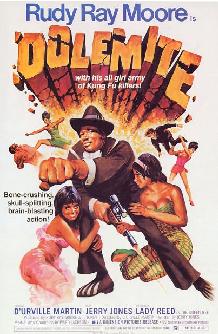
— I enjoyed Dolemite a whole lot more than Disco Godfather, my first Rudy Ray Moore experience, and not only because I’m now calling the former picture Boom Mic Motherfucker.

Disco Godfather lost me by about the millionth or maybe it was by the billionth time Moore (1927-2008) exclaimed Put your weight on it, a slogan that needless to say would not be adopted or adapted by 1980 U.S. Presidential candidates Jimmy Carter, Ronald Reagan, and John B. Anderson. Despite the fact that it tried cultivating a social conscience, Disco Godfather needed some weight put on it, because it was the cinematic equivalent of an anorexic crackhead.

Moore has been called The Godfather of Rap and both Dolemite and the character himself almost instantly serve notice why. Jailbird Dolemite’s first lines are Oh, shit. What the hell does that rat-soup-eatin’ motherfucker want with me? One could play a reasonable drinking game with how many times Dolemite utters motherfucker in the movie, because it’s not every time Cheech & Chong say Man in Up in Smoke (reportedly 285 times) or everybody says Carol Anne in Poltergeist III (121). You won’t get wasted, best shit you ever tasted, from Dolemite. You’ll probably feel pretty good and the alcohol will help laughter.

The plot: Dolemite gets released from prison and fights the criminals and corrupt police officers who sent our favorite cinematic pimp up the river in the first place. Really, though, Dolemite is about the profanity, fight scenes, female (we’ll forget about the male) nudity, and complete utter ridiculousness, all of it done over-the-top. Never mind that it’s a time capsule into Bicentennial-Era America filed right alongside Dog Day Afternoon.

To be honest, though, I was distracted from the plot and everything else by the unpaid co-star Boom Mic Visible, who’s absolutely the funniest motherfucker in Dolemite. According to IMDb, The boom mic is visible in many shots of original Xenon VHS to DVD transfer from the 1980s. The film was originally transferred without the proper ratio ‘gate’ of 1:85.1, revealing more of the top and bottom of the frame than the film makers originally intended. The 2016 Vinegar Syndrome Bluray release was re-transferred from an archive print of the film, at the proper ratio, so the boom mics are hidden in many shots. The Bluray release also includes a ‘boom mic’ version of the new transfer, intentionally revealing the boom mics for comic effect.

Now we know.

The actor John Kerry (not that John Kerry) played Detective Mitchell in Dolemite and it’s a missed opportunity that nobody ever asked 2008 U.S. Presidential Candidate John Kerry about his experiences making Dolemite, what Rudy Ray Moore was really like, etc. That’s a real shame.

Rating: Three stars.

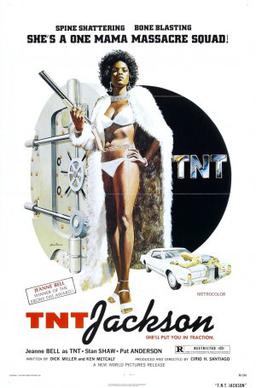
TNT Jackson is definitely not a good movie, but I am still feeling a certain lingering affection for it that other (better) movies wish they could make me feel for them.

What else could be said about some of the worst martial arts sequences ever committed to celluloid, from the very first fists and feet of fury scene all the way to the grand finale. Would you believe punches and kicks that do not connect but still inflict damage? Would you believe the heroine could punch right through the villain? Well, prepare yourself for TNT Jackson.

TNT Jackson falls short of the standard established by similar pictures Coffy and Cleopatra Jones, because, let’s face it, TNT Jackson star Jeannie Bell falls below Pam Grier and Tamara Dobson, respectively. Sure, former playmate and bunny Bell looks absolutely stunning with her great hair, great face, and great body, but she can’t act her way out of a paper bag and we don’t really believe that she could fight her way out of one if she wasn’t the star of the movie. Miss Jackson and her inevitable white chick nemesis (Pat Anderson) wage what’s possibly the worst cat fight ever in the history of the movies. It’s a doozy, and that describes the vast majority of the 72-minute TNT Jackson. Yes, that’s right, 72 minutes, a genuine throwback.

The late, great character actor Dick Miller (1928-2019) earned a screenwriting credit on TNT Jackson, but apparently producer Roger Corman had it rewritten by Ken Metcalfe, who plays the sleazy sub-villain Sid in TNT. Miller does not appear in TNT Jackson.

It’s amazing TNT Jackson romantic lead and main villain Stan Shaw did not get The Sensational, Smooth, Suave, Sophisticated, Stunning Stan Shaw for his screen credit, but maybe just maybe that’s because he overplays his smooth, suave, sophisticated ways so much that we’re tired of his jive real quick. Heck, even Shaw’s afro overplays it throughout TNT Jackson. I’ve not seen this much overacting by hair since, oh, let’s see, Chu Chu and the Philly Flash or maybe I’m mixing up Carol Burnett’s decorative head cover (wait, that’s just part of her costume) with her maracas.

Basically, I can’t hate too much on TNT Jackson like I do Chu Chu (more like Poo Poo and the Poopy Gas), since director Cirio H. Santiago remade TNT a few years later as Firecracker and substituted (white) Jillian Kesner for Bell in the title role. Both movies have similar plot elements, namely infamous topless fights, and Metcalfe in a similar role, but Firecracker does it better.

After watching TNT Jackson, I could not help but gravitate toward AC/DC’s song and the chorus ‘Cause I’m T.N.T., I’m dynamite / T.N.T., and I’ll win the fight / T.N.T., I’m a power load / T.N.T., watch me explode. Bonus points for TNT Jackson, ones that keep it from a two-star rating.

The best version of TNT Jackson is the two-minute promotional trailer put together by Joe Dante and Allan Arkush for New World Pictures circa 1974 or 1975. The voice-over narration takes it to greatness: TNT Jackson, Black Bombshell with a Short Fuse! This Hit Lady’s Charm Will Break Both Your Arms! She’s a One-Mama Massacre Squad! TNT’s Mad and That’s Real Bad! With That Dynamite Bod She’s a Jet Black Hit Squad! A Super Soul Sister and a Bad News Brother Under Cover and Out to Blast a Killer Army That’s Poisoning the People with Deadly China White! You Best Pay the Fine or She’ll Shatter Your Spine! Black Chinatown, Where Flesh is Cheap and Life is Cheaper! TNT Jackson, She’ll Put You in Traction!

Rating: Two-and-a-half stars. Trailer: Four stars.

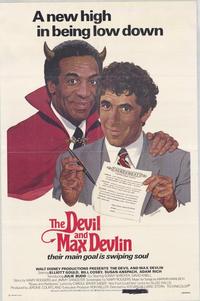
— Before The Devil and Max Devlin, it had no doubt been a long time since Walt Disney Studios depicted Hell in one of their films.

For example, Hell’s Bells from 1929 and Pluto’s Judgement Day from 1935 leap first to mind, two animated shorts that might blow people’s minds who normally associate animation with cute-and-cuddly innocuous fare at this late point in history.

To be fair to the older films, which are both far superior to the main film currently under consideration, feature length The Devil and Max Devlin doesn’t spend a lot of time in Hell.

Well, actually, according to some former President, right, aren’t California and Hell the same?

I wonder, given the subject matter and the presence of Bill Cosby in one of the starring roles, if The Devil and Max Devlin will go or has already gone the way of the controversial, divisive Song of the South — suppressed for seeming eternity by the folks at Disney. I found them both in the dark, dank recesses of the Internet and I hope that I won’t go to jail or Hell for either cultural sin.

Anyway, I like the locations (especially Hell) and I like the high concepts behind The Devil and Max Devlin like a slumlord trying to save his soul by giving the bad guys three unsullied souls and it turned out to be perfect casting to have Cosby in the role of the Devil’s helper, but the movie gets so bogged down in plot details that it evolves into a real slog and we just want more than anything else in the world at the moment for the movie to finally be over. At least, if nothing else, that’s how The Devil and Max Devlin made me feel watching it.

Rating: Two-and-a-half stars.

Rats! Rats! Rats! You’ve Got a Friend in Willard and Ben

RATS! RATS! RATS! YOU’VE GOT A FRIEND IN WILLARD AND BEN
It makes sense that a sequel to the 1971 hit Willard appeared within the next year.

It makes sense that this sequel focused on the rat Ben and would be called Ben, given the previous film’s rather downbeat ending.

It also makes sense that Phil Karlson directed Ben, since Karlson directed such gritty films as Kansas City Confidential, 99 River Street, and The Phenix City Story, all involving characters who might be considered dirty rats.

Karlson never directed any character badder and meaner than Ben, though. Not any of the tough guys played by John Payne, Preston Foster, Neville Brand, Lee Van Cleef, and Jack Elam in Kansas City Confidential. Ben don’t need no stinking mask, for one. Ben also has an infinitely larger gang anyway and they’re real hungry as demonstrated throughout Ben. Nor Tennessee sheriff Buford Pusser from Walking Tall, which Karlson made right after Ben. Joe Don Baker must have come as quite a relief after Ben, who quickly became a has been after his two film roles and multiple songs about him. Ben must have wanted even more dough to return for a third film. That dirty rat!

Ben also won a PATSY Award for his performance in Ben, which undoubtedly contributed to his ego problem.

Anyway, I didn’t much care for Ben, because it quickly established a dread pattern after the obligatory flashback to the events that ended Willard. Here’s that pattern: Rat attack. Cutesy poo musical number. Rat attack. Cutesy poo musical number. Rat attack. Cutesy poo musical number. Rat attack. Cutesy poo musical number. Rat attack. Cutesy poo musical number.

Sounds like a real winner, right? Yeah, if you like a bunch of bad ideas bouncing off each other for 90 minutes.

You can also throw in some police chatter, a journalist character who’s seemingly working on just this one story (though it’s hard to blame him, I mean it’s not everyday that millions of street rats terrorize a city), and a little boy named Danny and his sister (played by Meredith Baxter before her marriage and hyphenated name, before her TV mother fame, before her Lifetime movie career, before her coming out) and his mother who all seem like refugees from a Disney live-action project.

Oh yeah, like Willard before him, the little boy possesses the ability to communicate with rats, especially Ben. Oh yeah, once again, the lonely little boy has a heart condition.

Danny proves responsible for the musical numbers scattered throughout Ben and he even gives Ben a puppet show. Wow, just wow.

A 13-year-old Michael Jackson sings “Ben’s Song” over the end credits and “Ben” competed against songs from The Poseidon Adventure, The Little Ark, The Life and Times of Judge Roy Bean, and The Stepmother for Best Original Song at the 1973 Academy Awards. “Ben” lost to “The Morning After” from The Poseidon Adventure, believe it or not, and having heard both songs, I don’t believe it since “The Morning After” defines godawful. Unfortunately so does most of the movie Ben.

I’ll give Karlson and animal trainer Moe Di Sesso their due for amplifying the rat count to 4,000 for Ben. Eight times the rats as Willard, but that’s the only area in which Ben triumphs over its older brother. Granted, one human year translates to approximately 30 in rat years, so maybe that’s why Ben’s motion picture career stopped after two films in two years.

Rating: One star.

— What else can I say other than I liked Willard and I would not be surprised if I found out that it played as one-half of a double bill with fellow 1971 cult film Harold and Maude.

Both are weird little items with a delightfully morbid sense of humor and I only say delightfully because I like both films, and they have offbeat lead characters who push the patience of every adult.

Bruce Davison stars as Willard Stiles, who must contend with a harridan mother (Elsa Lanchester) and a bully for a boss (Ernest Borgnine). Willard develops a close relationship with Ben and Socrates, who unfortunately for Willard are rats. See, Willard finds out that he can communicate directly with rats and that he enjoys their company more than his fellow human beings, especially his overbearing mother and all her overbearing friends and his asshole boss. His mother wants Willard to get rid of them damn rats and his boss, well, he develops genuine distaste for Rattus norvegicus after Willard’s rats crash his party one night.

Willard also begins a tentative, very tentative relationship with his lovely temporary co-worker Joan (Sondra Locke). In the end, Willard should have pursued Joan more than Socrates and Ben. No doubt that our lad Willard would have lived a whole lot longer.

As interesting as it was to watch Davison and Locke early in their careers and Lanchester (The Bride from The Bride of Frankenstein) late in her career, Borgnine proved to be the key component in the success of Willard. For a picture like Willard to work any whatsoever, we need a character that we love to hate and Borgnine’s Al Martin suitably fills that need. For us to fully anticipate and then relish his inevitable death, Borgnine needed to work us into a frenzy every time he’s onscreen. Borgnine does that and then some, especially when he seizes upon Socrates and kills him with delight. We know then, more than ever before, that Martin will meet a spectacular demise.

Borgnine won the Academy Award for Best Actor in 1956 for his extremely likable performance as the title character in Marty, directed by Delbert Mann. Sixteen years later, in a picture directed by Daniel Mann, Borghine mined the opposite end of the character spectrum for Martin.

For sure, Borghine might be the first, last, and thus far only Academy Award-winning actor to be annihilated by rats.

That alone is worth the price of admission.

Rating: Three stars.

Charlie Brown, He’s No Clown: Snoopy, Come Home & Race for Your Life, Charlie Brown

CHARLIE BROWN, HE’S NO CLOWN: SNOOPY, COME HOME & RACE FOR YOUR LIFE, CHARLIE BROWN

Charlie Brown and the “Peanuts” gang first appeared as “Li’l Folks” in 1947, debuted as “Peanuts” Oct. 2, 1950, and launched into Sunday papers on Jan. 6, 1952.

Multiple generations came to love Charles M. Schulz’s creation through TV specials, movies, merchandise, and newspapers.

I learned to read at no later than the age of 4 by perusing copies of my grandparents’ Pittsburg Morning Sun and I remember “Peanuts” being at or near the top of the comics page along with “Garfield.” Then, it was (in no particular order) “Blondie,” “Alley Oop,” “Beetle Bailey,” “Doonesbury,” “Family Circus,” and “Calvin and Hobbes.” Sure, I missed a strip or two in this nostalgic reverie.

I later wrote for the Morning Sun (considerably downsized from 2009 through 2014 with sadly more considerable downsizing to come) and I scrapbooked a few strips that particularly tickled my funny bone. You might not believe how much feedback we received about our comics page, but I have found that obituaries, comics, and sports form the backbone of a small town paper. I remember editors grumbling about how readers were still upset years later about what happened with the Sunday comics not being in color and not having their own little section … and I said that I am one of those readers mad about that, as well as the Sun dropping a Monday paper.

Anyway, we have to ask one of the five W’s: What makes “Peanuts” so unique in the first place and even still today?

First and foremost, indelible characters who resonate with readers and viewers. Just as a little exercise, let’s rattle some of them off and I bet that we don’t even need to cheat and consult Google or Wikipedia. Let’s see, we have Schulz’s alter ego Charlie Brown, of course, Linus and his security blanket, Schroeder and his toy piano, Lucy Van Pelt, Peppermint Patty, Marcy, little sister Sally Brown, Snoopy, Woodstock, and Pig-Pen (the Walking Dust Bowl). Over the years, I myself have called a child or two “Pig-Pen.”

Recently, one quarantine afternoon I decided to watch Charlie Brown cinematic adventures SNOOPY, COME HOME (1972) and RACE FOR YOUR LIFE, CHARLIE BROWN (1977) back-to-back.

SNOOPY, COME HOME took me by surprise with its emotional punch and I’d rate it even higher were it not for the presence of so many songs written by Richard M. and Robert B. Sherman that feel like padding to inflate SNOOPY, COME HOME to a running time of 80 minutes.

Snoopy receives a letter from his previous owner Lila, who’s sick in the hospital, and Snoopy and Woodstock set out upon a grand adventure to reach her. Charlie Brown and his friends face the possibility that Snoopy will return to his first owner and that whole plot development provides the emotional sucker punch right to the guts. I’ll admit to getting a little misty-eyed when the gang throws a farewell party for Snoopy.

Meanwhile, throughout his adventure, Snoopy encounters “No Dogs Allowed.” We are talking libraries, beaches, buses, seemingly everywhere our favorite little beagle turns. That’s no way to treat a star the caliber of Snoopy. These people must be somehow unaware of “Peanuts” and they must have never heard the songs “Snoopy vs. The Red Baron,” “The Return of the Red Baron,” and “Snoopy’s Christmas.” What kind of people are these?

After being driven away from the library, Snoopy picks fights against Van Pelt siblings Linus and Lucy, and we are suddenly in Laurel and Hardy territory with big laughs from violent slapstick (though not as violent as say the Three Stooges and still within the ‘G’ rating). Fans have taken Snoopy vs. Lucy and scored MORTAL KOMBAT and ROCKY to it.

Also, during his adventure, Snoopy encounters his worst nightmare, a little girl named Clara who has the unmitigated audacity to call him “Rex.” Snoopy and Woodstock barely make it out alive.

In the end, “No Dogs Allowed” benefits Charlie Brown, Snoopy, etc.

RACE FOR YOUR LIFE, CHARLIE BROWN proved to be a mere meager diversion after SNOOPY, COME HOME.

That’s right, RACE FOR YOUR LIFE is nothing more than a pleasant way to spend 77 minutes with characters that we like.

It does not have the dynamic emotional range of SNOOPY, COME HOME and the river rafting race does not rank with the use of baseball and football in CHARLIE BROWN’S ALL-STARS and numerous gags in strips and TV specials, respectively.

Upon further reflection, the special appeal of the Charlie Brown TV specials and SNOOPY, COME HOME is that adults have the ability to take away more from them than children, without ever feeling that we are being lectured or hearing a sermon. That’s ironic, given the relative absence of adults in “Peanuts.”

SNOOPY, COME HOME ***; RACE FOR YOUR LIFE, CHARLIE BROWN **1/2

Fat City (1972)

FAT CITY

FAT CITY (1972) ****

I would not be surprised if writer and director John Huston (1906-87) had the nickname “The Great Adapter.”

Huston directed 37 feature films from 1941 through 1987 and his films adapted from works by Dashiell Hammett, Ellen Glasgow, Robert Carson, B. Traven, Maxwell Anderson, Robert Sylvester, W.R. Burnett, Stephen Crane, C.S. Forester, Pierre LaMure, Claud Cockburn, Herman Melville, Charles Shaw, Romain Gary, Alan LeMay, Philip McDonald, Tennessee Williams, the Book of Genesis, Carson McCullers, Ian Fleming, David Haggart, Hans Koningsberger, Noel Behn, Leonard Gardner, Desmond Bagley, Rudyard Kipling, Flannery O’Conner, Zoltan Fabri, Harold Gray, Malcolm Lowry, Richard Condon, and James Joyce.

Huston co-wrote some of those adaptations, but it was Gardner himself who adapted his own novel, “Fat City,” for the big screen.

In a 2019 interview with the Paris Review, celebrating the 50th anniversary of his novel, Gardner spoke about Huston and the film adaptation.

“Before I started to write it (the screenplay), he invited me to come over to his place in Ireland for a couple of weeks for a discussion about how it was going to go,” Gardner said. “He was a funny guy. He trusted me, I think, because we didn’t talk all day about the script. We talked maybe a half an hour. Then he wanted to paint. He was always painting.

“He’d been an amateur boxer. It was lucky because my objection to boxing movies back then was that they were all the same. It’s a fixed fight and the hero won’t take a dive and maybe they break his hands afterward. I thought there needed to be a boxing film done another way. He was all for it.”

FAT CITY set itself within the city of Stockton, California, population over 100,000 at the time of the making of the film. The scenes are played out in skid row bars, restaurants and living spaces, work on a migrant labor farm, bowling alleys, a boxing gym, and boxing venues in a gritty, street-level fashion. Huston and Gardner definitely created a boxing film that’s done another way.

Stockton, now with a population above 300,000, received a dubious recognition from Forbes Magazine in 2012: “The Most Miserable City in the U.S.”

“I think that this is such a rough place that people who are highly educated use it as a springboard to get jobs in other places, and what it leaves behind is not the cream of the crop. The really smart people don’t want to stay here. They don’t want to be here with the violence and the crime and everything,” said substitute teacher Ronald Schwartz in a story for PBS News Hour.

So things only seemed to get worse in Stockton since 1972.

Creedence Clearwater Revival released the song “Lodi” as the B-side to “Bad Moon Rising,” the lead single from their third album “Green River,” in April 1969. Farrar, Straus & Giroux published “Fat City” in 1969.

Lodi is approximately 15-20 miles north of Stockton.

Creedence songwriter John Fogerty has said that he picked Lodi because it had the coolest-sounding name. The song’s refrain “Oh Lord, stuck in Lodi again” has truly stuck with Lodi for more than 50 years, unfairly or not.

FAT CITY utilizes Kris Kristofferson’s “Help Me Make It Through the Night” and the lyrics and the way Kristofferson sings them suit FAT CITY perfectly. Kristofferson said that he got his inspiration for the song from an interview with Frank Sinatra, who said “Booze, broads, or a bible … whatever helps me make it through the night.”

Any of the characters in FAT CITY could have said that.

We follow two boxers in FAT CITY: 29-year-old Billy Tully (Stacy Keach) and 18-year-old Ernie Munger (Jeff Bridges). Tully meets Ernie in a Stockton gym, sees potential in the young man after they spar, and encourages him to get into the fight game. Tully recommends manager and trainer Ruben (the great character actor Nicholas Colasanto).

Keach and Bridges play off or against each other perfectly. Bridges, in his early 20s and on his fifth feature overall, fits the part of a promising up-and-coming talent like a glove; Bridges had already received an Academy Award nomination for Best Supporting Actor for his performance in THE LAST PICTURE SHOW. Keach’s own struggles to get a part like Billy Tully infuses his characterization of a washed-up boxer clawing and scratching (and drinking) his way through life; for example, Mike Nichols fired Keach from CATCH-22 a week into rehearsals. Keach’s propensity for overacting and Bridges’ for underacting factored in.

“FAT CITY is a good film,” Keach said in Dennis Brown’s “Actors Talk: Profiles and Stories from the Acting Trade,” “but 20 minutes were cut. Twenty minutes longer, FAT CITY is a great film, a classic. Unfortunately, 20 minutes longer made it 20 minutes more depressing.”

A theory: All good films are not depressing and all bad films are.

Boxing takes Ernie away from the pressures of a young wife (Candy Clark) and the start of a nuclear family. Tully, a shell of himself since his wife left him and since his defeat in the ring in Panama City, takes up with Oma (Susan Tyrrell), a character described as a “woozy boozy floozy” in the New York Times. Booze initially lubricates their relationship, of course, but it fizzles out spectacularly down the home stretch.

Tully tells Oma “You can count on me!” so many times that you wonder if he’s attempting to get himself to believe that more than even this woman.

Night of the Lepus (1972)

NIGHT OF THE LEPUS (1972) Three stars

Janet Leigh (1927-2004) famously said that she never took another shower after her iconic scene in PSYCHO.

Wonder what she said after her performance in William F. Claxton’s NIGHT OF THE LEPUS.

Reportedly, Leigh said “I’ve forgotten as much as I could about that picture.”

Well, Claxton ain’t quite Hitchcock and NIGHT OF THE LEPUS ain’t quite PSYCHO, but this 1972 picture certainly deserves a far better reputation. Like PLAN 9 FROM OUTER SPACE, it’s simply just too darn entertaining to be anywhere near the “worst movie ever made.”

After all, it’s not every day that you see a bad movie featuring Leigh, Stuart Whitman, Rory Calhoun (1922-99), DeForest Kelley (1920-99), Paul Fix (1901-83), and a cast of all-star killer rabbits. They’re playing it straight and not condescending to the material. Give them at least that much credit.

The single biggest gripe against NIGHT OF THE LEPUS: The killer rabbits are not scary. I don’t know if there’s ever been a single review of NIGHT OF THE LEPUS that’s gone without making a major note about the premise itself and then the botched execution of that bad idea.

Claxton and crew obviously worked very hard to make the homicidal rabbits more imposing and terrifying. They constructed miniature sets for regular-sized rabbits to run wild through, filmed them from angles conducive to making the rabbits appear larger-than-life, and cooked up very convincing guttural noises for our furry friends when they’re in full-on beast mode. Basically, our title characters look like they’re running wild on the set of a Western filmed in the back lots of Arizona … and I believe that’s exactly what happened.

Maybe one day they’ll cross NIGHT OF THE LEPUS with THE TERROR OF TINY TOWN.

As far as rabbits not being scary, I do believe these complainers have not encountered that dynamite rabbit from MONTY PYTHON AND THE HOLY GRAIL and Ted “Theodore” Logan’s brush with the Easter Bunny from Hell in BILL AND TED’S BOGUS JOURNEY.

Rabbits can be scary. In theory, anything could be scary, if done right.

Honestly, I don’t know if I could handle a truly scary killer rabbit picture.

The producers did their best to obscure the nature of the killers in promoting NIGHT OF THE LEPUS, apparently booking on the fact that millions did not know the Latin word for rabbit.

They believed that people would not waste their time and money on a killer rabbit picture.

Idiom: “A fool and his money are soon parted.”

Well, here we are at least 47 years after the release of NIGHT OF THE LEPUS and I received a DVD copy of the film for an early Christmas present. It’s a gift that’s already kept on giving.

On first re-watch, I enjoyed NIGHT OF THE LEPUS all over again and I actually enjoyed it more at the age of 41 being able to see all its flaws more clearly than when I first watched the film in late prepubescence. I enjoyed all the melodramatic efforts to make the rabbits scary (especially the bloody aftermath of rabbits on the rampage scenes), all the scientific mumbo-jumbo, all the scenes of the rabbits on their attack route (Pamplona with rabbits and no people), all the blatantly obvious set-ups for blatantly obvious payoffs, the ridiculous final plan to exterminate the rabbits and restore natural order, and I especially loved watching the all-star cast diligently keep a straight face through all the silliness and earn their paychecks.

It’s still a notch below such contemporaneous classics as FROGS, GODZILLA VS. THE SMOG MONSTER, and INVASION OF THE BEE GIRLS.

The Thing with Two Heads (1972)

THE THING WITH TWO HEADS (1972) Three stars

Former NFL player Rosey Grier and 1946 Academy Award for Best Actor winner Ray Milland are the two heads. Let’s get that out of the way right from the start.

Top-billed Milland plays a brilliant scientist with terminal cancer who finds trial success with a two-headed gorilla (Rick Baker’s preparation for KING KONG). He comes up with a diabolical scheme to keep on living. Just like Spinal Tap lead singer David St. Hubbins once said, “It’s such a fine line between stupid, and clever.”

Second-billed Grier plays a convicted murderer on Death Row who has volunteered his body to medical science.

Doctors transplant Milland’s head onto Grier’s body, since both are running out of time. Maybe the wrong Grier, because just imagine Milland’s head, for example, on Pam Grier’s body. Now, that would be interesting. American International Pictures could have made it happen, at least for a sequel, but unfortunately it’s too late since Milland passed away in 1986.

You might not believe this, but Grier’s Jack Moss is an innocent man and Milland’s Maxwell Kirshner is an unapologetic racist. Try and imagine a TV show where they put Archie Bunker’s head on George Jefferson’s body.

Honestly, I don’t think THE THING WITH TWO HEADS takes off until it gets Milland and Grier out of the hospital and into the open after their transplant. That’s about the halfway point of the picture, when they kidnap black doctor Fred Williams (Don Marshall) and Moss and Kirshner both do their best negotiating to get the good doctor on their side. They both face challenges, in Moss being on Death Row and Kirshner being an unrepentant bigot. They both want the other head removed.

THE THING WITH TWO HEADS devotes several minutes to a chase scene with many police cars in hot pursuit of a “two-headed monster.” You really have not lived until you see this chase, especially after Grier and Milland commandeer a motor bike, make their way through a race course, and evade 14 crashing police cars en route to a safe haven. These policemen are incredibly incompetent: They cannot shoot, cannot drive, and cannot even close a trunk on their downtrodden squad cars. Yes, they do drive, but just look at their end results. Like a test reel for SMOKEY AND THE BANDIT and THE BLUES BROTHERS.

Milland plays basically the same character that he does in FROGS, another 1972 production from American International; FROGS came out on March 10 and THE THING WITH TWO HEADS on July 19. Milland sinks his teeth into the dialogue in both films and he gives off the feeling of an unhappy camper in both performances, but it works for his characters. Reportedly, Milland sweated so much during the production of FROGS, filmed in the Everglades, that his toupee fell off several times; additionally, he hated the production so much that he left it three days early.

Grier, meanwhile, has lived an interesting life to say the least and a starring role as one of the heads in THE THING WITH TWO HEADS barely scratches at the surface of that life, believe it or not. Grier played college football at Penn State and then professionally for the New York Giants and the Los Angeles Rams from 1955 through 1966. He served as a bodyguard for Robert Kennedy during the 1968 presidential campaign and it was Grier who subdued assassin Sirhan Sirhan. Grier hosted a TV show, enjoyed a recording career, became an ordained minister, spoke at the 1984 Republican National Convention, and entertained running for the Governor of California in 2018, lest we forget Grier’s 1973 book “Rosey Grier’s Needlepoint for Men.” He’s the last living member of the Rams’ “Fearsome Foursome,” a defensive line that included Deacon Jones (1938-2013) and Merlin Olsen (1940-2010).

Grier even gets to show off his singing ability just a little bit in the final moments of THE THING WITH TWO HEADS and let’s just say that, of course, the film ends on “Oh Happy Day.” It is just that kind of a movie.

NOTE: I would assign the film’s trailer four stars. It is 2 minutes, 21 seconds of greatness, especially with that dynamite opening line “It seemed like a good idea at the time,” which might just be exactly what many people have said after seeing THE THING WITH TWO HEADS.

The Last House on the Left (1972)

LAST HOUSE ON THE LEFT

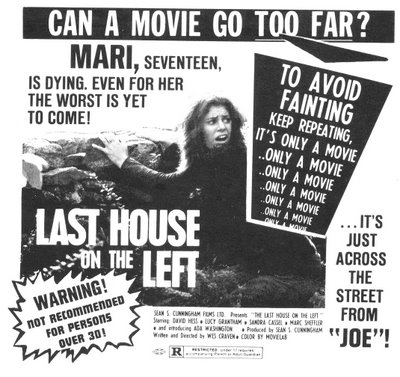
THE LAST HOUSE ON THE LEFT (1972) Three stars
Former academic Wes Craven (1939-2015), who also did some work on pornographic films under different aliases, made a big bang with his feature debut THE LAST HOUSE ON THE LEFT, one of the great shockers of the seventies.

It’s an exploitative American modern take on Ingmar Bergman’s THE VIRGIN SPRING (1960), a film itself based on a 13th Century Swedish folk ballad. THE VIRGIN SPRING won the Academy Award for Best Foreign Language Film at the 1961 Academy Awards.

The film’s classic tagline, “To avoid fainting, keep repeating: It’s only a movie, only a movie, only a movie. …” Viewers had a variety of extreme reactions, of course which only helped to hype the film en route to $3.1 million in returns on a $87,000 budget.

Theaters and drive-ins showed LAST HOUSE in many different prints, because individual machinists took it upon themselves to make their own cuts. Normally, the most shocking bits would end up missing. Good luck finding an uncut version of the film.

It received some of the nastiest reviews imaginable, which made seeing the film again seem like more of an event, a happening. Writing for the New York Times, Howard Thompson said, “When I walked out, after 50 minutes (with 35 to go), one girl had just been dismembered with a machete. They had started in on the other with a slow switch blade. The party who wrote this sickening tripe and also directed the inept actors is Wes Craven. It’s at the Penthouse Theater, for anyone interested in paying to see repulsive people and human agony.” Roger Ebert wrote just about the only positive review at the time of the film.

I first watched it about 10 years back and I thought it was a powerful work. I wrote a very positive review somewhere and I gave it three-and-a-half stars. I found it less powerful after subsequent viewings.

Craven and crew made some appalling choices that create a split personality movie.

Watching LAST HOUSE for the first time, you might notice the buffoonish antics of the Sheriff (Marshall Anker) and the Deputy (Martin Kove). Their comedic relief never works and in fact they play like failed slapstick comedy dropped in from another movie. I noticed this element upon first viewing and it was the reason I graded THE LAST HOUSE ON THE LEFT three-and-a-half rather than four stars.

PSYCHO. Herrmann. SUSPIRIA. Goblin. HALLOWEEN. Carpenter.

Well, you’ll never find THE LAST HOUSE ON THE LEFT soundtrack filed alongside those indelible horror movie scores and their composers. That’s why I started a new paragraph.

David Hess, who plays the main villain Krug, wrote and performed four songs for the movie: “The Road Leads to Nowhere” (the best song of the bunch), “Wait for the Rain,” “Sadie and Krug (Baddies’ Theme),” and “Now You’re All Alone.”

Upon more viewings, this music stuck out like a sore thumb, one that poked me right straight in the eye. I’m not sure why I overlooked the music the first time around.

Krug the character, played by Hess the actor, would have killed Hess the singer and songwriter, just slit his throat for singing one of those ridiculous songs. Believe it or not, Hess wrote “Speedy Gonzales,” which became a big hit for Pat Boone in the year 1962.

I still deduct one-half star from LAST HOUSE for the rumbling bumbling stumbling cops and a good quarter star for them Hess songs.

Hess (1936-2011) is so good as the bad guy in LAST HOUSE that we can understand precisely why he became typecast as villain. He played one of the henchmen in Craven’s SWAMP THING.

Sandra Peabody and Lucy Grantham play Mari and Phyllis, who are kidnapped, tortured, raped, and murdered by Krug and company. They have the most difficult roles.

Filming LAST HOUSE proved to be a horrifying ordeal for Peabody, especially since Hess believed in method acting and even threatened assaulting her for real during a rape scene. Peabody dropped out from acting in 1974, after being cast in movies like VOICES OF DESIRE and MASSAGE PARLOR MURDERS! She went into screenwriting, producing children-orientated entertainment, and being an acting coach.

Fred Lincoln (1936-2013) played Weasel, one of Krug’s nasty associates, and LAST HOUSE marked Lincoln’s only non-pornographic role. Lincoln directed more than 300 films; the Internet Movie Database lists 340 directorial credits for the New York native.

Jeramie Rain, who played the vicious Sadie, was married to Richard Dreyfuss from 1983 to 1995 and their union produced three children. She once hitched a ride with real-life serial killers Charles Manson and Tex Watson. That’s fitting because LAST HOUSE seems to have been heavily influenced by the Manson Family and their murders.

Richard Towers and Eleanor Shaw, under different names, play Mari’s parents Dr. John and Estelle Collingwood, highly respectable upper middle class folk. Krug and his gang disguise themselves as traveling salesmen and they call upon the Collingwoods. Both parties eventually discover the others’ identities: The Collingwoods find out their guests killed their daughter and Krug and company discover that Dr. John and Estelle are Mari’s parents.

Dr. John and Estelle devise some elaborate booby traps and Craven displays his fondness for booby traps for the first time. Booby traps also played a role in both THE HILLS HAVE EYES and A NIGHTMARE ON ELM STREET. I believe that Craven should have directed at least the first HOME ALONE, given his predilection for booby traps.

This juxtaposition of seeing a socially respectable upper middle class couple getting down-and-dirty to exact revenge has been one of the most fascinating elements at work in LAST HOUSE. You just might find yourself asking, “What would I do if I found myself in a similar situation?”

Though it’s not a classic on the same level as both NIGHT OF THE LIVING DEAD and THE TEXAS CHAINSAW MASSACRE, LAST HOUSE is essential viewing for horror fans.

Frenzy (1972)

FRENZY

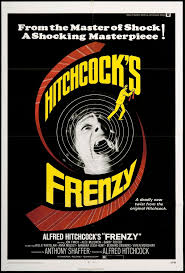
FRENZY (1972) Four stars
Legendary director Alfred Hitchcock (1899-1980) used the theme of the falsely accused several times: THE LODGER (1929), MURDER! (1930), THE 39 STEPS (1935), YOUNG AND INNOCENT (1937), THE TROUBLE WITH HARRY (1955), THE WRONG MAN (1956), NORTH BY NORTHWEST (1959), and, for the last time, FRENZY.

FRENZY, Hitchcock’s penultimate film in a 53-film career that lasted from silent through sound, found Hitchcock returning to not only one of his favorite themes but also to his native land of England for the third and final time since his exodus to Hollywood that began in 1940 with REBECCA, Hitchcock’s only Academy Award for Best Picture winner.

I have not seen every one of Hitchcock’s falsely accused movies (MURDER! and THE TROUBLE WITH HARRY have eluded me thus far in life), but I believe it is safe to say that Richard Ian “Dick” Blaney (Jon Finch) in FRENZY presents us with the Hitchcock falsely accused protagonist with the greatest odds against him in proving his innocence during the movie. Blaney’s not an inherently likeable character, he’s not played by a big charismatic movie star like Henry Fonda or Cary Grant, so it does take some time for this Blaney to grow on us. We have all had stretches in our lives where we’ve been down on our luck and it seems everything’s against us. Blaney has it even worse.

We viewers know Blaney’s not the killer. That’s because we are shown the true identity of “The Necktie Killer,” a serial killer and rapist terrorizing London town, early on in the picture, Blaney’s friend Bob (Barry Foster). Blaney definitely seems like the most obvious suspect as the circumstantial evidence piles up against him, with a little help from his old friend Bob. We root for Blaney to prove his innocence and for Bob to be caught because this “Necktie Killer” is one of the nastiest pieces of work that we have ever seen on a movie screen.

FRENZY takes it down to the very end of the movie before playing its final hand. The film is a reminder why Hitchcock is still called “The Master of Suspense” decades after his death.

Where did the themes of the falsely accused and fear of the police come from in Hitchcock? A childhood experience, of course.

One day, Hitchcock’s father decided upon an unique punishment for the troublesome young lad. You can just imagine how much of a devious little brat Hitchcock was as a child.

“I must have been about 4 or 5 years old,” Hitchcock told Francois Truffaut in 1966. “My father sent me to the police station with a note. The chief of police read it and locked me in a cell for five or 10 minutes, saying, ‘This is what we do to naughty boys.’”

Truffaut followed up with the question why did Hitchcock’s father punish him.

“I haven’t the faintest idea,” Hitchcock said. “As a matter of fact, my father used to call me his ‘little lamb without a spot.’ I truly cannot imagine what it was I did.”

Hitchcock was in his early 70s when he made FRENZY, and it’s not a work that one would necessarily associate with an older man. It pulsates with a certain anger, especially through the down-on-his-luck protagonist, and that’s a state associated with younger men.

There’s a rape and murder sequence in FRENZY that’s even more unsettling than anything in PSYCHO, since it goes on far longer than any of the murders in PSYCHO.

Anthony Shaffer’s screenplay also expresses a tremendously morbid sense of humor that befits Hitchcock. For example, a doctor in a pub says, “We haven’t had a good juicy series of sex murders since Christie. And they’re so good for the tourist trade. Foreigners somehow expect the squares of London to be fog-wreathed, full of hansom cabs and *littered* with ripped whores, don’t you think?”

In the midst of all this murder and mayhem, we get an unique relationship between Chief Inspector Tim Oxford (Alec McCowan) and his wife (Vivien Merchant) that’s both funny and touching. Mrs. Oxford serves her husband a variety of culinary delights and then dishes up her own take on the case of “The Necktie Killer” and these Blaney and Bob characters.

FRENZY is a powerful work by a grand master, one of many great films by Hitchcock.

Don’t Torture A Duckling (1972)

DAY 26, DON'T TORTURE A DUCKLING

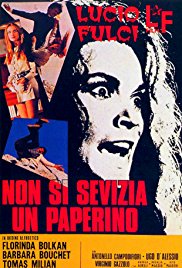
DON’T TORTURE A DUCKLING (1972) Three-and-a-half stars
The third time proved to be the charm for me and the films of Italian director Lucio Fulci (1927-96), who earned the nicknames “The Godfather of Gore,” “The Spaghetti Splatter King,” and “Horror Maestro.”

About 10 years ago, I watched THE BEYOND and THE HOUSE BY THE CEMETERY (both 1981), two installments of Fulci’s “Gates of Hell” trilogy, and I found them to be two of the most wretched exercises in godawful dubbing, pathetic dialogue and characters and situations recycled from better horror movies (HOUSE BY THE CEMETERY just screams THE SHINING), and laughable gore I have ever seen.

I hated those movies, and I think hate might actually be an understatement. We need a word here that goes beyond hate.

(I have reviews of them buried somewhere.)

Of course, naturally, I came across the DVD of Fulci’s 1972 giallo DON’T TORTURE A DUCKLING in the multimedia collection of the Leonard H. Axe Library on the campus of beautiful Pittsburg State University in lovely Pittsburg, Kansas, U.S.A.

I believe I grabbed KING KONG VS. GODZILLA on VHS and Ingmar Bergman’s PERSONA on DVD in a heartbeat that fateful day in 2009. Another day brought EL NORTE and Akira Kurosawa’s THRONE OF BLOOD.

DON’T TORTURE A DUCKLING presented a conundrum for me, though, right there smack dab in the middle of the Axe.

The Devil on my shoulder (borrowed from ANIMAL HOUSE) fired off a plot summary, “A reporter and a promiscuous young woman try to solve a series of child killings in a remote southern Italian town rife with superstition and a distrust of outsiders.”

Sounds good, I thought, because of the reporter and promiscuous young woman part of his presentation.

Hey, I was in college and had just started my career as hotshit, er, hotshot reporter for the Collegio, the school newspaper.

The Devil jumped out to the early lead, because I never heard anything he said past the point of “A reporter and a promiscuous young woman.”

Not to be outdone, The Angel on my other shoulder (also borrowed from ANIMAL HOUSE) reminded me that I hated THE BEYOND and THE HOUSE BY THE CEMETERY so much.

For his little spiel, The Angel changed his voice into the dub they used for child protagonist Bob in THE HOUSE BY THE CEMETERY. (Just search for “Bob from The House by the Cemetery” on YouTube and there’s a compilation of all his dialogue scenes. Give it a shot and crank that sucker up. You can thank me later. Hopefully, not with a sharp punch or kick to the groin, though. That compilation’s 3 minutes, 23 seconds of pure dubbed torture they should have used at the Guantanamo Bay detention camp.)

I wanted to cover my ears and run right out of the Axe.

With that voice, The Angel sounded more like the Devil.

The Angel, however, did have a point with THE BEYOND and THE HOUSE BY THE CEMETERY. I mean, for crying out loud, life is too short to watch crap like that.

The Devil came back with the fact DON’T TORTURE A DUCKLING includes a fantastic nude scene for the fabulous Barbara Bouchet. (I later discovered The Devil neglected to include the entire story behind this nude scene and that it will likely make you uncomfortable because she’s offering her body to an adolescent boy to initiate him into the world of sex. Damn you, Devil, and your manipulations!)

By the way, The Devil spoke in the voice of Curtis Armstrong’s character from RISKY BUSINESS.

The Devil even gave me the same basic (albeit profane) wisdom Tom Cruise’s Joel received in the movie. The Devil used this wisdom for his final pitch.

“Sometimes you gotta say WHAT THE FUCK, make your move. Brock, every now and then, say WHAT THE FUCK. WHAT THE FUCK brings freedom. Freedom brings opportunity, opportunity makes your future. Grab the movie, check it out, and go watch it.”

Another by the way, isn’t it great that I found a movie like DON’T TORTURE A DUCKLING at the Axe Library?

That’s more irony than “Ironic” by Alanis Morrissette, yeah I really do think.

Personally, I think it’s awesome that I studied hard for long hours at the Axe.

I brought DON’T TORTURE A DUCKLING home, rigged my VCR to my DVD player and broke all forms of international copyright laws, and I still have copies today.

Great success, just like Borat once said.

The Parents Guide for DON’T TORTURE A DUCKLING on IMDb ends on this note of understatement, “A very dark movie.”

Disturbing would also work, but I simply got caught up in the mystery and the themes of Catholic guilt, sexual repression, psychological trauma, and how small towns and communities find scapegoats and carry out their own ripped, twisted vigilante justice. I stayed riveted to the very end and that’s a sign the giallo worked. Fulci had a lot more restraint and tact than he did in THE BEYOND and THE HOUSE BY THE CEMETERY, and that’s the only way to succeed with such lurid subject matter, especially child murders.

Fist of Fury (1972)

day522cfistoffury

FIST OF FURY (1972) Three-and-a-half stars
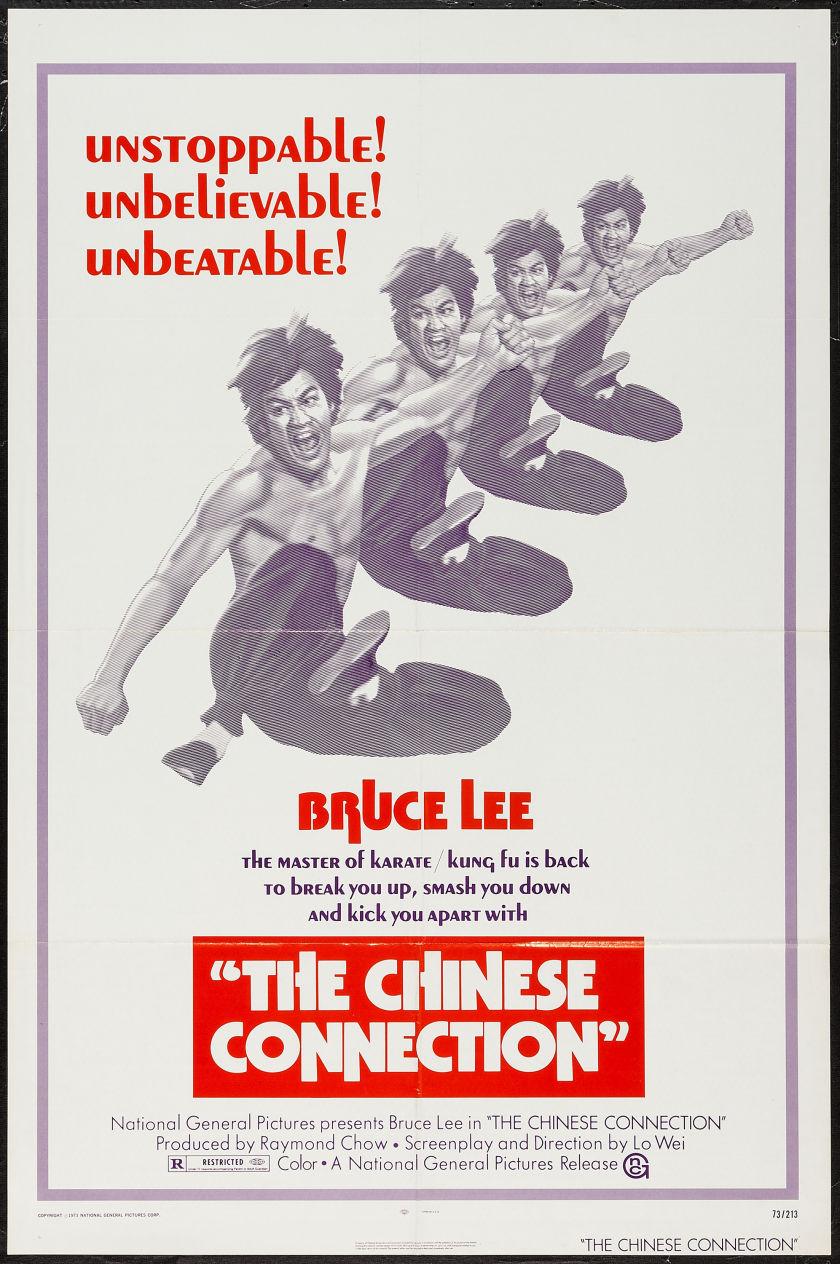
I started the month with Bruce Lee’s ENTER THE DRAGON and now I review a fifth Bruce Lee action spectacular, FIST OF FURY, originally called THE CHINESE CONNECTION for many, many years after its 1972 release in America.

FIST OF FURY ranks second in the Lee pantheon and for me it’s the most emotionally resonant of his pictures. ENTER THE DRAGON succeeds more as spectacle, a slambang entertainment, than anything else.

I’ve always responded to the story of Lee’s Chan Zhen in FIST OF FURY, a young man who stands against the Japanese antagonists who belittle their Chinese neighbors in Shanghai at every turn and Chan Zhen also seeks justice for those responsible for his master Huo Yuanja’s death. The other Lee films’ stories do not grip me quite like this one.

This was Lee’s second film, coming hot on the heels of THE BIG BOSS. It’s a far more successful film than its precursor, and it does away with any silly notion or pretense of nonviolence, when we all know that it would never last. I don’t think that withholding strategy worked whatsoever in THE BIG BOSS. I mean, come on, we just want to see Lee fight and waiting half the damn film made no damn sense. That would be like a Gene Kelly musical where he did not dance until the final scene.

FIST OF FURY gives us a couple nifty villains, although not quite as nifty as WAY OF THE DRAGON and ENTER THE DRAGON.

Former professional baseball player Riki Hashimoto portrays Suzuki, the master of the Hongkou dojo that presents so many problems for Chan Zhen and Huo Yuanja.

Hashimoto played for the Mainichi Orions (now the Chiba Lotte Marines) in the 1950s before an injury forced his early retirement. Hashimoto turned to acting and he had 25 credits from 1960 to 1985; FIST OF FURY was his third-to-last acting credit. Hashimoto died in 2017 at the age of 83, of lung cancer.

FIST OF FURY introduces a secondary villain, Suzuki’s translator played by Paul Wei. Yes, another movie where a translator’s rendered redundant by the fact all the characters are dubbed into English. Anyway, Wei returned in WAY OF THE DRAGON for a similar role. He’s an oily bastard in both movies, a weasel of the highest order basically. He’s called “Interpreter Wu” in FIST OF FURY and “Ho” in WAY OF THE DRAGON. Wei died in 1989.

So we have a story that grips us, a martial arts dynamo and all-around charismatic movie star in the lead role, and villains that we love to hate.

Sounds like a good movie.

Okay, now back to the titles. Until 2005, FIST OF FURY was mistakenly called THE CHINESE CONNECTION in America. See, they originally meant to title THE BIG BOSS as THE CHINESE CONNECTION and FIST OF FURY as, well, FIST OF FURY. They wanted to exploit William Friedkin’s THE FRENCH CONNECTION, a big critical and commercial success (and the first R-rated movie to win the Academy Award for Best Picture) that featured drug smuggling, just like THE BIG BOSS. For many years, however, we had the wrong titles.

Guess you could say though, in the case of FIST OF FURY, a good action movie under another name is a good action movie all the same.

On the eve of Thanksgiving, I’d like to say thanks for Lee (1940-73) and the work that he left behind. It’s still inspiring after all these years.

NOTE: This review was part of a series of reviews in November 2018.