
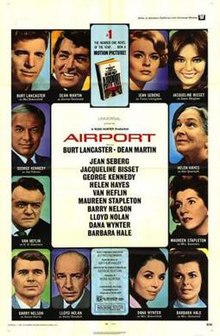
Auto Pilot Cinema: The Airport Movies

AUTO PILOT CINEMA: THE AIRPORT MOVIES
When thinking of the worst series in movie history, I am tempted to start with Saw and Fast and the Furious then move back through time with The Omen and Amityville Horror and finally go way way way back to the Dead End Kids, er, Bowery Boys.

In piecing through all this cinematic carnage, I should not leave behind the four Airport movies that were churned out by Universal Pictures from 1970 to 1979. Maybe I should leave them behind.

Airport, based on Arthur Hailey’s 1968 novel of the same name, made a killing at the box office upon its late May release in 1970 and it even received 10, yes, believe it or not, 10 Academy Award nominations, including Best Picture, and 70-year-old Helen Hayes won Best Supporting Actress.

The three subsequent films — helpfully labeled 1975, ’77, and ’79 — got worse and worse, naturally, and the last film in the series, The Concorde … Airport ’79, is so bad (and so aggressively stupid) in fact that it could kill off any series. That’s despite the fact that it reportedly made $65 million, a much better take than, for example, Irwin Allen productions The Swarm ($7.7 million), Beyond the Poseidon Adventure ($2.1 million), and When Time Ran Out ($3.8 million). Regardless, Universal stopped making Airport movies after The Concorde and I’m almost dumbfounded why there’s not been a remake or a reboot loaded with today’s stars.

Hey, wait, did somebody mention stars? Yes, stars, that’s what these Airport movies were about — speculating which ones would emerge at the end of the picture relatively intact and which ones would die spectacularly. Grand Hotel in the sky, not exactly, since none of the careers in the Airport movies were at their peak like the ones in Grand Hotel, but the idea of stuffing the screen with stars in every scene applies just the same.

Airport: Burt Lancaster, Dean Martin, Jean Seberg, Jacqueline Bisset, George Kennedy, Hayes, Van Heflin, Maureen Stapleton, Barry Nelson, Dana Wynter, Lloyd Nolan.

Airport 1975: Charlton Heston, Karen Black, Kennedy, Efrem Zimbalist Jr., Susan Clark, Helen Reddy, Linda Blair, Dana Andrews, Roy Thinnes, Sid Caesar, Myrna Loy, Gloria Swanson.

Airport ’77: Jack Lemmon, Lee Grant, Branda Vaccaro, Joseph Cotten, Olivia de Havilland, Darren McGavin, Christopher Lee, Robert Foxworth, Kathleen Quinlan, James Stewart.

Airport ’79: Alain Delon, Susan Blakely, Robert Wagner, Sylvia Kristel, Kennedy, Eddie Albert, Bibi Andersson, Charo, John Davidson, Andrea Marcovicci, Martha Raye, Cicely Tyson, Jimmie Walker, David Warner, Mercedes McCambridge.

More like Hollywood Squares in the Sky? Yeah, believe so, especially since Davidson hosted a Hollywood Squares revival in the late ’80s.

Beside Airport in the titles, Kennedy (1925-2016) proved to be the connective tissue between all four pictures, meaning he’s the inverse of the Brody boys (Jaws) and the Griswold children (Vacation). Kennedy played Joe Patroni — first as mechanic, then as vice president of operations (1975), a consultant (’77), and finally an experienced pilot (’79). Regardless of position or rank, the character got worse and worse over the course of the films, not that he or the films started out all that hot. I found even his cigar was guilty of overacting in the original film and Patroni was so odiously obnoxious in the fourth film, especially after he utters the line that articulates the sexism of the entire series, They don’t call it the cockpit for nothing, honey. George Kennedy as sex symbol? Sure, I’ll believe anything, nearly anything except for, oh, the entire plot of The Concorde.

I’ll talk more about The Concorde and the original because they’re fresher in my memory. To be honest, though, I probably won’t even feel like discussing the original because …

Movies rarely come any dumber than The Concorde: Let’s see, this is going to be fun, not really, anyway TV reporter Susan Blakely comes across some highly incriminating evidence against defense contractor (and covert arms dealer) Robert Wagner. Wagner decides that he’s going to attempt to blow up real good the plane she’s on en route from Washington to Paris. Okay, okay, his plot to blow up the Concorde real good fails and they have dinner together in Paris during the middle section of the movie, because, you know, they have a history together and they still love each other. She still has this incriminating evidence, naturally, she’s going to eventually go public with it, of course, and what does he do? Kill her? He lets her walk away safe and unharmed, so he’ll have to go after the plane again. That’s right, she gets back on the Concorde for the final leg of the flight from Paris to Moscow. Guilt stricken, Wagner commits suicide very late in the picture and I believe it’s not because his secret’s been discovered and will be exposed regardless of whether he’s alive or not, but more that he’s one of the worst villains in cinematic history.

The Concorde is so laughable in so many ways, as if that whole plot discussed in the last paragraph wasn’t enough. The Concorde stops over in Paris for a night, and every single passenger gets back on the plane the next morning. They all seem way too calm and collected after the events of the first half of the movie. I would love to have just heard one character say ‘Hell no, I’m not getting back on that damn plane!’ They all deserved to die, but we know that’s not happening.

At one critical point during the first attack on the Concorde, the Übermensch George Kennedy proves that he’s truly The Übermensch by sticking his hand out the window of the Concorde and throwing a flare. Unbelievable, utterly unbelievable even in this preposterous movie. If only the first Airport had been the in-flight movie on The Concorde, especially that scene where Patroni discusses the effects of a bomb on a 707 and concludes, When I was a mechanic in the Air Force, I was being transferred on a MATS plane. At 20,000 feet, one of the windows shattered. The guy sitting next to it was about 170 pounds. He went through that little space like a hunk of hamburger going down a disposal, and right after him coats, pillows, blankets, cups, saucers. That was just a MATS plane, not the fastest plane in the universe.

I’m done, I can’t take it anymore, and I’m bailing out on the Airport movies.

Airport (1970) **; Airport 1975 (1974) **1/2; Airport ’77 (1977) *; The Concorde: Airport ’79 (1979) 1/2*
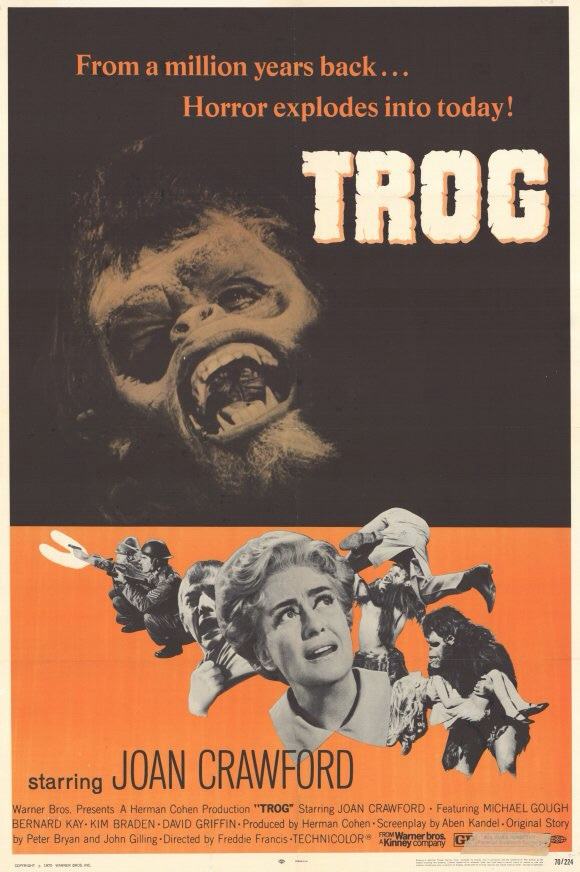
Trog (1970)

TROG

TROG (1970) ***

Joan Crawford began her long cinematic career in 1925 as the double for Norma Shearer in LADY OF THE NIGHT.

She appeared in small roles in Erich von Stroheim’s THE MERRY WIDOW, King Vidor’s THE BIG PARADE, and Fred Niblo’s BEN-HUR: A TALE OF THE CHRIST and first made her fame in Tod Browning’s THE UNKNOWN, her 20th screen credit already by 1927.

Crawford survived the transition from silent to sound and she won the Academy Award for Best Actress for her performance in the 1945 film noir MILDRED PIERCE.

That brings us to her final screen appearance, TROG.

To the best of all knowledge, Crawford (1906-77) is the only Academy Award winner to star in a caveman movie and speak lines “Please, Trog, let me have the girl!” and “Music hath charms that soothes the savage beast.” Aben Kandel wrote the screenplay and Peter Bryan and John Gilling received credit for original story.

Granted, she’s also the only Academy Award winner to star in a Blue Öyster Cult song, a ditty inspired by the book and the film MOMMIE DEAREST written by Crawford’s far beyond estranged daughter Christina. The boys turned Joan Crawford into more of a monster than Godzilla. That part in the song where Mommie Dearest is calling for bad little Christina, it just doesn’t get much better than that in this oh so cruel bitch of a world. “Joan Crawford has risen from the grave,” indeed.

Back on point: I enjoyed TROG a good deal, and it’s one of those films that inspires the very best stories.

Film critic Pauline Kael (1919-2001) wrote, “Joan Crawford plays Stella Dallas with an ape instead of a baby girl. Some actors will do anything to be in movies: she probably would have played the ape.”

Herman Cohen (1925-2002), a producer whose credits include BELA LUGOSI MEETS A BROOKLYN GORILLA and I WAS A TEENAGE WEREWOLF, said that Crawford’s alcoholism raged during TROG and she had 100-proof vodka in her frosted Pepsi Cola glass. He added that Crawford brought four cases of the juice with her to England, because of its unavailability in Merrie Olde. (Speaking of Pepsi, Crawford, once married to the chairman of the board and CEO of Pepsi and then herself a board of the directors member, works in one brief moment of product placement during an early scene.)

Freddie Francis (1917-2007), a two-time Academy Award winner for Best Cinematography for SONS AND LOVERS and GLORY, said that he regretted directing TROG (which he called terrible) and that Crawford had so much trouble remembering her lines they had to resort to using “idiot cards” to get through her scenes.

Former English professional wrestler Joe Cornelius played the title character in TROG and he defended Crawford against those accusations in a 2015 interview with cult film director and fan John Waters after the British Film Institute retrospective of the film.

In the ring, they called Cornelius “The Dazzler.” From the Online World of Wrestling, “What a presence ‘The Dazzler’ made when he entered the ring, the wavy jet black hair, the dazzling smile, the eyebrows! Damn! He had it all, a personality as big as the Royal Albert Hall and ring savvy second to none, he was like a puppet master with strings fastened to the hearts of every member of the audience.”

Guess at this point we should discuss exactly what’s a Trog.

Trog is short for “troglodyte” or a person who lived in a cave, especially in prehistoric times. He’s proclaimed, in promotion of the film, as having the strength of 20 demons, so it makes perfect sense to have Cornelius play the role.

Crawford stars as Dr. Brockton, who of course represents science against those who just want to destroy the “monster.” She wants to reach and teach Mr. Trog. She wants to domesticate “The Missing Link,” half-man and half-ape with a costume borrowed from 2001. These domestication scenes are worth their weight in gold, especially the one when Trog learns how to play catch. “Good boy, Trog!”

Thankfully, for the sake of the movie and its cult following, Crawford does not condescend to her role. She plays it absolutely 100 percent straight and resolutely serious. In other words, Crawford plays it just like she did in MILDRED PIERCE. That makes TROG even funnier than if she just played it winking at the audience the entire time.

Michael Gough (1916-2011) opposes Brockton and Trog from his very first appearance. I doubt Gough used TROG in his audition for Tim Burton’s BATMAN, because his bad manners here as Sam Murdock do not mesh with Alfred Pennyworth, Bruce Wayne’s dedicated butler. We await the fate that waits for Mr. Murdock and it is well worth the wait.

During his attempted domestication, Trog freaks out both at the color red and more upbeat music.

That got me thinking: What if they played Trog the Troggs’ “Love is All Around” from 1967? Just forget about “Wild Thing.” Yes, the Troggs, an English rock band originally called the Troglodytes before the name was shortened, had a huge impact on future noise with their songs covered by Jimi Hendrix, the Buzzcocks, and Hüsker Dü.

Patton (1970)

DAY 79, PATTON

PATTON (1970) Four stars
That darn cat Patton has been wanting me to get around to writing this review all month.

He’s especially been frustrated with his humanoid friend the last couple days. “Will you stop writing about sports long enough to sit down and write on PATTON? Will you do it for me?” He’s been asking such tough questions the last couple days.

I told him, “I worked a 13-hour day Saturday and wrote up over 4,200 words for Tuesday’s paper. I covered a few games in person and I’m dog tired. Then, I stayed up all night Sunday formatting everything into the system and posting it online.”

Patton the Cat did not want to hear such excuses. He said, “Don’t be a candy ass, suck it up Buttercup, and write me a few hundred words on PATTON. It’s where I got my name, you know, of course.” He knows how to bust a fellow’s balls, that’s for sure, that darn cat.

Just in a dirty look, one which he normally directs at the dog.

Alright, I’ll get you that darn review. Sure thing, boss, and I’ll give it everything I got just for you because I know you’ll come over and check out Facebook.

Fortunately, I’ve watched PATTON quite a few times over the years. Many years ago, I would slide the VHS into the player and just sit back and relax for nearly 3 hours. I did that on a regular basis. Sometimes, I would fall to sleep and take a little nap.

On a certain level, I’m a sucker for epics like BRIDGE ON THE RIVER KWAI, LAWRENCE OF ARABIA, THE TEN COMMANDMENTS, and even ones of more recent vintage like THE PATRIOT and THE LORD OF THE RINGS trilogy, for example. There’s just something innately appealing about the form itself. Like a baseball game, you can just lose yourself inside an epic for three hours at a time.

PATTON wisely starts out with a speech based on George S. Patton’s rabble-rouser to the Third Army. Of course, we see an abbreviated and less profane version, but it’s an effective curtain raiser that gets at the heart of the character and how we find this contradictory, larger-than-life character so fascinating despite any objections we might have to this man of war.

“Now, I want you to remember that no bastard ever won a war by dying for his country. He won it by making the other poor dumb bastard die for his country.

“Men, all this stuff you’ve heard about America not wanting to fight, wanting to stay out of the war, is a lot of horse dung. Americans, traditionally, love to fight. All real Americans love the sting of battle.

“When you were kids, you all admired the champion marble shooter, the fastest runner, the big league ball players, the toughest boxers. Americans love a winner and will not tolerate a loser. Americans play to win all the time. Now, I wouldn’t give a hoot in hell for a man who lost and laughed. That’s why Americans have never lost and will never lose a war. Because the very thought of losing is hateful to Americans.

“Now, an army is a team. It lives, eats, sleeps, fights as a team. This individuality stuff is a bunch of crap. The bilious bastards who wrote that stuff about individuality for the Saturday Evening Post don’t know anything more about real battle than they do about fornicating.

“Now, we have the finest food and equipment, the best spirit, and the best men in the world. You know, by God, I actually pity those poor bastards we’re going up against. By God, I do. We’re not just going to shoot the bastards. We’re going to cut out their living guts and use them to grease the treads of our tanks. We’re going to murder those lousy Hun bastards by the bushel.

“Now, some of you boys, I know, are wondering whether or not you’ll chicken-out under fire. Don’t worry about it. I can assure you that you will all do your duty. The Nazis are the enemy. Wade into them. Spill their blood. Shoot them in the belly. When you put your hand into a bunch of goo that a moment before was your best friend’s face, you’ll know what to do.

“Now there’s another thing I want you to remember. I don’t want to get any messages saying that we are holding our position. We’re not holding anything. Let the Hun do that. We are advancing constantly and we’re not interested in holding onto anything — except the enemy. We’re going to hold onto him by the nose, and we’re gonna kick him in the ass. We’re gonna kick the hell out of him all the time, and we’re gonna go through him like crap through a goose!

“Now, there’s one thing that you men will be able to say when you get back home, and you may thank God for it. Thirty years from now when you’re sitting around your fireside with your grandson on your knee, and he asks you, “What did you do in the great World War II?” — you won’t have to say, “Well, I shoveled shit in Louisiana.”

“Alright now you sons-of-bitches, you know how I feel. Oh, I will be proud to lead you wonderful guys into battle anytime, anywhere. That’s all.”

That speech definitely sets the mood for the rest of the picture, and George C. Scott commands the screen.

Francis Ford Coppola and Edmund H. North’s screenplay effectively plays both sides of the street and director Franklin J. Schaffner (PLANET OF THE APES) helmed a film that can appeal to both hawks and doves, a divide that was especially sharp in 1970 America.

(Or you can simultaneously or alternately be attracted to and repulsed by Patton and PATTON.)

Historical movies undoubtedly say more about the era when they are made, rather than whatever era in time they are depicting.

For example, three events from a turbulent April-May 1970 are tied together.

PATTON premiered on April 2.

Richard Nixon announced the invasion of Cambodia on national TV on April 30.

The Kent State shootings happened on May 4 after four days of protest by college students against invading Cambodia.

PATTON was Nixon’s favorite movie.

Philip D. Beidler wrote “Just Like in the Movies: Richard Nixon and Patton,” which appeared in “The Georgia Review” in the fall of 1995.

Beidler’s opening paragraph: “I began this examination of the strange and often dreadful reciprocity between American life and American entertainment—a commemorative essay, one might call it, in several meanings of that term—by adducing two parallel narratives, both essentially factual and both spanning roughly the same period twenty-five years ago. Each began in early April 1970 and ended slightly more than a month later, after the US Army invasion of Cambodia and the killing of four students by Ohio National Guardsmen at Kent State University. The first involves a US president and his obsession with a war movie. The second involves a US Army lieutenant and his experiences in a war being conducted at that time by that president. The president was Richard Nixon. The war movie was PATTON. The army lieutenant was me. The war, of course, was Vietnam.”

I am unable to read past the first page of Biedler’s essay because I do not have a JSTOR account.

Nixon, of course, instantly identified with PATTON and Patton, because I am sure Nixon was aware that he’s one of those people who many folks loved to hate, just like Patton. We have little doubt that PATTON inspired Nixon to get on with Cambodia.

Nixon’s official response to Kent State: “We think we’ve done a rather good job here in Washington in that respect. As you know, we handled the two demonstrations, Oct. 15 and Nov. 15 of last year, without any significant casualties. That took a lot of doing, because there were some rough people who were involved. A few were rough. Most of them were very peaceful.

“I would hope that the experience that we have had in that respect could be shared by the National Guards, which of course are not under Federal control but under state control. … I do know that when you have a situation with a crowd throwing rocks and the National Guard is called in, that there is always a chance that it will escalate into the kind of tragedy that happened at Kent State. … I saw the pictures of those four youngsters in the Evening Star the day after that tragedy. I vowed then that we were going to find methods that would be more effective to deal with these problems of violence, methods that would deal with those who would use force and violence and endanger others, but at the same time would not take the lives of innocent people.”

Kent State inspired Neil Young to write “Ohio” and it was released in June 1970, “Tin soldiers and Nixon coming / We’re finally on our own / This summer I hear the drumming / Four dead in Ohio” and “Gotta get down to it / Soldiers are cutting us down / Should have been done long ago / What if you knew her / And found her dead on the ground / How can you run when you know?”

Young on the song in the liner notes to 1977’s DECADE, “It’s still hard to believe I had to write this song. It’s ironic that I capitalized on the death of these American students. Probably the biggest lesson ever learned at an American place of learning. My best CSNY cut. Recorded totally live in Los Angeles. David Crosby cried after this take.”

And the sad saga pushed Jerry Casale, then a Kent State student, into forming Devo and using “De-evolution” (a.k.a. backward human evolution) as the conceptual framework of the band. Jeffrey Miller and Allison Krause, two of the four killed on May 4, were Casale’s friends.

“Until then I was a hippie,” Casale said in a 2005 interview. “I thought that the world is essentially good. If people were evil, there was justice … and that the law mattered. All of those silly naïve things. I saw the depths of the horrors and lies and the evil. The paper that evening, the Akron Beacon Journal, said that students were running around armed and that officers had been hurt. So deputy sheriffs went out and deputized citizens. They drove around with shotguns and there was martial law for 10 days. 7 p.m. curfew. It was open season on the students. We lived in fear. Helicopters surrounding the city with hourly rotating runs out to the West Side and back downtown. All first amendment rights are suspended at the instant the governor gives the order. All of the class-action suits by the parents of the slain students were all dismissed out of court, because once the governor announced martial law, they had no right to assemble.”