
Gappa (1967)

GAPPA: THE TRIPHIBIAN MONSTER (1967) ***
Sixty-two albums when he was alive and 54 more since his 1994 death, wanker guitar solos, frequently obscure and sophomoric lyrics, jazz and orchestral or hippie and doo-wop and other stylistic detours on the regular, and political and social satire that probably applies to all us members of the general audience somewhere down the line of a long and storied musical and recording career.

No, sorry, we’re not here to discuss the outstanding 2020 documentary Zappa directed by Alex Winter or Bill S. Preston, Esq., from the Bill & Ted films.

Nor are we here to discuss Gamera the giant flying turtle monster loved by children everywhere or Godzilla the ‘King of the Monsters’ or Gorgo and his sea monster mother Ogra (neither should necessarily be confused with Gorgo, Queen of Sparta) or Gordo the monster Spanish insult.

Nope, we’re here for Gappa: The Triphibian Monster from 1967, which if you like Gamera, Godzilla, Gorgo, etc., you might also find Gappa to your liking if you give it the good old college try. Why are there so many monsters that start with ‘G’? It’s a great big alphabet, for crying out loud.

The film’s also called Gappa the Triphibian Monsters and American-International dubbed the American version Monster from a Prehistoric Planet. It can be found in multiple places on the ‘Net.

Statement of fact: I’m a big fan of the old school monster movie aesthetic — rubber monsters, men-in-suits, miniatures, hapless government and military men, pro forma human interest though I usually wish monster films to go lighter on the human interest, etc. I like a lot of the Showa Era Godzilla moving pictures, like most of the Gamera films, and like Gorgo a good deal. Yeah, call them goofy or silly or ridiculous or preposterous or whatever denigrating pejorative haters desire but they’re mostly a good deal of fun.

By the way, what the hell is a Gappa? A triphibian monster, of course. What the heck’s a triphibian? A monster who’s adept at war on land, at sea, and in the air. A triple-threat, for a sports analogy. That also sounds like the potential for tons of mass destruction and busloads of extras running for their lives. Damn straight, Skippy.

The plot of Gappa has been called a virtual duplication of Gorgo — stupid fucking humans find a tropical island, take a monster back with them against the warnings of the islanders, and the monster’s parents come smashing Tokyo looking for their pride and monster joy — and one might be tempted to group them together with Son of Godzilla and All Monsters Attack as family values kaiju. The Family Values Kaiju Tour literally could have taken the world by storm, in spite of the fact that Son of Godzilla and All Monsters Attack both suck and rank among the worst Godzilla films.

Anyway, we’re not here for Godzilla and I’ll go on the permanent record right now to say that I bawl like a big ole blubbering baby at the end of Gappa. In the words of Weird Al, I was just overwhelmed by its sheer immensity, I had to pop myself a beer.
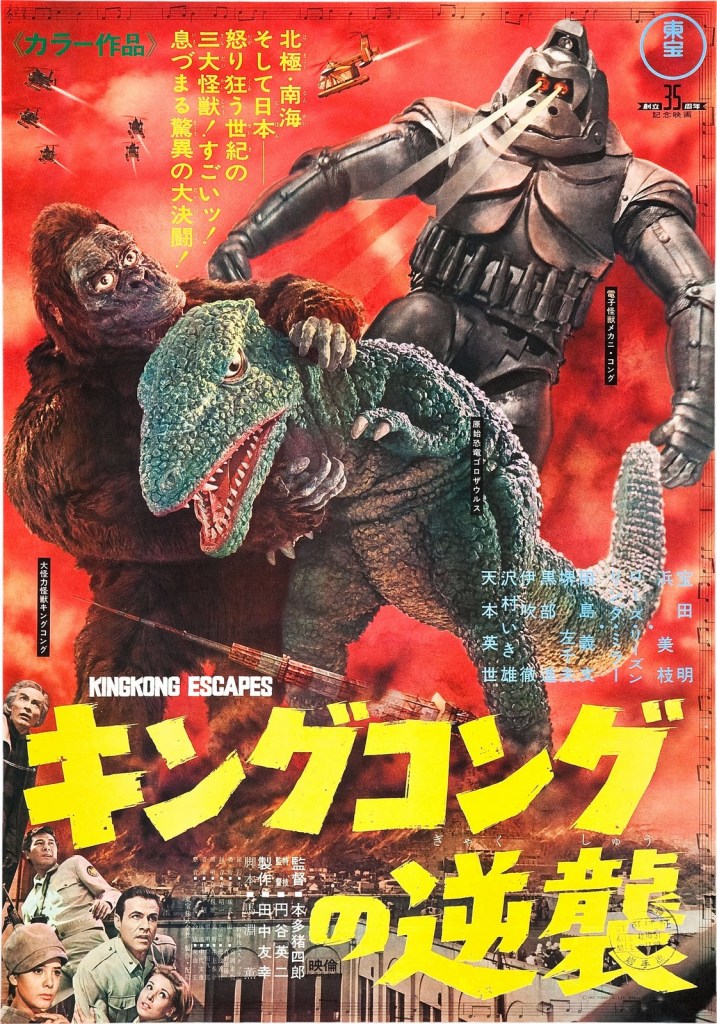
King Kong Escapes (1967)

KING KONG ESCAPES (1967) ****
I must be a sucker for movies like King Kong Escapes, but I just can’t help myself when it features so many awesome characters, plot details, and scenes.

Of course, we have the title character who’s obviously back from King Kong vs. Godzilla, one of Japan’s biggest Solid Gold hits of the early ’60s.

King Kong Escapes, a Toho Studios and Rankin/Bass Productions co-production, topped King Kong vs. Godzilla for me and I’d like to share how it did just that.

Not only do we have the iconic man-in-a-suit Kong, rather than the Willis O’Brien stop motion Kong from the immortal King Kong, the one that started it all, but we have Mechani-Kong, a giant robot double of Kong that first appeared in the 1966 animated TV series The King Kong Show (hence the Rankin/Bass involvement) and returned for live-action duty in King Kong Escapes.

King Kong Escapes also gives us Gorosaurus and a giant sea serpent, and Kong battles them near their home Mondo Island. See, Kong’s become obviously smitten with the lovely nurse Susan Watson (Linda Miller) and he’ll take on any beast to protect her. She holds sway on the big lug, and that naturally puts her life in danger from the bad guys. Kong saves her several times over the course of a 100-minute spectacular. All in a day’s work.

I believe it’s the human villains who put King Kong Escapes over into greatness for me — the evil mad scientist Dr. Who (not that Doctor Who) and the shady representative of an unknown Asian nation, Madame Piranha. She’s also called Madame X, but I’m sticking with Madame Piranha because I like that name better and she’s played by the pretty Mie Hama. 1967 proved to be a vintage year for Hama, who turned 24 that year and played Kissy Suzuki in the fifth James Bond film, You Only Live Twice. I believe Madame Piranha wins over Kissy Suzuki and ditto for their respective films. Madame Piranha, in fact, belongs right up there with Pussy Galore and Princess Dragon Mom.

Anyway, back to Dr. Who, played by the veteran character actor Hideyo Amamoto (1926-2003). He’s a cross between, I don’t know, Dracula (it’s the cape) and a Bond megalomaniac. He’s one of those characters that we absolutely love to hate and we savor his inevitable demise late in the picture. He’s so vain, so darn smart, so reckless, so persistent, so evil. Dr. Who created Mechani-Kong and when it fails him about 30 minutes into King Kong Escapes, Dr. Who captures first Kong and then Susan Watson, Commander Carl Nelson (Rhodes Reason), and Lt. Commander Jiro Nomura (Akira Takarada), Watson’s human interest. Needless to say, Kong and Mechani-Kong and Watson and gang escape from Dr. Who and his henchmen, which leads us to a battle royale atop Tokyo Tower.

I admit upfront that King Kong Escapes is silly, preposterous, and outright bloody ridiculous, in everything from its plot to its English dubbing, but it came as such a rejuvenation to my spirit after I watched The Gorilla, The Screaming Skull, The Robot vs. The Aztec Mummy, and The Curse of the Aztec Mummy earlier that same day, four exploitation films that if added together still did not provide as much entertainment value as King Kong Escapes.

Son of Godzilla (1967)

SON OF GODZILLA (1967) **
I made a terrible mistake.

Not in watching Son of Godzilla, the eighth film in the Godzilla series, per se, but watching it through the most available version online.

Characters begin speaking in dubbed English, of course only the best for us American monster movie aficionados, for a few seconds before a foreign language (presumably Russian) overlays the English. We get two bad dub jobs for the price of one, sure yeah whatever never mind.

I was desperate, though, and needed to watch Son of Godzilla to complete the entire 15-film Godzilla series Japan’s hallowed Toho Studios produced from 1954 to 1975. I sucked it up, buttercup, who cares about the bloody dialogue in a Godzilla movie anyway for crying out loud, and mission accomplished. Yes, I always save the worst for last.

Son of Godzilla marks the beginning of a period of several pictures when Toho made Godzilla a kinder, gentler monster. Like Arnold Schwarzenegger, as Godzilla became a bigger star, a monster if you will, the big guy preferred not playing a villain and so Son of Godzilla and 1969’s All Monsters Attack (a.k.a. Godzilla’s Revenge) are the equivalent of later Schwarzenegger pictures like Kindergarten Cop and Jingle All the Way. Not sure that Schwarzenegger ever made his Godzilla vs. Hedorah (a.k.a. Godzilla vs. The Smog Monster) and that’s a bummer.

The suits at Toho have made Godzilla and the men inside the suit do some awkward bull over a nearly 70-year period, but seeing the big guy try and relate to his adopted son Minilla during Son of Godzilla and All Monsters Attack just might take the cake. Godzilla rescues Minilla from a trio of Kamacuras or a mutated mantis species found on Sollgel Island, and is it in poor taste to say that I wish Minilla had been eaten by the mantis. Minilla’s just so darn cute that it took a great deal of restraint to not puke all over my relatively new laptop.

W.C. Fields died eight years before Godzilla’s screen birth, but we can be sure the famously curmudgeonly performer would have found some choice words for Son of Godzilla and All Monsters Attack, easily the worst of the 15 Showa Era films.

I believe Fields said, “I like children, if they’re properly cooked.”

The One-Armed Swordsman (1967)

day 37, the one-armed swordsman

THE ONE-ARMED SWORDSMAN (1967) Three-and-a-half stars
Last month, our glossary of cinematic terms included “giallo,” the Italian thriller genre that definitely had an impact on the American slasher film.

Just a few days into November, now we have “wuxia,” a genre of Chinese fiction incorporating martial arts, sorcery, and chivalry.

The genre enjoyed its 15 minutes of fame in America during the successful run of CROUCHING TIGER, HIDDEN DRAGON (2000). (I’ll never forget the tittering of some in the audience throughout its two hours at the Pittsburg 8 Cinema. I loved the movie.)

There’s just something about handicapped swordsman movies from the 1960s, but, then again, maybe only I have this problem.

Back in the days of a free Hulu account, I enjoyed the heck out of the Japanese ZATOICHI THE FUGITIVE, ZATOICHI ON THE ROAD, and ZATOICHI AND THE CHEST OF GOLD, starring Shintaro Katsu as the blind swordsman Zatoichi.

Just a couple years ago, I caught up with THE ONE-ARMED SWORDSMAN and its sequel released two years later, RETURN OF THE ONE-ARMED SWORDSMAN, both part of the Dragon Dynasty DVD series of releases that will give viewers a greater sense of where Quentin Tarantino found his inspiration. (One should also seek out 1976’s THE ONE-ARMED BOXER VS. THE FLYING GUILLOTINE, another highly entertaining concoction in the same league with INFRA-MAN and DRUNKEN MASTER.)

Jimmy Wang Yu stars as the titular protagonist, Fang Kang, whose servant father sacrifices his life to save his teacher and the Chi school of Golden Sword Kung Fu in the opening scene. The servant father’s dying wish is to have his son be taught at his master’s school. Fang Kang’s fellow students, especially the teacher’s daughter, grow to resent him and they do their best to make him leave. On a snowy night, Pei-er, the teacher’s daughter, challenges Fang Kang to a fight and in anger over his refusal to fight her, she chops off his arm. Dang, girl! Fang Kang flees through the woods.

A young woman named Xiao Man inadvertently finds Fang Kang (he falls into her boat) and nurses him back to good health. He decides that he will give up swordsmanship (we know how that’ll work, especially with the movie’s title) and become a farmer with Xiao Man.

Meanwhile, the bad, bad men led by The Long-Armed Devil and The Smiling Tiger have it out for Fang Kang’s teacher, Qi Ru Feng, and have developed a “sword-lock” device that will be the demise of Qi Ru Feng and all his disciples.

(Wouldn’t you love to be called “The Long-Armed Devil”? Well, that’s not a question for “the short-armed.”)

Fang Kang becomes depressed over not being able to practice his martial arts and the ever-reluctant Xiao Man gives him a half-burned out kung fu manual that she inherited from her dead parents. Fang Kang, of course, becomes a new master, yeah, you guessed it, “The One-Armed Swordsman.”

The One-Armed Swordsman learns of the plot to kill Qi Ru and saves the day.

We could have written this script with one arm tied behind our backs. Just please make it the weak arm.

I should now mention THE ONE-ARMED SWORDSMAN includes much bloodletting, a year’s worth of production at the blood bank in 117 minutes. This bloodletting will likely interest contemporary audiences more than anything else.

Not sure how they made the fake blood in THE ONE-ARMED SWORDSMAN, but there’s recipes for it throughout the Interwebs.

Bet we’ll have to start with corn syrup.

THE ONE-ARMED SWORDSMAN (influenced by American Westerns and Japanese Samurais) ushered in a new era of Hong Kong movies built around male anti-heroes, swordplay, and bloodletting.

This pioneering Shaw Brothers production became the first Hong Kong film to gross HK $1M in returns and made Jimmy Wang Yu an early martial arts star.