Odds and Odds: The Vikings, Dolls, The Monster Squad, Scream Blacula Scream

ODDS AND ODDS: THE VIKINGS, DOLLS, THE MONSTER SQUAD, SCREAM BLACULA SCREAM
Richard Fleischer’s The Vikings calls to mind epic grand adventure pictures Captain Blood, The Adventures of Robin Hood, The Sea Hawk, and The Sea Wolf, not to mention The Seventh Voyage of Sinbad from the same year (1958) and John Boorman’s Excalibur from 1981.

Kirk Douglas’ lust for life recalls Errol Flynn’s in Captain Blood, Robin Hood, and Sea Hawk and Janet Leigh’s incredible beauty compares with Olivia de Havilland’s in Captain Blood and Robin Hood, as well as Helen Mirren’s in Excalibur. Never mind that Leigh and Mirren play characters named Morgana; however, their beauty and first name are where their characters’ similarities begin and end.

In other words, The Vikings belongs to the fine cinematic tradition of swashbucklers, hair-raisers, cliff-hangers, nail-biters, period costume pieces, and historical fiction.

Of course, it doesn’t hurt that it has an uncredited Orson Welles narrate. The Vikings, in Europe of the eighth and ninth century, were dedicated to a pagan god of war, Odin. Trapped by the confines of their barren ice-bound northlands, they exploited their skill as shipbuilders to spread a reign of terror, then unequaled in violence and brutality in all the records of history. Good stuff.

Highlights include Douglas’ Einar and Curtis’ Eric having key body parts removed, the former his eye by a falcon and the latter his hand in a bout of capital punishment. These moments undoubtedly make The Vikings one of the most gruesome films in 1958 this side of the British classic Fiend Without a Face. Oh, that’s a golden oldie.

Naturally, one can’t go too wrong with any picture where Ernest Borgnine plays a character named Ragnar and spouts screenwriter Calder Willingham’s dialogue like a bountiful fountain, for example What man ever had a finer son? Odin could have sired him, but I did … and Look how he glares at me. If he wasn’t fathered by the black ram in the full of the moon my name is not Ragnar.

Back in the day, my friend would call on quotes from Airplane and Austin Powers for our amusement, and it’s a crying shame that we had no idea about The Vikings, because I think lines such as You sound like a moose giving birth to a hedgehog and The sun will cross the sky a thousand times before he dies, and you’ll wish a thousand times that you were dead would have perfectly fit a night of carousing, especially for two byproducts of a school with Vikings for its mascot.

Rating: Four stars.

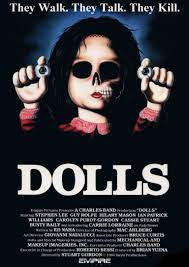
— I finally got around to watching Stuart Gordon’s Dolls for the first time.

Finally, because I love Gordon’s first two features Re-Animator and From Beyond.

I must say that I wasn’t disappointed by Dolls, though it’s a step down from From Beyond and a good two or three from Re-Animator.

Alas, Dolls belongs to a slightly different but no less venerable tradition than Re-Animator and From Beyond, both of which cross mad scientists and low-budget exploitation (nudity, gore, etc.). Think Frankenstein meets Dawn of the Dead.

Dolls, meanwhile, recalls such touchstones as The Old Dark House and The Devil-Doll, not to mention the 1979 Tourist Trap. See if this plot sounds familiar: On a dark and stormy night, six people — a dysfunctional family (husband and father, wife and stepmother, and daughter / stepdaughter) and a young man with two hitchhikers — find the nearest house (The Old Dark House) and they have to fight to make it out of the other end of the motion picture alive because their kindly old hosts are magical toy makers with killer dolls (The Devil-Doll, Tourist Trap).

Like both Re-Animator and From Beyond, Gordon and Dolls screenwriter Ed Naha jump off from their basic old-fashioned plot structure with inspired moments of madness.

Dolls also predates Child’s Play by more than a year and rather than just one killer doll, it has a horde … but Child’s Play, created by Don Mancini, spawned Child’s Play 2, Child’s Play 3, Bride of Chucky, Seed of Chucky, Curse of Chucky, Cult of Chucky, and Child’s Play (2019), plus short films Chucky’s Vacation Slides and Chucky Invades and the TV series Chucky.

So, apparently, not all killer doll films are created equal.

Rating: Three stars.

The Monster Squad starts with an absolute genius idea: Take a group of kids, horror movie fans one and all, and have them do battle against Dracula, Frankenstein’s Monster, Wolf Man, Mummy, and Gill Man.

Yes, what an absolutely positively brilliant idea by screenwriters Shane Black and Fred Dekker, whose names ring a bell loud and clear for genre fans. Others will be familiar with their work regardless whether they know their names or not.

Black made his fame and fortune first for the script of the buddy cop picture Lethal Weapon and some of his other credits include Predator (he plays Hawkins), The Last Boy Scout, and The Long Kiss Goodnight.

Dekker’s other feature directorial credits are the fantastic Night of the Creeps and the not-so-fantastic RoboCop 3.

The Monster Squad gives us both protagonists and monsters that we like, and that goes a long way toward producing a memorable motion picture experience.

The Wolf Man gets his due for a change. The fat kid Horace kicks the Wolf Man in the groin and unleashes the film’s trademark line Wolfman’s got nards! In 2018, Andre Gower, one of the stars of The Monster Squad, directed a documentary named Wolfman’s Got Nards, which looks at the impact one little cult horror film made on fans, cast and crew, and the movie industry.

Anyway, in a movie filled with nifty little moments, I love it when the Wolf Man regenerates after he’s blown up real good.

On the site Drinking Cinema, I found a game for The Monster Squad so drink whenever: 1. Dynamite EXPLODES! 2. A monster dies! 3. You hear a sweet insult. 4. You learn a new monster fact. 5. The cops are having a really hard time figuring out that, um, hello, the perps are various Jack Pierce creations. 6. You see amazing dog acting. 7. You witness a patented Monster Slow-Walk. 8. There’s a monster scare!

I give The Monster Squad a slight deduction for the obligatory music video montage right around the midway point of the picture.

Rating: Three-and-a-half stars.

— Vampirism and voodoo go together rather well and their combination helps Scream Blacula Scream become one of those rare sequels I prefer over the original.

I thought William Marshall’s performance as the title character was the redeeming factor in Blacula and he’s every bit as good in Scream Blacula Scream. Marshall just has a commanding screen presence and he brings both a gravitas to a character and legitimacy to a movie that otherwise might be laughable with the wrong person in the main role. He’s equally effective in every guise of this character — the debonair Mamuwalde who has a definite charm with the ladies befitting an African prince (which he indeed was before the racist Dracula cursed him and imprisoned in a coffin until Blacula awakened in 1972 Los Angeles), the menacing Blacula with his fangs bared, and the more reflective Mamuwalde who hates the dreaded vampire curse.

A highly respectable box office return — not voodoo, no matter what the plot synopsis might read — brought Mamuwalde / Blacula / Marshall back.

In the first movie, Mamuwalde / Blacula comes to believe the lovely Tina’s the reincarnation of his long dead wife Luva. Well, it definitely helps that Vonetta McGee plays both Tina and Luva. By golly, doesn’t this plot thread just get you every single time?

In the sequel, Mamuwalde / Blacula believes in the voodoo powers of Lisa Fortier. She can provide a cure and exorcise the curse once and forever.

Scream Blacula Scream came out two weeks after Coffy and had it been made later in 1973 after Pam Grier busted out as a star playing Coffy, her Lisa Fortier character in Scream Blacula Scream would have undoubtedly been different. Grier plays a more traditional leading lady and screaming and shrinking damsel in distress in Scream Blacula Scream, and she’s definitely no shrinking violet in either Coffy or Foxy Brown. So if Scream Blacula Scream had been produced more in the aftermath of both Coffy and Cleopatra Jones, which came out a month after both Coffy and Scream Blacula Scream, surely American-International — one of the best exploitation film outlets — would have wanted Grier to play one badass mama jama vampire killer rather than her more stereotypical role.

Fair warning: Scream Blacula Scream ends on an extremely jarring note. I remember thinking, in the immortal song title of Peggy Lee, is that all there is? Despite the fact of that ending, you might be surprised to find that I am granting Scream Blacula Scream three-and-a-half stars. Yes, it is just that good.

Attack of the Fantastical Movies

ATTACK OF THE FANTASTICAL MOVIES: ATTACK OF THE 50 FOOT WOMAN, EARTH VS. THE FLYING SAUCERS, PLANET OF THE VAMPIRES, MOTORPSYCHO!, GALAXINA, REPTILICUS, BIG BAD MAMA, REAL LIFE, NINJA III: THE DOMINATION, NIGHT OF THE DEMONS

How do I grade something like ATTACK OF THE 50 FOOT WOMAN from 1958? It has a setup that could be called “laborious” or “lackluster” or “lugubrious.” I’m not going to call it any of those words, but I can see exactly why somebody else would. In other words, it’s not until about the 45-minute mark that we get to the 50 foot woman. Yes, I wish they had reversed the numbers, 15 minutes of setup and 45 minutes of 50 foot woman. Simple mathematics. At least, 45 minutes of setup and 45 minutes of 50 foot woman. Yes, that sounds even better than “15 then 45.” The final 15 or 20 minutes of ATTACK OF THE 50 FOOT WOMAN, though, are solid gold. Rating: ***

— It’s virtually impossible to watch EARTH VS. THE FLYING SAUCERS and not think about MARS ATTACKS! (flying saucers) and INDEPENDENCE DAY (Washington D.C. invaded), two blockbusters from 1996 with a combined production budget of $145 million and big, big, big stars, including Jack Nicholson in dual roles in MARS ATTACKS! In EARTH VS. THE FLYING SAUCERS from 1956, Ray Harryhausen’s stop-motion flying saucers are the real star of the show (step aside, Hugh Marlowe) and the film thankfully wastes very little time in showcasing them. It’s the inverse of ATTACK OF THE 50 FOOT WOMAN. ***1/2

— Italian director Mario Bava (1914-80) became especially known for his stylish horror films. From his British Film Institute profile, “Mario Bava took a vital role in the creation of the modern horror film. If there was to be a a Mount Rushmore-style monument dedicated to four directors whose work pioneered a new form of big screen chills and thrills, those giant faces etched in granite on the mountainside would be: Bava, Alfred Hitchcock, Georges Franju and Michael Powell.” In the words of a Pavement song, a Bava film has style, miles and miles. Case in point: PLANET OF THE VAMPIRES, a low-budget science fiction and horror production from 1965 that masked its cheap sets through smoky skullduggery. Bava said in Fangoria, “Do you know what that unknown planet was made of? A couple of plastic rocks — yes, two: one and one! — left over from a mythological movie made at Cinecitta! To assist the illusion, I filled the set with smoke!” Watching PLANET OF THE VAMPIRES for the first time, you might think you’ve seen this basic plot somewhere before … ahem … Ridley Scott’s ALIEN. ***1/2

— 1965 proved to be a great year for titles with exclamation points and for director, producer, writer, cinematographer, and editor Russ Meyer (1922-2004), whose films often proved to be ahead of their time. Meyer contributed two exclamation point titles — FASTER, PUSSYCAT! KILL! KILL! and MOTORPSYCHO! — during a 1965 in which he directed three films overall; Meyer’s greatest cinematic year began with MUDHONEY. Proof of being ahead of its time: MOTORPSYCHO! (what a title) gives us a psychotic motorcycle trio led by a deeply disturbed Vietnam vet — before TAXI DRIVER, before ROLLING THUNDER, before THE DEER HUNTER, before FIRST BLOOD — in addition to all the elements (large-breasted women and endless cleavage, campy humor, satire, and quotable dialogue) we expect from a Meyer film. ***

— GALAXINA lands a few successful jabs at STAR WARS, STAR TREK, and ALIEN, but otherwise it’s a real long slog through 90-plus minutes of a lowbrow and low-budget science fiction and western parody set in the 31st century. Here’s just one example of the film’s humor: Avery Schreiber (1935-2002) plays a character named “Capt. Cornelius Butt.” Then again, I probably should have just said that it’s a Crown International Pictures release. Surely you remember Crown International Pictures? They brought us such immoral, er, immortal classics as THE BEAST OF YUCCA FLATS, THEY SAVED HITLER’S BRAIN, SEXTETTE, and THE BEACH GIRLS. The late former Playboy Playmate of the Year Dorothy Stratten fills the title role and she’s been described as “a voluptuous blonde android servant.” Galaxina works better when she’s silent (the first half of the picture), because Stratten proves that she was a true novice thespian every time she speaks during GALAXINA. Stratten reportedly complained to film director and her paramour Peter Bogdanovich that the ads for GALAXINA promoted her being the Playmate of the Year, because she wanted to be taken seriously as an actress. GALAXINA would not do good for anybody wanting to be taken seriously for anything. Unfortunately, Stratten’s estranged husband Paul Snider murdered her two months after the release of GALAXINA. Stratten would be immortalized on film by the 1981 TV movie DEATH OF A CENTERFOLD: THE DOROTHY STRATTEN STORY and the 1983 theatrical release STAR 80, played by Jamie Lee Curtis and Mariel Hemingway, respectively. In case you were wondering, you see a lot more of Stratten in Playboy than GALAXINA. *1/2

— Recent weeks, mostly under self-quarantine, have included a few first-time watch monster movies: GODZILLA VS. MECHAGODZILLA and TERROR OF MECHAGODZILLA, SLITHIS (possibly the worst monster movie ever made), THE GIANT CLAW, and, most recently, REPTILICUS, Denmark’s infamous first entry in the monster movie sweepstakes. Judging by REPTILICUS, the Danish should stick to pastries. They make a mean strudel, not so much a Godzilla rip-off. Apparently, there’s never been a second Danish monster movie, so I guess they have stuck to pastries for nearly 50 years since this 1961 turkey. Anyway, I wanted to find the Danish version of REPTILICUS, but, of course, I had to settle for the English dub from good old American International. The plot: Copper miners find the tail of a prehistoric reptile and it eventually regenerates into Reptilicus, a hand puppet (close-up) and a marionette (wide shot) that give the $50 Giant Claw its money for being the “best” worst movie monster of all-time. I enjoyed REPTILICUS even less than THE GIANT CLAW, though. For example, when Reptilicus eats an extra or two, the victims look like they have been cut out of a magazine and they are being thrown into the puppet’s mouth. In THE GIANT CLAW, at least its victims being eaten scene brought me back to the “Eat ‘em! Eat ‘em! Crunch! Crunch!” scene from Q: THE WINGED SERPENT. I even called out “Crunch! Crunch!” during THE GIANT CLAW. No such luck during REPTILICUS. **

— Arthur Penn’s 1967 film BONNIE AND CLYDE proved to be one of the watershed films of the second half of the 20th century and one indication was that for several years, BONNIE AND CLYDE inspired many sensationalistic crime films set during the Great Depression. Roger Corman produced a whole slew of them, with the most famous being 1974’s BIG BAD MAMA starring Angie Dickinson, Tom Skerritt, and William Shatner and directed by Steve Carver (who later directed the Chuck Norris spectacular LONE WOLF McQUADE). BIG BAD MAMA mixes in a hippie-like free love sensibility and showcases bed hopping and generous amounts of nudity between all the murder and mayhem. The title character (Dickinson) and her two not long past jailbait daughters (Susan Sennett, Robbie Lee) all have multiple nude scenes, highlighted by Dickinson’s full-frontal shot late in the picture. One of the picture’s tag lines: “Wilma gave her daughters everything — her looks, her lovers and the crime of their lives!” Dick Miller (1928-2019), yes, that guy, plays a crime fighter and you know you can’t go too wrong with a picture that features an old-fashioned bloody crime spree, much nudity and shenanigans (Dickinson looked absolutely sensational in 1974), Shatner, and Dick Miller. ***

— Many years before the proliferation of reality TV, Albert Brooks skewered it with his 1979 directorial debut REAL LIFE, a satire of the 1973 PBS documentary “An American Family.” Brooks plays an exaggerated version of himself and watching this movie for the first time in 2020, it’s difficult not to conjure up memories of all the obnoxious or obsequious hosts and participants on reality TV shows from years ago — “The Real World,” “The Bachelor,” et cetera, they’re all terrible and I’m fortunate to have survived all my encounters with them. All those creeps still give me the willies just thinking about it now, but unfortunately reality TV seems like it’s here and it’s here to stay. Take that from somebody who’s not watched a whole lot of TV in the last decade, with reality TV being one of the big reasons. I laughed a lot during REAL LIFE, from the epic sight gag on the head of every cameraman (I laughed every single time) to the fiery grand finale Brooks borrows from GONE WITH THE WIND. ****

— The Cannon Group’s best of the worst films could generously be called “sublime stupidity” and I believe that description fits NINJA III: THE DOMINATION perfectly. Part ENTER THE NINJA, part FLASHDANCE, and part EXORCIST, THE DOMINATION must be seen to not be believed. Imagine Jennifer Beals possessed by the evil spirit of a ninja with an Oriental Max von Sydow attempting to bring it out. THE DOMINATION starts out with its very best scene, a golf course massacre that leads to the bad ninja transferring his spirit into the body of telephone lineman and aerobics instructor Christie (Lucinda Dickey). Also happening in the first 30 minutes of the picture: Christie’s aerobics class, her fight against a handful of creeps who were harassing one of her students, and possibly the most awkward bedroom seduction scene in the history of cinema. Christie won’t give this creepy cop the time of day and then, practically the next moment, they end up in embrace and she pours V-8 on herself … this is the beginning of a beautiful friendship. There’s also a bizarre sequence involving Christie’s Bouncer arcade game. On the International Arcade Museum page for Bouncer, it says “Bouncer was seen in the low budget martial arts film NINJA 3: THE DOMINATION. The game is in the main character’s apartment and she is seen playing it. The character becomes possessed by the spirit of the ninja, and as he overtakes her body, the arcade cabinet begins to bellow out smoke and hypnotizes her with a little laser show from the screen.” I thought she was already possessed. Yeah, I know, bizarre. Then again, bizarre basically describes both THE DOMINATION and Cannon films in general. We wouldn’t have them any other way. ***

— We’ve seen NIGHT OF THE DEMONS done better before, especially the first two EVIL DEAD movies and RETURN OF THE LIVING DEAD, which it seems to reference through both Linnea Quigley and punk rock. We’ve seen this plot before: 10 (mostly) horny high school kids have a Halloween party inside an abandoned funeral parlor. You can fill in the rest, down to every detail both personality and plot. It’s not a bad movie, exactly, it’s just after having seen EVIL DEAD and RETURN OF THE LIVING DEAD and EVIL DEAD 2, why settle for less? Seemingly just about every movie from the ‘80s — the good, the bad, and the ugly — has developed a cult following over time and NIGHT OF THE DEMONS is one of them, spoken about in an enthusiastic tone by admirers. I can sympathize, because I feel similarly about numerous movies. I have mixed feelings on NIGHT OF THE DEMONS. On one hand, I can’t think very highly of a movie that goes for three jump scares very early on. That loses points for it real quickly. It’s also one of those movies that I started liking less down the home stretch and I wished it would get to its inevitable conclusion sooner rather than later. On the other hand, it does have a few good moments, just not enough for a recommendation. **

Fiend Without a Face (1958)

FIEND WITHOUT A FACE

FIEND WITHOUT A FACE (1958) ****

The 1958 British independent horror production FIEND WITHOUT A FACE contains everything this science fiction and horror fiend wants from a film of that era: a square but likeable hero (Marshall Thompson), a shapely heroine (Kim Parker), a mad scientist (Kynaston Reeves), townspeople who blame everything on the wrong people, atomic fallout, and horrible, terrifying stop motion animation monsters (created by the special effects team of Flo Nordhoff and Karl-Ludwig Ruppel) that are loads of fun.

It also has an evocative title.

The final 20 minutes or so of FIEND WITHOUT A FACE are phenomenal and push this film into the stratosphere.

The fiends of the title are floating killer brains who started as one brain materialized from the thoughts of Professor R.E. Walgate, a man who specializes in telekinesis. The nearby airbase’s nuclear power radar experiments have dire consequences and the original fiend escapes from Walgate’s lab and wreaks murder and mayhem on the surrounding community. The fiends replicate themselves through attacks on humans (looting their brains and spinal cords) and they remain invisible until the final 20 or so minutes after they crank up the nuclear power to DANGER! They must be stopped!

These fiends are one helluva brainstorm, literally. They have antennae and tentacles, and one can see their influence on later creature features creatures. (The ALIEN films leap to mind. George Romero must have watched at least the last 20 minutes of FIEND WITHOUT A FACE before he made the first NIGHT OF THE LIVING DEAD.)

When the fiends are shot in the brain (love that concept), they naturally gush out this great-looking brain glop and I honestly wish these death scenes lasted another 20 minutes. They are so much fun, and it’s just as great when our hero breaks out an axe. The fiends (love that word) finally turn into goo after our hero blows up their great power source real good.

When the fiends are in their invisible stage, we hear slurping sounds when they strike their victims’ brains and spinal cords. Awesome, totally awesome, because it’s not happening to us, of course.

Credited director Arthur Crabtree (reports have it that star Thompson worked on the film himself after Crabtree walked off the picture because directing sci-fi proved to be too much for his fragile little mind) and his team did a fantastic job with the fiends when they’re invisible or visible. FIEND WITHOUT A FACE pulls off the nifty little trick of building up high audience expectations toward a great final act, then it delivers the goods and maybe even exceeds expectations during that final act.

Believe it or not, FIEND WITHOUT A FACE apparently caused quite a storm of controversy when it was first released in early July 1958. The British Board of Film Censors demanded cuts be made before it would be certified for release and the picture still received an ‘X.’ It’s lucky to not have met the same fate as banned-for-many-years pictures like BATTLESHIP POTEMKIN (1926-54), FREAKS (1932-63), and ISLAND OF LOST SOULS (1932-58), for example.

Legend even has it that British Parliament discussed why the censors allowed FIEND WITHOUT A FACE to be released.

Over time, I’ve come to realize that I love 1950s horror and sci-fi: THE DAY THE EARTH STOOD STILL, THE THING FROM ANOTHER WORLD, HOUSE OF WAX, GODZILLA, THEM!, CREATURE FROM THE BLACK LAGOON, INVASION OF THE BODY SNATCHERS, THE INCREDIBLE SHRINKING MAN, ATTACK OF THE CRAB MONSTERS, FIEND, THE H-MAN, THE BLOB, THE FLY, HORROR OF DRACULA, PLAN 9 FROM OUTER SPACE, BUCKET OF BLOOD, and THE KILLER SHREWS all have made personal top 10 lists for their respective years and the decade also featured at least five of Hitchcock’s best works (STRANGERS ON A TRAIN, REAR WINDOW, THE WRONG MAN, VERTIGO, NORTH BY NORTHWEST) and other films that are horrifying in their own distinct ways, like film noir KISS ME DEADLY and war film FIRES ON THE PLAIN.

The Blob (1958)

THE BLOB 2

THE BLOB (1958) Four stars

Watching the original BLOB just the other day, once again it hit me how much THE BLOB seems to be influenced by the 1955 classic REBEL WITHOUT A CAUSE.

THE BLOB leads Steven McQueen and Aneta Corseaut respectively call to mind James Dean and Natalie Wood (McQueen even a few years older than Dean playing a high schooler), there’s a more friendly policeman in both films (Ray in REBEL WITHOUT A CAUSE, Dave in THE BLOB), and they both are iconographic time capsule films that appeal to all generations.

Plain and simple, THE BLOB is a goofy, ridiculously fun time at the movies.

It sets the tone with that glorious theme song over the opening credits — “Theme from the Blob” by the Five Blobs and it’s a real catchy little ditty written by Burt Bacharach and Mack David. It sure beats “Raindrops Keep Falling on My Head.”

“Beware of the Blob, it creeps

And leaps and glides and slides

Across the floor

Right through the door

And all around the wall

A splotch, a blotch

Be careful of the Blob.”

What’s the Blob? A modified weather balloon in early shots and colored silicone gel in later shots. From outer space.

It’s also been compared to cherry Jell-O.

THE BLOB was inspired by a real event that happened in  1950 Philadelphia. The Philadelphia Inquirer headline on Sept. 27, 1950: FLYING ‘SAUCER’ JUST DISSOLVES. Joe Keenan and John Collins, a pair of veteran police officers who probably both thought they had seen just about everything before the night in question, spotted a mysterious object falling from the sky, of course, just like in THE BLOB and KILLER KLOWNS FROM OUTER SPACE, for that matter. They pursued this mysterious object and eventually encountered a large mass which they described as “purple jelly.” Collins decided that he would reach out and touch the mysterious object … by that point, backup (two more officers) had arrived, so four policemen were taking on the case. Collins had much better luck than the old man at the beginning of both ’58 BLOB and ’88 BLOB. He survived. Within 30 minutes of the first sighting, this blob-like object disappeared. The police told their story to the local media the next day, and the rest is history.

Made for $240,000 (though numbers vary, as low as $110,000 has been reported), THE BLOB predates later George Romero horror films made in Pennsylvania.

THE BLOB filmed at Valley Forge Studios — destroyed by a fire in 1962 — and the towns of Phoenixville, Downingtown, Chester Springs, and Royersford. These locations give THE BLOB an unique flavor and I do enjoy how eventually young and old alike work together to defeat the monster.

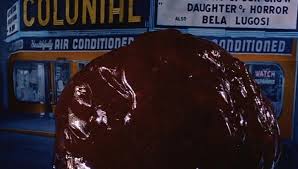
Phoenixville (2018 estimated pop.: 16,957) features the historic Colonial Theatre, one of the town’s claims to fame. Since 2000, Phoenixville and the Colonial commemorate THE BLOB with the annual “Blobfest.” The 21st edition will be held July 10-12, 2020. Every year, of course, they reenact the famous run out from the Colonial when the title character attacks. In addition to THE BLOB, FORBIDDEN PLANET and TEENAGERS FROM OUTER SPACE will be featured in 2020.

(BTW, Phoenixville ranks in the top 10 in the U.S. in breweries per capita. Let’s see, there’s Root Down, Crowded Castle, Stable 12, Rebel Hill, Rec Room, Iron Hill, Sly Fox, Baba’s Brew, A Culture Factory, Stickman Brews, Tuned Up, Steel City, et cetera, on the map.)

It just doesn’t get much better than when the title character attacks The Colonial during DAUGHTER OF HORROR, a real movie that’s the altered version of the 1955 movie DEMENTIA. The Kino Video DVD cover highlights three great reviews for DEMENTIA. Variety: “May be the strangest film ever offered for theatrical release.” Preston Sturges: “A work of art. It stirred my blood and purged my libido.” New York Censor Board: “Overflows with horror, hopelessness, sadism, violent acts of terror and outbursts of panic.”

Anyway, the Blob hates the cold. In that case, though, the Colonial must not have been too “Healthfully Air Conditioned,” because the Blob seems to thrive as it engorges the poor projectionist and heads into the auditorium.

Sometimes, during a bad bad bad movie at the multiplex, I’ve wanted the Blob to strike our screen and send us running.