
Take a Walk on the Spooky Side: Eight Great Disney Animated Shorts 1929-49

TAKE A WALK ON THE SPOOKY SIDE: EIGHT GREAT DISNEY ANIMATED SHORTS 1929-49
I know what some of you might be thinking: Why do you have Disney animated shorts under consideration during a horror marathon?

Like The Wizard of Oz, Disney animated films proved to be a perfect introduction to scary movies.

You have the haunted woods in Snow White and the Seven Dwarfs, Chernabog in Fantasia, the donkey boys in Pinocchio, the pink elephants in Dumbo, Bambi’s mother’s death in Bambi, the bear in The Fox and the Hound, the Horned King in The Black Cauldron, and Ratigan (voiced by horror legend Vincent Price) in The Great Mouse Detective, just for starters, all potential source material for the nightmares of children.

Now, I will take a look at eight great Disney animated shorts that were made from between 1929 and 1949.

The Skeleton Dance (1929; Walt Disney): Why is this short directed by Walt himself and animated by Ub Iwerks, Les Clark, and Wilfred Jackson, with music from Carl W. Stalling and Edvard Grieg, so important?

Music and animation were made at the same time for the first time, rather than having sound added in later, sure, that’s one very important reason, but it’s because the four dancing skeletons make for a great cover photo every October.

Walt Disney Productions made 75 animated musical short films from 1929 to 1939. They were called part of the Silly Symphony series, and the series began with none other than The Skeleton Dance in August 1929 and ended with The Ugly Duckling in April 1939.

Such classics as Iwerks’ Hell’s Bells, Burt Gillett’s Three Little Pigs, Jackson’s The Tortoise and the Hare, and Jackson’s The Old Mill appeared during the decade.

The Skeleton Dance falls under the classification Danse Macabre or dance of death or an artistic genre of allegory of the Late Middle Ages on the universality of death.

For the first couple minutes, we have a series of Gothic images leading us toward skeletons dancing in a cemetery — lightning, large eyes that are revealed to belong to an owl, strong wind, chimes at midnight, bats, a full moon, a howling hound dog, and black cats brawling on top of tombstones until they are scared off by our lead skeleton.

I may have forgotten about the spider, or was that another macabre Disney classic from the year 1929?

Anyway, around 2 minutes, 40 seconds, that’s when the dancing begins, and eat your heart out, Kevin Bacon! These skeletons are footloose and fancy free!

Hell’s Bells (1929; Ub Iwerks): The fourth entry in the Silly Symphony series takes a dark turn after the October 1929 entry Springtime.

It’s all fun and games and song and dance in this short until one of Satan’s subordinates becomes insubordinate when faced with the prospect of being served to Cerberus, Satan’s three-headed guard dog.

Song and dance set to the theme music from Alfred Hitchcock Presents.

I absolutely love the name of that piece of music, by the way.

Funeral March of a Marionette by Charles Gounod in the 1870s.

Was Hitchcock a Walt Disney fan?

Who Killed Cock Robin appeared in Hitchcock’s Sabotage.

Iwerks beat AC/DC to it by about 51 years.

Hell’s Bells came out on November 21, 1929, while the Hells Bells single was released October 31, 1980.

Somebody on YouTube put the 5:50 Hell’s Bells and the 5:12 Hells Bells together for a perfect marriage of sight and sound.

The Haunted House (1929; Walt Disney): This one has a plot that will sound awfully darn familiar to fans of the horror, mystery, suspense, and thriller genres.

Good old Mickey Mouse, he’s caught out in this horrible storm that makes the one in The Old Dark House seem like a jolly old time by comparison.

He’s not driving a motor car, though, he’s out walking. What are you doing, Mickey?

Fortunately, no, wait, make that unfortunately for him and fortunately for our high-quality entertainment value, there’s a house nearby that can provide Mickey with shelter from the storm.

Needless to say, we quickly find out why they called this one The Haunted House.

The four dancing skeletons return from The Skeleton Dance and their ability to coordinate a dance number in the midnight hour remained intact only a few months after their legendary motion picture debut.

The Skeleton Dance, Hell’s Bells, and The Haunted House all came out within a few months’ span in 1929, not a coincidence given the dark times faced around the world at that moment in time.

The Mad Doctor (1933; David Hand): On a dark and stormy night — are there ever any other kind in anything related to horror — the diabolical genius title character takes Pluto away to his mansion for a wacky transplant. Pluto’s head on the body of a chicken, and Mickey Mouse obviously comes to the rescue.

The title character apparently learned from Dr. Jerry Xavier played by Lionel Atwill in the 1932 classic Doctor X or maybe they’re cousins. Maybe it’s the other way around, since the mad doctor in The Mad Doctor goes by Dr. XXX.

Mickey walks his way through Saw 70 years before the start of that infamous series, only in seven minutes rather than 110 and no F-bombs.

Skeletons appear in a Disney short, and that’s almost the guarantee for a classic.

I’ll even forgive The Mad Doctor for including the dreaded ‘It’s only a dream’ ending.

Pluto’s Judgement Day (1935; David Hand): This one is truly something wild.

The family dog Pepper is absolutely positively terrified by this one.

She won’t even approach the plot summary.

Pluto’s Judgement Day opens with our favorite animated dog in the middle of chasing a kitten through the yard and eventually into Mickey Mouse’s living room.

Pluto becomes a muddy mess, Mickey saves the kitten, and Mickey scolds Pluto, telling him that he’ll pay on Judgment Day.

Pluto falls to sleep in front of the fire, so naturally he dreams that he’s on trial for his life in a Hell presided over by cats. They all have it in for Public Enemy No. 1, all the witnesses are Pluto’s victims, the jury of eight fine cats can balance justice with song and dance, and they give Pluto the chair.

It has a similar ending to The Mad Doctor, the 1933 short directed by David Hand that also featured Mickey and Pluto.

When I hear Pepper dreaming, I wonder if her dreams are anything like Pluto’s Judgement Day.

I sincerely hope not.

The Old Mill (1937; Wilfred Jackson, Graham Heid): The year 1937 definitely proved to be a landmark year for Walt Disney Studios.

On December 21, 1937, Disney’s first feature-length animated film Snow White and the Seven Dwarfs premiered in Los Angeles.

The Old Mill, a Silly Symphony short, appeared in theaters November 5, 1937, and it’s every bit the landmark in animation as Snow White.

See, The Old Mill introduces the multiplane camera, a technical innovation used on Disney animated films from Snow White to The Little Mermaid.

From the Disney Wiki for a multiplane camera, Various parts of the artwork layers are left transparent, to allow other layers to be seen behind them. The movements are calculated and photographed frame-by-frame, with the result being an illusion of depth by having several layers of artwork moving at different speeds – the further away from the camera, the slower the speed. The multiplane effect is sometimes referred to as a parallax process.

The plot is basic compared to the technical aspects of the short — the animal residents of an old mill do their best to survive a thunderstorm.

I love the scene, just before the storm comes in, when the denizens of a nearby pond — frogs and crickets — have a croaking and chirping duet or duel.

Lonesome Ghosts (1937; Burt Gillett): Peter Venkman, Ray Stantz, and Egon Spengler owe a debt of gratitude to Mickey Mouse, Donald Duck, and Goofy.

Four of the bored out of their gourd title characters see the ad for the Ajax Ghost Exterminators agency in their local newspaper, so they decide to alleviate their boredom by calling Mickey, Donald, and Goofy and having them come out to investigate their house. Our title characters then get their kicks with pranks and more pranks on Mickey, Donald, and Goofy once they’re inside to investigate. Inconceivable!

Goofy even utters the famous words, I ain’t a-scared of no ghosts.

Goofy also does a mirror routine with one of the ghosts, only he sees the ghost’s reflection in the mirror the entire time.

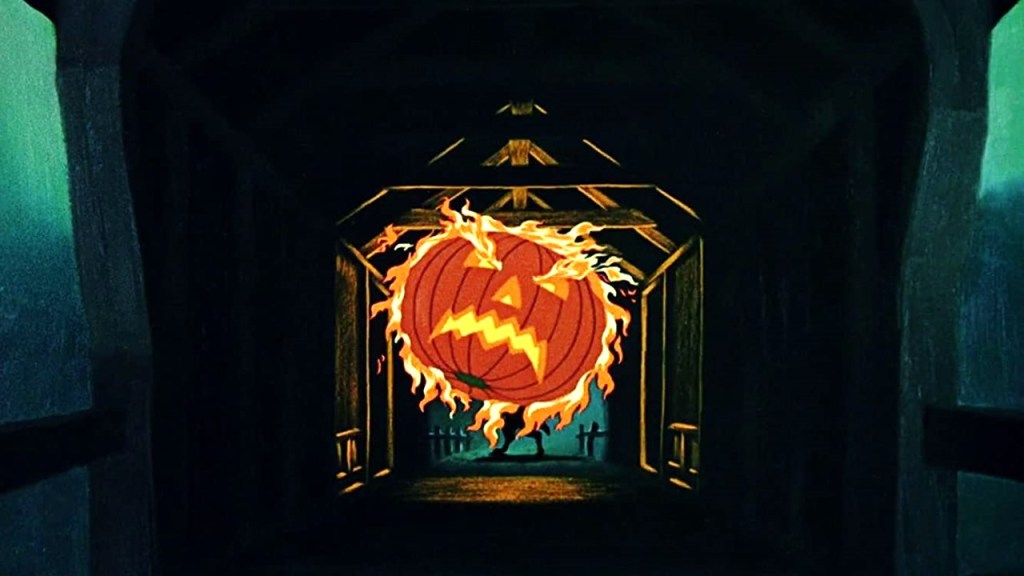
The Legend of Sleepy Hollow (1949; Clyde Geronimi, Jack Kinney): I already reviewed The Adventures of Ichabod and Mr. Toad that packaged shorts The Wind and the Willows and The Legend of Sleepy Hollow into a 68-minute feature.

I prefer The Legend of Sleepy Hollow alone.

We have an adaptation of Washington Irving’s 1820 The Legend of Sleepy Hollow that’s more faithful than more famous adaptations, like Tim Burton’s 1999 Sleepy Hollow.

We have Ichabod Crane and Brom Bones, as well as a host of other characters, and the legendary Headless Horseman.

Bing Crosby provides the voice for the narrator and the singing voice for Ichabod and Brom Bones.

Crosby and Jud Conlon’s Rhythmaires are great in their performance of The Headless Horseman, which starts Gather ’round and I’ll elucidate / What goes on outside when it gets late / Along about midnight the ghosts and banshees / They get together for their nightly jamboree / There’s things with horns and saucer eyes / Some with fangs about this size / Some are fat and some are thin / And some don’t even wear their skin / I’m telling you, brother, it’s a frightful sight / To see what goes on Halloween night.

Gotta love the chorus: With a hip, hip and a clippity clop / He’s out looking for a top to chop / So don’t stop to figure out a plan / You can’t reason with a headless man.

The final 11 minutes of The Legend of Sleepy Hollow, beginning when Brom starts his Headless Horseman song, rank with the opening in Frankenstein Meets the Wolf Man.

The Universal Frankenstein Movies

THE UNIVERSAL FRANKENSTEIN MOVIES
Of all the horror movie series, there’s not one I like more than Universal Studios’ Frankenstein cycle which started with the immortal 1931 classic Frankenstein and continued through The Bride of Frankenstein, Son of Frankenstein, The Ghost of Frankenstein, Frankenstein Meets the Wolf Man, House of Frankenstein, House of Dracula, and finally concluded with Abbott and Costello Meet Frankenstein in 1948.

Seven of the eight films are stone cold classics and I rate Frankenstein, The Bride of Frankenstein, Son of Frankenstein, and Abbott and Costello Meet Frankenstein at four stars and The Ghost of Frankenstein, Frankenstein Meets the Wolf Man, and House of Frankenstein three-and-a-half, with House of Dracula ranked two-and-a-half and it’s the only one that I would even slightly hesitate to recommend to people.

I watched Frankenstein, The Bride of Frankenstein, and Abbott and Costello Meet Frankenstein around roughly the same time in the late ’90s and early ’00s. I caught up with the others much later on during a marathon of Universal horror films. I liked The Ghost of Frankenstein, Frankenstein Meets the Wolf Man, and House of Frankenstein upon first viewing, as well Abbott and Costello Meet Frankenstein a lot, but they’ve all grown on me to where I bumped up their rating one-half star.

I have a feeling that watching the eight films in close proximity to one another will become a tradition, like it has for who knows how many people over the last 90 years.

Here’s a look at the film series that seemingly started it all in the horror genre.

Frankenstein (1931; James Whale): The one that started it all, Edward Van Sloan, who plays Dr. Van Helsing in Dracula and Doctor Waldman in Frankenstein, begins the picture, How do you do? Mr. Carl Laemmle feels it would be a little unkind to present this picture without just a word of friendly warning. We’re about to unfold the story of Frankenstein, a man of science who sought to create a man after his own image without reckoning upon God. It is one of the strangest tales ever told. It deals with the two great mysteries of creation: life and death. I think it will thrill you. It may shock you. It might even horrify you. So if any of you feel that you do not care to subject your nerves to such a strain, now is your chance to, uh … well, we’ve warned you!

Colin Clive and Dwight Frye are great in their roles as mad scientist Henry Frankenstein and hunchbacked assistant Fritz, Van Sloan is much better in Frankenstein than in Dracula, and Boris Karloff is not even credited as Karloff yet for playing The Monster. The opening credits have it The Monster — ?

The work done by makeup artist Jack Pierce and set designer Herman Rosse is just as definitive and influential as the characters and performances by Clive, Frye, and Karloff.

We’ve all seen Frankenstein time and time again in the thousands if not hundreds of thousands of films that have been influenced by James Whale’s first horror masterpiece.

The Bride of Frankenstein (1935; James Whale): One of the greatest horror films and greatest sequels ever made, I rate The Bride of Frankenstein as the best Frankenstein and it’s not even all that close, despite the fact that it shares the same star rating as Frankenstein, Son of Frankenstein, and Abbott and Costello Meet Frankenstein.

The Bride of Frankenstein has a more wicked sense of humor than any of the other films in the series, and that’s including Abbott and Costello Meet Frankenstein, and it’s undeniably the most fun to watch. It’s just as iconic and influential as the original Frankenstein, from the more sympathetic, speaking Monster to the makeup and the sets.

Mad scientists do not come madder than Ernest Thesiger’s Doctor Pretorius, and he’s a devious hoot throughout The Bride of Frankenstein. He’s so mad that he makes Colin Clive’s Doctor Frankenstein seem almost sane. You think I’m mad. Perhaps I am. But listen, Henry Frankenstein. While you were digging in your graves, piecing together dead tissues, I, my dear pupil, went for my material to the source of life. I grew my creatures, like cultures, grew them as nature does, from seed.

I wish they would have done more with the title character, that’s just about my only gripe against The Bride of Frankenstein.

Son of Frankenstein (1939; Rowland V. Lee): Easily the longest of the series, the third Frankenstein entry benefits tremendously from the presence of four absolute legends of the genre in Lionel Atwill, Boris Karloff, Bela Lugosi, and Basil Rathbone. Atwill and Lugosi are especially fantastic.

I would make the argument that Lugosi never had a better role than Ygor and never gave better performances than he did in Son of Frankenstein and The Ghost of Frankenstein. He’s the driving engine in both films and helps make them so entertaining. They hanged me once Frankenstein. They broke my neck. They said I was dead. Then they cut me down. They threw me in here, long ago. They wouldn’t bury me in holy place like churchyard. Because I stole bodies, eh they said. So, Ygor is dead! So, Dr. Frankenstein. Nobody can mend Ygor’s neck. It’s alright.

Atwill became the most versatile and most important supporting player in the Frankenstein series, playing Inspector Krogh in Son of Frankenstein, Doctor Theodore Bohmer in The Ghost of Frankenstein, the Mayor in Frankenstein Meets the Wolf Man, Inspector Arnz in House of Frankenstein, and Police Inspector Holtz in House of Dracula.

He’s at his best as Inspector Krogh, and this character will ring a bell to Young Frankenstein fans, as will Ygor. Most vivid recollection of my life. I was but a child at the time, about the age of your own son Herr Baron. The Monster had escaped and was … ravaging the countryside, killing, maiming, terrorizing. One night he burst into our house. My father took a gun and fired at him but the savage brute sent him crashing to a corner. Then he grabbed me by the arm!

Karloff gives his final performance as Frankenstein’s Monster and he’s given less to do than Frankenstein and especially The Bride of Frankenstein. He returns to not speaking in Son of Frankenstein after the strides the Monster made in Bride, but Karloff had the innate ability to communicate much without dialogue.

The Ghost of Frankenstein (1942; Erle C. Kenton): This is the first downturn in quality in the series after the triple triumph of Frankenstein, The Bride of Frankenstein, and Son of Frankenstein, but The Ghost of Frankenstein still proves to be loads of fun with the return of Ygor, the brain transplant and mad scientist plot, and plenty of action during one of the shortest running times in the entire series.

Ygor could take a hanging before Son of Frankenstein and take a shooting in Son and keep on ticking in The Ghost of Frankenstein. He’s still got his one true friend in Ghost, Frankenstein’s Monster, though it’s no longer Boris Karloff but Lon Chaney Jr in his first and only appearance. Chaney became a big horror movie star after The Wolf Man and Universal cast him as Frankenstein’s Monster, Dracula, and Kharis. Not sure how they missed him for The Invisible Man and The Phantom of the Opera.

Anyway, Lugosi dominates The Ghost of Frankenstein, despite the fact that Ygor’s not as menacing as he was in Son of Frankenstein. You cannot take my friend away from me. He’s all that I have. Nothing else. You’re going to make him your friend and I’ll be alone. Ygor plots to have his brain transplanted inside Frankenstein’s Monster, so he can rule the world, and finds a willing conspirator in Atwill’s Doctor Theodore Bohmer. As Doctor Ludwig Frankenstein says, You’re a cunning fellow, Ygor. Do you think I would put your sly and sinister brain into the body of a giant? That would be a monster indeed. You will do as I tell you or I will not be responsible for the consequences.

The Ghost of Frankenstein has one of the better casts in the series with Cedric Hardwicke as Ludwig Frankenstein and The Wolf Man cast members Ralph Bellamy and Evelyn Ankers join Chaney and Lugosi. The original Frankenstein (Colin Clive) makes an archive footage cameo appearance; Clive passed away in 1937 at the age of 37.

Frankenstein Meets the Wolf Man (1943; Roy William Neill): The fifth installment of the series begins with arguably the best seven minutes of the entire franchise and the film takes a steady dip in quality for the next hour until we get to the last few minutes.

Lawrence Talbot and The Wolf Man make their first appearance in the series, and his tortured soul number makes sweet music especially as played by Chaney Jr. I only want to die. That’s why I’m here. If I ever find peace I’ll find it here. Lugosi plays Frankenstein’s Monster, but one might remember from the end of The Ghost of Frankenstein that our Monster speaks like Ygor because of the brain transplant operation late in the picture. He’s still blind, as well, respecting continuity for a change in any of these sequels, but it’s all rendered moot because Universal muted Lugosi’s speaking voice as the Monster. He’s not the worst Monster, and they all became interchangeable after Karloff left the role anyway.

Before King Kong vs. Godzilla and long before Freddy vs. Jason, there was Frankenstein Meets the Wolf Man.

Isn’t it an interesting coincidence that Frankenstein Meets the Wolf Man came out in 1943, the American version of King Kong vs. Godzilla in 1963, and Freddy vs. Jason in 2003?

House of Frankenstein (1944; Erle C. Kenton): The sixth installment piles on the monster characters and the acting talent.

Boris Karloff returns to the series for the final time as the mad doctor Gustav Niemann and not Frankenstein’s Monster, Chaney returns as Lawrence Talbot and The Wolf Man, John Carradine and Glenn Strange make their debuts as Dracula and Frankenstein’s Monster, and J. Carrol Naish almost steals the show as the hunchbacked henchman Daniel.

There’s also Lionel Atwill, George Zucco, and Sig Ruman, so there’s no shortage of talent in the cast even in the smallest roles.

Where’s Lugosi? No, seriously, where’s Lugosi?

Carradine and Strange are major downgrades as Dracula and Frankenstein’s Monster, it’s great to have Karloff back in a speaking and a mad doctor role though I’d still prefer him as Frankenstein’s Monster, Chaney plays his tortured soul number again, and Naish joins Dwight Frye and Lugosi in the lexicon of scene-stealing servant characters.

This is as good a place as any to mention Frye, who passed away in 1943 and who appeared in Frankenstein as Fritz, The Bride of Frankenstein as Karl, Son of Frankenstein as a villager, The Ghost of Frankenstein as a village, and Frankenstein Meets the Wolf Man as Rudi, a nice little supporting role for Frye.

House of Frankenstein is a step down from The Ghost of Frankenstein and Frankenstein Meets the Wolf Man and closer to a three-star rating.

House of Dracula (1945; Erle C. Kenton): This is the only film in the series that I’ve not been able to warm into a positive review after repeat viewings. Apparently, I’ve made three attempts over the last couple years.

Unfortunately, by this point in the series, House of Dracula feels like we’ve been here before … and in better films.

The title, the poster, and the cast of characters echo House of Frankenstein.

The Wolf Man, Dracula, and Frankenstein’s Monster all return and we have a new mad doctor and a new hunchback after Karloff and Naish in House of Frankenstein.

I must state again that I don’t particularly care for Carradine and Strange in the roles of Dracula and Frankenstein’s Monster. They are many grades below Lugosi and Karloff. Especially Carradine, who I unfortunately watched playing Dracula first in Billy the Kid vs. Dracula from 1966. I had no idea back then Carradine had played Dracula before he revisited the role for director William Beaudine in a toothless cross between a western and a horror film. Anyway, Carradine does this thing with his eyes that’s supposed to be hypnotic, but it always comes across like somebody’s just squirted him in the eyes. They wisely gave Strange absolutely little to do in House of Frankenstein, House of Dracula, and Abbott and Costello Meet Frankenstein.

Chaney is still pretty good in House of Dracula, and he’s the main positive reason for the film’s mixed review.

Abbott and Costello Meet Frankenstein (1948; Charles Barton): The comedic duo of Bud Abbott and Lou Costello and the monsters like Frankenstein’s Monster, Dracula, and The Wolf Man were the main cash cows for Universal throughout the 1940s.

Universal squeezed from the teets for a big hit in Abbott and Costello Meet Frankenstein — we have Bud and Lou as Chick and Wilbur, Lugosi for the second and final time as Dracula, Chaney once more as tortured soul Lawrence Talbot and The Wolf Man, and Strange as Frankenstein’s Monster. The monsters do make for great straight men and Costello’s fright never proved more convincing or delightful or funny than it is throughout Abbott and Costello Meet Frankenstein.

Lenore Aubert and Jane Randolph are both quite fetching as women with ulterior motives for their interest in Wilbur.

I reviewed Abbott and Costello Meet Frankenstein at length earlier in the month, and I stand 100 percent behind that four-star review.

The Universal Frankenstein Movies, Ranked
1. The Bride of Frankenstein (1935) ****
2. Frankenstein (1931) ****
3. Son of Frankenstein (1939) ****
4. Abbott and Costello Meet Frankenstein (1948) ****
5. Frankenstein Meets the Wolf Man (1943) ***1/2
6. The Ghost of Frankenstein (1942) ***1/2
7. House of Frankenstein (1944) ***1/2
8. House of Dracula (1945) **1/2

Karloff Meets Lugosi Meets Poe: The Black Cat, The Raven

KARLOFF MEETS LUGOSI MEETS POE: THE BLACK CAT, THE RAVEN
Boris Karloff (1887-1969) and Bela Lugosi (1882-1956) endure as two icons of horror and their best movies remain essential to a greater understanding of the horror genre long after their death.

Karloff and Lugosi starred in many classic films. Dracula. Frankenstein. Island of Lost Souls. The Mummy. White Zombie. Old Dark House. Murders in the Rue Morgue. The Mask of Fu Manchu. Chandu the Magician. The Bride of Frankenstein. Mark of the Vampire. The Black Room. The Man They Could Not Hang. The Wolf Man. Frankenstein Meets the Wolf Man. The Return of the Vampire. House of Frankenstein. Isle of the Dead. Bedlam. Abbott and Costello Meet Frankenstein. Targets.

That list grows once the several films they made together are considered: The Black Cat, The Raven, The Invisible Ray, Son of Frankenstein, Black Friday (not a classic), You’ll Find Out (not seen this one), and The Body Snatcher.

The Black Cat and The Raven, generally paired together in greatest hits packages, are the films where Karloff and Lugosi are most evenly matched on screen. They’re both immortal movie classics based on that mere fact alone; Lugosi nearly walks away with Son of Frankenstein as Ygor, while it’s sad to see how much of a nonentity part Lugosi received in The Body Snatcher, especially when compared against Karloff’s meaty role as John Gray and perhaps his best performance.

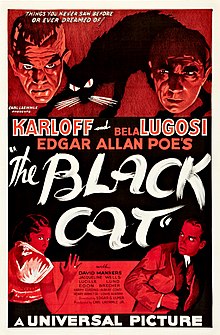
Young American lovers on their honeymoon in Hungary, a train ride beginning and ending the picture, a dark and rainy night, a road accident, an old dark house, an enigmatic doctor, a Satan worshipping priest, a story suggested by the work of Edgar Allan Poe with story and direction from Edgar G. Ulmer, and The Black Cat flies past in about 65 minutes, like a lot of the early horror classics.

Of course, there’s Karloff credited merely as Karloff, David Manners as one of the young American lovers, and Karloff and Lugosi find themselves at each other’s throat by the end of the picture.

Like the Frankenstein pictures and the Mary Shelley source material, The Black Cat departs almost entirely from Poe’s short story originally published in The Saturday Evening Post on August 19, 1843. I am okay with that, because Ulmer has a style all his own like James Whale in Frankenstein and The Bride of Frankenstein and The Black Cat pairs two movie legends for the first time.

The Raven gets done faster than even The Black Cat at 61 minutes, credits both Karloff and Lugosi with their surnames alone, and it has a lot of the same elements as The Black Cat.

Lugosi plays arguably his most diabolical and evil character in Dr. Richard Vollin, the archetype for the brilliant but troubled surgeon who has this, let’s say, morbid obsession with instruments of torture. He’s not your average doctor, obviously. Lugosi chews through the scenery, especially in the final reel, and relishes lines like Death is my talisman, I like torture, I tear torture out of myself by torturing you, and Poe, you are avenged!

Yes, he’s also obsessed with Edgar Allan Poe. The Pit and the Pendulum even makes a cameo appearance!

The Raven tilts more toward being Lugosi’s show because Karloff doesn’t even show up for his first scene until 17 minutes into the picture.

Karloff is great though, of course, and brings a certain poignancy to the tortured murderer on the run Edmond Bateman, who just wants the doctor to fix his ugly face.

EB: I’m saying, Doc, maybe because I look ugly … maybe if a man looks ugly, he does ugly things.

DRV: You are saying something profound.

Naturally, Vollin makes Bateman’s face even uglier and enlists him in a diabolical scheme.

The rest of the cast doesn’t measure up against Lugosi and Karloff, especially Irene Ware as the screaming socialite Jean Thatcher, but it doesn’t really matter because Lugosi and Karloff are so damn great.

I heartily recommend The Black Cat and The Raven, both Poe and Universal.

The Black Cat (1934) ****; The Raven (1935) ****


Werewolf of London (1935)

WEREWOLF OF LONDON (1935) ***
Werewolf of London — Hollywood’s first werewolf picture — must be one of the most overlooked horror films in the history of overlooked horror films, for obvious reasons.

During the 1930s, Universal Studios released Werewolf of London among the following group of horror films: Dracula, Dracula (Spanish version), Frankenstein, The Mummy, The Invisible Man, The Bride of Frankenstein, Dracula’s Daughter, and Son of Frankenstein, over half of them landmark productions that spawned multiple imitations and sequels. Werewolf of London came out nearly a month after The Bride of Frankenstein in the spring of 1935 and The Bride of Frankenstein became a big hit and developed a reputation for being a sequel that arguably betters the original.

Late in 1941, Universal’s second werewolf film appeared, The Wolf Man, and it quickly became the quintessential werewolf film, leaving Werewolf of London behind in the dustbins of cinematic history. Lon Chaney Jr. joined his late father Lon Chaney (Phantom of the Opera), Boris Karloff (Frankenstein), and Bela Lugosi (Dracula) in becoming a horror movie icon just from a single performance. Chaney Jr. revisited Larry Talbot / The Wolf Man in Frankenstein Meets the Wolf Man, The House of Frankenstein, House of Dracula, and Abbott and Costello Meets Frankenstein, and he displayed his versatility by portraying Dracula, Frankenstein’s Monster, and the Mummy.

In addition to Chaney Jr., The Wolf Man cast includes Claude Rains and Ralph Bellamy and many horror films love it for its mood and first-rate atmosphere.

By contrast, Werewolf of London stars veteran character actor Henry Hull and that’s unfortunately not a name that rolls off the tongue like, say, Lon Chaney Jr. Warren Zevon name checked both Chaneys in “Werewolves of London” — Well, I saw Lon Chaney walking with the Queen / Doing the Werewolves of London / I saw Lon Chaney Jr. walking with the Queen / Doing the Werewolves of London / I saw a werewolf drinking a piña colada at Trader Vic’s / And his hair was perfect — but, alas, no direct mention of Hull.

Werewolf of London definitely holds its most value as curiosity (and conversational) piece and not only for its place as the most overlooked film within the Universal canon and for its overall historical standing. After all, when’s the last time any protagonist in a film counted botany for their career or a horror film started with a prologue in Tibet. It also holds considerable fascination comparing and contrasting Jack Pierce’s makeup work between Werewolf of London and The Wolf Man, as well as how this earlier film handled the essential transformation scenes. The werewolf seems to have inspired Eddie Munster, so Werewolf of London does have that going for it.

The Marx Brothers & The Three Stooges

THE MARX BROTHERS & THE THREE STOOGES

Before Elvis and Chuck Berry, the Beatles and the Stones, Zeppelin and the Who, the Clash and the Sex Pistols, Nirvana and Pearl Jam, Woody Allen and Mel Brooks, Richard Pryor and George Carlin, Monty Python and Benny Hill, David Letterman and Jay Leno, and Jay and Conan, there was Buster Keaton and Charlie Chaplin, yes, but also the Marx Brothers and the Three Stooges.

There seems to be a notion that you can’t like both the Marx Brothers and the Three Stooges, and that you have to choose one over the other and the twain shall never meet.

I call bullshit on that notion.

There’s room for both in this mad, mad, mad, mad world.

However, I will admit upfront a preference for the Marx Brothers.

Granted, at the age of 8 through 10 or 11, I absolutely loved the Three Stooges and I learned only of the Marx Brothers from a scene in GOOD MORNING, VIETNAM. For a period of time on the school bus, my two cousins and I pretended that we were the Three Stooges and I played the Moe role. For many years after that obsessive period, though, I barely paid the Three Stooges a bit of attention. I don’t know, like fart jokes, they just seemed precisely like something that you instinctively move beyond as you get older and mature. I’ve revisited the Three Stooges’ work recently, though, and I’ve found enjoyment in them once again.

During college, I discovered the Marx Brothers and DUCK SOUP (1933) became one of my favorite all-time movies and Groucho Marx’s Rufus T. Firefly one of my favorite all-time characters. The Marx Brothers influenced my sense of humor tremendously, Groucho especially, and I don’t know how many co-workers or women I flirted with ever picked up any of the distinctive Marxist vibes.

I once argued with a college professor that DUCK SOUP retained value in the 21st Century because there’s still pompous jerks around who need to be deflated, not that I would have ever thought of naming that particular college professor as one.

In the end, I’ll choose Marxist anarchy over Stoogian anarchy because I prefer absurdist verbal wit over slapstick brutality.

The Marx Brothers paved the road for Mel Brooks, Woody Allen, Monty Python, Rodney Dangerfield, Bill Murray, Dan Aykroyd, Peter Sellers, Carl Reiner, Robin Williams, AIRPLANE!, Borat, Bugs Bunny, and “South Park.” Their influence extended to music — you cannot tell me their satirical and sartorial choices in military dress at the end of DUCK SOUP did not have an impact on the “Combat Rock” era Clash, Queen named two of their albums after Marx Brothers spectaculars (A NIGHT AT THE OPERA, A DAY AT THE RACES), and Alice Cooper and Groucho reportedly became good friends late in Groucho’s life. Groucho died in 1977, a year that also included the deaths of Elvis Presley and Charlie Chaplin (Elvis and Groucho separated by a mere three days in August 1977). The Ramones also had that great song “I’m Against It” on 1978’s ROAD TO RUIN, itself a reference to Hope and Crosby.

The Three Stooges influenced Sam Raimi, John Hughes, John Landis, John Belushi, John Candy, Chris Farley, the Farrelly Brothers, Mel Gibson, SMOKEY AND THE BANDIT, and wherever violent slapstick can be found in animation or live-action.

Now, I present 10 Marx Brothers and Three Stooges classics, five from each comedic team.

It should be duly noted the Marx Brothers starred in feature-length pictures (13 from 1929 to 1949) and the Three Stooges produced shorts (190 from 1934-1959).

HORSE FEATHERS (1932) — You don’t have to attend college for 10 years to appreciate HORSE FEATHERS. Oh, it definitely helps, don’t get me wrong. I must say I adopted Groucho’s opening song “I’m Against It” as my credo during college (I didn’t give a hoot that I had no son during the song adoption process): “I don’t know what they have to say / It makes no difference anyway / Whatever it is, I’m against it / No matter what it is or who commenced it / I’m against it / Your proposition may be good / But let’s have one thing understood: Whatever it is, I’m against it / And even when you’ve changed it or condensed it / I’m against it / I’m opposed to it / On general principles, I’m opposed to it … For months before my son was born / I used to yell from night till morn / ‘Whatever it is, I’m against it’ / And I’ve been yelling since I first commenced it / I’m against it.” I just now realized that “I’m Against It” as credo may have been responsible for 10 years of college. I met a lot of Connie Baileys during college, and they for sure were not “college widows,” but, yeah, everyone still says ‘I love you.’

DUCK SOUP (1933) — I don’t know how many damn times I’ve laughed myself silly at this damn movie. I just love how Groucho comes out firing innuendos and witticisms from the get-go and I’ve used several of them in real life like “I could dance with you till the cows come home. On second thought, I’d rather dance with the cows till you came home” and “[Fill in the blank] here may talk like an idiot and look like an idiot. But don’t let that fool you. He really is an idiot.” I must say that I always wanted to conduct official business at staff meetings just like Groucho’s Rufus T. Firefly does in the darkest chamber of Freedonia, especially the business about new and old business and the workers demanding shorter hours. DUCK SOUP upset Benito Mussolini and flopped at the box office, precipitating the brothers’ move from Paramount to MGM and the loss of one brother (Zeppo) from their movies. That’s what you get for truly being ahead of your time. DUCK SOUP is all killer, no filler Marx Brothers madness, and earns the highest (second highest) recommendation.

PUNCH DRUNKS (1934) — Moe Howard, Larry Fine, and Curly Howard starred together in 97 short films from 1934 to 1947, and there were many, many more featuring different Stooge permutations for Columbia Pictures. In their second production, Moe’s a struggling boxing manager, Curly’s a shy waiter, and Larry’s a fiddler. Curly turns into the world’s greatest heavyweight boxer, though, under the influence of the tune “Pop Goes the Weasel.” Rosin up that bow, Larry, and say ‘Bye, Curly, hello, K.O. Stradivarius.’ We can understand the effects of “Pop Goes the Weasel” in 1934 through later songs. In the late-1960s, for example, it’d have been the MC5’s “Kick Out the Jams.” In the early 1980s, Motorhead’s “Ace of Spades” or AC-DC’s “Hells Bells.” In the early 2000s, Drowning Pool’s “Bodies” would’ve perfectly suited a PUNCH DRUNKS remake. Personally, over the years, I’ve found much therapeutic value in such lovely, lilting songs as the Stooges’ “Search and Destroy,” the Clash’s “Cheat,” and the Misfits’ “Where Eagles Dare.”

MEN IN BLACK (1934) — Before Tommy Lee Jones and Will Smith, there was Doctor Howard, Doctor Fine, and Doctor Howard hot off the heels of PUNCH DRUNKS in this hospital spectacular that puts “Laughter is the Best Medicine” to the ultimate test. I know it was during the Great Depression, but one should consider how much dire straits a hospital must have been in to call on Doctor Howard, Doctor Fine, and Doctor Howard. MEN IN BLACK spoofs on the Clark Gable and Myrna Loy film MEN IN WHITE, which earned the distinction of being one of the first films condemned by the Legion of Decency. MEN IN BLACK competed against winner LA CUCARACHA and WHAT, NO MEN! for Best Short Subject – Comedy at the Academy Awards, the Three Stooges’ lone nomination in this category. The Three Stooges worked the broken glass running gag better than BETTER OFF DEAD (1985).

HOI POLLOI (1935) — Greek rooted phrase “Hoi polloi” means the masses or the common people, and elitist snobs use it derisively for people they believe are beneath them. Some pompous fools might even say the Three Stooges are “hoi polloi” or lowest common denominator entertainment. You might remember the good old “Nature vs. Nurture” discussion from school or at least TRADING PLACES when Ralph Bellamy and Don Ameche placed their bets on Dan Aykroyd and Eddie Murphy. Nature argues that genes and hereditary factors determine human behavior, whereas nurture centers around childhood experiences and how individuals are raised. Many great minds — from John Locke to Steven Pinker — have entered the dialectical fray in the last say 400 years, but the work of Doctor Howard, Doctor Fine, and Doctor Howard should not be neglected in the halls of history. HOI POLLOI is their 18-minute dissertation, replete with those patented Three Stooges slaps, eye pokes, head conks, and nose honks. Believe that’s even the name of a 1-minute, 42-second YouTube clip. There’s also some real good dancing in HOI POLLOI, and it left me with the urge to listen to Pulp’s or William Shatner’s “Common People.”

NIGHT AT THE OPERA, A (1935) — MGM producer Irving Thalberg (1899-1936) made sure the Marx Brothers were more “commercial” and “normal” after their five anarchic pictures at Paramount — especially DUCK SOUP — failed. A NIGHT AT THE OPERA, their MGM debut, gives us less Groucho, Chico, and Harpo and more standard romantic leads Allan Jones (not an improvement from Zeppo, who was a perfect parody of this kind of leading man) and Kitty Carlisle. We don’t want this romantic carp, er, crap, er, carp anywhere near our Marx Brothers madcap antics and wasn’t this a betrayal for our boys? For crying out loud, at the end of DUCK SOUP, all four Marx Brothers pelt Margaret Dumont with fruit when she begins singing a sweet victory song. One picture two years later, our boys embraced opera and let Jones and Carlisle sing their songs. What a letdown! Come on, man, I wish our heroes used fruit on Jones and Carlisle. I wish Zeppo stayed in their act. That said, Groucho, Chico, and Harpo still perform some of their best gags in A NIGHT AT THE OPERA and that’s a must to get somebody who hates opera through 96 minutes of a plot centered around opera.

DAY AT THE RACES, A (1937) — Despite not being the biggest fan of phones in real life, I’ve long been a fan of great telephone scenes in the movies, everything from Ray Milland’s final scene in FROGS (referencing DIAL M FOR MURDER, no doubt) and DR. STRANGELOVE to ONCE UPON A TIME IN AMERICA and IT’S A WONDERFUL LIFE. Groucho’s Dr. Hackenbush gives us a beautiful prank stall call scene and the boys get to ruffle the stuffed shirts of both Leonard Ceeley and Sig Ruman in A DAY AT THE RACES. I’ve always found it easier to get through A DAY AT THE RACES than A NIGHT AT THE OPERA, surely because it’s not opera. Yes, because it’s not opera and I’ll stop calling you Shirley. Allan Jones still needs a pie in the face whenever he opens that pretty boy mouth to sing, but Maureen O’Sullivan — TARZAN movies — proves to be a major upgrade from Kitty Carlisle and this is the MGM picture that most captures the spirit of the Marx Brothers at Paramount.

YOU NAZTY SPY! (1940) — A pioneer in mocking Hitler, well before THE DEVIL WITH HITLER and DER FUEHRER’S FACE and even before Charlie Chaplin’s THE GREAT DICTATOR. YOU NAZTY SPY premiered January 19, 1940, beating Chaplin’s first full-fledged talking picture by 286 days. Moe plays dictator Moe Heilstone, Larry’s propaganda minister Larry Pebble, and Curly’s field marshal Curly Gallstone. At least nobody’s “kidney stone.” After some evil shenanigans by evil cabinet ministers, Moe, Larry, and Curly take over Moronica and prove that old Rufus T. Firefly line true from the start of DUCK SOUP, “If you think this country’s bad off now / Just wait ‘till I get through with it.” The sung laws of Firefly’s administration included the line “Pop goes the weasel,” ironically the ditty featured in PUNCH DRUNKS. Yes, both YOU NAZTY SPY and its follow-up I’LL NEVER HEIL AGAIN could play right alongside DUCK SOUP … in fact, all three could join THE GREAT DICTATOR, TO BE OR NOT TO BE, THE DEVIL WITH HITLER, DER FUEHRER’S FACE, STALAG 17, and THE PRODUCERS in a marathon friendly to fascist dictators. Reportedly, YOU NAZTY SPY was both Moe’s and Larry’s favorite Three Stooges short.

I’LL NEVER HEIL AGAIN (1941) — Moe Heilstone (dictator), Larry Pebble (propaganda minister), and Curly Gallstone (field marshal) return again for this sequel released July 4, 1941, months before the United States’ official entry into World War II. The boys are paired again with director Jules White and screenwriters Clyde Bruckman and Felix Adler, despite the fact their characters were fed to the lions or something disturbing like that in YOU NAZTY SPY. One must wonder if Adolf Hitler and Joseph Goebbels ever came across YOU NAZTY SPY and I’LL NEVER HEIL AGAIN and how exactly they reacted. There’s much debate on whether or not Hitler saw THE GREAT DICTATOR. Chaplin himself wanted to know what Hitler thought of it. There were reports that Moe Howard rushed from the production to his daughter’s birthday party while still being dressed in full-on Hitler. Bet the switchboards in Hollywood went crazy on that one. It predated the mass hysteria in PLAN 9 FROM OUTER SPACE.

NIGHT IN CASABLANCA, A (1946) — German emigre Sig Ruman enjoyed a distinguished career in the films of the Marx Brothers, Ernst Lubitsch, and Billy Wilder and when you Google Sig Ruman you’ll encounter “Sig Ruman Marx Brothers” as keyword very quickly. He appeared in A NIGHT AT THE OPERA, A DAY AT THE RACES, and A NIGHT IN CASABLANCA, finding work in the most temporal Marx Brothers films. He’s like a windup machine that specializes in anger … and the Marx Brothers masterfully wind up that machine. Ruman’s incredible at both the double take and the overreaction. Watching A NIGHT IN CASABLANCA for the first time in several years, Ruman came to mind because he’s so great as the comic villain. Both the Marx Brothers and the Three Stooges needed comic villains, because sure they aggravate virtually everybody in their films but it’s more fun when it’s a comic villain who’s beyond exasperated.

The Marx Brothers: HORSE FEATHERS (1932) Four stars; DUCK SOUP (1933) Four stars; NIGHT AT THE OPERA, A (1935) Three-and-a-half stars; DAY AT THE RACES, A (1937) Four stars; NIGHT IN CASABLANCA, A (1946) Three-and-a-half stars

The Three Stooges: PUNCH DRUNKS (1934) Three-and-a-half stars; MEN IN BLACK (1934) Three-and-a-half stars; HOI POLLOI (1935) Three-and-a-half stars; YOU NAZTY SPY (1940) Four stars; I’LL NEVER HEIL AGAIN (1941) Four stars

Bride of Frankenstein (1935)

day 14, bride of frankenstein

BRIDE OF FRANKENSTEIN (1935) Four stars
Boris Karloff movies could fill an entire year of daily movie reviews.

Karloff (1887-1969) undoubtedly is one of the most prolific actors who ever lived, working steadily from 1918 through 1968.

Karloff established an incredible work pace, especially in the 1930s.

Take, for example, the years 1931 and 1932 alone when Karloff appeared in 24 films, including such classics as FRANKENSTEIN, SCARFACE, THE OLD DARK HOUSE, THE MASK OF FU MANCHU, and THE MUMMY.

He was billed only as “Karloff” in several pictures after FRANKENSTEIN (1931) made him a phenomenon.

For example, a producer’s note before the start of THE OLD DARK HOUSE: “Karloff, the mad butler in this production, is the same Karloff who created the part of the mechanical monster in ‘Frankenstein.’ We explain this to settle all disputes in advance, even though such disputes are a tribute to his great versatility.”

Every time I watch both FRANKENSTEIN and BRIDE OF FRANKENSTEIN (1935), I am just amazed once again by what Karloff was able to do with The Monster.

He’s absolutely phenomenal.

It took make-up artist Jack Pierce four hours every day to make Karloff into Frankenstein’s Monster, with a concoction of cotton, collodion, gum, and green greasepaint. Pierce and Karloff worked together on a multitude of films during the Golden Age of Horror (1930s and 1940s).

The IMDb identified eight Karloff trademarks and I especially like the eighth one: “Making audiences feel sorry for his evil characters by displaying extreme frailty and vulnerability, even when the material didn’t call for this.”

We feel a multitude of things for the Frankenstein Monster, and that’s at the center of the character’s greatness.

We especially feel for The Monster during BRIDE OF FRANKENSTEIN, a rare sequel that builds upon and honestly betters the previous film.

Karloff did not want The Monster to speak, feeling that it would eventually destroy the character. He looks a little differently here than in the first film, because in order to speak more clearly Karloff did not remove the dental plate in his face like he did in the first film. His cheeks appear less hollow as a result.

While giving The Monster the ability to speak could have miserably backfired, it works (like just about everything else) in BRIDE OF FRANKENSTEIN.

The Monster is a quick learner and the writers give him some great lines.

“I love dead … hate living” and “Alone: bad. Friend: good!” might not seem like much on the page, but the way Karloff handles them, they affect viewers on a deep emotional level.

There’s much poignancy to be found in the plight of The Monster.

He’s more like an innocent child than pure evil in both FRANKENSTEIN and BRIDE OF FRANKENSTEIN.

He can’t help what God or Dr. Henry (Victor in the novel) Frankenstein in this case made him.

Like Karloff, Colin Clive returns for the sequel as Dr. Frankenstein and he’s reluctant to the extreme (after the events of the first movie) to participate in Dr. Pretorius’ scheme to make The Monster a bride. Finally, he does though, of course, and it’s back to the laboratory; production designer Charles D. Hall’s lab sets in the first two FRANKENSTEIN films have been endlessly influential.

Clive and Dwight Frye (killed as two different characters in FRANKENSTEIN and BRIDE OF FRANKENSTEIN) are two of the great scenery chewers of all-time, but this is largely Karloff’s and Ernest Thesiger’s show.

Thesiger plays Dr. Pretorius, Dr. Frankenstein’s former teacher and, of course, a rebellious mad scientist. He’s as explicitly homosexual as one could present in a 1935 film and, according to the book “The Monster Show: A Cultural History of Horror” by David J. Skal, openly gay director James Whale told Thesinger to play Dr. Pretorius as an “over-the-top caricature of a bitchy and aging homosexual.”

Frankenstein and Pretorius rank among the best screen mad scientists.

BRIDE OF FRANKENSTEIN can be enjoyed at face value or can be seen as a daring gay parable that sneaked just enough content past the censors.

In the 1997 Gary Morris article “Sexual Subversion: The Bride of Frankenstein” printed in the Bright Lights Film Journal, the author postulates that the movie “assaults the notion of the sanctity of standard sex roles and ‘family values.'” Whale thus made the only sequel that interested him.

“THE BRIDE can be read from a modern perspective as a homosexual joke on the heterosexual communities Whale — a gay man — served and benefited from: his ‘masters’ at Universal and the mass audience to whom he could present unconventional images and ideas and see them unknowingly endorsed and approved in the most direct way possible: from the moviegoer’s pocketbook,” Morris wrote.

Under this theory, Whale’s attacks on hetero institutions can be seen most vividly when The Bride (Elsa Lanchester) rejects The Monster near the end, including a famous hiss that speaks louder than a thousand words. (Reportedly, Lanchester based her spitting and hissing on the swans in Regent’s Park, London.)

Not everything passed the censors enforcing the Motion Picture Production Code: Any references to the sexual arrangements of Mary Shelley (Lanchester in her first of two roles), Percy Bysshe Shelley, and Lord Byron (especially this line of dialogue: “We are all three infidels, scoffers at all marriage ties, believing only in living freely and full”) and “too revealing” shots of Lanchester’s cleavage were cut.

It’s still amazing what Whale put into the film.

Others have dismissed the gay parable angle in BRIDE OF FRANKENSTEIN.

That’s fine because any way you read it, though, BRIDE OF FRANKENSTEIN is a classic.