What’s Good for the Goose May Not Be Good for the Gander

WHAT’S GOOD FOR THE GOOSE MAY NOT BE GOOD FOR THE GANDER: JONATHAN LIVINGSTON SEAGULL & MILLION DOLLAR DUCK

Jonathan Livingston Seagull felt like the cinematic equivalent of a bird pooping on you for 99 long, long, long minutes. How long? It felt twice as long as watching Shoah.

By the way, what did that bird spray on its way? A whole load of New Age gobbledygook that gobsmacked me right in the kisser. I’ll stand with the flock of seagulls in this case, thank you very much, and put Jonathan Livingston Seagull on blast for being one festering piece of poo.

The nature photography and some level of admiration for exactly how they filmed it earn Jonathan Livingston Seagull one star, and that’s definitely more than our next specimen. However, I hate Neil Diamond’s songs and the birds’ outer-inner monologues, and I desperately wish Jonathan Livingston Seagull was a silent movie. Maybe I should have watched it muted. My bad.

For example, there’s six-and-a-half minutes of a Diamond concoction named “Be.” Maybe just maybe it will replace “Sweet Caroline” as the Great American Sing-a-Long. This sports writer can only hope after 10 years of hearing “Sweet Caroline” at every single baseball game. I’ll have endless admiration for a crowd that could make something timeless from lyrics the likes of “Be / As a page that aches for words / Which speaks on a theme that’s timeless / While the Sun God will make for your day / Sing / As a song in search of a voice that is silent / And the one God will make for your way.”

Early on in Jonathan Livingston Seagull, it tricked me into thinking I might be stumbling into a remake of the Alfred Hitchcock classic The Birds. Oh, how I wish it were true. Guess I can wish in one hand and have bird shit in the other.

Now, we come to Million Dollar Duck, a Walt Disney Studios production from 1971 that must have created a commotion back then, namely the sound of Uncle Walt rolling over in his grave at the abysmal quality of what might quite possibly be “one of the most profoundly stupid movies I’ve ever seen.” Roger Ebert and Gene Siskel agreed, because I quoted Ebert and now I will mention that Siskel walked out on Million Dollar Duck.

For the record, I endured about one hour and I stopped watching Million Dollar Duck right around the point when they brought out a photo of Richard Nixon and the stereotype of a Japanese diplomat carried over from World War II propaganda. At that point, I told Million Dollar Duck to go straight to The Devil and Max Devlin.

Sandy Duncan’s Katie Dooley has a beat on being the single dumbest character in cinematic history, and yes, that’s including any dumb character played by Pauly Shore or Adam Sandler and Lloyd and Harry from Dumb and Dumber, for crying out loud. You wonder how Katie Dooley and her brilliant husband Professor Albert Dooley (Dean Jones) ever created a child, let alone one of those precious, er, precocious Disney brood, er, children that could kill Damien with kindness.

The other dumb characters are not far behind, who are all dumber than the title character who earns the title, you guessed it, by laying golden eggs. Million Dollar Duck certainly laid an egg, all right, definitely not golden.

Once upon a time, my Grandma told me the story of how a bird found my Grandpa’s bald head in their back yard one day and how the bird started pecking away on that bald head. Actually, she told me that story a few times over the years and I must admit that I thought about it and pictured my poor Grandpa being pecked by that bird during both Jonathan Livingston Seagull and Million Dollar Duck. Finally, though, I cannot hate Jonathan Livingston Seagull and Million Dollar Baby too much because they helped me think about my grandparents and I have settled on the thought that one day I will tell my grandchildren about that one fateful night I watched Jonathan Livingston Seagull and Million Dollar Duck back-to-back and how I lived to tell the tale.
The Dark (1979)

THE DARK (1979) *

Be afraid, very afraid, not of the dark but of The Dark, a laughable thriller that only increases in being laughable until one of the most ridiculous conclusions in cinematic history.

See, I’m not afraid of sleeping in the dark, not afraid of being in a cemetery late at night, not afraid of being home alone in an old house, not afraid of admitting or being wrong, et cetera. In all honesty, though, I hated working alone late nights at the Neosho Daily News office and avoided it as much as possible, except Friday nights during football season. Once corporate killed the Sunday edition and made Tuesday our next paper, though, I started going home after the game, uploaded photos online, and wrote the gamer the next day.

Anyway, The Dark tells the story of a killer who strikes every night in the Los Angeles area and earns the cheap nickname ‘The Mangler.’ What’s a killer without a cheap nickname? This one is a nightmare for the police, because of his unusual strength, his seeming lack of any discernible pattern in his killing, his ability to leave no forensic evidence behind, and, predating Austin Powers, he shoots frickin’ laser beams from his frickin’ eyes. We eventually find out that he even grows stronger with every killing.

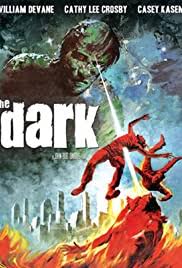
The killer and his laser beams look awesome on the poster for The Dark and I grade that promo artwork three-and-a-half stars. In the actual movie, though, the killer and his laser beams absolutely positively suck. These special effects alone impeded the advancement of all technology. When our killer unleashes his laser beams on several anonymous policemen in the grand finale, he clearly misses the mark but the policemen nonetheless take a mighty fall. In all seriousness, just thinking about these scenes now, I haven’t laughed this loudly since Richard Burton’s telekinesis in The Medusa Touch.

Just think all one had to do was light the killer on fire and BOOM! KABOOM! KABLOOEY! Just thinking about the killer’s demise now, I haven’t laughed so heavily since the paragraph before.

The Dark wastes a relatively distinguished cast — William Devane, Cathy Lee Crosby, Richard Jaeckel, and Keenan Wynn — and I find it ironic that fired director Tobe Hooper (replaced by John Cardos) later directed a flop horror film titled The Mangler.

Please remember, though, to be afraid, very afraid, of The Dark, especially since it’s possible that one’s head may explode from convulsive laughter.

The Prowler (1981)

THE PROWLER (1981) *
Describe The Prowler in one word.

Excess.

Yes, indeed, director Joseph Zito goes for an excess of false alarms and jump scares. It seems like there’s a scene like that every couple minutes. I mean, for crying out loud, somebody (usually her policeman significant other) sneaks up on our main female protagonist alone at least five times. Keep in mind The Prowler (hopefully not confused with the 1951 Joseph Losey thriller) earned Zito the opportunity to direct Friday the 13th: The Final Chapter.

Tom Savini’s gore effects ran into considerably less interference than earlier 1981 slasher films My Bloody Valentine and Friday the 13th Part 2, both released in the immediate aftermath of John Lennon’s murder and the subsequent MPAA tougher stance against graphic violence. Savini’s effects are quite frankly almost too good for their own good, as the blood gushes like a geyser at regular intervals. I found them a little much, just as I did in Maniac, and I usually love Savini’s work, especially Dawn of the Dead and Day of the Dead.

In addition to all the false alarms and jump scares, The Prowler relies too much on cat-and-mouse or a ‘contrived action involving constant pursuit, near captures, and repeated escapes.’ The main female protagonist and her dashing cop significant other recall Nancy Drew and one of the Hardy Boys. At one point late in the picture, she even attempts the old hiding underneath the bed with a deranged, psychopathic killer nearby trick.

The Prowler begins with a 1945 newsreel and a ‘Dear John’ letter, before getting down to brass tacks with a double homicide in the distant past that will trigger a present-day murder spree. After the success of Halloween, this flashback style of storytelling to start the whole shebang in style became the vogue for slasher films. Let’s see, Friday the 13th, Prom Night, Terror Train, and The Burning all started up this way and Happy Birthday to Me and My Bloody Valentine were both not too far behind with tours of the past. The plots of The Prowler and My Bloody Valentine have striking parallels, especially the overall look of the killer.

The Prowler conceals the identity of the killer until nearly the end of the movie and that’s probably best … but, who are we kidding, since I found some or even most of the Prowler’s behavior laughable even before the unveiling that calls into question every murder in the past hour. Fortunately, though, we have only a brief unmasking and then our heroine unceremoniously shotgun blasts the Prowler’s head to smithereens. We are spared any big speech or further character motivation and the frenzied scenery chewing of, let’s say, Betsy Palmer late in Friday the 13th. Unfortunately, we are not spared yet another jump scare in the film’s last scene, as if Zito received a bonus for overloading the picture with jump scares. Jump scares are cheap, though, and eventually some audience members turn against any picture that abuses jump scares, false alarms, cat-and-mouse, flashbacks, and dream sequences or whatever combination of them.

Casting Farley Granger as Sheriff George Fraser proved to be a strike against The Prowler, because I flashed back on two of the greatest thrillers ever made, Rope and Strangers on a Train, directed by none other than the Master of Suspense, Alfred Hitchcock. All the marvels of modern cinematic technology like nudity, gore, and profanity galore cannot make up for the difference between Zito and Hitchcock or the difference between a hack and a master.

The Magic of Lassie (1978)

THE MAGIC OF LASSIE

THE MAGIC OF LASSIE (1978) *

Nostalgia became a dominant cultural force in the 1970s, between AMERICAN GRAFFITI, “Happy Days,” ANIMAL HOUSE, ROCKY, STAR WARS, SUPERMAN, and THAT’S ENTERTAINMENT I and II.

Nostalgia also explains THE MAGIC OF LASSIE, in everything from everybody’s favorite cinematic collie to genial old timers James Stewart and Mickey Rooney to the songs by Richard M. and Robert B. Sherman and especially the values implied and directly stated by Lassie, Stewart, Rooney, and their songs.

The picture opens, for crying out loud, with All-American cinematic icon Jimmy Stewart singing “That Hometown Feeling.” I came up with a couple quick reactions: Thankfully, Stewart rarely ever sang during his long entertainment career; They are laying it on awful darn thick real quick in this pic. Of course, paraphrasing Bachman-Turner Overdrive, I hadn’t seen nothin’ yet. Is BTO on the soundtrack? No, but Stewart, Mickey Rooney, Debby Boone, and the Mike Curb Congregation are instead … hot diggity dog!

I just moaned and groaned about the Sherman Bros. songs in the 1972 animated SNOOPY, COME HOME, a picture about 10 or 50 or 100 times better than THE MAGIC OF LASSIE even with them darn songs.

In addition to songs that might cause somebody to wish for temporary hearing loss, THE MAGIC OF LASSIE relies heavily on a couple of my least favorite plot devices: A shady businessman leans on a property owner to sell his property (in this case a vineyard) and (mostly) comic villains ineptly chase our heroes.

In some real cutthroat business practices, Jamison takes Lassie away from kind old Grandpa Clovis Mitchell (Stewart) and his feisty grandchildren Kelly (Stephanie Zimbalist) and Chris (Michael Sharrett) and that horrible man makes it all the way to Colorado Springs with the prized bitch. Lassie runs away, headed for California. Chris runs away, headed for Colorado. Clovis takes off to look for Chris and Lassie. Clovis and Chris should be thankful, eternally grateful that Lassie’s the absolute smartest character in the entire movie, although maybe she wished she wasn’t so smart because her name would not have been in the title. Then again, wasn’t Lassie’s name always in the title of her entertainment packages?

It would take approximately 20 hours by automobile to get from Colorado Springs back to Sonoma (filming location of THE MAGIC OF LASSIE) and walking amounts to a trip lasting 414 hours. There are moments when THE MAGIC OF LASSIE feels like it lasts that long.

They really burden Lassie with some indignities during THE MAGIC OF LASSIE, all within that glorious ‘G’ rating. At least three name changes. A nasty addiction to banjo. Lassie rescues a cat from a burning building. That last one, why that’s just going way, way, way too far. I hope they paid her owners very handsomely.

Believe it or not, centerpiece song “When You’re Loved” (seen and heard in by my count two would-be feel good montages during the 100-minute cinematic endurance contest) received a nomination for Best Original Song at the 51st Academy Awards. I really can believe it, though, that “When You’re Loved” lost to Donna Summer’s “Last Dance” from THANK GOD IT’S FRIDAY.

By the end of THE MAGIC OF LASSIE (or TGIF, for that matter), though, all I was saying was “Thank God It’s Over.”

Couple Bombs from ’81: The Legend of the Lone Ranger, First Monday in October

COUPLE BOMBS FROM ‘81: THE LEGEND OF THE LONE RANGER, FIRST MONDAY IN OCTOBER

THE LEGEND OF THE LONE RANGER fails miserably at capturing any of the magic of the 1978 blockbuster SUPERMAN, its obvious cinematic inspiration.

Not even one speck.

Like SUPERMAN, LONE RANGER gives us a mythic origin story for an old cultural hero and then unfurls a new grand adventure featuring our updated hero and other updated characters. Sounds like a great time at the movies, but where did LONE RANGER go so absolutely incredibly stupendously wrong?

First stumbling block first, we have screen neophyte Klinton Spilsbury, who more or less remains a screen neophyte after LONE RANGER. That’s because Spilsbury botched his opportunity so badly that producers dubbed him with James Keach in post-production. Spilsbury quickly became a punchline upon the release of the film. For example, Gene Siskel remarked in his review that Spilsbury playing the Lone Ranger would make for a fine trivia question in the 1990s. I am straining to remember if Spilsbury appeared in “Trivial Pursuit” or perhaps on “Jeopardy” as the answer to who played the Lone Ranger in THE LEGEND OF THE LONE RANGER. If producers dub in another actor’s voice, how much of a performance did the dubbed out actor really give? Nevertheless, Spilsbury joined the ranks of infinitely superior actor Harvey Keitel, whose trademark Brooklyn accent did not make the final cut of SATURN 3. Sorry, Mr. Keitel.

Spilsbury definitely proved to be no Christopher Reeve, whose performance as both mild-mannered reporter for a great metropolitan newspaper Clark Kent and Kal-El, a.k.a. Superman, a.k.a. The Man of Steel, contributed a great deal to what made SUPERMAN and SUPERMAN II successful super-budget entertainments that connected with a mass audience on a personal level. Reeve said that he found inspiration from Cary Grant’s performance in BRINGING UP BABY and SUPERMAN and SUPERMAN II indeed at times resemble screwball romantic comedies. (Gene Hackman, Ned Beatty, and gang unfortunately suggest the campy villains from the 1960s Batman TV show, almost upsetting that precarious balance ‘tween humor and seriousness. Terence Stamp, Jack O’Halloran, and Sarah Douglas make better villains in SUPERMAN II.)

LONE RANGER lacks a lighter, humorous touch to counterbalance its mythology attempts. It is so somber that it becomes ponderous and then dreary before it finally springs into action, despite the efforts of Merle Haggard in the Waylon Jennings “Dukes of Hazzard” balladeer role. Obituarists skipped this chapter in Haggard’s career out of respect for the man when he died in 2016.

Finally springs into action is an understatement in the case of LONE RANGER.

LONE RANGER takes approximately 70 minutes to get the title character into costume and to play the William Tell Overture on the soundtrack, and we’re talking about a movie clocked at 98 minutes. William A. Fraker (director), Walter Coblenz (producer), Martin Starger (executive producer), and the writing team of Ivan Goff, Ben Roberts, William Roberts, Michael Kane, and Gerald B. Derloshon discovered a new level of stupidity.

Complete epic failure amounts to the only legend created by THE LEGEND OF THE LONE RANGER.

FIRST MONDAY IN OCTOBER also has its roots in old movies, though it may not be as obvious as LONE RANGER.

FIRST MONDAY wanted to be like one of those movies pairing Spencer Tracy and Katharine Hepburn — WOMAN OF THE YEAR, KEEPER OF THE FLAME, WITHOUT LOVE, SEA OF GRASS, STATE OF THE UNION, ADAM’S RIB, PAT AND MIKE, DESK SET, and GUESS WHO’S COMING TO DINNER.

Those movies succeeded in part because of the chemistry between Tracy and Hepburn and our enjoyment from watching them interact.

FIRST MONDAY fails in large part because Walter Matthau and Jill Clayburgh do not spark that Tracy-Hepburn chemistry and they are both miscast in their roles. FIRST MONDAY should be renamed “The Bickersons Go to the Supreme Court.”

Matthau stars as veteran Associate Justice Dan Snow and Clayburgh draws freshly appointed Associate Justice Ruth Loomis. All we need to know about them boils down to cranky old white ultra-liberal male (Snow) and feisty liberated white ultra-conservative female (Loomis) babble and battle but nonetheless develop affection toward each other.

Matthau gives the standard Matthau performance and it simply does not suit his character. Melvyn Douglas and Henry Fonda played this character on stage and they were both much better fits than Matthau.

Clayburgh made her fame as the quintessential liberated woman in AN UNMARRIED WOMAN and so it is jarring to see her play a rigid conservative. Also, she’s too young for her character. Jean Arthur, Jane Alexander (a few years older than Clayburgh), and Eva Marie Saint played the role on stage.

Paramount originally planned to release FIRST MONDAY in early 1982, but after President Ronald Reagan nominated Sandra Day O’Connor to the Supreme Court on July 7, 1981, Paramount rushed FIRST MONDAY forward to release in late August, one month before the Senate confirmed O’Connor’s appointment.

It is possible that FIRST MONDAY benefited commercially from publicity attendant with O’Connor’s historic appointment. FIRST MONDAY earned nearly $13 million in returns. In the long run, though, so what?

Upon first perusal of British director Ronald Neame’s film credits, one sees two disaster films, THE POSEIDON ADVENTURE and METEOR. After watching FIRST MONDAY, I count three disaster films directed by Neame.

I reviewed two bombs from ‘81 because Hollywood still recycles, rehashes, regurgitates, recapitulates, and remakes old movies, old plays, old TV shows relentlessly.

Message from Space (1978)

MESSAGE FROM SPACE

MESSAGE FROM SPACE (1978) *

It took two tries to make it all the way through Kinji Fukasaku’s MESSAGE FROM SPACE, one of the first of many STAR WARS rip-offs that only make you appreciate more what George Lucas and gang did in their movies.

How does MESSAGE FROM SPACE rip off STAR WARS? Let us count the ways. A soap, er, space opera, characters named Meia and Hans, a robot, interplanetary strife and destruction, aerial dogfights in space, laser beams, and a musical score by Kenichiro Morioka that should have been enough for grounds for a lawsuit from 20th Century Fox, John Williams, and the London Symphony Orchestra.

I struggled through MESSAGE FROM SPACE and it was a real cinematic endurance contest to get through its 105 minutes. I only made it through about 30 minutes the first try.

At one point in time, I thought about cutting MESSAGE FROM SPACE a little slack for its often lousy special effects, until I read that MESSAGE FROM SPACE cost $5-6 million. Okay, that’s about half of what 20th Century Fox spent on STAR WARS the previous year, but the budget for MESSAGE FROM SPACE apparently established a record (long since broken, of course) for largest budget for a Japanese movie. There went the slack, she be gone.

Vic Morrow (1929-82) sadly found himself at that stage in his career when he appeared in awful movies like HUMANOIDS FROM THE DEEP, GREAT WHITE, and MESSAGE FROM SPACE. Work is work is work, right? In MESSAGE FROM SPACE, Morrow plays a character named General Garuda and receives top billing in the cast above Sonny Chiba. Garuda Indonesia is the airline of Indonesia. Morrow seems to be drinking in every scene and if you had to act with an imitation R2-D2 named Beba, you’d be a full-blown alcoholic too.

This is one of those films not exactly helped out by a bad dubbing job.

I am normally one equipped with more empathy and enthusiasm than the average cinematic pleasure seeker for movies like MESSAGE FROM SPACE. I mean, for crying out loud, I have given four stars to INFRA-MAN, DRUNKEN MASTER, and PLAN 9 FROM OUTER SPACE, three incredibly ridiculous movies that immediately came to mind.

I just found scant pleasure to be experienced from MESSAGE FROM SPACE.

Hard to believe, right, when MESSAGE FROM SPACE features eight Liabe seeds. They resemble walnuts, glowing, magical walnuts that are the unifying plot device; bet Nuts.com would do killer business with a MESSAGE FROM SPACE remake. Rather than The Force, MESSAGE FROM SPACE only manages doze nuts. Bad joke, I know right, but the bad movie made me do it. I promise, I promise, I would never write anything like that otherwise.

More American Graffiti (1979)

MORE AMERICAN GRAFFITI

MORE AMERICAN GRAFFITI (1979) *

I missed the point of MORE AMERICAN GRAFFITI, the 1979 sequel to George Lucas’ highly influential smash hit from 1973, AMERICAN GRAFFITI.

Sure, I realize we are intended to catch up with John Milner (Paul LeMat), Steve and Laurie Bolander (Ron Howard and Cindy Williams), Debbie Dunham (Candy Clark), Carol “Rainbow” Morrison (Mackenzie Phillips), and Terry “The Toad” Fields (Charles Martin Smith) at different points in the 1960s, but I don’t know if the film had any other greater purpose than attempting to cash in on the AMERICAN GRAFFITI name for another box office bonanza.

You’re right: Richard Dreyfuss and Curt Henderson did not return for the sequel. He’s only the main character in AMERICAN GRAFFITI, for crying out loud. Just like there’s no Dreyfuss and Matt Hooper in JAWS 2. Like his friend Steven Spielberg did not direct JAWS 2, Lucas does not direct MORE AMERICAN GRAFFITI. Unlike Spielberg, though, Lucas had far more involvement with the AMERICAN GRAFFITI sequel, including editing duties.

We have Milner on New Year’s Eve 1964, The Toad in Vietnam on New Year’s Eve 1965, Debbie in San Francisco on New Year’s Eve 1966, and Steve and Laurie on New Year’s Eve 1967.

We shuffle between the four different New Year’s Eve days and director and screenwriter Bill L. Norton gussies up the 1965 and 1966 scenes with grainy newsreel style footage (1965) and split screen (1966). That helps us identify which year we’re seeing, for sure, but otherwise, both gimmicks do not work. Especially the split screen, a technique already overplayed after WOODSTOCK and Brian DePalma films like CARRIE. In MORE AMERICAN GRAFFITI, split screen takes away from every scene it’s used.

The original AMERICAN GRAFFITI focused on a single long day in 1962 and that made the parallel adventures of Curt, Milner, The Toad, and Steve much easier to follow and less distracting. Automobiles cruising the main drag and car radios playing Wolfman Jack’s radio show unified just about every scene.

AMERICAN GRAFFITI also proved to have a theme: It showed Curt, Milner, and The Toad all outside their comfort zones and getting to know somebody beyond their accustomed social circle: intellectual and future college boy Curt and the tough guy car club the Pharaohs, the James Dean “Rebel Without a Cause” Milner and a young teenage girl dumped off on him by her older sister and older friends, and the geeky and socially awkward Toad and the blonde bombshell Debbie. They all form a greater understanding of each other.

Lucas did not get across the theme in a pretentious, heavy-handed, preachy way. Just about every scene in AMERICAN GRAFFITI worked on some level, and it especially seemed incredibly accurate about what life was like in 1962.

Meanwhile, in MORE AMERICAN GRAFFITI, hardly any scenes work and the film never builds up any momentum. It seems to mark off the list of every cliche of the era and maybe it just feels that way even more after one million ‘60s nostalgia trips. MORE AMERICAN GRAFFITI plays like a Time Life movie.

MORE AMERICAN GRAFFITI loses steam early on when Debbie and her loser man friend Lance Harris (John Lansing) are pulled over and he’s busted for just a little joint by Officer Bob Falfa (gratuitous Harrison Ford cameo appearance) after a chase that feels like it takes forever … and that’s immediately followed by Steve and Laurie playing the Bickersons.

Considering how little works in MORE AMERICAN GRAFFITI, it’s even greater insult to injury when the final shot teases us with the death of a main character.

A New World Pictures Double Feature: Avalanche & Piranha (1978)

A NEW WORLD PICTURES DOUBLE FEATURE: AVALANCHE & PIRANHA (1978)

Two New World Pictures exploitation films entered the Great American box office sweepstakes in August 1978.

One became a surprise hit and the other dramatically flopped.

Roger Corman, a man of a million film productions, tossed his hat into the disaster movie ring with AVALANCHE, while PIRANHA riffed on the killer fish blockbuster JAWS.

PIRANHA, directed by Joe Dante and populated by experienced character actors like Bradford Dillman and Keenan Wynn and Dick Miller, recouped its budget and then some and spawned one sequel and at least two remakes.

Star actors Rock Hudson (1925-85) and Mia Farrow headline the human cast of AVALANCHE and New World invested a reported $6.5 million on the picture, a great deal more $ than PIRANHA. You know that it did not go very well for AVALANCHE when its greatest claim to fame is that it made “The Official Razzie Movie Guide” honoring the 100 most enjoyably bad movies ever made.

This bad movie enthusiast, however, did not enjoy AVALANCHE. I found it to be a long slog. I mean, I felt like the one climbing the mountain to get through its 90-odd minutes.

First and foremost, it’s a soap opera in the shape of a ski resort hosting a ski tournament and a figure skating competition. Egads! Magazine reporter Caroline (Farrow) divorced control freak and wealthy ski resort owner David (Hudson). You guessed it, David wants her back, wants her to use his last name rather than her maiden name, she keeps him at arm’s length, and she attaches herself to another man, which only infuriates Mr. Control Freak. Man oh man, that scene on the dance floor when David flips on Caroline, I wanted to bury my head in the snow.

That’s not all: We have David’s spirited mother, an elite skier who seems to be even better as lothario, competing figure skaters, competing lovers, a television reporter, and a nosy photographer. Remember, we need a body count.

That nosy photographer (Robert Forster) and David act out a scene near and dear to disaster movie connoisseurs everywhere. Nick Thorne, the nosy photographer’s name, warns David there’s an avalanche coming and that everybody’s in danger. Any of us could write the rest of the scene and, for that matter, the rest of the movie.

Disaster movies often create a dilemma in our hearts and minds: We desperately want the disaster to come and take us away from the phony baloney dialogue and situations. Yes, I’ll say it, the characters deserve to die a dramatic cinematic death sooner rather than later. … Then, when disaster strikes, disaster movies invariably give us scenes just as phony baloney as before. That’s what happens in AVALANCHE.

Director and screenwriter Corey Allen (1934-2010) blamed AVALANCHE’s disaster as a movie on budget cuts and a tight production schedule, whereas Corman said PIRANHA succeeded because it’s funny and very well directed.

I agree.

PIRANHA tips its humorous hand very early on when one of the main characters plays the classic Atari “Shark Jaws” arcade game. Then, we have classic lines like “They’re eating the guests, sir” and “People eat fish. Fish don’t eat people” and “Terror, horror, death. Film at eleven.” Those with a darker sense of humor may find a friend in PIRANHA. We can thank John Sayles for the script.

I’ve said it before and I’ll gladly say it again: Joe Dante is one of the best American directors. His credits include GREMLINS, GREMLINS 2: THE NEW BATCH, THE HOWLING, THE ‘BURBS, MATINEE, and SMALL SOLDIERS. I don’t think he’s ever let me down, and he does not let me down in PIRANHA.

PIRANHA goes cheerfully over-the-top.

For example, JAWS eliminates one kid. PIRANHA takes out virtually an entire summer camp in grisly detail. I’ve known people who hate PIRANHA because of this one sequence.

Roger Ebert began his one-star review, “I walked into PIRANHA wondering why the U.S. government would consider the piranha to be a potential secret weapon. After all, I reasoned, you can lead the enemy to water but you can’t make him wade. I was, it turns out, naive. PIRANHA is filled with people who suffer from the odd compulsion to jump into the water the very moment they discover it is infested by piranhas.”

Of course, the characters in PIRANHA have a compulsion to jump into piranha-infested waters. Honestly, that’s all part of the joke and part of the fun, especially when Kevin McCarthy works up a variant on his INVASION OF THE BODY SNATCHERS performance.

Just like it’s fun seeing Dick Miller doing his take on Murray Hamilton’s mayor in JAWS. Miller, of course, does not want to hear about top secret scientifically-engineered killer piranhas (created through Operation: Razorteeth) and he does not cancel his party for prospective home buyers. You can guess what happens to most of them home buyers. Yes, PIRANHA takes many of the elements from JAWS and pushes them to extremes.

I enjoyed PIRANHA quite a bit, for its tongue-in-cheek humor and film buff references. There’s brilliant little touches strewn throughout the film, like Phil Tippett’s stop-motion animation creation in McCarthy’s lab. He’s the scientific genius behind them super killer fish, who are released into the system by our heroes played by Dillman and Heather Menzies. Anyway, this stop-motion creation, part-fish and part-lizard, epitomizes the generosity of PIRANHA in general. The film gives us a lot to enjoy.

The credits for PIRANHA are first-rate: Dante, Sayles, Tippett, composer Pino Donaggio, editors Dante and Mark Goldblatt, and makeup effects creator Rob Bottin. They all have done some fine work during their careers, inc. PIRANHA.

Steven Spielberg, the director of JAWS, reportedly considered PIRANHA the best of the many JAWS rip-offs and his approval expressed to Universal stopped the studio from pursuing an injunction against New World for PIRANHA. Universal’s first JAWS sequel, JAWS 2, came out two months before PIRANHA.

AVALANCHE (1978) *; PIRANHA (1978) ***

The Car (1977)

THE CAR

THE CAR (1977) *

The Devil and cars were huge in the movies of the 1970s.

Building on the momentum of ROSEMARY’S BABY in 1968, we saw THE BROTHERHOOD OF SATAN, THE EXORCIST (the biggest hit of them all that spawned many imitators and successors), THE DEVIL’S RAIN, THE DEVIL WITHIN HER, BEYOND THE DOOR, BEYOND THE DOOR II, THE OMEN and DAMIEN: OMEN II, and THE AMITYVILLE HORROR.

As far as cars, we had TWO-LANE BLACKTOP, DUEL, THE SUGARLAND EXPRESS, GONE IN 60 SECONDS, DEATH RACE 2000, THE GUMBALL RALLY, EAT MY DUST, GRAND THEFT AUTO, and SMOKEY AND THE BANDIT.

THE CAR, directed by Elliot Silverstein and distributed by Universal, combines The Devil and cars to make one stupefying, awful, patently ridiculous horror movie.

Yes, that’s right, a homicidal maniac automobile seemingly possessed … or just having a really, really, really bad day. Maybe the latter was just me watching THE CAR.

This movie just doesn’t know when to quit and it starts early with the murders of two bicycling teenagers in the majestic desert of Utah. We’re talking first few minutes and the film wastes absolutely no time in establishing its basic pattern. Maybe I should have turned off the subtitles, because they provided the evocative forewarning “Ominous instrumental music.” I knew the bludgeoning music was coming, though, because I’ve seen a movie or two before, especially a horror movie. Ominous instrumental music indeed, especially when it sounds like 50 horror film musical scores piled up into one super bad score. Forget the killer car next time, I want the movie about the killer musical score. Tagline: “They could not believe their ears, until it was too late. … THE MUSICAL SCORE FROM HELL will make your eardrums bleed. Coming soon to a theater near you.”

Every 10-15 minutes, at least, we are beaten with a ridiculous death scene or, barring that, a scene of peril just for variety. That ominous instrumental music, all them close-ups of the customized 1971 Lincoln Continental Mark III (built by George Barris, who previously brought us the Batmobile for the 1966 BATMAN), and Silverstein’s overall poor handling of action. At times, the vehicles look like they’re being artificially sped up.

Unfortunately, in between those violent scenes, we are served a steady diet of banalities and unpleasantries, only adding insult to injury.

For example, just about every scene with veteran character actor R.G. Armstrong (1917-2012) applies the unpleasant extra thick. He beats on his wife and insults just about everybody in sight. Never mind his slurs against Native American character Chas (played by Henry O’Brien in his final feature film). He’s a nasty old man. Honestly, why is his character Amos not killed? You’re right, it must have something to do with the explosives needed for the grand finale … and, before that, Sheriff Everett (John Marley) needs to be killed rather than Amos so Wade (James Brolin, who seems to be hired when Sam Elliott is unavailable), our main human protagonist, can take charge. It all makes sense.

Our title character is maddening to the nth degree and we have already touched on why, but let’s pursue it more.

Sure, it can kill a main character by driving through her house in the ultimate display of supernatural power. This character, Lauren (Kathleen Lloyd), the lover of the protagonist, turns her back to the window as she speaks to Wade on the phone. This means, however, that we can see the car coming straight for her through her window. This scene is supposed to be a highlight, a real heart breaker or at least a real tense moment since we see the murderous car well before her, but, like virtually every other scene in THE CAR, it’s laughably bad in a bad way.

Just like the scene that establishes the car’s need for revenge against Lauren. Safe on the hollowed grounds of a cemetery, Lauren really lets our title character have it, resorting to chickenshit and a son of a bitch. That’s obviously going too far, even before she tosses a tree branch at it. She asked for her auto demise. I should mention that she’s a school teacher whose marching band students were chased into that cemetery by you know who. We have seen that scene archetype before, namely in Alfred Hitchcock’s 1963 classic THE BIRDS. THE CAR just drags this entire sequence out.

Then again, dragging it out describes the entire movie.

Our title character is especially maddening because it wastes two perfect opportunities to flatten Wade like a pancake. What’s that all about? We get the feeling that were it any other character and not the protagonist, it would be “Sayonara, sucker!” The first opportunity even gives us a cut from Wade in danger in the desert to being safe in a hospital bed. I hate cheap tricks like that.

Was there anything I liked about THE CAR? Fleeting moments, like glimpses of the Utah scenery as seen through filming locations St. George, Snow Canyon, Zion National Park, Glen Canyon, Hurricane, the Mount Carmel Tunnel, and Kanab. I would have preferred a 96-minute nature documentary on this area over THE CAR.

I knew I was in trouble when THE CAR starts out with a quote from Church of Satan leader Anton LaVey (1930-97) and The Satanic Bible.

LaVey also previously had a hand in the making of THE DEVIL’S RAIN, another godawful horror movie.

Sometimes, it seems like even the Devil just can’t buy a break.

Night School (2018)

NIGHT SCHOOL

NIGHT SCHOOL (2018) One star

I know that I am probably not the target audience for director Malcolm D. Lee’s comedy starring Kevin Hart, who also served as one of the six writers and producers on NIGHT SCHOOL.

I know that, but I am still hard pressed to come up with a single (even fleeting) moment I laughed at during a movie listed at 111 minutes.

I struggled through NIGHT SCHOOL, but I must report there were those around me who laughed their heads off at regular intervals. They made up the difference for my stone face. (Previously, I had this experience at THE HANGOVER, STEP BROTHERS, and TED, though far more pronounced for those comedies since I watched them in a crowded multiplex.)

Perusing through Hart’s credits, I found one movie over the last 18 years that I watched before experiencing NIGHT SCHOOL, just one movie and not exactly a good one at that, SCARY MOVIE 3. I might have watched SUPERHERO MOVIE, but it’s not exactly coming back to me now with any clarity. I am glad that I have missed just about every one of his movies.

In NIGHT SCHOOL, Hart plays a high school dropout named Teddy who’s forced to attend night school at his alma mater to pursue a GED. It is far more complicated than that, of course, especially since he’s not been honest with his far more successful fiance about a single thing. Yes, he’s a hustler. I know, I know, it’s a shocker.

I especially found any of the restaurant scenes in NIGHT SCHOOL difficult to watch, because they involve a pubic hair custody battle, incessant mugging and melodrama especially by Hart, racism accusations that will remind one of bad scenes from BEVERLY HILLS COP and RUSH HOUR 2 involving Eddie Murphy and Chris Tucker, and I just can’t take that sentence and paragraph any longer though I will be leaving behind crucial plot points.

The classroom scenes are really not any better, since the night school students and authority figures combine to form a modern-day comedic variation on a platoon in a World War II movie. There are would-be identification figures for everybody in NIGHT SCHOOL.

We have the harpy teacher with an inspirational heart of gold (Tiffany Haddish), the high school principal (Taran Killam) whom our protagonist embarrassed back in high school who’s prone to fits of mugging for the camera more pronounced than the rest of the cast, the working class laborer (Rob Riggle) who has literally broken his back and wants to get into management, the harried housewife (Mary Lynn Rajskub) with a great big lummox for a husband, the former waiter (Al Madrigal) who dreams of being like Justin Bieber or Justin Timberlake, the woke conspiracy theorist (Romany Malco), the young woman (Anne Winters) from a wealthy family, and the convict (Fat Joe) beamed into a standard plot through Skype.

Hart, Haddish, and Killam in particular are guilty of overplaying everything, bludgeoning us with every single joke until the film gets all gooey and sentimental in the final reel and takes its plot oh so seriously. This cast acts like each audience member suffers from a learning disability (or hearing loss).

I absolutely hate it when comedies go for cheap gag after cheap gag for most of their running time and then get all serious and borderline preachy at the end, like they want both their NATIONAL LAMPOON’S ANIMAL HOUSE and their ABC Afterschool Special. I wanted to gag when Teddy began his meandering feel good speech at graduation.

Austin Chronicle reviewer Marc Savlov incorporated both the Hindenburg and John Hughes’ THE BREAKFAST CLUB into his opening sentence. That’s good and true, because NIGHT SCHOOL indeed leaves me saying “Oh, the Humanity!”