BATTLE OF BRITAIN (1969) One star Never in the field of motion pictures were so few scenes owed by so few to so many.
— Harry Saltzman
As far as we know, Harry Saltzman never actually said that, nor did Winston Churchill or, for that matter, Yogi Berra and Yogi the Bear.
Anyway, that would-be quote came to mind several times during Battle of Britain and it’s been on my mind preparing this review inside my ripped, twisted brain.
Just look at the cast: Harry Andrews, Michael Caine, Trevor Howard, Curt Jurgens, Ian McShane, Kenneth More, Laurence Olivier, Nigel Patrick, Michael Redgrave, Ralph Richardson, Robert Shaw, Patrick Wymark, Susannah York, Michael Bates. Anyway, we get the point and to fill in the rest of the cast might take every bit as long as Battle of Britain.
Battle of Britain lasts approximately 2 hours, 12 minutes, and yeah, that’s exactly right, very little screen time for each actor since there’s so many of them.
Regardless, the planes get all the good lines in Battle of Britain.
Beyond the planes, though, Michael Caine’s dog gives the best dramatic performance. Unfortunately, I couldn’t even find the dog’s name in the seemingly neverending end credits.
Battle of Britain invested so much into the planes that it forgot about the characters, the people, you know, the reason why audiences engage with any successful motion picture spread. They spent so much on the planes, in fact, they couldn’t even afford subtitles for the German dialogue spoken often throughout Battle of Britain, for crying out loud.
I am not always the biggest fan in the world of these cast-of-thousands World War II epics and Battle of Britain joins The Longest Movie, Boring! Boring! Boring!, and A Movie Too Long in the cinematic wreckage of bloated, ponderous war movies.
It especially doesn’t help when the musical score for Battle of Britain has me thinking that’s what it must feel like to be trapped inside a tuba for a two-hour concert.
The Kinks’ incredible, indelible concept album Arthur (Or the Decline and Fall of the British Empire) came out two weeks before Battle of Britain in October 1969 and coincidentally, I put Arthur on almost immediately after Battle of Britain. Arthur provided the emotional and intellectual content missing from Battle of Britain, as well as a great sense of humor and sharp wit, not to mention tunes out the wazoo.
Arthur lasts all of 49 minutes, 17 seconds, and travels from the Victorian era to World War I to World War II to post-war England to Australia in a mere 12 songs. Ray Davies proved himself once again to be one of the great storytellers in popular music on this album, from opener “Victoria” and “Shangri-La” to “Mr. Churchill Says” and closer “Arthur.”
I get more from one song on Arthur than all of Battle of Britain; for example, these rather cinematic lyrics from “Some Mother’s Son,” Some mother’s son lies in a field / Someone has killed some mother’s son today / Head blown up by some soldier’s gun / While all the mothers stand and wait / Some mother’s son ain’t coming home today / Some mothers son ain’t got no grave / Two soldiers fighting in a trench / One soldier glances up to see the sun / And dreams of games he played when he was young / And then his friend calls out his name / It stops his dream and as he turns his head / A second later he is dead / Some mother’s lies in a field / Back home they put his picture in a frame / But all dead soldiers look the same.
RATS! RATS! RATS! YOU’VE GOT A FRIEND IN WILLARD AND BEN It makes sense that a sequel to the 1971 hit Willard appeared within the next year.
It makes sense that this sequel focused on the rat Ben and would be called Ben, given the previous film’s rather downbeat ending.
It also makes sense that Phil Karlson directed Ben, since Karlson directed such gritty films as Kansas City Confidential, 99 River Street, and The Phenix City Story, all involving characters who might be considered dirtyrats.
Karlson never directed any character badder and meaner than Ben, though. Not any of the tough guys played by John Payne, Preston Foster, Neville Brand, Lee Van Cleef, and Jack Elam in Kansas City Confidential. Ben don’t need no stinking mask, for one. Ben also has an infinitely larger gang anyway and they’re real hungry as demonstrated throughout Ben. Nor Tennessee sheriff Buford Pusser from Walking Tall, which Karlson made right after Ben. Joe Don Baker must have come as quite a relief after Ben, who quickly became a has been after his two film roles and multiple songs about him. Ben must have wanted even more dough to return for a third film. That dirty rat!
Ben also won a PATSY Award for his performance in Ben, which undoubtedly contributed to his ego problem.
Anyway, I didn’t much care for Ben, because it quickly established a dread pattern after the obligatory flashback to the events that ended Willard. Here’s that pattern: Rat attack. Cutesy poo musical number. Rat attack. Cutesy poo musical number. Rat attack. Cutesy poo musical number. Rat attack. Cutesy poo musical number. Rat attack. Cutesy poo musical number.
Sounds like a real winner, right? Yeah, if you like a bunch of bad ideas bouncing off each other for 90 minutes.
You can also throw in some police chatter, a journalist character who’s seemingly working on just this one story (though it’s hard to blame him, I mean it’s not everyday that millions of street rats terrorize a city), and a little boy named Danny and his sister (played by Meredith Baxter before her marriage and hyphenated name, before her TV mother fame, before her Lifetime movie career, before her coming out) and his mother who all seem like refugees from a Disney live-action project.
Oh yeah, like Willard before him, the little boy possesses the ability to communicate with rats, especially Ben. Oh yeah, once again, the lonely little boy has a heart condition.
Danny proves responsible for the musical numbers scattered throughout Ben and he even gives Ben a puppet show. Wow, just wow.
A 13-year-old Michael Jackson sings “Ben’s Song” over the end credits and “Ben” competed against songs from The Poseidon Adventure, The Little Ark, The Life and Times of Judge Roy Bean, and The Stepmother for Best Original Song at the 1973 Academy Awards. “Ben” lost to “The Morning After” from The Poseidon Adventure, believe it or not, and having heard both songs, I don’t believe it since “The Morning After” defines godawful. Unfortunately so does most of the movie Ben.
I’ll give Karlson and animal trainer Moe Di Sesso their due for amplifying the rat count to 4,000 for Ben. Eight times the rats as Willard, but that’s the only area in which Ben triumphs over its older brother. Granted, one human year translates to approximately 30 in rat years, so maybe that’s why Ben’s motion picture career stopped after two films in two years.
Rating: One star.
— What else can I say other than I liked Willard and I would not be surprised if I found out that it played as one-half of a double bill with fellow 1971 cult film Harold and Maude.
Both are weird little items with a delightfully morbid sense of humor and I only say delightfully because I like both films, and they have offbeat lead characters who push the patience of every adult.
Bruce Davison stars as Willard Stiles, who must contend with a harridan mother (Elsa Lanchester) and a bully for a boss (Ernest Borgnine). Willard develops a close relationship with Ben and Socrates, who unfortunately for Willard are rats. See, Willard finds out that he can communicate directly with rats and that he enjoys their company more than his fellow human beings, especially his overbearing mother and all her overbearing friends and his asshole boss. His mother wants Willard to get rid of them damn rats and his boss, well, he develops genuine distaste for Rattus norvegicus after Willard’s rats crash his party one night.
Willard also begins a tentative, very tentative relationship with his lovely temporary co-worker Joan (Sondra Locke). In the end, Willard should have pursued Joan more than Socrates and Ben. No doubt that our lad Willard would have lived a whole lot longer.
As interesting as it was to watch Davison and Locke early in their careers and Lanchester (The Bride from The Bride of Frankenstein) late in her career, Borgnine proved to be the key component in the success of Willard. For a picture like Willard to work any whatsoever, we need a character that we love to hate and Borgnine’s Al Martin suitably fills that need. For us to fully anticipate and then relish his inevitable death, Borgnine needed to work us into a frenzy every time he’s onscreen. Borgnine does that and then some, especially when he seizes upon Socrates and kills him with delight. We know then, more than ever before, that Martin will meet a spectacular demise.
Borgnine won the Academy Award for Best Actor in 1956 for his extremely likable performance as the title character in Marty, directed by Delbert Mann. Sixteen years later, in a picture directed by Daniel Mann, Borghine mined the opposite end of the character spectrum for Martin.
For sure, Borghine might be the first, last, and thus far only Academy Award-winning actor to be annihilated by rats.
CREATURE FROM THE HAUNTED SEA (1961) * Lemme tell you about Jack from Creature from the Haunted Sea.
His real name is Happy Jack Monahan and he’s a crew member of crook Renzo Capetto, who has this real genius plan backfire on him miserably. Renzo wants to systematically eliminate his hapless crew and blame their deaths on a certain legendary sea monster, and that monster turns out to be real. Who could have guessed such a phenomenon? Anyway, Happy Jack’s played by Robert Bean and not by Jim Beam, which might improve Creature from the Haunted Sea.
This Happy Jack character, who probably once lived in the sand at the Isle of Man, imitates all form of animal life and it’s not a good sign for any sort of a good movie when Happy Jack lets out his inner yak. Happy Jack undoubtedly could have had a great future in “Farmer Says” toys, had he not been cast in Creature from the Haunted Sea.
That’s a roundabout way to get to the main point: Creature from the Haunted Sea ranks with the absolute dregs of the monster movie, down there buried at the bottom of the sea alongside Robot Monster and Slithis and APE, three other infamous monster movie titles featuring infamous movie monsters. You might feel sorry for this poor creature from the haunted sea and for all those associated with him, but mostly you’ll just laugh at him in that same way many people often do when they come across old movies and their antiquated special effects.
I am thankful, however, for Creature from the Haunted Sea, because its tedium afforded me the opportunity for an afternoon nap. I woke up and I felt like I didn’t miss a thing, not a beat; even if I did miss a thing, I would be grateful for it. That afternoon nap earned Creature from the Haunted Sea one-half star more than Slithis and APE, for example, I do believe.
I have not watched every Roger Corman monster movie, but Creature from the Haunted Sea is definitely the worst so far, leagues below Attack of the Crab Monsters from 1957 that’s for certain. Hell, Creature from the Haunted Sea is so bad that it makes The Wasp Woman look almost like Citizen Kane by comparison.
Charles B. Griffith (1930-2007), credited or not but more often credited, wrote screenplays for Corman spectaculars It Conquered the World, Attack of the Crab Monsters, A Bucket of Blood, and The Little Shop of Horrors, as well as later Corman productions Death Race 2000 and Eat My Dust. In other words, the man definitely had his better moments like Bucket of Blood and Little Shop of Horrors. Alas, Creature from the Haunted Sea is not one of them.
Rather, it’s a compendium of crap.
For example, Creature from the Haunted Sea gives us more voiceover narration than what’s necessary for any creature feature. I mean, for crying out loud, I bet there’s more voiceover in Creature from the Haunted Sea than in all the other films combined from 1961. Sure that’s why I fell asleep for a while. Airplane spoofed voiceover fantastically, although thankfully I did not meet the same fate as the characters on that infamous cinematic flight.
It doesn’t even matter that future Academy Award-winning screenwriter Robert Towne delivers this narration or that he’s credited for ‘Sparks Moran / Agent XK150 / Narrator.’
I have not talked much about the actual creature in Creature from the Haunted Sea and there’s a good reason for that. Yes, that’s right, the creature from the haunted sea just might be the worst movie monster I have ever seen, and please keep in mind I’ve seen Robot Monster.
SIX WEEKS (1982) * My wife awoke in the middle of the night, it took her quite some time falling back asleep, and so naturally she joined me for about the last 30 minutes or so of Six Weeks. She asked me some basic journalistic questions like ‘What’s the little girl dying from?’ ‘I believe it’s leukemia.’ ‘No, it can’t be. It’s got to be something else. I don’t think she’d just suddenly die like that.’
At some point during our discussion, I said that actually this poor little girl has got the dread movie disease where the invariably dead-by-the-end-of-the-movie character becomes ever more beautiful and noble until her big death scene. Yes, the late film critic Roger Ebert named this affliction ‘Ali MacGraw Disease’ after the star of Love Story, the film based on the best-selling novel that one might say started it all way back in 1970.
Movies derived in way or another from Love Story invariably pour it on awful darn thick with the sentiment, until the movie in question becomes a real maudlin exercise. Six Weeks pulls out the stops more than most in this dubious category and that’s why I was utterly amazed that it did not feature a hot-air balloon scene like fellow maudlin tearjerkers Bobby Deerfield, Yes Giorgio, and Just the Way You Are. That’s about the only restraint practiced by Six Weeks.
Casting 101 pairs Dudley Moore (1935-2002) and Mary Tyler Moore (1936-2017), fresh off critical and commercial hot commodities Arthur and Ordinary People, respectively. Yes, wow, how far out, both actors have the same last name and they’re apparently not related. They don’t even have the same national origin. Anyway, like Walter Matthau and Jill Clayburgh in the turkey bomb First Monday in October, Moore and Moore do not share the slightest bit chemistry either, that’s for darn sure. Dudley plays a California politician who’s running for Congress, Mary’s a wealthy cosmetics heiress with the precocious 12-year-old daughter already discussed in the opening paragraph. Dudley’s hopelessly lost in an early scene, very late to a political fundraiser where he’s the featured speaker, and the 12-year-old gives him directions and a whole lot more. She wants Dudley to win his election and Moore² to hook up and become the ultimate happy family for her life’s remaining duration.
Katherine Healy plays the dying little girl and she’s a bit, what’s the word, insufferable. She’s one of those movie children with an unlimited supply of wannabe sharp dialogue and snappy comebacks. She’s dying, remember, and that makes her dialogue even worse and her fantasies ever more powerful. Yes, that’s right, she’s got six weeks left and she’s going to live out as many of her fantasies as possible within the production budget of a 107-minute feel good extravaganza.
Moore² and the little girl hit the bright lights of New York City because what better place to live out fantasies on the big screen and little Niki skates at The Rink at Rockefeller Center, takes on the lead in The Nutcracker, and rounds up Moore² for a smug little cutesy pie wedding ceremony that almost extracted wholesale vomit from the pit of my stomach. Not exactly in that order, though, because the wedding ceremony happens before the grandstanding grand finale ballet number. Niki performed her ballet number on center stage, I looked at my wrist like there’s a watch attached to it and said to my wife, ‘It’s about time for the little girl to die.’ Sure enough, that’s what happened in the very next scene.
I left out the part (until now, anyway) about Dudley’s family, his dutiful wife and teenage son. That’s OK, because they’re not that important and don’t stand in the way of the main body of the plot. Speaking of the plot, Six Weeks pushes and pulls so many emotional levers that it becomes one of the most shameful tearjerkers ever made. They finally resorted to yanking them emotions with pliers. Thankfully, I still resisted and this review signals my protest on aesthetic and emotional grounds.
BOMB, BOMB, BOMB: PARTNERS, CHARLIE CHAN AND THE CURSE OF THE DRAGON QUEEN, WHEN TIME RAN OUT
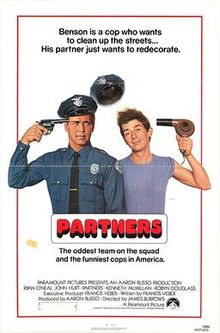
I could only make it through about 30 minutes of Partners and that’s more than enough for at least about 10 lifetimes, I’d say. I gave up on the picture for good around the fourth time star Ryan O’Neal uttered the epithet faggot. Yeah, Partners basically plays Cruising for laughs. Ha-ha, funny … about as funny as punching somebody’s mother in the face.
I consider Partners the absolute worst film from 1982, at least among the 70 or so films that I have seen thus far in my 42 years on this planet. It supplanted Amityville II: The Possession, a lovely little number incorporating blood, vomit, incest, matricide and patricide, fratricide and sororicide, and demonic possession. Never mind Inchon, a $46 million Korean War epic that bombed mightily at the box office with only a $5.2 million return. Never mind Halloween III: Season of the Witch, which features one of the least likable lead characters (Dr. Dan Challis) and lead performances (Tom Atkins) in recent memory. Believe it or not, Partners beats those other films in sheer unpleasantness.
Did longtime TV director James Burrows use Partners for his audition for Will and Grace? I seriously doubt it, because Partners is one of the nastiest pieces of work I have ever seen. Burrows has directed more than 1,000 TV episodes, including 237 Cheers and 75 Taxi and 32 Frasier. Thankfully, Burrows stuck with television after Partners.
Early in the picture, O’Neal asks his boss how he got stuck partnering up (literally) with gay records clerk Kerwin (John Hurt) to infiltrate and investigate a series of murders in the Los Angeles gay community. Anyway, Chief Wilkins (Kenneth McMillan) tells our matinee idol, “Because you’re a good cop, a real good cop. And because of your cute ass.” Maybe that’s how O’Neal himself got the gig. O’Neal certainly dressed up for the part, wearing a ridiculous tank top and then a leather garb in just the portion I watched before saying Roberto Duran on Partners.
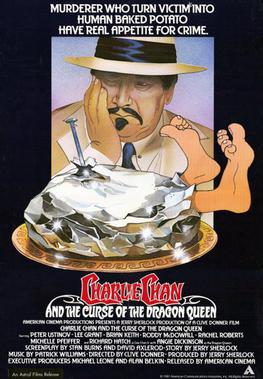
— As I sit here before this keyboard and ponder my next direction, I consider how I endured all 95 minutes or so of Charlie Chan and the Curse of the Dragon Queen, another great big smelly turd from the early ’80s like the ones mentioned about three paragraphs up.
When folks express this incredible nostalgia for the ’80s, undoubtedly it’s not Charlie Chan or Partners or Inchon, for that matter, they’re nostalgic about, because they SUCK in the immortal words of Al from Caddyshack. Then again, if I have learned anything over the years writing about movies or music online, it’s that somewhere in this great big world there’s a cult following Howard the Duck or Halloween III, for example, and they just might flame you for not cherishing their cult object in the same way they do.
Charlie Chan asks us to believe Peter Ustinov (1921-2004), Richard Hatch (1945-2017), and Angie Dickerson as characters of Asian descent. Sure, I believe the Englishman Ustinov as fictional Belgian detective Hercule Poirot (a character he played six times, including features Death on the Nile, Evil Under the Sun, and Appointment with Death) and Roman emperor Nero in Quo Vadis, but I call it more of a stretch to consider him as Chan in 2020, nearly 40 years after the film was made. It’s even worse for both Hatch and Dickerson.
Charlie Chan features plenty of the broadest comedy and frenzied overacting by a rather distinguished cast that also includes Lee Grant, Brian Keith, Roddy McDowall, Rachel Roberts, and Michelle Pfeiffer early in her career. Hatch plays Chan’s fumbling bumbling stumbling grandson Lee Chan Jr. and I’ve watched so many films lately with fumbling stumbling bumbling would-be detectives that I now grumble and rumble when I see them on the screen. I’m thankful my Grandma never behaved like the one played by Grant in Charlie Chan. Keith’s police chief says ‘Goddamn’ about 50 times. McDowall and Roberts play Grant’s domestic helpers, Gillespie and Mrs. Dangers respectively, but they both provide little help to Charlie Chan since they are both in the grand tradition of melodramatic domestic help in the movies; Mrs. Dangers calls to mind Patsy Kelly’s frantic maid in The Gorilla. Pfeiffer could have dialed the perkiness down a notch or few and still have saved enough for the rest of her career. Nearly all of these characters are cringeworthy.
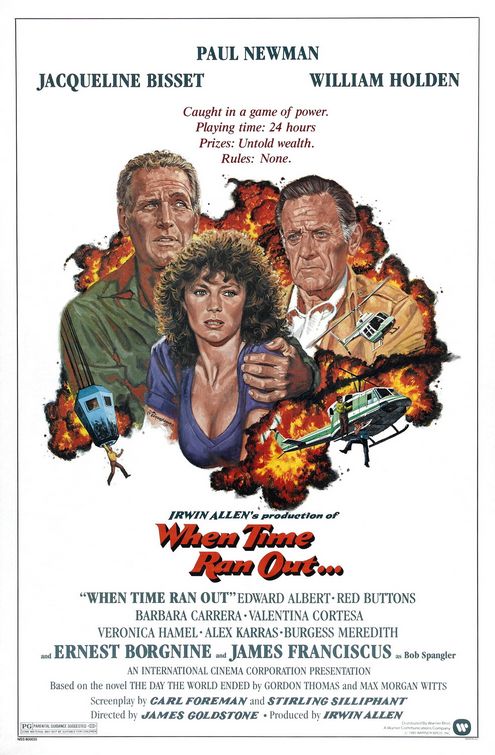
— When Time Ran Out came out Mar. 28, 1980 and it eventually fell about $16 million short of making its $20 million production budget back at the American box office.
Later that year, on July 2, Airplane parodied Airport specifically and disaster movies in general, and became one of the biggest hits of the summer and the entire calendar year.
The failure of When Time Ran Out and the success of Airplane signaled the end of the disaster movie, at least in the form that dominated the first half of the seventies with The Poseidon Adventure, Earthquake, and Towering Inferno and then dribbled out pure unadulterated dreck the final half of that decade like The Swarm, Beyond the Poseidon Adventure, and Meteor. Since I mentioned Meteor, I also have to mention Avalanche, which provided disaster footage recycled in Meteor as if being in one disaster of a disaster movie just simply was not enough.
Master of disaster Irwin Allen (1916-91) produced at least half the films mentioned in the paragraph right above this one and he even stepped in the director’s chair for the turkey bombs The Swarm and Beyond the Poseidon Adventure. Allen called on Rollercoaster director James Goldstone for When Time Ran Out, which features the required number of old time movie stars, hot commodities, and fledgling character actors. When Time Ran Out should have been called Take the Money and Run, though Woody Allen and Steve Miller already used it for a comedy (1969) and a hit song (1976).
We have William Holden (1918-81), Paul Newman (1925-2008), Jacqueline Bisset, Ernest Borgnine (1917-2012), James Franciscus (1934-91), Burgess Meredith (1907-97), Red Buttons (1919-2006), Barbara Carrera, Pat Morita (1932-2005), Veronica Hamel, Edward Albert (1951-2006), and Alex Karras (1935-2012), as well as a volcano, a tidal wave, etc.
Seemingly half of the cast takes part in a glorified soap opera before the molten lava really begins to flow and they have to repeat business from Beyond the Poseidon and seemingly every other disaster movie of the era. Here’s that glorified soap opera: Holden proposes to Bisset very early in the movie and she turns him down because she’s in love with Newman, who’s not the marrying kind and anyway he does not seem to much care for Bisset but maybe he’s just masking his true feelings toward her with standard male bluster. Franciscus is married to Hamel but he’s fooling around with half-brother Albert’s significant other Carrera. Just wait, it gets better, Albert does not know that he’s Franciscus’ half-brother … and Holden and Hamel are sleeping together. I think I just about nailed it down and you’re right if you’re thinking all that seems like too much plot for such a dimwitted movie.
You’re also right that I hated these characters and their miserable lives, and rooted for the volcano to wipe them all out.
Especially Franciscus, who takes chronic disbelief in the face of impending disaster to new lows in When Time Ran Out. Unfortunately, an incredibly shoddy special effect leads to an incredibly unsatisfying death for Franciscus’ character. We crave to see him bite the dust or eat molten lava in spectacular fashion, and what we get is just plain laughable.
Of course, just plain laughable describes about 99 percent of When Time Ran Out.
Believe it or not, costume designer Paul Zastupnevich earned an Academy Award nomination for Best Costume Design and went against winner Tess, The Elephant Man, My Brilliant Career, and Somewhere in Time, all of them period films where the look of the film itself becomes another important character.
Yeah, I hope the 1981 Oscar broadcast used a shot of Newman in his utterly ridiculous Urban Cowboy garb.
Zastupnevich received a nomination for the same award two years before for his edgy, state-of-the-art costume work on The Swarm, beekeeper outfits. The Agatha Christie Hercule Poirot period murder mystery Death on the Nile won the prize.
I hate to say it, but time ran out on this review because I don’t want to consider When Time Ran Out any longer than I already have.
Partners No stars; Charlie Chan and the Curse of the Dragon Queen 1/2*; When Time Ran Out *
When you have Bela Lugosi and Lionel Atwill in the cast, make them supporting players, and focus instead on the Ritz Brothers and Patsy Kelly, I call that a major failure.
The Gorilla, distributed by Twentieth Century-Fox and not surprisingly based on a stage play given the film’s limited sets and overall stagy feel, made that very choice. Lugosi earns more laughs than the execrable Ritz Brothers just by playing it straight. Yes, I found Al, Jimmy, and Harry execrable, as they fumbled bumbled and stumbled their way and I conversely grumbled my way through The Gorilla, a horror comedy that fails miserably at both genres. I read the Ritz Brothers walked away from The Gorilla because of the shoddy quality of the script and that’s never a good sign when the stars themselves grumble. They were right, though, because The Gorilla is shoddy, but the Ritz Brothers don’t get let off the hook. Not so fast.
The Ritz Brothers have been called a poor man’s Marx Brothers. No way, they’re not even good enough for that. Granted, to be fair, The Gorilla marked my first exposure to Al, Jimmy, and Harry, so maybe they did their best work elsewhere. Based on The Gorilla, though, I could not differentiate between Al, Jimmy, and Harry, who might as well be any Tom, Dick, and Harry off the street. They blended into one grating personality. I mean, Groucho, Harpo, and Chico created their own distinctive trademark comic personalities and they provided us a wealth of great comic material when they worked at their best (Horse Feathers, Duck Soup).
Laurel and Hardy did this horror comedy number much, much, much better in the 28-minute The Laurel-Hardy Murder Case from 1930. Watching The Gorilla, there’s one recurring gag involving a chair, a desk, a light, and disappearance that specifically makes it clear The Gorilla ripped off The Laurel-Hardy Murder Case, which parodies silent films The Cat and the Canary and The Bat. Paramount released a The Cat and the Canary remake starring Bob Hope and Paulette Goddard on Nov. 10, 1939, only about five-and-a-half months after The Gorilla.
We’ve all seen The Gorilla before, possibly many times before, through other movies, not only the fumbling bumbling stumbling detectives but also the maid who loves to shriek in just about every other scene, the wealthy uncle and the lovely young niece and her male friend and the inheritance plot, the butler who did not do it but who seems to show up at exactly the wrong time so he becomes an obvious suspect for the murders afoot, and both a killer named ‘The Gorilla’ and a real gorilla escaped from the local zoo on the loose and in the same house.
I believe that we talked about Lugosi and his great cinematic love for apes and gorillas back when I reviewed Bela Lugosi Meets a Brooklyn Gorilla. I gave that one three stars, but it actually has almost a full point lower average rating than The Gorilla on Internet Movie Database. Big whoop! I found Jerry Lewis and Dean Martin knockoffs Sammy Petrillo and Duke Mitchell a whole lot more endearing and funny than Al, Jimmy, and Harry Ritz, and Bela Lugosi Meets a Brooklyn Gorilla is not a snooze fest hopelessly dedicated to one set like The Gorilla.
SHE-WOLF OF LONDON (1946) * I have an alternate title for the 1946 Universal Studios anti-horror classic She-Wolf of London: She-Wolf of Tedium.
Since there’s no actual she-wolf, our new alternate title downsizes to Tedium.
Over a 31-year period, Universal made 31 films that are grouped together as the Classic Monsters series, featuring Dracula, Frankenstein’s Monster, the Wolf Man, the Invisible Man, the Phantom, the Mummy, and/or the Werewolf of London, not to mention Abbott and Costello.
She-Wolf of London falls outside the Classic Monsters jurisdiction and it’s worse than any of them. Yes, it’s even worse than The Invisible Woman, the nadir of the Classic Monsters series.
Since I watched The Wolf Man and Werewolf of London, I expected a she-wolf in London, transformation scenes, and scenes of mayhem.
No, director Jean Yarbrough (The Devil Bat), screenwriter George Bricker, and producer Ben Pivar give us a standard issue murder mystery.
June Lockhart, then a 21-year-old ingenue years before her mother roles on Lassie and Lost in Space, stars as poor, poor Phyllis Allenby, whose deep, deep belief in the so-called ‘Curse of the Allenbys’ leads her to believe that she’s the werewolf responsible for all the deaths in the local park. Good old Aunt Martha (Sara Haden), that good old Aunt Martha, anyway, she owns dogs that bark all night and they take a real shining to poor, poor Phyllis. Between all the murders that point toward her and dogs barking and curse talk, Phyllis gets worse over the course of She-Wolf of London. That’s all part of Aunt Martha’s master plan, since she wants to drive Phyllis insane and inside an asylum so Aunt Martha and her daughter remain living inside the mansion rather than Phyllis and her doting barrister, boyfriend, and potential husband Barry Lanfield (Don Porter). Barry sees through it all, believes in Phyllis, and it’s all so touching when he proves her innocence. Instead, Aunt Martha becomes one of those less than convincing movie murderers, you know, in a revelation that renders the rest of the movie, what’s the word, ridiculous … and not the good ridiculous either.
Yeah, that’s a whole lot of plot synopsis and She-Wolf of London surrenders itself to many exposition scenes during a 61-minute motion picture spread. All that exposition becomes the source of all that pesky tedium, which is not exactly what I was expecting from a movie titled (incorrectly) She-Wolf of London. There I go again, my own worst enemy.
THE INVISIBLE MAN (2020) * I should have called the cops on The Invisible Man.
The latest remake of an old Universal Studios warhorse, The Invisible Man gives viewers two hours of domestic violence. That makes it a relentlessly unpleasant and positively joyless viewing experience, and definitely not what I expected from an Invisible Man movie. Obviously, it’s my problem that I entered The Invisible Man expecting a grand old entertainment and received something else that produced the barest minimum of entertainment value.
I know, I know, shame on me.
Recently, I watched The Invisible Woman, Invisible Agent, and The Invisible Man’s Revenge to complete the series of six Invisible Man pictures that began in 1933 with James Whale’s classic and ended in 1951 with Abbott and Costello Meet The Invisible Man. I give five of the six films positive reviews and they’re all entertaining in their own ways — yes, even The Invisible Woman has its moments, few and far between but nonetheless they’re visible.
Invisible Agent wisely took the series in a new direction — a different one from the wrong hard left turn made by The Invisible Woman — incorporating Nazis, Nazi spies, spying against Nazis, and Peter Lorre into the formula. It’s hard not to watch Invisible Agent and think Steven Spielberg loved the movie growing up and it later informed Raiders of the Lost Ark, especially Ronald Lacey’s Peter Lorre-like character.
The Invisible Man’s Revenge returns to the roots of the series and the title describes the plot.
Here’s the length of the first six Invisible Man pictures: 71 minutes, 81, 72, 81, 78, and 82, all well below the 124 minutes offered by the 2020 version.
However, the new Invisible Man contributes maybe five minutes of entertainment value and it’s one of those films I liked less and less as it traveled down a long and predictable road. The earlier Invisible Man films move along briskly, while this marvel of modern technology belabors everything to such a degree that a three-toed sloth dipped in molasses moves faster.
Aside from the invisibility hook and the Griffin surname for the title character and his slimy brother, the new Invisible Man has a lot more in common with the 1991 Julia Roberts battered woman hit Sleeping with the Enemy. By calling it The Invisible Man brand name, though, expectations are high for entertainment, but that’s not what it offers in the slightest so it set itself up for its own failure.
I generally distrust remakes, reboots, sequels, etc., and I am sure that many of us do in varying degrees. I love it when viewers of all demographics bitch and complain about old movies, how they’re crusty and slow-moving and not in color, but they’re plundered from on a regular basis most often with inferior storytelling craft by the new guard.
The Invisible Man director and writer Leigh Whannell previously brought us the first three Saw movies, and so the fact that his Invisible Man wallows in and lingers over domestic violence should be of little or no surprise. Whannell wrote the story or screenplay or both for all three, and starred as Adam Faulkner-Stanheight in Saw. I managed to mostly avoid the once seemingly interminable Saw series, catching only one of the seven films churned out by the foremost torture porn assembly line in seven years. For some unknown reason even to me, I watched Saw IV and hated just about every single millisecond of it. All these years later, I only remember thinking they should have called it Fuck with an exclamation point because that’s about the only dialogue used with any regularity.
Never fear, fans of Whannell and rehashes and Whannell rehashes, because Wolfman and Escape from New York are in pre-production.
ROLLERCOASTER (1977) * Rollercoaster, a thriller that combines Peter Bogdanovich’s vastly superior Targets, a disaster movie, and a mad bomber movie, marked the first time I returned to an amusement park since that fateful day on family vacation this past summer at Holiday World in Santa Claus, Indiana.
Everything was fine and dandy, we even maintained social distance and wore our masks as often as possible, until 16-year-old Emily wanted 12-year-old Isaac to ride on a roller coaster. She said he promised that he would try at least one roller coaster with her, he said that he made no such promise, she won’t ride on a roller coaster by her lonesome, he did not budge and refused to ride, and they eventually broke into hysterics and went their separate ways. Emily followed my wife Lynn and I back into the main body of the park and she frequently groused about her younger brother, while Isaac stayed behind and wept for the state of the world or something on a bench.
Two hours later, Emily decided to go to the car and she found Isaac sleeping on a bench just outside the park en route to the parking lot. No big deal, he said, he was tired, so he walked off, walked out, and took a nap. He did look a little refreshed.
I virtually walked the entire length of Holiday World twice over looking for Isaac to no avail and I lost count of every Beatles, every Beach Boys song the park blasted that day over the loud speakers. I had precise numbers, and they were gone. Lynn and I were obviously not pleased with either Emily or Isaac, and this is the first time I have spoken publicly about that Sunday afternoon in a place seven hours away from home.
The best thing about Rollercoaster, aside from the fact that it finally ended, is that it put that day in Santa Claus in perspective. I mean, yeah, at least we didn’t have happen to us what happened to the characters in Rollercoaster, especially at the 10-minute mark in the movie when our resident mad bomber (just call him The Mad Bomber with No Name who apparently represents something about our fears) played by Timothy Bottoms blows up a section of track and spectacularly derails a roller coaster. Needless to say, Universal Studios released Rollercoaster — in Sensurround, which Universal head Sidney Sheinberg called as big as any star in the movies — in June ’77 and a little release named Star Wars blew it away. Universal made just one more film in Sensurround. Big star?
Bottoms’ bomber presents one fundamental problem, because we never learn even his name or his motivation or much of anything ’bout him or even see that he enjoys being a mad bomber. He’s a cipher who’s not even mad enough in either way to justify being called a mad bomber. So when he meets his inevitable demise in the film’s grand finale, I felt no joy and only relief because it finally put this two-hour movie to pasture where it can rest in manure for eternity.
Here’s that perspective: Rollercoaster and that ordeal in Holiday World both lasted about two hours in real time, and both felt much longer. Yeah, I don’t much care for roller coasters in real life or captured on celluloid.
In closing, I should mention that Helen Hunt and Steve Guttenberg make their feature film debuts, iconic actors Henry Fonda and Richard Widmark appear here strictly for the money, and the eccentric rock band Sparks reportedly calls their cameo appearance in Rollercoaster — where they perform two songs from their 1976 LP Big Beat — the biggest regret of their career.
BLOODLINE (1979) * Bloodline, a.k.a. Sidney Sheldon’s Bloodline, tries its hand at several fiction genres and fails mightily at every single one of them.
Let’s see here, we have the always popular Woman in Danger, murder mystery, police procedural, and the film adaptation of a literary potboiler that revolves around the rich and the shameful, predominantly shameful anyway, in lush international jet set surroundings. It also throws in a snuff film style murder every 30 minutes.
The great British actress Audrey Hepburn (1929-93) proves to be the only redeeming factor at play during Bloodline and she’s responsible for the one star rating. She brings a touch of class to the proceedings. At that point in her career, Hepburn rarely did movies and focused more of her time on her family. Considering the dubious nature of Bloodline, her first and only R-rated movie, she should have devoted even more time to her family. After all, Hepburn made her fame in such films as Roman Holiday, Sabrina, Funny Face, Breakfast at Tiffany’s, and My Fair Lady, productions far removed from the cheap thrills and tawdry exploitation that Bloodline tenders at its best and worst. Hepburn and Bloodline director Terence Young made the 1967 psychological thriller Wait Until Dark and that’s much, much, much better and way, way, way more suspenseful than Bloodline.
Maybe, just maybe I have an instant great distaste for adaptations made from the fiction of such writers as Sheldon (1917-2007), Harold Robbins (1916-97), and Jacqueline Susann (1918-74), who are said to have authored popular novels or works better understood by the unwashed masses than the snooty literary critics. I have not read their work, but having watched Valley of the Dolls and Bloodline, both trashy productions, I’ll stick being to a snob, thank you very much. Anyway, I can’t read a single word of anything else until I finish Crime and Punishment.
Since it wants to be classy, Bloodline comes hyped as a thriller rather than a horror film, but there’s not a single thrill to be had regardless of genre classification. Hepburn plays Elizabeth Roffe, a pharmaceutical heiress who becomes the next in line for murder after her father’s murdered in the film’s opening scene. Like her father before her, Ms. Roffe doesn’t want her company’s stock to go public and this creates incredible friction with her three cousins who mostly provide the rich and shameful portion of the program. All roads lead to the obligatory denouement, and I should have taken a detour.
In fact, I did just that because at regular intervals during Bloodline, I kept distracting myself with other movies. For example, almost every time I saw Gert Frobe’s Inspector Hornung, I desperately wanted him to say (just once), “No, Mr. Bond, I expect you to die.” Instead, Hornung spends most his screen time discussing the case with a talking computer. Ben Gazzara seems like he’s under sedation throughout Bloodline and I could not believe this was the same actor who gave us such lusty characters in Anatomy of a Murder and Road House. Meanwhile, I still occasionally debate within myself which one’s worse between Bloodline and Oh Heavenly Dog, both turkey bombs featuring Omar Sharif. Yes, I don’t hate myself.








 Attack of the Killer Librarian