Broadway Melody, Cimarron Won Best Picture! So What, Because They Suck!

BROADWAY MELODY, CIMARRON WON BEST PICTURE! SO WHAT, BECAUSE THEY SUCK!
The Broadway Melody and Cimarron are horrible, terrible, horrible movies and the first two examples of how winning the Academy Award for Best Picture does not guarantee quality.

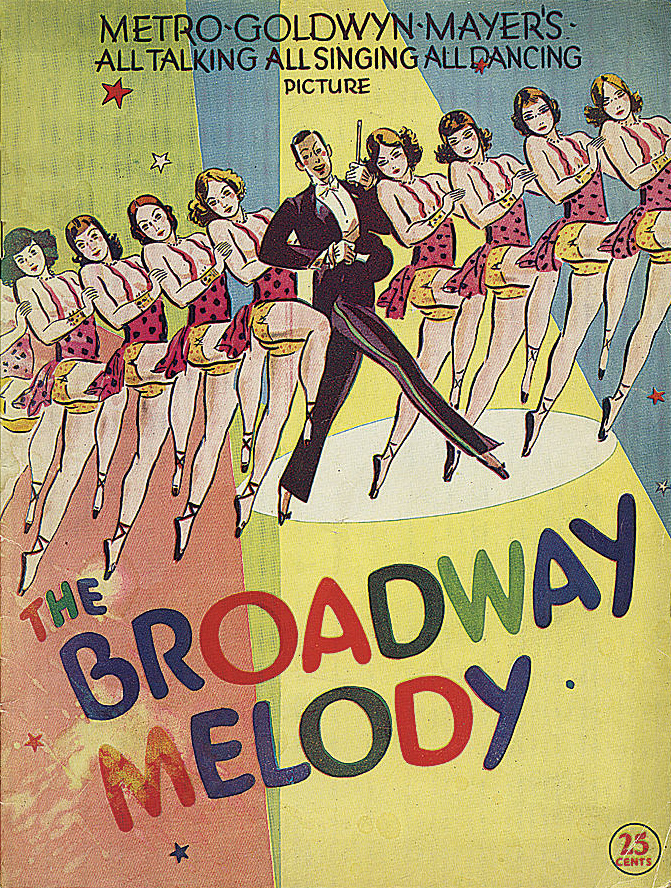
The Broadway Melody (1929) owns the distinction of being the first talking picture and the first musical to win Best Picture, thus it has a permanent place in cinematic history. Otherwise, though, The Broadway Melody makes me wonder how come the motion picture industry did not return to silent pictures, because the dialogue and the songs both stink up the screen every step of the way. (Apparently, MGM also released The Broadway Melody in a silent version.)

Likewise, Cimarron (1931) is the first Western to win Best Picture and it’s one of those movies, well, near the end of its 130-minute duration, I told my wife, “I feel like I’ve aged 40 years watching this movie.” In fact, I had to use hedge trimmers on my facial hair and step in the barber’s chair after Cimarron, and perhaps I should be thankful Cimarron only covered 1889 to 1929 and not a longer historical span. I might have been in deep trouble, at least six feet under, had the Howard Estabrook and Louis Sarecky screenplay and the 1929 Edna Ferber novel instead considered 50 or 60 years of Yancey and Sabra Cravat.

The first in a series of musicals for MGM, The Broadway Melody stars Charles King as Eddie Kearns and Anita Page and Bessie Love as sisters Queenie and Harriet ‘Hank’ Mahoney. See, what happens, Eddie and Hank have had a thing, but then he lays his eyes on a now grown up Queenie and boy oh boy, his eyes nearly pop out their head. Whee, Queenie lays off Eddie, sister loyalty, and lets New York high society playboy Jock Warriner (reference to studio mogul Jack Warner) play her. Eddie and Queenie realize they’re in love, Hank finally accepts it, and it all ends happily ever after with the closing line delivered by the character with a stutter. It was so good that I forgot it.

Charles King should have been renamed ‘Charles Sing’ because he sings much better than he acts and the scenes between Eddie and Hank (and Queenie) (and Jock) try and ultimately fail my test for strained melodrama. Yap! Yap! Yap! Yap! That’s right, one yap for every piece in the romantic square. Love and Page are easy on the eyes, especially Page, but difficult on the ears with all their hemming and hawing (more Page than Love) and perpetually melodramatic carrying on (more Love than Page). Either way, their dialogue scenes are destined for the mute button and subtitles.

I learned a lesson from Cimarron and it has nothing to do with Oklahoma’s state history before and after statehood on Nov. 16, 1907.

The Lesson: Do not start your movie with a land rush scene, because it’s highly unlikely that you will find something else to approach the excitement of that slambang opener.

After the intense thrills of the land rush, I must admit that I started paralleling Yancey Cravat’s restlessness and I desperately wanted to move to another movie, one that doesn’t even have to be a Best Picture winner, just as long as it can involve me from beginning to end and does not leave me contemplating how many years I have aged just watching it. That’s about the bare minimum I expect from a movie, any movie, and that isn’t asking for too much, now, is it?

The Manitou (1978)

THE MANITOU (1978) *1/2
California is going to hell.

— Donald J. Trump on Twitter

Obviously, President Trump — a big movie fan, the biggest movie fan ever — forgot The Manitou from 1978, because then he would have known California, at least one San Francisco hospital, had already gone straight to Hell for one absolutely positively bloody ridiculous 103-minute horror movie.

The Manitou just might help explain what’s happening today in California and many other places, for that matter. Yes, that’s right, it’s another possession movie.

Tony Curtis plays a phony baloney psychic seen in movies upon occasion (normally bad movies) — one of them who reads Tarot cards to little old ladies and other suckers — and his former flame discovers a growth on the back of her neck. The foremost tumor expert calls it “malignant.” It’s definitely malignant, alright, it’s the reborn spirit of the most powerful 400-year-old medicine man on his fifth reincarnation. You think you’re having a bad day or a bad time, just wait until you see what happens to poor Karen Tandy (Susan Strasberg) in The Manitou.

This is yet another one of those movies where I am thankful every actor maintained a straight face reciting all their dialogue. To be honest, though, I want to learn their secret. The Manitou combines doctor talk, psychic talk, spiritual talk, and Indian talk into one concoction that’s overloaded and overheated with jive, like, for example, we all — even us White people — have a Manitou and that we includes all our possessions. I cannot help myself when I laugh at such dialogue like “Gichi Manitou? Harry, you don’t call Gichi Manitou. He …” and (in response) “Oh, yeah, well he’s going to get a person-to-person call from me … collect!”

The Manitou somewhat redeems itself with a spectacular psychedelic light show late in the picture. It comes in about 90-95 minutes to be a tad bit more precise and that display earned the picture a half-star bump in overall rating. By the way, I almost rescinded that half-star boost after The Manitou hits us with the following statement:

Fact: Tokyo, Japan, 1969.

A fifteen-year-old boy developed what doctors thought was a tumor in his chest. The larger it grew, the more uncharacteristic it appeared. Eventually, it proved to be a human fetus.

After 100 minutes of The Manitou, about the last thing in the world we needed was any claim to factual basis.

The Manitou is so bad that I hope it will not be reborn in 400 years, when it would be ever more powerful and worse.

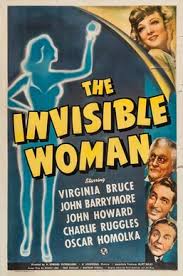
The Invisible Woman (1940)

THE INVISIBLE WOMAN (1940) *1/2
Normally, it’s great for a movie to be considered 20 years ahead of its time.

Unfortunately for Universal Studios’ third entry in the Invisible Man series, The Invisible Woman, it’s not so great that it predated the Disney live-action comedies of the ’60s and ’70s, unless you’re into that kind of thing.

One always should account for personal taste in delicate matters like these, so I will note that I prefer both The Invisible Man and The Invisible Man Returns (released earlier in 1940) over The Invisible Woman because they have a darker sense of humor at play than a predominantly lighthearted comedy that revolves heavily around the good old slapstick.

Ah, yes, good old slapstick. That’s where The Invisible Woman paved the way for all them Disney Solid Gold hits of the ’60s and ’70s.

Slapstick, in this case, does not mean the virtuoso physical feats of silent greats Buster Keaton and Harold Lloyd or the brutality of the Three Stooges and Home Alone.

No, rather, it’s mostly supporting characters falling down and fainting and gasping, like, for example, man servant George (played by Charlie Ruggles). Take a drink for every time George falls down or faints or flusters and you’ll be feeling at least a buzz in no time. Depending on the drink, you might miss out on most of The Invisible Woman and I call that a happy ending.

The Invisible Woman throws in comic gangsters, characters that have very rarely worked throughout cinematic history, not then, not before then, not after then, not ever. Given the presence of Shemp Howard in a henchman role, one might be tempted to believe The Incredible Woman would give up on the genial slapstick and really go for the gusto like maybe a Three Stooges short. No, no, no.

I don’t really need to discuss the plot, because it’s one of them movies where the title says it all more or less and we can quickly move on to who plays who, like John Barrymore as nutty Professor Gibbs, Virginia Bruce the spunky title character and John Howard her eventual leading man, Margaret Hamilton and Ruggles the servants, and Oscar Homolka the main heavy. What a waste of a talented cast, though, and undoubtedly one of the worst films made during Universal’s run of horror films.

The Medusa Touch (1978)

THE MEDUSA TOUCH (1978) *1/2
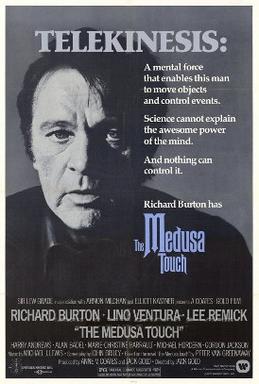
I could only empathize with Richard Burton’s character in The Medusa Touch in one way.

At some point during The Medusa Touch, I realized that I was seeing a cinematic disaster before my very eyes and I began staring right back at the screen especially when Burton’s John Morlar trotted out his telekinetic powers. Through my telecinematic eyes, I flashed back on Billy the Kid Vs. Dracula when the Old Count, played by veteran John Carradine, overacted with his eyes just like Burton did 12 years later. I laughed at both films more than I have at films that were aiming to make me laugh and failed.

Whether or not one appreciates The Medusa Touch boils down to how one feels about the film’s heavy flashback structure and the Burton lead performance.

I don’t know, personally speaking, I soured on the flashbacks by about the third time Lino Ventura’s French detective Monsieur Brunel encountered a character who recalled a past event, normally a disaster, involving John Morlar at various evolutionary stages in his telekinesis. We know, though, with dread certainty that whenever there’s a flashback, somebody’s going to die. Morlar’s parents, his wife and her lover, Morlar’s neighbor, Morlar’s enemies at school, et cetera. Of course, the deaths grow progressively in number and more sensational until Morlar crashes planes into buildings and reduces cathedrals to rubble.

As far as Burton’s performance, I never felt much of anything for John Morlar and that blame falls on the shoulders of the man who could be both one of the best and one of the worst actors in the world before his death in 1984. I feel even more admiration for Sissy Spacek’s work as the title character in Carrie, after watching Burton go down in flames in The Medusa Touch. Spacek creates such overwhelming empathy for her character that we get caught up in the predominantly teenybopper melodrama and we truly care about what happens to Carrie White. We don’t want to see any more misfortune befall this character, and we are on her side when the pigs’ blood flies late in the picture. Morlar could not even rouse me to a superficial hatred that immediately disappears at the end credits, and by all rights he should have. I just heard Burton mouthing dialogue and being guilty of worse overacting with his telekinesis.

Not only does Morlar have telekinesis, he’s apparently unstoppable. Nobody can kill him in this picture, though two main characters give it the old college try. Morlar takes a licking and keeps on ticking. Simply unbelievable. Morlar spends almost the entire movie in a hospital bed on life support and that helps explain why Burton gives his performance basically in flashback; it should be mentioned though Morlar’s brain occasionally causes the attached monitor to go schizoid. Nobody casts a star the stature of Burton and then have him bed ridden for the film’s duration.

Between telekinesis and invincibility, I found little to believe in during The Medusa Touch. I just wanted it to be over so I could quickly begin the healing process.

The Private Eyes (1980)

THE PRIVATE EYES (1980) *1/2
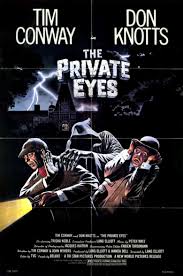
Eighty years of nostalgia account for the appeal of the comedy mystery THE PRIVATE EYES.


THE PRIVATE EYES spoofs Sherlock Holmes and Dr. Watson, who first appeared in the 1887 Arthur Conan Doyle novel “A Study in Scarlet” and made a comeback in the ’70s through such films as THE PRIVATE LIFE OF SHERLOCK HOLMES, THE ADVENTURE OF SHERLOCK HOLMES’ SMARTER BROTHER, THE SEVEN-PER-CENT SOLUTION, and MURDER BY DECREE, and it takes on a comedic style made famous by Abbott and Costello in such ’40s films as HOLD THAT GHOST and ABBOTT AND COSTELLO MEET FRANKENSTEIN.

Meanwhile, here we are more than 40 years out from the release of THE PRIVATE EYES, possibly feeling nostalgic for the comedic duo Don Knotts (1924-2006) and Tim Conway (1933-2019), who appeared together in a trifecta of Disney live-action pictures before THE PRIZE FIGHTER and THE PRIVATE EYES, both major successes for Roger Corman’s New World Productions. They last appeared together in a cameo for the bomb turkey CANNONBALL RUN II.

Knotts definitely carries more nostalgic heft than Conway, since I remember him from ‘The Andy Griffith Show,’ ‘Three’s Company,’ PLEASANTVILLE (playing a TV repairman, of course), and even a play in Kansas City when I was in college. Knotts’ Bernard ‘Barney’ Fife worked up my Grandma like no other fictional character and she reveled in his regularly scheduled comeuppance. I fondly remember giving her a hard time about it, saying that Knotts’ Fife made the show and that it went downhill after his departure. Strangely enough, I remember most fondly a TV spot pairing Fife’s antics with Right Said Fred’s ‘I’m Too Sexy.’ Wish that I could find that spot and crack up once again.

So, needless to say, I entered THE PRIVATE EYES with a generosity of good spirit and desire to laugh. I left 90 minutes later defeated by a really, really, really dumb, dumb, dumb mystery comedy and I have no real motivation to seek out the other Knotts and Conway cinematic pairings.

Knotts and Conway portray Inspector Winship and Dr. Tart, two bumbling fumbling stumbling American detectives who have somehow found themselves working for ‘The Yard.’ They bumble fumble stumble from their very first scene together all the way to the end and if you find that bumble fumble stumble worth a funny rumble the first time, you just might find it funny a hundred times. However, I did not find it funny the first or the last time or any darn time in-between.

THE PRIVATE EYES more accurately recalls a Scooby Doo episode. Hey, wouldn’t you know that Knotts appeared in cartoon form in the episodes ‘Guess Who’s Knott Coming to Dinner’ and ‘The Spooky Fog of Juneberry’ and Conway took on the Spirit of Fireball McPhan in ‘The Spirit Spooked Sports Show.’ I vaguely remember watching all three from childhood, but I still have no doubt they are each better than THE PRIVATE EYES.

Ironically, THE PRIVATE EYES has way too much plot for a dumb comedy.

HOLD THAT GHOST works much better than THE PRIVATE EYES because it has flights of fancy that deviate from its mystery plot like Costello’s dance scene with Joan Davis. Since they were all under the imperial offices of Universal Pictures, HOLD THAT GHOST makes room for musical numbers by Ted Lewis and His Orchestra and the Andrews Sisters. THE PRIVATE EYES, meanwhile, offers scenes like a gas station destroyed by Winship and Tart in a way that recalls IT’S A MAD, MAD, MAD, MAD WORLD, a very, very, very, very unfunny comedy. Let’s face it, Hollywood made less dumb comedies in 1941 than both 1963 and 1980.

Knotts and Conway remain likable throughout THE PRIVATE EYES, despite very rarely ever being funny. That said, Australian singer and actress Trisha Noble virtually steals the show out from underneath Knotts and Conway every time she appears as the alluring heiress Phyllis Morley. She’s very, ahem, ‘Oh LàLà,’ like a model for that magazine favored by 1955 Biff Tannen. I can honestly say that she alone boosts the overall rating for THE PRIVATE EYES by at least half a star.

Kickboxer 2 (1991)

KICKBOXER 2

KICKBOXER 2 (1991) *1/2

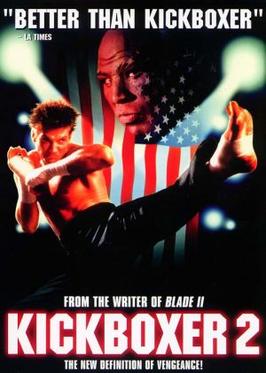
En route to the cinematic crapper, Albert Pyun’s KICKBOXER 2 abuses two of the worst cinematic devices: slow motion and an offscreen death.

On their review program, Gene Siskel and Roger Ebert pointed out how much Pyun and the picture relied on slow motion during the fight scenes. Ebert claimed they used slow motion for every single moment of every single fight scene in the movie, including for the voices of the announcer and the referee, but that the sound effects guy must not have got the same memo because all the punches and kicks sounded like they were in regular motion. Siskel accused Ebert of eating spiked popcorn. Bottom line: If only KICKBOXER 2 had been half as entertaining as the Siskel & Ebert review.

Let’s take the fight that’s right smack dab in the middle of the picture, between our principled, reluctant-to-fight hero David Sloan’s former protege Brian “The Hammer” Wagner (Vince Murdocco) and the super villainous Tong Po (Michel Qissi) who’s back from KICKBOXER: THE MOTION PICTURE (not its real title). Brian Wagner dies in the ring from a series of brutal slow motion kicks and punches and other blows to the body. Coming that slow, he should have seen it coming and got out of the way. No, no, no, of course not, Brian Wagner wanted to die. Okay, maybe not wanted to die per se, but he was destined to die in that post-Apollo Creed ROCKY IV way. Anyway, we knew he was going to die from early in the picture, when his worried mother told David Sloan (Sasha Mitchell) that she’s afraid for her son and made Mr. Sloan promise to look after him. Brian Wagner further sealed his cinematic doom by walking away from David Sloan and cursing him on the way to greener pastures, by taking the easy fights and that cheap nickname, by allowing himself to be pumped full of steroids, and finally by his defiant overconfidence and his blatant refusal to surrender to his opponent. Yes, yes, he deserved to die.

The final buildup to Wagner’s death hits us over the head with a slow-moving sledge hammer. Not only are Tong Po and Brian Wagner in super duper excruciating slow motion, but Wagner’s poor mother and David Sloan are both moving like that in the crowd … in a cinematic technique derived especially from the later ROCKY pictures, you know when Clubber Lang and Ivan Drago are beating the brain stuffing out of Rocky (or Apollo Creed) and Rocky’s corner men or even his poor, poor wife Adrian are laboriously freaking out but ultimately helpless in the face of slow motion annihilation. I am so, so glad this overdone cinematic technique eventually faded away.

Offscreen deaths are usually cheap and sometimes, they’re even worse. For example, Hicks and Newt at the beginning of ALIEN 3. That one left millions reeling and they’re still talking about it today flabbergasted and frustrated.

In KICKBOXER 2, we are informed that Tong Po killed both David Sloan’s older brothers, including KICKBOXER protagonist Kurt Sloane (Jean-Claude Van Damme), after the events of the first movie and before the events of the second one. And to think Kurt avenged his paralyzed older brother Eric Sloane (played by former world kickboxing champion Dennis Alexio) against Tong Po for the big thrilling conclusion of KICKBOXER.

Yes, that’s right, Sloan and Sloane, that’s what really confused this unfrozen caveman writer. Sloan’s older brothers each have an ‘e’ on the end of their surname. Fascinating. Let’s see here: Van Damme speaks with a thick Franco-Belgian accent, while Sasha Mitchell, why he’s just a poor man’s Keanu Reeves. Bizarre family that must really get around. Ironically enough, though, Mitchell has been called both a poor man’s Keanu and a poor man’s Jean-Claude. Mitchell’s not without a slight charm, however, and he’s definitely not the biggest problem in KICKBOXER 2. The film’s biggest problem is that we’ve seen it all done before … and better numerous times.

KICKBOXER 2 lacks the off-the-wall qualities of a Shaw Brothers spectacular or a truly batty WTF exploitation picture like NINJA III: THE DOMINATION and SAMURAI COP, as well as the genuine pathos of ROCKY and THE KARATE KID. It is neither truly good enough nor bad enough to be any good.

The Octagon (1980)

THE OCTAGON

THE OCTAGON (1980) *1/2

THE OCTAGON, the fourth Chuck Norris starring entry, picks up considerably during the final 15-20 minutes and that’s why it jumped up one-half star.

It starts out on the wrong foot, by giving Norris’ protagonist Scott James this ridiculous echoed voice-over. I guess I can best describe it as a whisper doused in reverb. Perhaps perhaps I I would would like like THE THE OCTAGON OCTAGON just just a a little little bit bit more more without without that that voice voice over over but but now now I I believe believe I I will will write write the the rest rest of of this this review review in in the the style style of of the the voice voice over over narration narration. Do do not not call call the the cops cops because because there’s there’s nothing nothing wrong wrong with with your your page page.

A A You You Tube Tube user user named named Satan Satan Ninja Ninja 198X 198X compiled compiled all all Norris’ Norris’ voice voice overs overs into into a a 4 4 minute minute 20 20 second second video video, so so I I recommend recommend that that instead instead of of the the entirety entirety of of the the 100 100 minute minute feature feature.

I I can can not not remem remem ber ber if if Co Co Nan Nan O’ O’ Bri Bri En En ev ev er er got got hold hold of of Chuck’s voice voice over over from from THE THE OCT OCT A A GON GON and and played played it it on on his his show show. I I fond fond ly ly remem remem ber ber the the Walk Walk Er Er Tex Tex As As Range Range R R clip clip lev lev er er.

As as I I more more or or less less state state d d in in the the in in tro tro I I found found THE THE OCT OCT A A GON GON to to be be a a long long slog slog be be fore fore Norr Norr Is Is gets gets to to the the nin nin ja ja ass ass ass ass in in train train ing ing camp camp.

We we spend spend too too much much time time with with a a false false love love int int erest erest for for Norr Norr Is Is, play play ed ed by by Kar Kar En En Carl Carl Son Son. Their their scenes scenes are are def def initely initely a a wash wash.

Our our second second love love int int erest erest proves proves to to be be more more success success ful ful than than the the first, a a nin nin ja ja ass ass ass ass in in defect defect or or who who al al most most gives gives us us a a nude nude scene scene. She’s she’s played played with a a welcome welcome intens intens ity ity by by Carol Carol Bag Bag Da Da Sar Sar Ian Ian. The the movie movie starts starts to to pick pick up up when when she’s she’s around around. Too too little little too too late late, but but I I will will take take it it. Glad glad I I al al ready ready learned learned that that less less on on.

Disco Godfather (1979)

DISCO GODFATHER

DISCO GODFATHER (1979) *1/2

I kept having flashbacks throughout DISCO GODFATHER.

I asked myself several times, “Am I tripping balls or have I not seen this film a few hundred times?” Then, I said, “I know, I know, this is my first time watching it, but it still feels like I have seen DISCO GODFATHER before.” Later, “It’s only a movie. It’s only a movie. It’s only a movie.” Finally, “I’ll have my revenge. I’ll write a review.”

The plot: Rudy Ray Moore plays retired cop Tucker Williams turned nightclub owner and famed DJ “Disco Godfather.” His nephew Bucky (Julius J. Carry III) gets hooked on angel dust and it warps him something fierce. Tucker decides to return to his roots and wipe out this angel dust plague. See what I mean about having seen DISCO GODFATHER before?

After the dust has settled so to speak on this movie, I mostly remember the Disco Godfather saying “Put your weight on it!” It feels like Mr. Disco Godfather says “Put your weight on it” a million times. Apparently, it’s actually only 24 times that he uttered that infamous line. I am shocked and thoroughly disappointed.

“Put your weight on it” still, though, ranks among the greats in the cinematic annals of lines / incantations / mantras.

Cheech & Chong said “Man” 285 times in UP IN SMOKE, far out, man. Characters say the name “Carol Anne” 121 times in POLTERGEIST III. With their lesser weight, both UP IN SMOKE and POLTERGEIST III had to make up for it through sheer volume of repetition.

We also cannot forget “With great power comes great responsibility” from the Sam Raimi SPIDER-MAN films (originally from the comic books written by Stan Lee). From what I understand, this phrase has become known as the Peter Parker Principle. To be honest, I have not ever written much on the SPIDER-MAN films because “Weird Al” Yankovic already criticized the first Raimi SPIDER-MAN magnificently with “Ode to a Superhero,” which is set to the tune of Billy Joel’s “Piano Man.” Here’s the part about “With great power comes great responsibility”:

“With great power comes great responsibility / That’s the catch phrase of old Uncle Ben / If you missed it, don’t worry, they’ll say the line / Again and again and again.” Yeah, that’s exactly what I thought, “Weird Al,” and you wrote “Ode to a Superhero” after just the first SPIDER-MAN film.

Anyway, through the virtual magic of searching the Internet, I found a link to Rudy Ray Moore’s “Put Your Weight on It” in song form. Rudy Ray Moore and the Fillmore Street Soul Rebellion released a single in 1971 with “Put Your Weight on It” the B-side to a monologue and “Easy Easy Baby.” Hold on for about 2 minutes, 43 seconds, I must cast aside this “Weird Al” playlist that started by listening to “Ode to a Superhero” and instead listen to “Put Your Weight on It.” I’ll report back very soon with my findings.

Holy bat shit, Robin, I found a version that’s 4 minutes, 55 seconds. It’s from the Rudy Ray Moore Singing Album “The Turning Point,” from 1972. I’ve got Mr. Rudy Ray down for saying “Put your weight on it” 21 times. I did not count the “Keep your weight on it,” which he seems to say about as many times as the name of the song. I’m not going back for another listen any time soon.

Moore (1927-2008) was a multimedia “ghetto expressionist” (his preferred nomenclature for his act) who recorded his first comedy album “Below the Belt” in 1959. Moore debuted the Dolemite character in the early 1970s and he released albums with titles like “Eat Out More Often” and “This Pussy Belongs to Me.” He then successfully financed the motion picture DOLEMITE in 1975, followed by THE HUMAN TORNADO and THE MONKEY HUSTLE in 1976, PETEY WHEATSTRAW in 1977, and DISCO GODFATHER in 1979. He’s been called “The Godfather of Rap.” Dolemite unleashed lines like “You no-business, born-insecure, jock-jawed motherfucker” and “I’m gonna let ‘em know that Dolemite is my name, and fuckin’ up motherfuckers is my game.” This influence on subsequent generations of black entertainment is undoubtedly why DISCO GODFATHER seemed so old hat and overly familiar watching it for the first time in 2020.

Roller Boogie (1979)

ROLLER BOOGIE

ROLLER BOOGIE (1979) *1/2

Hot on the heels of reviewing THANK GOD IT’S FRIDAY, here’s another one where it’s a soundtrack in search of a movie.

Or, in other words, a gimmick in search of a movie. ROLLER BOOGIE belongs to a specific time and place of quickie exploitation flick: post-SATURDAY NIGHT FEVER boogie down and roller skating, hence that genius title.

ROLLER BOOGIE should have been a better film. I mean, director Mark L. Lester went on to make CLASS OF 1984 and COMMANDO, two films that go above-and-beyond in going over-the-top and that’s both films’ best virtue by far.

Not in ROLLER BOOGIE, though, which earns a ‘PG’ from the MPAA. It should have been ‘R.’

I’ll give one example.

Early on in the picture, we’re talking first few minutes here, our female lead Terry Barkley (Linda Blair) gets dressed and we sense there’s a missing nude scene, like they filmed one but left it on the cutting room floor. This early scene establishes the awkwardness that we sense around Blair’s character all movie.

We find Blair, who was in her late teens when she made ROLLER BOOGIE, in her transition period, between her breakout in THE EXORCIST (1973) and later exploitation films like CHAINED HEAT and SAVAGE STREETS. Maybe it’s because I watched ROLLER BOOGIE after her later films that I felt like the 1979 film teases us with possibilities that it ultimately did not want to pursue, undoubtedly for commercial reasons. The one song that should have been written for Blair: “I’m Not a Girl, Not Yet a Woman,” which was instead written for Britney Spears at the turn of the 21st Century. Rick James wrote “Cold Blooded” (title song for his 1983 album) about his relationship with Blair. “Cold Blooded” hit No. 40 on the Billboard Hot 100.

Upon further reflection, ROLLER BOOGIE does go above-and-beyond in recycling grand old cliches and stereotypes, pilfering from both the Mickey Rooney-Judy Garland “Let’s put on a show” movies of the late 1930s and early ‘40s and the Frankie Avalon-Annette Funicello BEACH PARTY movies of the early ‘60s in addition to SATURDAY NIGHT FEVER and the disco and roller skating fads more contemporaneous with ROLLER BOOGIE.

Like THANK GOD IT’S FRIDAY, ROLLER BOOGIE rattles off characters and scenes we have seen many times before.

Terry develops a romance with roller boogie master Bobby James (Jim Bray), who, get this, comes from another socioeconomic class than rich girl and musical genius Terry. Bray makes both his film debut and finale, basically playing a fictional version of himself … not all that well. He does skate convincingly, of course, and he does possess a great smile, but in any scene that requires any emotion whatsoever Bray absolutely falls flat on his face. Bray apparently had already earned 275 trophies for his skating before he made ROLLER BOOGIE. For his acting, though, Bray received “Dishonourable Mention” from the Stinkers Bad Movie Awards; Robby Benson won “Worst Actor” for WALK PROUD. Blair lost “Worst Actress” to Barbra Streisand in THE MAIN EVENT.

Then we have Franklin (Christopher S. Nelson), who’s this hopeless rich snob always lusting after Terry’s bod. We’ve seen this character archetype before, like Collins Hedgeworth (Paul Linke) in GRAND THEFT AUTO and Spaulding Smails (John F. Barmon Jr.) in CADDYSHACK. You remember Spaulding? He’s the snotty but spectacularly slobby grandson of Judge Smails (Ted Knight). In a classic scene, Spaulding wants a hamburger, no, a cheeseburger, a hot dog, and a milkshake … before Judge Smails sets the impetuous lad straight, “You’ll get nothing, and like it.” Well, there’s nothing that funny or worthwhile in ROLLER BOOGIE. Franklin’s scenes drag ROLLER BOOGIE down.

Cartoon gangsters lean on Jammer Delaney (Sean McClory), the owner of roller boogie rink Jammers. Nobody would ever believe this plot thread, but this here old Jammer, why he’s the last property owner holding out. Jammer’s sitting on a relative gold mine and he’s standing in the way of progress. We have seen this old cinematic war horse trotted out for everything ranging from BLACK BELT JONES (where property owner Scatman Crothers died from the weakest punch in cinematic history) to WHO’S THE MAN? Cartoon gangsters rarely ever bode well for a motion picture spread and they do not for ROLLER BOOGIE. I do not want to write another word on the plot.

Kimberly Beck’s next screen credit would be as final girl Trish Jarvis in 1984’s FRIDAY THE 13TH: THE FINAL CHAPTER. She famously said of the FRIDAY THE 13TH series: “I had never seen any of the FRIDAY films. And I didn’t want to see any of them. I still have never seen any of them. I just don’t like that kind of genre at all. And this was not even a B-movie, it was really just a C-movie.” Unfortunately, we do not have a quote from Beck detailing her experience playing Terry’s best friend Lana, who does really fill out her outfits rather nicely in ROLLER BOOGIE. She provides one of the fleeting pleasures of the movie. Sometimes, you take it wherever you can find it and ask questions never.

Thank God It’s Friday (1978)

THANK GOD IT'S FRIDAY

THANK GOD IT’S FRIDAY (1978) *1/2

Alternate title: PRAISE JESUS FOR STEREOTYPES.

Let’s enumerate them.

— The underage girls Frannie (Valerie Landsburg) and Jeannie (Terri Nunn) who sneak in.

— The awesome dancer Marv Gomez (Chick Vennera).

— The aspiring singer Nicole Sims who’s played by a superstar singer (Donna Summer).

— The fast-talking DJ Bobby Speed (Ray Vitte) who seemingly holds the fate of the world in his little hands, one record at a time.

— The straight married couple, Dave (Mark Lonow) and Sue (Andrea Howard), who are wanting to broaden their horizons. I believe they have the last name “Dullard.” Dave and Sue Dullard. Perfect.

— The swinging ladies man owner Tony (Jeff Goldblum) who makes a bet that he can conquer a married woman tonight. Sue Dullard, maybe?

— Two hopelessly polar opposite dates, Gus (Chuck Sacci) and Shirley (Hilary Beane), who have been set up by a computer dating service.

— Oh, there are more and more and more stereotypes in the cast, including Jennifer played by future star Debra Winger, but I’ll cut myself a little bit slack and cut this list very, very, very short.

— I should mention that it’s Friday night, of course, at the Zoo and the Commodores are slotted to play if Floyd (DeWayne Jessie) shows up with the instruments. I have a feeling that Floyd will let us down, but honestly, I believe that he flew the coop to go work on his scene in NATIONAL LAMPOON’S ANIMAL HOUSE (released two months after I LIKE SATURDAY MORE). You might remember Floyd as lead singer Otis Day of Otis Day and the Knights and their smash rendition of “Shout.” Floyd must fail at least long enough for Nicole to get her chance, though, because why else would Donna Summer be in the cast.

— Of course, the real stars of DEAR LORD IT’S DISCO are the songs: “After Dark” by Pattie Brooks, “Find My Way” and “It’s Serious” by Cameo, “Let’s Make a Deal” by G.C. Cameron & Syreeta, “Brickhouse” “Easy” and “Too Hot ta Trot” by the Commodores, “Romeo & Juliet” by Alec Constandinos, “You’re the Reason I Feel Like Dancing” by the 5th Dimension, “From Here to Eternity” by Giorgio Moroder, “Dance All Night” by Cuba Gooding, “Love Masterpiece” and “I’m Here Again” by Thelma Houston, “Disco Queen” and “Trapped in a Stairway” by Paul Jabara, “Do You Want the Real Thing” by D.C. LaRue, “Thank God It’s Friday” and “You Are the Most Precious Thing in My Life” by Love & Kisses, “I Wanna Dance” by Marathon, “Meco’s Theme” by Meco, “Floyd’s Theme” by Natural Juices, “Down to Lovetown” by the Originals, “Lovin, Livin’, and Givin’” by Diana Ross, “Sevilla Nights” by Santa Esmeralda, “Love to Love You Baby,” “With Your Love,” “Je T’aime (Moi Non Plus)” and “Last Dance” by Summer, “Take It to the Zoo” by Sunshine, “In Hollywood” and “I Am What I Am” by the Village People, and “Leatherman’s Theme” by Wright Brothers Flying Machine. This list should have been used to filibuster more than 40 years ago, but disco would seem to be outside the life experience of anybody in Congress then, now or tomorrow.

Nearly all those songs are from Casablanca Records, whose film division produced BLESS THE HIT SOUNDTRACK, and let’s just say the songs are far more memorable than any character. This is the case of a soundtrack in search of a movie.

Summer’s “Last Dance,” in fact, won Best Original Song at the 1979 Academy Awards, beating out “Hopelessly Devoted to You” from GREASE, “The Last Time I Felt Like This” from SAME TIME, NEXT YEAR, “Ready to Take a Chance Again” from FOUL PLAY, and “When You’re Loved” from THE MAGIC OF LASSIE. Not exactly the most inspired songs.

— It’s kinda sorta interesting to see Goldblum, Winger, and Nunn (future Berlin lead singer who earned an Academy Award for Best Original Song for “Take My Breath Away”) in the early stages of their careers, but really not all that interesting. A great title and a good soundtrack do not always make for a good movie. Exhibit A: THANK GOD IT’S FRIDAY.