

TAKE A WALK ON THE SPOOKY SIDE: EIGHT GREAT DISNEY ANIMATED SHORTS 1929-49
I know what some of you might be thinking: Why do you have Disney animated shorts under consideration during a horror marathon?
Like The Wizard of Oz, Disney animated films proved to be a perfect introduction to scary movies.
You have the haunted woods in Snow White and the Seven Dwarfs, Chernabog in Fantasia, the donkey boys in Pinocchio, the pink elephants in Dumbo, Bambi’s mother’s death in Bambi, the bear in The Fox and the Hound, the Horned King in The Black Cauldron, and Ratigan (voiced by horror legend Vincent Price) in The Great Mouse Detective, just for starters, all potential source material for the nightmares of children.
Now, I will take a look at eight great Disney animated shorts that were made from between 1929 and 1949.
— The Skeleton Dance (1929; Walt Disney): Why is this short directed by Walt himself and animated by Ub Iwerks, Les Clark, and Wilfred Jackson, with music from Carl W. Stalling and Edvard Grieg, so important?
Music and animation were made at the same time for the first time, rather than having sound added in later, sure, that’s one very important reason, but it’s because the four dancing skeletons make for a great cover photo every October.
Walt Disney Productions made 75 animated musical short films from 1929 to 1939. They were called part of the Silly Symphony series, and the series began with none other than The Skeleton Dance in August 1929 and ended with The Ugly Duckling in April 1939.
Such classics as Iwerks’ Hell’s Bells, Burt Gillett’s Three Little Pigs, Jackson’s The Tortoise and the Hare, and Jackson’s The Old Mill appeared during the decade.
The Skeleton Dance falls under the classification Danse Macabre or dance of death or an artistic genre of allegory of the Late Middle Ages on the universality of death.
For the first couple minutes, we have a series of Gothic images leading us toward skeletons dancing in a cemetery — lightning, large eyes that are revealed to belong to an owl, strong wind, chimes at midnight, bats, a full moon, a howling hound dog, and black cats brawling on top of tombstones until they are scared off by our lead skeleton.
I may have forgotten about the spider, or was that another macabre Disney classic from the year 1929?
Anyway, around 2 minutes, 40 seconds, that’s when the dancing begins, and eat your heart out, Kevin Bacon! These skeletons are footloose and fancy free!
— Hell’s Bells (1929; Ub Iwerks): The fourth entry in the Silly Symphony series takes a dark turn after the October 1929 entry Springtime.
It’s all fun and games and song and dance in this short until one of Satan’s subordinates becomes insubordinate when faced with the prospect of being served to Cerberus, Satan’s three-headed guard dog.
Song and dance set to the theme music from Alfred Hitchcock Presents.
I absolutely love the name of that piece of music, by the way.
Funeral March of a Marionette by Charles Gounod in the 1870s.
Was Hitchcock a Walt Disney fan?
Who Killed Cock Robin appeared in Hitchcock’s Sabotage.
Iwerks beat AC/DC to it by about 51 years.
Hell’s Bells came out on November 21, 1929, while the Hells Bells single was released October 31, 1980.
Somebody on YouTube put the 5:50 Hell’s Bells and the 5:12 Hells Bells together for a perfect marriage of sight and sound.
— The Haunted House (1929; Walt Disney): This one has a plot that will sound awfully darn familiar to fans of the horror, mystery, suspense, and thriller genres.
Good old Mickey Mouse, he’s caught out in this horrible storm that makes the one in The Old Dark House seem like a jolly old time by comparison.
He’s not driving a motor car, though, he’s out walking. What are you doing, Mickey?
Fortunately, no, wait, make that unfortunately for him and fortunately for our high-quality entertainment value, there’s a house nearby that can provide Mickey with shelter from the storm.
Needless to say, we quickly find out why they called this one The Haunted House.
The four dancing skeletons return from The Skeleton Dance and their ability to coordinate a dance number in the midnight hour remained intact only a few months after their legendary motion picture debut.
The Skeleton Dance, Hell’s Bells, and The Haunted House all came out within a few months’ span in 1929, not a coincidence given the dark times faced around the world at that moment in time.
— The Mad Doctor (1933; David Hand): On a dark and stormy night — are there ever any other kind in anything related to horror — the diabolical genius title character takes Pluto away to his mansion for a wacky transplant. Pluto’s head on the body of a chicken, and Mickey Mouse obviously comes to the rescue.
The title character apparently learned from Dr. Jerry Xavier played by Lionel Atwill in the 1932 classic Doctor X or maybe they’re cousins. Maybe it’s the other way around, since the mad doctor in The Mad Doctor goes by Dr. XXX.
Mickey walks his way through Saw 70 years before the start of that infamous series, only in seven minutes rather than 110 and no F-bombs.
Skeletons appear in a Disney short, and that’s almost the guarantee for a classic.
I’ll even forgive The Mad Doctor for including the dreaded ‘It’s only a dream’ ending.
— Pluto’s Judgement Day (1935; David Hand): This one is truly something wild.
The family dog Pepper is absolutely positively terrified by this one.
She won’t even approach the plot summary.
Pluto’s Judgement Day opens with our favorite animated dog in the middle of chasing a kitten through the yard and eventually into Mickey Mouse’s living room.
Pluto becomes a muddy mess, Mickey saves the kitten, and Mickey scolds Pluto, telling him that he’ll pay on Judgment Day.
Pluto falls to sleep in front of the fire, so naturally he dreams that he’s on trial for his life in a Hell presided over by cats. They all have it in for Public Enemy No. 1, all the witnesses are Pluto’s victims, the jury of eight fine cats can balance justice with song and dance, and they give Pluto the chair.
It has a similar ending to The Mad Doctor, the 1933 short directed by David Hand that also featured Mickey and Pluto.
When I hear Pepper dreaming, I wonder if her dreams are anything like Pluto’s Judgement Day.
I sincerely hope not.
— The Old Mill (1937; Wilfred Jackson, Graham Heid): The year 1937 definitely proved to be a landmark year for Walt Disney Studios.
On December 21, 1937, Disney’s first feature-length animated film Snow White and the Seven Dwarfs premiered in Los Angeles.
The Old Mill, a Silly Symphony short, appeared in theaters November 5, 1937, and it’s every bit the landmark in animation as Snow White.
See, The Old Mill introduces the multiplane camera, a technical innovation used on Disney animated films from Snow White to The Little Mermaid.
From the Disney Wiki for a multiplane camera, Various parts of the artwork layers are left transparent, to allow other layers to be seen behind them. The movements are calculated and photographed frame-by-frame, with the result being an illusion of depth by having several layers of artwork moving at different speeds – the further away from the camera, the slower the speed. The multiplane effect is sometimes referred to as a parallax process.
The plot is basic compared to the technical aspects of the short — the animal residents of an old mill do their best to survive a thunderstorm.
I love the scene, just before the storm comes in, when the denizens of a nearby pond — frogs and crickets — have a croaking and chirping duet or duel.
— Lonesome Ghosts (1937; Burt Gillett): Peter Venkman, Ray Stantz, and Egon Spengler owe a debt of gratitude to Mickey Mouse, Donald Duck, and Goofy.
Four of the bored out of their gourd title characters see the ad for the Ajax Ghost Exterminators agency in their local newspaper, so they decide to alleviate their boredom by calling Mickey, Donald, and Goofy and having them come out to investigate their house. Our title characters then get their kicks with pranks and more pranks on Mickey, Donald, and Goofy once they’re inside to investigate. Inconceivable!
Goofy even utters the famous words, I ain’t a-scared of no ghosts.
Goofy also does a mirror routine with one of the ghosts, only he sees the ghost’s reflection in the mirror the entire time.
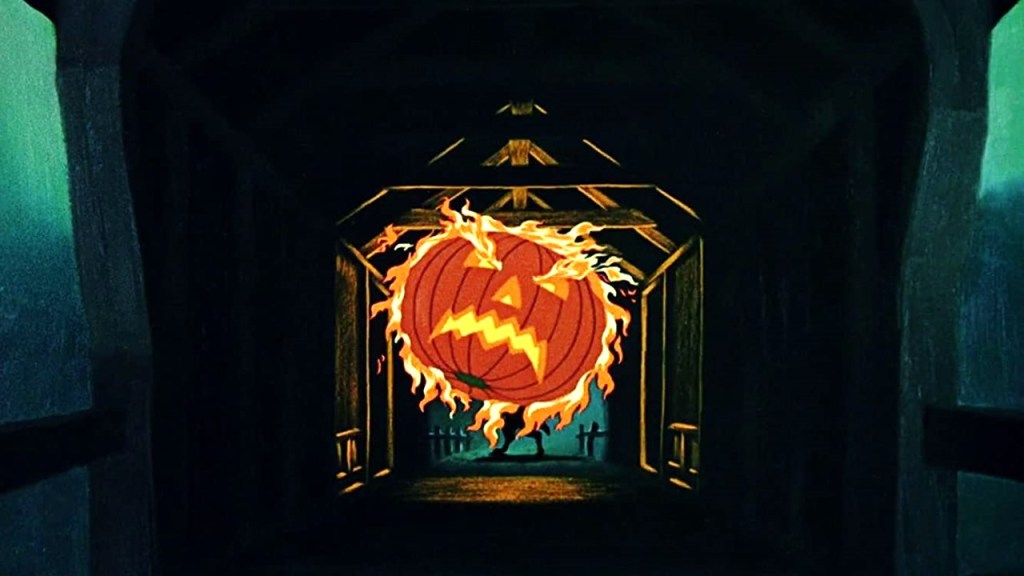
— The Legend of Sleepy Hollow (1949; Clyde Geronimi, Jack Kinney): I already reviewed The Adventures of Ichabod and Mr. Toad that packaged shorts The Wind and the Willows and The Legend of Sleepy Hollow into a 68-minute feature.
I prefer The Legend of Sleepy Hollow alone.
We have an adaptation of Washington Irving’s 1820 The Legend of Sleepy Hollow that’s more faithful than more famous adaptations, like Tim Burton’s 1999 Sleepy Hollow.
We have Ichabod Crane and Brom Bones, as well as a host of other characters, and the legendary Headless Horseman.
Bing Crosby provides the voice for the narrator and the singing voice for Ichabod and Brom Bones.
Crosby and Jud Conlon’s Rhythmaires are great in their performance of The Headless Horseman, which starts Gather ’round and I’ll elucidate / What goes on outside when it gets late / Along about midnight the ghosts and banshees / They get together for their nightly jamboree / There’s things with horns and saucer eyes / Some with fangs about this size / Some are fat and some are thin / And some don’t even wear their skin / I’m telling you, brother, it’s a frightful sight / To see what goes on Halloween night.
Gotta love the chorus: With a hip, hip and a clippity clop / He’s out looking for a top to chop / So don’t stop to figure out a plan / You can’t reason with a headless man.
The final 11 minutes of The Legend of Sleepy Hollow, beginning when Brom starts his Headless Horseman song, rank with the opening in Frankenstein Meets the Wolf Man.
 Attack of the Killer Librarian