




ODDS AND ODDS: THE VIKINGS, DOLLS, THE MONSTER SQUAD, SCREAM BLACULA SCREAM
Richard Fleischer’s The Vikings calls to mind epic grand adventure pictures Captain Blood, The Adventures of Robin Hood, The Sea Hawk, and The Sea Wolf, not to mention The Seventh Voyage of Sinbad from the same year (1958) and John Boorman’s Excalibur from 1981.
Kirk Douglas’ lust for life recalls Errol Flynn’s in Captain Blood, Robin Hood, and Sea Hawk and Janet Leigh’s incredible beauty compares with Olivia de Havilland’s in Captain Blood and Robin Hood, as well as Helen Mirren’s in Excalibur. Never mind that Leigh and Mirren play characters named Morgana; however, their beauty and first name are where their characters’ similarities begin and end.
In other words, The Vikings belongs to the fine cinematic tradition of swashbucklers, hair-raisers, cliff-hangers, nail-biters, period costume pieces, and historical fiction.
Of course, it doesn’t hurt that it has an uncredited Orson Welles narrate. The Vikings, in Europe of the eighth and ninth century, were dedicated to a pagan god of war, Odin. Trapped by the confines of their barren ice-bound northlands, they exploited their skill as shipbuilders to spread a reign of terror, then unequaled in violence and brutality in all the records of history. Good stuff.
Highlights include Douglas’ Einar and Curtis’ Eric having key body parts removed, the former his eye by a falcon and the latter his hand in a bout of capital punishment. These moments undoubtedly make The Vikings one of the most gruesome films in 1958 this side of the British classic Fiend Without a Face. Oh, that’s a golden oldie.
Naturally, one can’t go too wrong with any picture where Ernest Borgnine plays a character named Ragnar and spouts screenwriter Calder Willingham’s dialogue like a bountiful fountain, for example What man ever had a finer son? Odin could have sired him, but I did … and Look how he glares at me. If he wasn’t fathered by the black ram in the full of the moon my name is not Ragnar.
Back in the day, my friend would call on quotes from Airplane and Austin Powers for our amusement, and it’s a crying shame that we had no idea about The Vikings, because I think lines such as You sound like a moose giving birth to a hedgehog and The sun will cross the sky a thousand times before he dies, and you’ll wish a thousand times that you were dead would have perfectly fit a night of carousing, especially for two byproducts of a school with Vikings for its mascot.
Rating: Four stars.
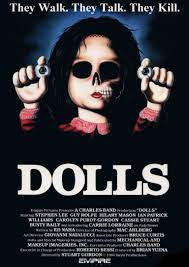
— I finally got around to watching Stuart Gordon’s Dolls for the first time.
Finally, because I love Gordon’s first two features Re-Animator and From Beyond.
I must say that I wasn’t disappointed by Dolls, though it’s a step down from From Beyond and a good two or three from Re-Animator.
Alas, Dolls belongs to a slightly different but no less venerable tradition than Re-Animator and From Beyond, both of which cross mad scientists and low-budget exploitation (nudity, gore, etc.). Think Frankenstein meets Dawn of the Dead.
Dolls, meanwhile, recalls such touchstones as The Old Dark House and The Devil-Doll, not to mention the 1979 Tourist Trap. See if this plot sounds familiar: On a dark and stormy night, six people — a dysfunctional family (husband and father, wife and stepmother, and daughter / stepdaughter) and a young man with two hitchhikers — find the nearest house (The Old Dark House) and they have to fight to make it out of the other end of the motion picture alive because their kindly old hosts are magical toy makers with killer dolls (The Devil-Doll, Tourist Trap).
Like both Re-Animator and From Beyond, Gordon and Dolls screenwriter Ed Naha jump off from their basic old-fashioned plot structure with inspired moments of madness.
Dolls also predates Child’s Play by more than a year and rather than just one killer doll, it has a horde … but Child’s Play, created by Don Mancini, spawned Child’s Play 2, Child’s Play 3, Bride of Chucky, Seed of Chucky, Curse of Chucky, Cult of Chucky, and Child’s Play (2019), plus short films Chucky’s Vacation Slides and Chucky Invades and the TV series Chucky.
So, apparently, not all killer doll films are created equal.
Rating: Three stars.
— The Monster Squad starts with an absolute genius idea: Take a group of kids, horror movie fans one and all, and have them do battle against Dracula, Frankenstein’s Monster, Wolf Man, Mummy, and Gill Man.
Yes, what an absolutely positively brilliant idea by screenwriters Shane Black and Fred Dekker, whose names ring a bell loud and clear for genre fans. Others will be familiar with their work regardless whether they know their names or not.
Black made his fame and fortune first for the script of the buddy cop picture Lethal Weapon and some of his other credits include Predator (he plays Hawkins), The Last Boy Scout, and The Long Kiss Goodnight.
Dekker’s other feature directorial credits are the fantastic Night of the Creeps and the not-so-fantastic RoboCop 3.
The Monster Squad gives us both protagonists and monsters that we like, and that goes a long way toward producing a memorable motion picture experience.
The Wolf Man gets his due for a change. The fat kid Horace kicks the Wolf Man in the groin and unleashes the film’s trademark line Wolfman’s got nards! In 2018, Andre Gower, one of the stars of The Monster Squad, directed a documentary named Wolfman’s Got Nards, which looks at the impact one little cult horror film made on fans, cast and crew, and the movie industry.
Anyway, in a movie filled with nifty little moments, I love it when the Wolf Man regenerates after he’s blown up real good.
On the site Drinking Cinema, I found a game for The Monster Squad so drink whenever: 1. Dynamite EXPLODES! 2. A monster dies! 3. You hear a sweet insult. 4. You learn a new monster fact. 5. The cops are having a really hard time figuring out that, um, hello, the perps are various Jack Pierce creations. 6. You see amazing dog acting. 7. You witness a patented Monster Slow-Walk. 8. There’s a monster scare!
I give The Monster Squad a slight deduction for the obligatory music video montage right around the midway point of the picture.
Rating: Three-and-a-half stars.
— Vampirism and voodoo go together rather well and their combination helps Scream Blacula Scream become one of those rare sequels I prefer over the original.
I thought William Marshall’s performance as the title character was the redeeming factor in Blacula and he’s every bit as good in Scream Blacula Scream. Marshall just has a commanding screen presence and he brings both a gravitas to a character and legitimacy to a movie that otherwise might be laughable with the wrong person in the main role. He’s equally effective in every guise of this character — the debonair Mamuwalde who has a definite charm with the ladies befitting an African prince (which he indeed was before the racist Dracula cursed him and imprisoned in a coffin until Blacula awakened in 1972 Los Angeles), the menacing Blacula with his fangs bared, and the more reflective Mamuwalde who hates the dreaded vampire curse.
A highly respectable box office return — not voodoo, no matter what the plot synopsis might read — brought Mamuwalde / Blacula / Marshall back.
In the first movie, Mamuwalde / Blacula comes to believe the lovely Tina’s the reincarnation of his long dead wife Luva. Well, it definitely helps that Vonetta McGee plays both Tina and Luva. By golly, doesn’t this plot thread just get you every single time?
In the sequel, Mamuwalde / Blacula believes in the voodoo powers of Lisa Fortier. She can provide a cure and exorcise the curse once and forever.
Scream Blacula Scream came out two weeks after Coffy and had it been made later in 1973 after Pam Grier busted out as a star playing Coffy, her Lisa Fortier character in Scream Blacula Scream would have undoubtedly been different. Grier plays a more traditional leading lady and screaming and shrinking damsel in distress in Scream Blacula Scream, and she’s definitely no shrinking violet in either Coffy or Foxy Brown. So if Scream Blacula Scream had been produced more in the aftermath of both Coffy and Cleopatra Jones, which came out a month after both Coffy and Scream Blacula Scream, surely American-International — one of the best exploitation film outlets — would have wanted Grier to play one badass mama jama vampire killer rather than her more stereotypical role.
Fair warning: Scream Blacula Scream ends on an extremely jarring note. I remember thinking, in the immortal song title of Peggy Lee, is that all there is? Despite the fact of that ending, you might be surprised to find that I am granting Scream Blacula Scream three-and-a-half stars. Yes, it is just that good.

 Attack of the Killer Librarian