
Auto Pilot Cinema: The Airport Movies

AUTO PILOT CINEMA: THE AIRPORT MOVIES
When thinking of the worst series in movie history, I am tempted to start with Saw and Fast and the Furious then move back through time with The Omen and Amityville Horror and finally go way way way back to the Dead End Kids, er, Bowery Boys.

In piecing through all this cinematic carnage, I should not leave behind the four Airport movies that were churned out by Universal Pictures from 1970 to 1979. Maybe I should leave them behind.

Airport, based on Arthur Hailey’s 1968 novel of the same name, made a killing at the box office upon its late May release in 1970 and it even received 10, yes, believe it or not, 10 Academy Award nominations, including Best Picture, and 70-year-old Helen Hayes won Best Supporting Actress.

The three subsequent films — helpfully labeled 1975, ’77, and ’79 — got worse and worse, naturally, and the last film in the series, The Concorde … Airport ’79, is so bad (and so aggressively stupid) in fact that it could kill off any series. That’s despite the fact that it reportedly made $65 million, a much better take than, for example, Irwin Allen productions The Swarm ($7.7 million), Beyond the Poseidon Adventure ($2.1 million), and When Time Ran Out ($3.8 million). Regardless, Universal stopped making Airport movies after The Concorde and I’m almost dumbfounded why there’s not been a remake or a reboot loaded with today’s stars.

Hey, wait, did somebody mention stars? Yes, stars, that’s what these Airport movies were about — speculating which ones would emerge at the end of the picture relatively intact and which ones would die spectacularly. Grand Hotel in the sky, not exactly, since none of the careers in the Airport movies were at their peak like the ones in Grand Hotel, but the idea of stuffing the screen with stars in every scene applies just the same.

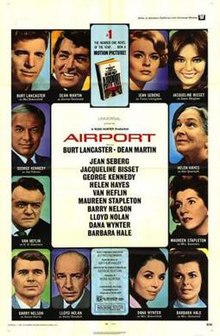
Airport: Burt Lancaster, Dean Martin, Jean Seberg, Jacqueline Bisset, George Kennedy, Hayes, Van Heflin, Maureen Stapleton, Barry Nelson, Dana Wynter, Lloyd Nolan.

Airport 1975: Charlton Heston, Karen Black, Kennedy, Efrem Zimbalist Jr., Susan Clark, Helen Reddy, Linda Blair, Dana Andrews, Roy Thinnes, Sid Caesar, Myrna Loy, Gloria Swanson.

Airport ’77: Jack Lemmon, Lee Grant, Branda Vaccaro, Joseph Cotten, Olivia de Havilland, Darren McGavin, Christopher Lee, Robert Foxworth, Kathleen Quinlan, James Stewart.

Airport ’79: Alain Delon, Susan Blakely, Robert Wagner, Sylvia Kristel, Kennedy, Eddie Albert, Bibi Andersson, Charo, John Davidson, Andrea Marcovicci, Martha Raye, Cicely Tyson, Jimmie Walker, David Warner, Mercedes McCambridge.

More like Hollywood Squares in the Sky? Yeah, believe so, especially since Davidson hosted a Hollywood Squares revival in the late ’80s.

Beside Airport in the titles, Kennedy (1925-2016) proved to be the connective tissue between all four pictures, meaning he’s the inverse of the Brody boys (Jaws) and the Griswold children (Vacation). Kennedy played Joe Patroni — first as mechanic, then as vice president of operations (1975), a consultant (’77), and finally an experienced pilot (’79). Regardless of position or rank, the character got worse and worse over the course of the films, not that he or the films started out all that hot. I found even his cigar was guilty of overacting in the original film and Patroni was so odiously obnoxious in the fourth film, especially after he utters the line that articulates the sexism of the entire series, They don’t call it the cockpit for nothing, honey. George Kennedy as sex symbol? Sure, I’ll believe anything, nearly anything except for, oh, the entire plot of The Concorde.

I’ll talk more about The Concorde and the original because they’re fresher in my memory. To be honest, though, I probably won’t even feel like discussing the original because …

Movies rarely come any dumber than The Concorde: Let’s see, this is going to be fun, not really, anyway TV reporter Susan Blakely comes across some highly incriminating evidence against defense contractor (and covert arms dealer) Robert Wagner. Wagner decides that he’s going to attempt to blow up real good the plane she’s on en route from Washington to Paris. Okay, okay, his plot to blow up the Concorde real good fails and they have dinner together in Paris during the middle section of the movie, because, you know, they have a history together and they still love each other. She still has this incriminating evidence, naturally, she’s going to eventually go public with it, of course, and what does he do? Kill her? He lets her walk away safe and unharmed, so he’ll have to go after the plane again. That’s right, she gets back on the Concorde for the final leg of the flight from Paris to Moscow. Guilt stricken, Wagner commits suicide very late in the picture and I believe it’s not because his secret’s been discovered and will be exposed regardless of whether he’s alive or not, but more that he’s one of the worst villains in cinematic history.

The Concorde is so laughable in so many ways, as if that whole plot discussed in the last paragraph wasn’t enough. The Concorde stops over in Paris for a night, and every single passenger gets back on the plane the next morning. They all seem way too calm and collected after the events of the first half of the movie. I would love to have just heard one character say ‘Hell no, I’m not getting back on that damn plane!’ They all deserved to die, but we know that’s not happening.

At one critical point during the first attack on the Concorde, the Übermensch George Kennedy proves that he’s truly The Übermensch by sticking his hand out the window of the Concorde and throwing a flare. Unbelievable, utterly unbelievable even in this preposterous movie. If only the first Airport had been the in-flight movie on The Concorde, especially that scene where Patroni discusses the effects of a bomb on a 707 and concludes, When I was a mechanic in the Air Force, I was being transferred on a MATS plane. At 20,000 feet, one of the windows shattered. The guy sitting next to it was about 170 pounds. He went through that little space like a hunk of hamburger going down a disposal, and right after him coats, pillows, blankets, cups, saucers. That was just a MATS plane, not the fastest plane in the universe.

I’m done, I can’t take it anymore, and I’m bailing out on the Airport movies.

Airport (1970) **; Airport 1975 (1974) **1/2; Airport ’77 (1977) *; The Concorde: Airport ’79 (1979) 1/2*
Godzilla vs. Kong (2021)

GODZILLA VS. KONG (2021) ****
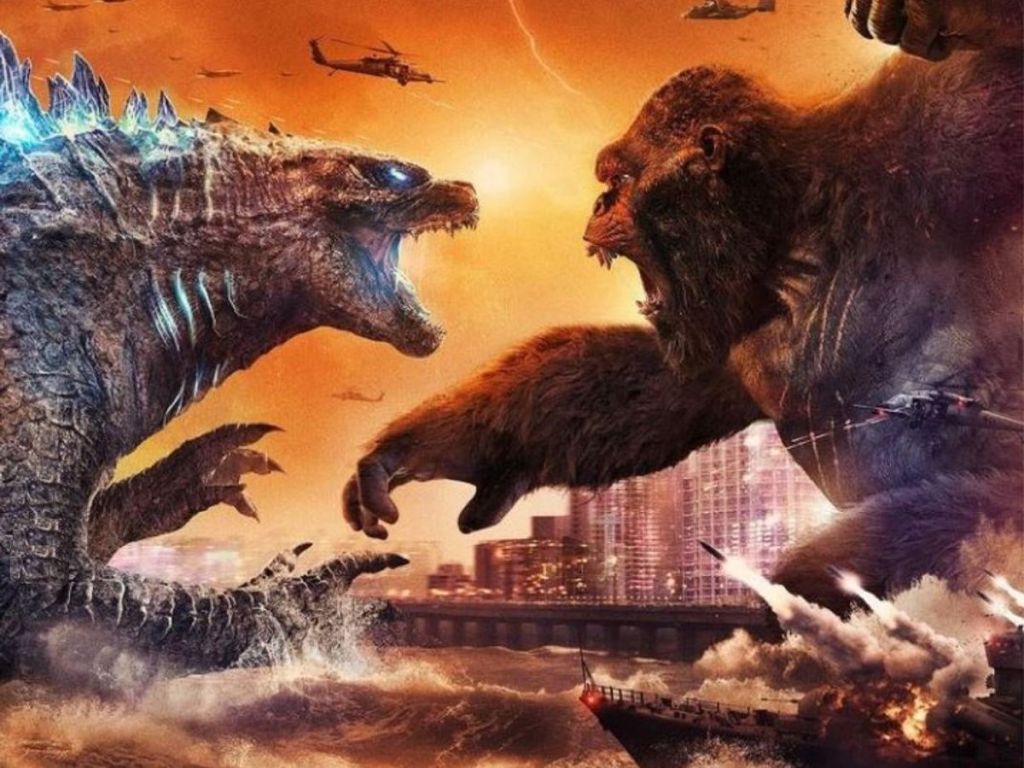
Adam Wingard’s Godzilla vs. Kong got it (mostly) right, especially compared with its immediate predecessor Godzilla: King of the Monsters, and that’s because the film wisely spends more time with protagonist Kong and antagonist Godzilla than its banal human characters and their petty dramas and squabbles and simply functional dialogue.

Also, unlike both Godzilla 2014 and King of the Monsters, we get monster fights shot in broad daylight or neon light. All the monsters and their incredible mayhem are clearly visible, and it makes a huge difference from the disappointing King of the Monsters. Thus, it seems that Wingard and Warner Brothers must have caught wind of the complaints about King of the Monsters, that we didn’t see Godzilla and King Ghidorah and Mothra enough and instead we had to squirm our way through too many family drama scenes involving father Kyle Chandler, mother Vera Farmiga, and daughter Millie Bobby Brown just to get to the monsters. Chandler and Brown return for Godzilla vs. Kong, Farmiga does not for an obvious reason from the end of King of the Monsters, and they’re sidelined for Godzilla and Kong, the nominal stars of the movie, just like they should. We have plenty of new human characters in Godzilla vs. Kong, as well, and they’re not all that important, not as important as Mechagodzilla anyway. Monsters rule Godzilla vs. Kong.

In other words, Godzilla vs. Kong gave me a damn good time at the movies.

I’ve read and heard complaints that Godzilla vs. Kong features too many ridiculous and just plain inexplicable plot elements and developments. What? No way! That’s what I wanted more from Godzilla ’14 and King of the Monsters, to just be silly and ridiculous occasionally and display a lighter touch, esp. King of the Monsters.

The best Godzilla movies work for different reasons: The original 1954 classic has a darker, somber tone unlike any other Godzilla and introduces one of the great movie monsters; Godzilla vs. Hedorah (1971) and Godzilla vs. King Ghidorah (1991) are off-the-wall and so far off-the-wall they could be in another house; Godzilla ’14 gave us a serious Godzilla movie with legitimate actors and it took many of us by surprise, especially with memories of the previous American Godzilla picture.

I’ve watched most all of the 36 Godzilla films — 32 from Japan’s Toho Studios, four from America — and I currently recommend 28 of them, except for Godzilla vs. Gigan (a close miss), All Monsters Attack and Son of Godzilla, and the 1998 Godzilla, the absolute bottom-of-the-barrel cinematic dregs from Roland Emmerich and Dean Devlin that should have been fed to the Smog Monster.

We’ve had many fewer Kong movies over the years, but I’ve loved most of them. The 1933 original remains one of my touchstone movie experiences and it’s something that I am compelled to put on every once in a while just to be dazzled and amazed all over again. I’ll enthusiastically or vehemently defend the 1976 and 2005 remakes, the 1933 sequel could have been so much greater had it not been rushed into release during the same calendar year as the original film, I’ve not seen King Kong Lives from 1986, and I enjoyed Kong: Skull Island more than King of the Monsters, though go figure I gave them both the same three-star rating. Okay, okay, Skull Island edges closer to three-and-a-half and King of the Monsters two-and-a-half, but who needs all that nuance. Apparently, there’s 12 films overall in the King Kong franchise, including the Toho productions King Kong vs. Godzilla and King Kong Escapes. I love King Kong Escapes for most of the reasons I love Godzilla vs. Hedorah and Godzilla vs. King Ghidorah, and they’re all gloriously ridiculous and preposterous. Quite frankly, I wouldn’t have it any other way.

What better space than here and better time than now to put in a word for Marv Newland’s 1969 classic animated short Bambi Meets Godzilla and King Kong knockoff films King Kung Fu and the Shaw Brothers’ The Mighty Peking Man, the former the only monster movie filmed in Wichita, Kansas, and the latter comes to us from dudes known for The One-Armed Swordsman and Five Fingers of Death though they also brought us The Super Inframan and Hammer co-production The Legend of the 7 Golden Vampires. We’re still giving the middle finger to A*P*E and I would be remiss to not mention The Most Dangerous Game from 1932 that was filmed on some of the same sets as King Kong and includes King Kong stars Fay Wray and Robert Armstrong in a dangerous adventure saga on an island and Mighty Joe Young from 1949 with the same creative team as King Kong — Merian C. Cooper and Ernest B. Schoedsack — as well as Armstrong, splendid work from The Lost World and King Kong special effects pioneer Willis O’Brien (assisted by Ray Harryhausen), and a surprisingly touching and involving friendship at the heart of the picture.

The original King Kong vs. Godzilla needed upgraded because, let’s face it, its success or failure hinges on whether or not viewers embrace or reject the cheesy special effects, the preposterous plot, the horrific dubbing (at least in the American version). On first viewing, I rejected King Kong vs. Godzilla yet I’ve warmed to it just a little bit more every time on subsequent viewings. I watched it as the start of a mini-marathon the night before seeing Godzilla vs. Kong in theaters and it remained good, solid fun. Still, though, it’s not some masterpiece that should never be remade and remodeled, like, for example, Psycho (oops, Gus Van Sant didn’t get that memo) and 2001.

I appreciate the nods that Godzilla vs. Kong makes to King Kong vs. Godzilla and King Kong Escapes (I hope a future installment makes room for Mechani-Kong), as well as other elements seen before during Pacific Rim and Tron. Guess what? I have enjoyed Pacific Rim and Tron, films which their critics have dismissed for being cheesy, as well and Godzilla vs. Kong joins their ranks.

— BONUS: I read three reviews of Godzilla vs. Kong before seeing the movie. Two of them reminded me that Emmerich and Devlin inserted characters based on Roger Ebert and Gene Siskel in their Godzilla, but they didn’t have the guts or the nuts to have Mayor Ebert and Gene stomped out by their bad CGI monster.

You don’t even have to read the full review by Armond White to feel like saying Lighten up, Francis. On Apr. 2, White proclaimed Godzilla vs. Kong to be the Shiny Dud of the Week, because it (in White’s words) cheapens the moviegoing habit thru mindless spectacle and shameless formula. Several hours later, White shared his review again and hyped it, If you have a mind, Godzilla vs. Kong is not the movie for you. Ah, it’s mindless entertainment, I see, but, hey wait, my prefrontal and limbic regions of the neocortex, particularly the orbitofrontal region of the prefrontal cortex, anterior cingulate cortex, and the insular cortex, especially object to White’s review.

Web-based film critic James Berardinelli finished his review, I wonder how my eight-year-old self would have reacted to Godzilla vs. Kong. There was a time when I gobbled up anything with monsters, irrespective of the quality of special effects. I didn’t care about the level of destruction and took it as a necessity that the movie would sometimes become bogged down by focusing on underdeveloped humans and their silly concerns. I suspect I might have loved this film in all its overproduced glory. But what works for an eight-year-old doesn’t always work for someone who has evolved to expect more.

Personally, the 42-year-old me is ecstatic the 38-year-old director Wingard and the screenwriting team of 41-year-old Eric Pearson and presumably-40ish-year-old Max Borenstein decided to focus more on Kong and Godzilla and less on inane humans. They could have gone even further. I’d love a Jurassic Park movie, for example, to feature only dinosaurs and prehistoric life — no banal or venal human beings to muddle and bungle it all up — and this ideal dinosaur movie would be made in the style of Luis Bunuel’s The Phantom of Liberty and Richard Linklater’s Slacker.

I find myself closer to Matt Zoller Seitz’s rave on RogerEbert.com, which had me at Godzilla vs. Kong is a crowd-pleasing, smash-’em-up monster flick and a straight-up action picture par excellence. It is a fairy tale and a science-fiction exploration film, a Western, a pro wrestling extravaganza, a conspiracy thriller, a Frankenstein movie, a heartwarming drama about animals and their human pals, and, in spots, a voluptuously wacky spectacle that plays as if the creation sequence in The Tree of Life had been subcontracted to the makers of Yellow Submarine.

Yeah, Godzilla vs. Kong got it about 90 percent right.