Godzilla: King of the Monsters (2019)


GODZILLA: KING OF THE MONSTERS (2019) ***
The latest Godzilla: King of the Monsters inspires mixed feelings.

On the one hand, Warner Bros. pumped an estimated $170-200 million into King of the Monsters (likely more spent on this one Godzilla picture than all the Toho Studios productions combined) and cast a diverse, multinational group of actors and actresses, Kyle Chandler, Vera Farmiga, Millie Bobby Brown, Bradley Whitford, Sally Hawkins, Charles Dance, Thomas Middleditch, Aisha Hinds, O’Shea Jackson Jr., David Straithaim, Ken Watanabe, and Zhang Ziyi. Perhaps, most importantly for them, they are not dubbed, badly dubbed.

On the other, King of the Monsters spends way too much time in banter and disputes between scientists, military men, etc., and it’s still cliché dialogue no matter what if read by an Oscar winner or not. When the monsters Godzilla, King Ghidorah, Mothra, and Rodan do fight, it’s somehow not enough and I wanted King of the Monsters to give us a good old Royal Monster Mash Rumble right out in the middle of the streets in broad daylight, for crying out loud. Watching King of the Monsters for a second time, I felt tempted to begin chanting “No rain! No rain! No rain!” but I doubted there were any Woodstock or Live Rust fans aside from me in the house, so I restrained myself and thought better to save it for this review.

Honestly, I definitely miss all the bizarre little touches Toho sprinkled throughout their Godzilla films, especially the 1954-75 Showa Era. For example, it took a little time to wrap my warped little mind around seeing Mothra without her representatives from Infant Island, two tiny twin fairies who speak for and accompany Mothra and sing “Mothra’s Song,” “Mothra oh Mothra / If we were to call for help / Over time, over sea, like a wave / You’d come / Like a guardian angel / Mothra oh Mothra.” To be fair, King of the Monsters references the twins through twin scientist characters Ilene and Ling Chen (played by Ziyi) and we do get an instrumental version of “Mothra’s Song” late in the picture.

King of the Monsters could have used a lighter touch.

I liked the first Warner Bros. Godzilla more than King of the Monsters and I have no doubt Godzilla 2014 benefited more from the novelty of being a serious Godzilla film, which took so many of us by surprise because that’s not what we expected from an American Godzilla film after the disastrous 1998 production brought to us kind folks by TriStar Pictures and the creative partnership — writer and director Roland Emmerich and writer and producer Dean Devlin — who previously dumped Stargate and Independence Day on humanity.

Regardless, I am looking forward to Godzilla vs. Kong whenever that moment will come.

Son of Godzilla (1967)

SON OF GODZILLA (1967) **
I made a terrible mistake.

Not in watching Son of Godzilla, the eighth film in the Godzilla series, per se, but watching it through the most available version online.

Characters begin speaking in dubbed English, of course only the best for us American monster movie aficionados, for a few seconds before a foreign language (presumably Russian) overlays the English. We get two bad dub jobs for the price of one, sure yeah whatever never mind.

I was desperate, though, and needed to watch Son of Godzilla to complete the entire 15-film Godzilla series Japan’s hallowed Toho Studios produced from 1954 to 1975. I sucked it up, buttercup, who cares about the bloody dialogue in a Godzilla movie anyway for crying out loud, and mission accomplished. Yes, I always save the worst for last.

Son of Godzilla marks the beginning of a period of several pictures when Toho made Godzilla a kinder, gentler monster. Like Arnold Schwarzenegger, as Godzilla became a bigger star, a monster if you will, the big guy preferred not playing a villain and so Son of Godzilla and 1969’s All Monsters Attack (a.k.a. Godzilla’s Revenge) are the equivalent of later Schwarzenegger pictures like Kindergarten Cop and Jingle All the Way. Not sure that Schwarzenegger ever made his Godzilla vs. Hedorah (a.k.a. Godzilla vs. The Smog Monster) and that’s a bummer.

The suits at Toho have made Godzilla and the men inside the suit do some awkward bull over a nearly 70-year period, but seeing the big guy try and relate to his adopted son Minilla during Son of Godzilla and All Monsters Attack just might take the cake. Godzilla rescues Minilla from a trio of Kamacuras or a mutated mantis species found on Sollgel Island, and is it in poor taste to say that I wish Minilla had been eaten by the mantis. Minilla’s just so darn cute that it took a great deal of restraint to not puke all over my relatively new laptop.

W.C. Fields died eight years before Godzilla’s screen birth, but we can be sure the famously curmudgeonly performer would have found some choice words for Son of Godzilla and All Monsters Attack, easily the worst of the 15 Showa Era films.

I believe Fields said, “I like children, if they’re properly cooked.”

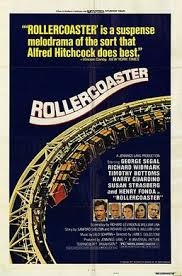
Rollercoaster (1977)

ROLLERCOASTER (1977) *
Rollercoaster, a thriller that combines Peter Bogdanovich’s vastly superior Targets, a disaster movie, and a mad bomber movie, marked the first time I returned to an amusement park since that fateful day on family vacation this past summer at Holiday World in Santa Claus, Indiana.

Everything was fine and dandy, we even maintained social distance and wore our masks as often as possible, until 16-year-old Emily wanted 12-year-old Isaac to ride on a roller coaster. She said he promised that he would try at least one roller coaster with her, he said that he made no such promise, she won’t ride on a roller coaster by her lonesome, he did not budge and refused to ride, and they eventually broke into hysterics and went their separate ways. Emily followed my wife Lynn and I back into the main body of the park and she frequently groused about her younger brother, while Isaac stayed behind and wept for the state of the world or something on a bench.

Two hours later, Emily decided to go to the car and she found Isaac sleeping on a bench just outside the park en route to the parking lot. No big deal, he said, he was tired, so he walked off, walked out, and took a nap. He did look a little refreshed.

I virtually walked the entire length of Holiday World twice over looking for Isaac to no avail and I lost count of every Beatles, every Beach Boys song the park blasted that day over the loud speakers. I had precise numbers, and they were gone. Lynn and I were obviously not pleased with either Emily or Isaac, and this is the first time I have spoken publicly about that Sunday afternoon in a place seven hours away from home.

The best thing about Rollercoaster, aside from the fact that it finally ended, is that it put that day in Santa Claus in perspective. I mean, yeah, at least we didn’t have happen to us what happened to the characters in Rollercoaster, especially at the 10-minute mark in the movie when our resident mad bomber (just call him The Mad Bomber with No Name who apparently represents something about our fears) played by Timothy Bottoms blows up a section of track and spectacularly derails a roller coaster. Needless to say, Universal Studios released Rollercoaster — in Sensurround, which Universal head Sidney Sheinberg called as big as any star in the movies — in June ’77 and a little release named Star Wars blew it away. Universal made just one more film in Sensurround. Big star?

Bottoms’ bomber presents one fundamental problem, because we never learn even his name or his motivation or much of anything ’bout him or even see that he enjoys being a mad bomber. He’s a cipher who’s not even mad enough in either way to justify being called a mad bomber. So when he meets his inevitable demise in the film’s grand finale, I felt no joy and only relief because it finally put this two-hour movie to pasture where it can rest in manure for eternity.

Here’s that perspective: Rollercoaster and that ordeal in Holiday World both lasted about two hours in real time, and both felt much longer. Yeah, I don’t much care for roller coasters in real life or captured on celluloid.

In closing, I should mention that Helen Hunt and Steve Guttenberg make their feature film debuts, iconic actors Henry Fonda and Richard Widmark appear here strictly for the money, and the eccentric rock band Sparks reportedly calls their cameo appearance in Rollercoaster — where they perform two songs from their 1976 LP Big Beat — the biggest regret of their career.

The Manitou (1978)

THE MANITOU (1978) *1/2
California is going to hell.

— Donald J. Trump on Twitter

Obviously, President Trump — a big movie fan, the biggest movie fan ever — forgot The Manitou from 1978, because then he would have known California, at least one San Francisco hospital, had already gone straight to Hell for one absolutely positively bloody ridiculous 103-minute horror movie.

The Manitou just might help explain what’s happening today in California and many other places, for that matter. Yes, that’s right, it’s another possession movie.

Tony Curtis plays a phony baloney psychic seen in movies upon occasion (normally bad movies) — one of them who reads Tarot cards to little old ladies and other suckers — and his former flame discovers a growth on the back of her neck. The foremost tumor expert calls it “malignant.” It’s definitely malignant, alright, it’s the reborn spirit of the most powerful 400-year-old medicine man on his fifth reincarnation. You think you’re having a bad day or a bad time, just wait until you see what happens to poor Karen Tandy (Susan Strasberg) in The Manitou.

This is yet another one of those movies where I am thankful every actor maintained a straight face reciting all their dialogue. To be honest, though, I want to learn their secret. The Manitou combines doctor talk, psychic talk, spiritual talk, and Indian talk into one concoction that’s overloaded and overheated with jive, like, for example, we all — even us White people — have a Manitou and that we includes all our possessions. I cannot help myself when I laugh at such dialogue like “Gichi Manitou? Harry, you don’t call Gichi Manitou. He …” and (in response) “Oh, yeah, well he’s going to get a person-to-person call from me … collect!”

The Manitou somewhat redeems itself with a spectacular psychedelic light show late in the picture. It comes in about 90-95 minutes to be a tad bit more precise and that display earned the picture a half-star bump in overall rating. By the way, I almost rescinded that half-star boost after The Manitou hits us with the following statement:

Fact: Tokyo, Japan, 1969.

A fifteen-year-old boy developed what doctors thought was a tumor in his chest. The larger it grew, the more uncharacteristic it appeared. Eventually, it proved to be a human fetus.

After 100 minutes of The Manitou, about the last thing in the world we needed was any claim to factual basis.

The Manitou is so bad that I hope it will not be reborn in 400 years, when it would be ever more powerful and worse.

The Stepfather (1987)

THE STEPFATHER (1987) ****

Every now and then, a horror film will feature a performance that earns widespread critical acclaim and official recognition typically not bestowed on actors or actresses within horror films.
For example, we’ve had Fredric March in Dr. Jekyll and Mr. Hyde, Anthony Perkins in Psycho, Sissy Spacek in Carrie, Anthony Hopkins in Magic, and Jeff Goldblum in The Fly. We should include The Stepfather star Terry O’Quinn with those distinguished performances. He’s so magnificently malevolent that he elevates The Stepfather a notch or two above the average horror thriller and makes it a transcendent exploitation film.

O’Quinn is one of those veteran character actor types who creates the stereotypical reaction, “Hey, I know that guy! He looks so familiar and he was in. …” But most people can’t quite name him! That joke told about John Malkovich in Being John Malkovich applies even more to O’Quinn. Let’s see, aside from a pair of Stepfather movies, O’Quinn appeared in Young Guns, The Rocketeer, and Tombstone, as well as numerous TV shows and movies.

O’Quinn plays a real piece of work in The Stepfather and the movie begins with him assuming his next guise Jerry Blake, after he murdered his family. We see the bloody aftermath, so there’s no doubt about the identity of the killer and we’re left waiting for the moment Blake again explodes into violence. We’re also waiting for when his new family discovers his old identity and his bloody murders, all roads leading to a final showdown that seems obligatory for any thriller since Halloween. That macabre interest level starts with the standard One Year Later title card.

O’Quinn effectively shows that he wants to be a straight, clean-cut, self-effacing man with the All-American nuclear family traditionally identified with Father Knows Best, Leave It to Beaver, and The Adventures of Ozzie and Harriet, also familiar through many, many other sitcoms. At the same time, we know that it’s 99.9 percent likely he’ll gradually snap, crack, and pop when familial disappointment hits dear old Dad again, so a lot of the fun involves Blake’s tension between establishing or slaughtering his new family.

Jill Schoelen’s spitfire teenage stepdaughter Stephanie naturally sees right through Jerry Blake and her character earns our sympathy and empathy almost immediately after we learn her biological father died only a year before this Blake fellow entered the picture and romanced her mother. Of course, nobody quite believes Stephanie, who gets expelled from school for her latest punch out, when she expresses that something’s not quite right about her stepfather. Schoelen plays a 16-year-old girl, so it’s a little creepy when director Joseph Ruben and screenwriter Donald E. Westlake give her a nude scene late in the picture; granted, Schoelen carried on the grand old movie tradition of a teenager portrayed by somebody at least several years older.

Shelley Hack complements O’Quinn and Schoelen and completes the trio of solid performances, in the role of the new Mrs. Blake. She plays a tricky role, perhaps just as tricky as the title role, because her discovery of the truth must be timed absolutely perfect. Otherwise, we see that she’s a dolt and feel she deserves her fate. The Stepfather times it just perfect, and it gets so many things right that we bask in the presence of a superior horror film.

Orgy of the Dead (1965)

ORGY OF THE DEAD (1965) ****
Officially, Stephen C. Apostolof (1928-2005) is the director of Orgy of the Dead, but it bears so many of the trademarks of its screenwriter, Edward D. Wood Jr., that it could play as the back end of a doubleheader with the immortal Plan 9 from Outer Space directed by Wood.

Loopy dialogue? Check. How about “Torture, torture! It pleasures me!” “A pussycat is born to be whipped.” “If I am not pleased with tonight’s entertainment, I shall banish their souls to everlasting damnation!” “Q: Is it some kind of college initiation? A: It’s an initiation alright, but not to any college as you or I know it!”

Criswell as narrator? Check. On top of being the narrator, Criswell stars as The Emperor, giving him more screen time than Plan 9 and he’s the source of most of the quotes in the above paragraph. Yeah, anyway, here’s the epic narration to open the film in true Wood (and Criswell) style, “I am Criswell. For years, I have told the almost unbelievable, related the unreal, and showed it to be more than a fact. Now I tell a tale of the threshold people, so astounding that some of you may faint. This is a story of those in the twilight time. Once human, now monsters, in a void between the living and the dead. Monsters to be pitied, monsters to be despised. A night with the ghouls, the ghouls reborn from the innermost depths of the world.”

Questionable acting? Check. Continuity errors galore? Check. Shoddy visual effects stemming from a micro budget? Check.

Unlike Plan 9 though, Orgy of the Dead features about one dozen bizarre topless dance sequences and that ultimately gives it the edge over Plan 9.

I love a film where the nominal protagonists have the only proper names. Of course, one of them answers to Bob and he’s a writer looking for inspiration. Boy, does he ever find it. Otherwise, in addition to The Emperor, we have The Black Ghoul and the bevy of dancers, Hawaiian Dance, Skeleton Dance, Indian Dance, Slave Dance, Street Walker Dance, Cat Dance, Fluff Dance, Mexican Dance, and Zombie Dance (great Cramps song). That’s all the plot synopsis necessary.

Orgy of the Dead, though, also leaves plenty enough room for poorly costumed Mummy and Wolfman as imperial henchmen. Pat Barrington essays a double role as Bob’s lady friend Shirley and the Gold Girl. The Gold Girl calls to mind Shirley Eaton’s infamous golden paint demise in the 1964 Bond film Goldfinger. At first, I thought they were saving the good girl’s nudity for last, like the bodaciously buxom good girl Debra Blee in the 1982 sex comedy The Beach Girls, but that’s not true in Orgy of the Dead since Barrington also played the Gold Girl.

Even the taglines for Orgy of the Dead (Titty Dance of the Dead describes the film more accurately) are incredible, especially “Are you heterosexual?” and “In Gorgeous ASTRAVISION and Shocking SEXICOLOR!” Shocking sexy color, indeed.

The Vampire Bat (1933)

THE VAMPIRE BAT (1933) ***
The Vampire Bat would otherwise be a forgotten horror entry were it not for the presence of four members of the Horror Movie Hall of Fame, three of them surefire first ballot inductees.

Fay Wray (1907-2004) earned her claim to be the First Lady of Horror and the first scream queen through her work alone in the 1933 classic King Kong. Ann Darrow gave Wray instantaneous immortality, but she also starred in Doctor X, The Most Dangerous Game, The Vampire Bat, and Mystery of the Wax Museum in a year period leading up to King Kong. She was no one-hit wonder.

Lionel Atwill (1885-1946) appeared in a variety of horror movie roles over a 15-year period, in such entries as Doctor X, The Vampire Bat, Mystery of the Wax Museum, Mark of the Vampire, Son of Frankenstein, The Ghost of Frankenstein, Frankenstein Meets the Wolf Man, House of Frankenstein, and House of Dracula. He generally played a mad doctor or an authority figure, be it Inspector Krogh (Son of Frankenstein) or the Mayor (Frankenstein Meets the Wolf Man). Atwill essayed an inspector in several Universal horror flicks.

Salina, Kansas born Dwight Frye (1899-1943) received a tribute nearly 30 years after his death when Alice Cooper released “Ballad of Dwight Fry” on the 1971 album Love It to Death, one of those classic Cooper morbid ballads / epics. Babe Ruth once said that he was paid more than Herbert Hoover because he had a better year than the President and Frye should have been able to say the same in 1931, between his roles in Dracula and Frankenstein, but it’s doubtful Universal paid a supporting actor in any movie more than the greatest home run hitter. Renfield’s presence certainly would have made the Kamala Harris-Mike Pence vice-presidential debate more interesting.

Melvyn Douglas (1901-81) enjoyed a 50-year acting career and he won Academy Awards for his supporting performances in Hud and Being There, but he earned his spot in the hallowed halls of horror history by appearing in the 1932 classic The Old Dark House.

In other words, Wray, Atwill, Frye, and Douglas elevate The Vampire Bat.

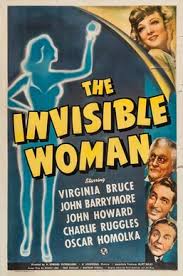
The Invisible Woman (1940)

THE INVISIBLE WOMAN (1940) *1/2
Normally, it’s great for a movie to be considered 20 years ahead of its time.

Unfortunately for Universal Studios’ third entry in the Invisible Man series, The Invisible Woman, it’s not so great that it predated the Disney live-action comedies of the ’60s and ’70s, unless you’re into that kind of thing.

One always should account for personal taste in delicate matters like these, so I will note that I prefer both The Invisible Man and The Invisible Man Returns (released earlier in 1940) over The Invisible Woman because they have a darker sense of humor at play than a predominantly lighthearted comedy that revolves heavily around the good old slapstick.

Ah, yes, good old slapstick. That’s where The Invisible Woman paved the way for all them Disney Solid Gold hits of the ’60s and ’70s.

Slapstick, in this case, does not mean the virtuoso physical feats of silent greats Buster Keaton and Harold Lloyd or the brutality of the Three Stooges and Home Alone.

No, rather, it’s mostly supporting characters falling down and fainting and gasping, like, for example, man servant George (played by Charlie Ruggles). Take a drink for every time George falls down or faints or flusters and you’ll be feeling at least a buzz in no time. Depending on the drink, you might miss out on most of The Invisible Woman and I call that a happy ending.

The Invisible Woman throws in comic gangsters, characters that have very rarely worked throughout cinematic history, not then, not before then, not after then, not ever. Given the presence of Shemp Howard in a henchman role, one might be tempted to believe The Incredible Woman would give up on the genial slapstick and really go for the gusto like maybe a Three Stooges short. No, no, no.

I don’t really need to discuss the plot, because it’s one of them movies where the title says it all more or less and we can quickly move on to who plays who, like John Barrymore as nutty Professor Gibbs, Virginia Bruce the spunky title character and John Howard her eventual leading man, Margaret Hamilton and Ruggles the servants, and Oscar Homolka the main heavy. What a waste of a talented cast, though, and undoubtedly one of the worst films made during Universal’s run of horror films.

Bloodline (1979)

BLOODLINE (1979) *
Bloodline, a.k.a. Sidney Sheldon’s Bloodline, tries its hand at several fiction genres and fails mightily at every single one of them.

Let’s see here, we have the always popular Woman in Danger, murder mystery, police procedural, and the film adaptation of a literary potboiler that revolves around the rich and the shameful, predominantly shameful anyway, in lush international jet set surroundings. It also throws in a snuff film style murder every 30 minutes.

The great British actress Audrey Hepburn (1929-93) proves to be the only redeeming factor at play during Bloodline and she’s responsible for the one star rating. She brings a touch of class to the proceedings. At that point in her career, Hepburn rarely did movies and focused more of her time on her family. Considering the dubious nature of Bloodline, her first and only R-rated movie, she should have devoted even more time to her family. After all, Hepburn made her fame in such films as Roman Holiday, Sabrina, Funny Face, Breakfast at Tiffany’s, and My Fair Lady, productions far removed from the cheap thrills and tawdry exploitation that Bloodline tenders at its best and worst. Hepburn and Bloodline director Terence Young made the 1967 psychological thriller Wait Until Dark and that’s much, much, much better and way, way, way more suspenseful than Bloodline.

Maybe, just maybe I have an instant great distaste for adaptations made from the fiction of such writers as Sheldon (1917-2007), Harold Robbins (1916-97), and Jacqueline Susann (1918-74), who are said to have authored popular novels or works better understood by the unwashed masses than the snooty literary critics. I have not read their work, but having watched Valley of the Dolls and Bloodline, both trashy productions, I’ll stick being to a snob, thank you very much. Anyway, I can’t read a single word of anything else until I finish Crime and Punishment.

Since it wants to be classy, Bloodline comes hyped as a thriller rather than a horror film, but there’s not a single thrill to be had regardless of genre classification. Hepburn plays Elizabeth Roffe, a pharmaceutical heiress who becomes the next in line for murder after her father’s murdered in the film’s opening scene. Like her father before her, Ms. Roffe doesn’t want her company’s stock to go public and this creates incredible friction with her three cousins who mostly provide the rich and shameful portion of the program. All roads lead to the obligatory denouement, and I should have taken a detour.

In fact, I did just that because at regular intervals during Bloodline, I kept distracting myself with other movies. For example, almost every time I saw Gert Frobe’s Inspector Hornung, I desperately wanted him to say (just once), “No, Mr. Bond, I expect you to die.” Instead, Hornung spends most his screen time discussing the case with a talking computer. Ben Gazzara seems like he’s under sedation throughout Bloodline and I could not believe this was the same actor who gave us such lusty characters in Anatomy of a Murder and Road House. Meanwhile, I still occasionally debate within myself which one’s worse between Bloodline and Oh Heavenly Dog, both turkey bombs featuring Omar Sharif. Yes, I don’t hate myself.

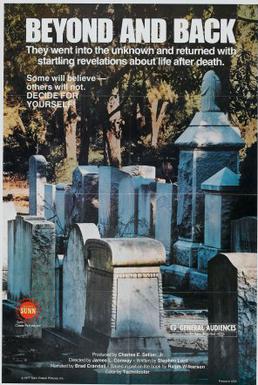
Beyond and Back (1978)

BEYOND AND BACK (1978) No stars

I am here to tell you about life after Beyond and Back.

I cannot believe that I finally watched a film that displaces The Star Wars Holiday Special as my selection for the worst film made in 1978.

Beyond and Back proved to be D.O.A. It showed no vital signs of cinematic life and brought me a micrometre closer to atheism with its faith-based and family-friendly agenda shoved down my throat, 90 minutes of bad actors monotonously gushing over near-death experiences, life after death, psychokinesis, Heaven and Hell, bright light, weighing souls, seeing dead relatives, ad nauseam.

Beyond and Back puts Benjamin Franklin, Elizabeth Barrett Browning, Eddie Rickenbacker, Thomas Edison, Louisa May Alcott, Ernest Hemingway, George S. Patton, and Harry Houdini on an equal plane with Anne Fleck, Dr. Stevens, Byron Temple, and Dr. Paul Kelly, since they’re all just cannon fodder for that agenda told through a pseudo-documentary approach with bad narration and bad reenactment.

Two of the worst films ever made (both from 1978) involve laughable disclaimers:

The African killer bee portrayed in this film bears absolutely no relationship to the industrious, hardworking American honey bee to which we are indebted for pollinating vital crops that feed our nation — The Swarm

The events you have just seen have been taken from actual accounts, but the names of the persons involved have been changed to preserve their anonymity. All such persons have been portrayed by professional actors and actresses — Beyond and Back

Of course, Beyond and Back is the same picture that starts with its narrator telling us, “You are about to see one of the most extraordinary movies of our time, a movie that dares to investigate the possibility of life after death.”

We can thank the folks at Sunn Classic Pictures for such classics, er, drivel as Beyond and Back, namely director, producer, novelist, and Sunn Classics founder Charles E. Sellier. Sellier (1943-2011) evolved from Cajun Catholicism to Mormonism and finally evangelical Christianity, but his product remained in the realm of quick-buck exploitation, whether it was Sunn Classic productions In Search of Noah’s Ark and In Search of Historic Jesus or the controversial killer Santa picture Silent Night, Deadly Night and the teenage comedy Snowballing (both directed by Sellier) or his later productions George W. Bush: Faith in the White House, Breaking the Da Vinci Code, The Search for Heaven, and Apocalypse and the End Times.

For obvious theological reasons and philosophical differences, Beyond and Back passed on many tales and famous last words.

Last words are for fools who haven’t said enough — Karl Marx

I hope the exit is joyful and hope never to return — Frida Kahlo

Dammit, don’t you dare ask God to help me — Joan Crawford

I’m bored with it all — Winston Churchill

I’m going, but I’m going in the name of the Lord — Bessie Smith (I do not recall a single black person in Beyond and Back)

My wallpaper and I are fighting a duel to the death. One or the other of us has to go — Oscar Wilde

Dear World, I am leaving because I am bored. I feel I have lived long enough. I am leaving you with your worries in this sweet cesspool. Good luck — George Sanders (a charming wit to the end)

As we depart this mortal review, I leave this joke: What’s the last thing that goes through a fly’s mind when I kill him? My fist (reporter’s notebook).