
The Last Dragon (1985)

THE LAST DRAGON

THE LAST DRAGON (1985) Three stars

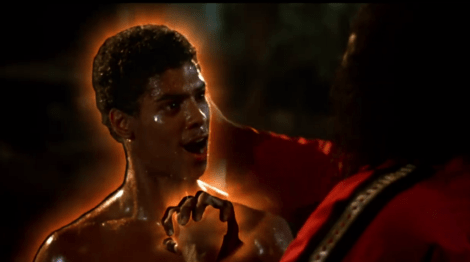
Gene Siskel included THE LAST DRAGON among his “Guilty Pleasures” in a 1987 “Siskel & Ebert” show and he gave it one of his funniest reviews, highlighted by “I’m a sucker for glowing fingers. Roger, I see glowing fingers in a movie, I tend to like the movie. … Just one finger (in E.T.), that’s how much I like it. In this one, you get 20. Two men, Roger, 20. Can you imagine the ads? ‘20 times the entertainment value of E.T.’” Siskel gave it three-and-a-half stars in his 1985 print review.

Roger Ebert gave it a mixed negative review and two-and-a-half stars, “THE LAST DRAGON turns into a funny, high-energy combination of karate, romance, rock music and sensational special effects. It’s so entertaining that I could almost recommend it … if it weren’t for an idiotic subplot about a gangster and his girlfriend, a diversion that brings the movie to a dead halt every eight or nine minutes. … They’ve been borrowed from a hundred other movies, they say things that have been said a hundred other times, and they walk around draining the movie of its vitality. They’re tired old cliches getting in the way of the natural energy of Taimak, Vanity and the Shogun character.”

I find myself occupying the middle ground between Siskel and Ebert. They both agreed on the strengths and the weaknesses of THE LAST DRAGON, but Siskel found the strengths to be stronger and Ebert the weaknesses to be weaker. LAST DRAGON co-stars Taimak, Vanity, and Julius J. Carry III are the strengths and Chris Murney as comic gangster Eddie Arkadian and Faith Prince as his aspiring singer girlfriend Angela Viracco are the weaknesses.

Taimak (full name Taimak Guarriello) stars as Leroy Green, who’s inspired by the works of Bruce Lee to such a degree that he’s called “Bruce Leroy.” He’s in pursuit of “The Glow,” referenced memorably by Siskel — see, only a true martial arts master can exhibit “The Glow” over his entire body and that’s Leroy’s No. 1 goal. Scenes like “Don’t think, feel! It’s like a finger pointing away to the moon. Do not concentrate on the finger or you will miss all of the heavenly glory” from ENTER THE DRAGON undoubtedly warmed the heart of Mr. Leroy … and possibly Motown mogul Berry Gordy, whose Motown Productions sponsored THE LAST DRAGON.

He’s opposed by Sho’nuff (Carry III), a.k.a. “The Shogun of Harlem,” who sees Leroy in his way for ultimate martial arts mastery. Sho’nuff interrupts a showing of the sacred text ENTER THE DRAGON in an urban theater and he throws down the gauntlet, “Well well, well. If it ain’t the serious, elusive Leroy Green. I’ve been waiting a long time for this, Leroy. I am sick of hearing these bullshit Superman stories about the — Wassah! — legendary Bruce Leroy catching bullets with his teeth. Catches bullets with his teeth? Nigga please.” Leroy counters with two platitudes that he might have gleaned from the “Kung Fu” TV show, then Sho’nuff throws it down again, “See, now it is mumbo jumbo like that, and skinny little lizards like you thinkin’ they the last dragon that gives kung fu a bad name. Get up, Leroy, I got somethin’ real fo’ yo’ ass in these hands.” Carry III (1952-2008) undoubtedly prepared for his role as Sho’nuff by playing in both DISCO GODFATHER, his debut feature, and THE FISH THAT SAVED PITTSBURGH.

All roads lead to a final showdown between Leroy and Sho’nuff when, sure enough, they both have “The Glow.” Leroy, though, finally exhibits true martial arts mastery.

Bruce Leroy also becomes the protector of television personality Laura Charles (Vanity) against them comic gangsters. She tells Leroy, “I thought that maybe it would be a great idea if I got myself a bodyguard. You know, like someone to guard my body? What girl could do worse than to have her own real life kung fu master?”

THE LAST DRAGON is a lot of fun, especially for viewers who are fans of martial arts spectaculars, particularly Bruce Lee. During the 1985 episode they reviewed THE LAST DRAGON, Siskel and Ebert lamented the lack of quality martial arts entertainment in a special “X-ray segment.” They singled out three “better” martial arts films that predated THE LAST DRAGON: ENTER THE DRAGON, THE OCTAGON starring Chuck Norris, and THE KARATE KID, the surprise blockbuster from 1984. I felt bad for Siskel and Ebert, because it seemed like they missed a great many great martial arts films like DRUNKEN MASTER and THE 36TH CHAMBER OF SHAOLIN, for example, and instead they made several “Dogs of the Week” (their picks for worst movie each episode until September ‘82) from seeing obviously inferior martial arts imports with lousy prints and horrific dubbing. It would be difficult for anybody not to form a negative opinion about martial arts films from seeing only the mass-produced bargain-basement rip-offs that almost immediately came in the wake of Bruce Lee’s death in 1973.

Thankfully, through ventures like the Dragon Dynasty, we can see classics like THE 36TH CHAMBER, KING BOXER (a.k.a. FIVE FINGERS OF DEATH), THE ONE-ARMED SWORDSMAN, FIST OF LEGEND, MAD MONKEY KUNG FU, FIVE DEADLY VENOMS, and EIGHT DIAGRAM POLE FIGHTER in quality prints and not dubbed in dodgy English. Films like these have provided me a ridiculous amount of enjoyment over the years.

Roller Boogie (1979)

ROLLER BOOGIE

ROLLER BOOGIE (1979) *1/2

Hot on the heels of reviewing THANK GOD IT’S FRIDAY, here’s another one where it’s a soundtrack in search of a movie.

Or, in other words, a gimmick in search of a movie. ROLLER BOOGIE belongs to a specific time and place of quickie exploitation flick: post-SATURDAY NIGHT FEVER boogie down and roller skating, hence that genius title.

ROLLER BOOGIE should have been a better film. I mean, director Mark L. Lester went on to make CLASS OF 1984 and COMMANDO, two films that go above-and-beyond in going over-the-top and that’s both films’ best virtue by far.

Not in ROLLER BOOGIE, though, which earns a ‘PG’ from the MPAA. It should have been ‘R.’

I’ll give one example.

Early on in the picture, we’re talking first few minutes here, our female lead Terry Barkley (Linda Blair) gets dressed and we sense there’s a missing nude scene, like they filmed one but left it on the cutting room floor. This early scene establishes the awkwardness that we sense around Blair’s character all movie.

We find Blair, who was in her late teens when she made ROLLER BOOGIE, in her transition period, between her breakout in THE EXORCIST (1973) and later exploitation films like CHAINED HEAT and SAVAGE STREETS. Maybe it’s because I watched ROLLER BOOGIE after her later films that I felt like the 1979 film teases us with possibilities that it ultimately did not want to pursue, undoubtedly for commercial reasons. The one song that should have been written for Blair: “I’m Not a Girl, Not Yet a Woman,” which was instead written for Britney Spears at the turn of the 21st Century. Rick James wrote “Cold Blooded” (title song for his 1983 album) about his relationship with Blair. “Cold Blooded” hit No. 40 on the Billboard Hot 100.

Upon further reflection, ROLLER BOOGIE does go above-and-beyond in recycling grand old cliches and stereotypes, pilfering from both the Mickey Rooney-Judy Garland “Let’s put on a show” movies of the late 1930s and early ‘40s and the Frankie Avalon-Annette Funicello BEACH PARTY movies of the early ‘60s in addition to SATURDAY NIGHT FEVER and the disco and roller skating fads more contemporaneous with ROLLER BOOGIE.

Like THANK GOD IT’S FRIDAY, ROLLER BOOGIE rattles off characters and scenes we have seen many times before.

Terry develops a romance with roller boogie master Bobby James (Jim Bray), who, get this, comes from another socioeconomic class than rich girl and musical genius Terry. Bray makes both his film debut and finale, basically playing a fictional version of himself … not all that well. He does skate convincingly, of course, and he does possess a great smile, but in any scene that requires any emotion whatsoever Bray absolutely falls flat on his face. Bray apparently had already earned 275 trophies for his skating before he made ROLLER BOOGIE. For his acting, though, Bray received “Dishonourable Mention” from the Stinkers Bad Movie Awards; Robby Benson won “Worst Actor” for WALK PROUD. Blair lost “Worst Actress” to Barbra Streisand in THE MAIN EVENT.

Then we have Franklin (Christopher S. Nelson), who’s this hopeless rich snob always lusting after Terry’s bod. We’ve seen this character archetype before, like Collins Hedgeworth (Paul Linke) in GRAND THEFT AUTO and Spaulding Smails (John F. Barmon Jr.) in CADDYSHACK. You remember Spaulding? He’s the snotty but spectacularly slobby grandson of Judge Smails (Ted Knight). In a classic scene, Spaulding wants a hamburger, no, a cheeseburger, a hot dog, and a milkshake … before Judge Smails sets the impetuous lad straight, “You’ll get nothing, and like it.” Well, there’s nothing that funny or worthwhile in ROLLER BOOGIE. Franklin’s scenes drag ROLLER BOOGIE down.

Cartoon gangsters lean on Jammer Delaney (Sean McClory), the owner of roller boogie rink Jammers. Nobody would ever believe this plot thread, but this here old Jammer, why he’s the last property owner holding out. Jammer’s sitting on a relative gold mine and he’s standing in the way of progress. We have seen this old cinematic war horse trotted out for everything ranging from BLACK BELT JONES (where property owner Scatman Crothers died from the weakest punch in cinematic history) to WHO’S THE MAN? Cartoon gangsters rarely ever bode well for a motion picture spread and they do not for ROLLER BOOGIE. I do not want to write another word on the plot.

Kimberly Beck’s next screen credit would be as final girl Trish Jarvis in 1984’s FRIDAY THE 13TH: THE FINAL CHAPTER. She famously said of the FRIDAY THE 13TH series: “I had never seen any of the FRIDAY films. And I didn’t want to see any of them. I still have never seen any of them. I just don’t like that kind of genre at all. And this was not even a B-movie, it was really just a C-movie.” Unfortunately, we do not have a quote from Beck detailing her experience playing Terry’s best friend Lana, who does really fill out her outfits rather nicely in ROLLER BOOGIE. She provides one of the fleeting pleasures of the movie. Sometimes, you take it wherever you can find it and ask questions never.

Thank God It’s Friday (1978)

THANK GOD IT'S FRIDAY

THANK GOD IT’S FRIDAY (1978) *1/2

Alternate title: PRAISE JESUS FOR STEREOTYPES.

Let’s enumerate them.

— The underage girls Frannie (Valerie Landsburg) and Jeannie (Terri Nunn) who sneak in.

— The awesome dancer Marv Gomez (Chick Vennera).

— The aspiring singer Nicole Sims who’s played by a superstar singer (Donna Summer).

— The fast-talking DJ Bobby Speed (Ray Vitte) who seemingly holds the fate of the world in his little hands, one record at a time.

— The straight married couple, Dave (Mark Lonow) and Sue (Andrea Howard), who are wanting to broaden their horizons. I believe they have the last name “Dullard.” Dave and Sue Dullard. Perfect.

— The swinging ladies man owner Tony (Jeff Goldblum) who makes a bet that he can conquer a married woman tonight. Sue Dullard, maybe?

— Two hopelessly polar opposite dates, Gus (Chuck Sacci) and Shirley (Hilary Beane), who have been set up by a computer dating service.

— Oh, there are more and more and more stereotypes in the cast, including Jennifer played by future star Debra Winger, but I’ll cut myself a little bit slack and cut this list very, very, very short.

— I should mention that it’s Friday night, of course, at the Zoo and the Commodores are slotted to play if Floyd (DeWayne Jessie) shows up with the instruments. I have a feeling that Floyd will let us down, but honestly, I believe that he flew the coop to go work on his scene in NATIONAL LAMPOON’S ANIMAL HOUSE (released two months after I LIKE SATURDAY MORE). You might remember Floyd as lead singer Otis Day of Otis Day and the Knights and their smash rendition of “Shout.” Floyd must fail at least long enough for Nicole to get her chance, though, because why else would Donna Summer be in the cast.

— Of course, the real stars of DEAR LORD IT’S DISCO are the songs: “After Dark” by Pattie Brooks, “Find My Way” and “It’s Serious” by Cameo, “Let’s Make a Deal” by G.C. Cameron & Syreeta, “Brickhouse” “Easy” and “Too Hot ta Trot” by the Commodores, “Romeo & Juliet” by Alec Constandinos, “You’re the Reason I Feel Like Dancing” by the 5th Dimension, “From Here to Eternity” by Giorgio Moroder, “Dance All Night” by Cuba Gooding, “Love Masterpiece” and “I’m Here Again” by Thelma Houston, “Disco Queen” and “Trapped in a Stairway” by Paul Jabara, “Do You Want the Real Thing” by D.C. LaRue, “Thank God It’s Friday” and “You Are the Most Precious Thing in My Life” by Love & Kisses, “I Wanna Dance” by Marathon, “Meco’s Theme” by Meco, “Floyd’s Theme” by Natural Juices, “Down to Lovetown” by the Originals, “Lovin, Livin’, and Givin’” by Diana Ross, “Sevilla Nights” by Santa Esmeralda, “Love to Love You Baby,” “With Your Love,” “Je T’aime (Moi Non Plus)” and “Last Dance” by Summer, “Take It to the Zoo” by Sunshine, “In Hollywood” and “I Am What I Am” by the Village People, and “Leatherman’s Theme” by Wright Brothers Flying Machine. This list should have been used to filibuster more than 40 years ago, but disco would seem to be outside the life experience of anybody in Congress then, now or tomorrow.

Nearly all those songs are from Casablanca Records, whose film division produced BLESS THE HIT SOUNDTRACK, and let’s just say the songs are far more memorable than any character. This is the case of a soundtrack in search of a movie.

Summer’s “Last Dance,” in fact, won Best Original Song at the 1979 Academy Awards, beating out “Hopelessly Devoted to You” from GREASE, “The Last Time I Felt Like This” from SAME TIME, NEXT YEAR, “Ready to Take a Chance Again” from FOUL PLAY, and “When You’re Loved” from THE MAGIC OF LASSIE. Not exactly the most inspired songs.

— It’s kinda sorta interesting to see Goldblum, Winger, and Nunn (future Berlin lead singer who earned an Academy Award for Best Original Song for “Take My Breath Away”) in the early stages of their careers, but really not all that interesting. A great title and a good soundtrack do not always make for a good movie. Exhibit A: THANK GOD IT’S FRIDAY.

Kiss Me Deadly (1955)


KISS ME DEADLY (1955) ****

Sometimes, it seems that like no author ever liked any film adaptation of their work. It feels that way every time I read up on a film based on a novel.

For example, British novelist Roald Dahl (1916-90) hated WILLY WONKA & THE CHOCOLATE FACTORY, though he’s credited for writing the screenplay. David Seltzer rewrote Dahl’s original script and the original author hated the changes like a different ending and the addition of musical numbers. The choice of Gene Wilder to play Willy Wonka also did not jibe with Dahl.

Stephen King famously hates Stanley Kubrick’s adaptation of THE SHINING. “I have a real problem with THE SHINING and Stanley Kubrick knew that I had a real problem with THE SHINING. I had a discussion with him beforehand. He said, ‘Stephen, Stanley Kubrick here, don’t you agree that all stories of ghosts are fundamentally optimistic?’ I said, ‘What do you mean?’ and he said ‘Well if there are ghosts it means we survive death and that’s fundamentally an optimistic view, isn’t it?’ I said, ‘Mr. Kubrick, what about Hell?’ and there’s a long pause on the telephone line and then he said in a very stiff and a very different voice, ‘I don’t believe in Hell.’ I said to myself, ‘Well, that’s fine, but some of us do and some of us believe that ghosts may survive and that may be Hell.’” King called THE SHINING “a cold film” with “striking images” and compared it to a “beautiful car that had no engine.”

Now, we get to the classic 1955 apocalyptic film noir KISS ME DEADLY directed by Robert Aldrich (1918-83) and written by screenwriter A.I. Bezzerides (1908-2007) and an uncredited Aldrich from Mickey Spillane’s 1952 novel.

Spillane (1918-2006), of course, did not find the film adaptation of his novel to be “classic.” Apparently, Bezzerides felt the same about the source material.

“I was given the Spillane book and I said, ‘This is lousy. Let me see what I can do.’ So I went to work on it. I wrote it fast because I had contempt for it. … I tell you Spillane didn’t like what I did with his book. I ran into him at a restaurant and, boy, he didn’t like me.”

Why not?

Bezzerides added espionage and the infamous nuclear suitcase (“The great whatsit”), plot details not in Spillane’s novel. On top of that, Bezzerides made detective protagonist Mike Hammer a narcissistic bully of a very high degree of creep. Hammer, played by Ralph Meeker, pushes anti-hero to its most extreme limits. For whatever reason, Nazareth’s “Hair of the Dog” comes to mind, mainly that “Now you’re messin’ with a son of a bitch” chorus.

The appropriately named Hammer makes his living (predominantly) by blackmailing adulterous husbands and wives and he’s appropriately named Hammer because he’s always dropping the hammer on somebody in his way. Assorted thugs and sordid contacts, of course, but also a coroner not wanting to part with a key and a clerk not wanting to cooperate because Hammer’s not a member. Hammer’s friends and associates also pay dearly for their association with the detective.

I love Bezzerides’ dialogue.

One thug waxes poetic, “Dames are worse than flies.”

That’s as great as “I don’t pray. Kneeling bags my nylons” from Billy Wilder’s ACE IN THE HOLE and Harry Lime’s “cuckoo clock” speech from Carol Reed’s THE THIRD MAN.

KISS ME DEADLY prepares us for what lies ahead from its very first scene and then its opening credits, both stating that it will be a film like none other. What’s that old Cole Porter song? Yes, “Anything Goes.”

First scene: A frightened young woman. Dressed only in a trench coat, and she’s also in her bare feet. She’s flagging a ride as the motor cars zip past on a highway. She’s desperate, so desperate that she finally places herself in front of the path of one of the zipping cars. That car just happens to be driven by none other than Hammer. His first line, “You almost wrecked my car! Well? Get in!”

Opening credits: They scroll backwards. All the while, we hear the cries of the frightened young woman (Cloris Leachman).

Christina Bailey, the frightened young woman, tells Hammer, “Get me to that bus stop and forget you ever saw me. If we don’t make it to the bus stop. … If we don’t, remember me.” Needless to say, Miss Bailey does not make it to the bus stop and Hammer (and by extension, we) go down the proverbial rabbit hole. All roads lead to the atomic suitcase and one helluva explosive finale.

Every film noir seems to have at least one femme fatale and KISS ME DEADLY gives us Lily Carver (Gaby Rodgers), who’s compared to Pandora and Lot by one character she guns down late in the picture. She then greets Hammer, “Kiss me, Mike. I want you to kiss me. Kiss me. The liar’s kiss that says I love you, and means something else.” She unloads on Hammer, too.

Yes, she’s arguably the most fatal of any femme.

From her profile on “The Female Villains Wiki,” “Lily often has the manner of a slightly flaky adolescent, which doesn’t seem to be all assumed for the deceptive role she’s playing in the early scenes. When her true identity and character are later revealed, it’s clear she’s one of the most black hearted, deadly female villains ever put on screen. … She kills people easily, with no ethical concerns whatever evident. She smirks after she’s done it. In the last scene in which she appears, we see she’s more than just a greedy, callous killer, very pleased with herself, she’s also a sadist.”

Lily meets her maker in one of the great cinematic deaths. There’s a shot during the apocalyptic ending in RAIDERS OF THE LOST ARK that’s a dead ringer for one in KISS ME DEADLY. Gotta love that Spielberg.

In the alternate ending, the one that was seen for many years, even Hammer goes down in flames. Nihilism and its variants have been used to describe KISS ME DEADLY many times, 639,000 in fact according to Google.

Aldrich later directed WHAT EVER HAPPENED TO BABY JANE?, THE DIRTY DOZEN, and THE LONGEST YARD, but he already outdid himself with KISS ME DEADLY.

All we need to know is that the Kefauver Commission named KISS ME DEADLY as 1955’s No. 1 menace to American youth. That would have included an 8-year-old Steven Spielberg and look how he turned out.