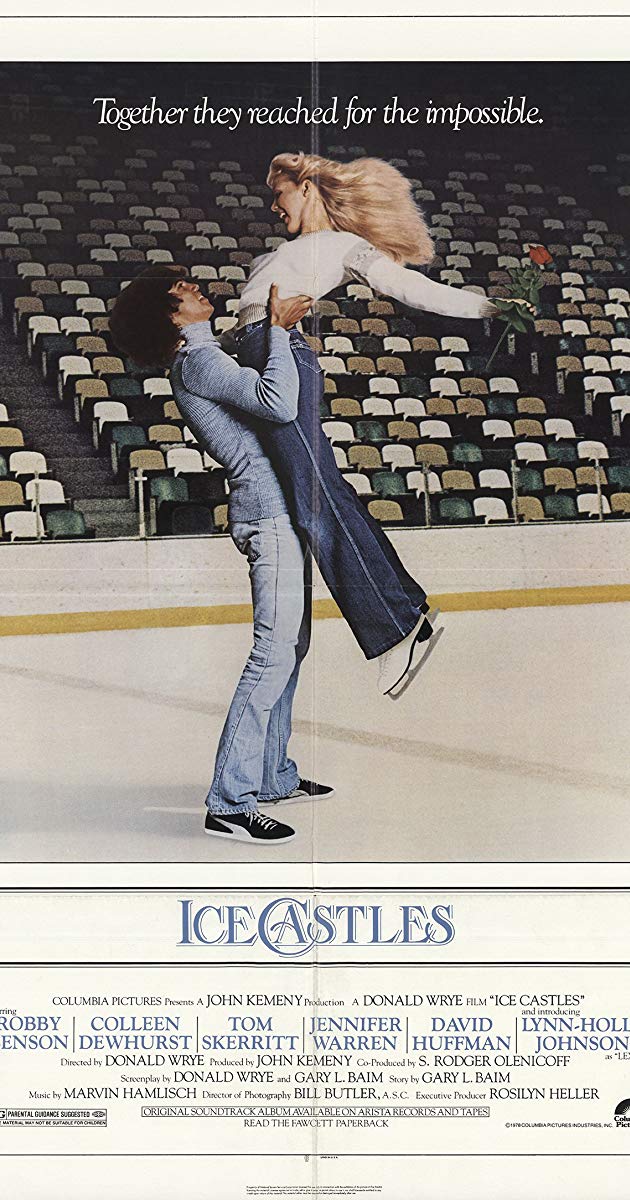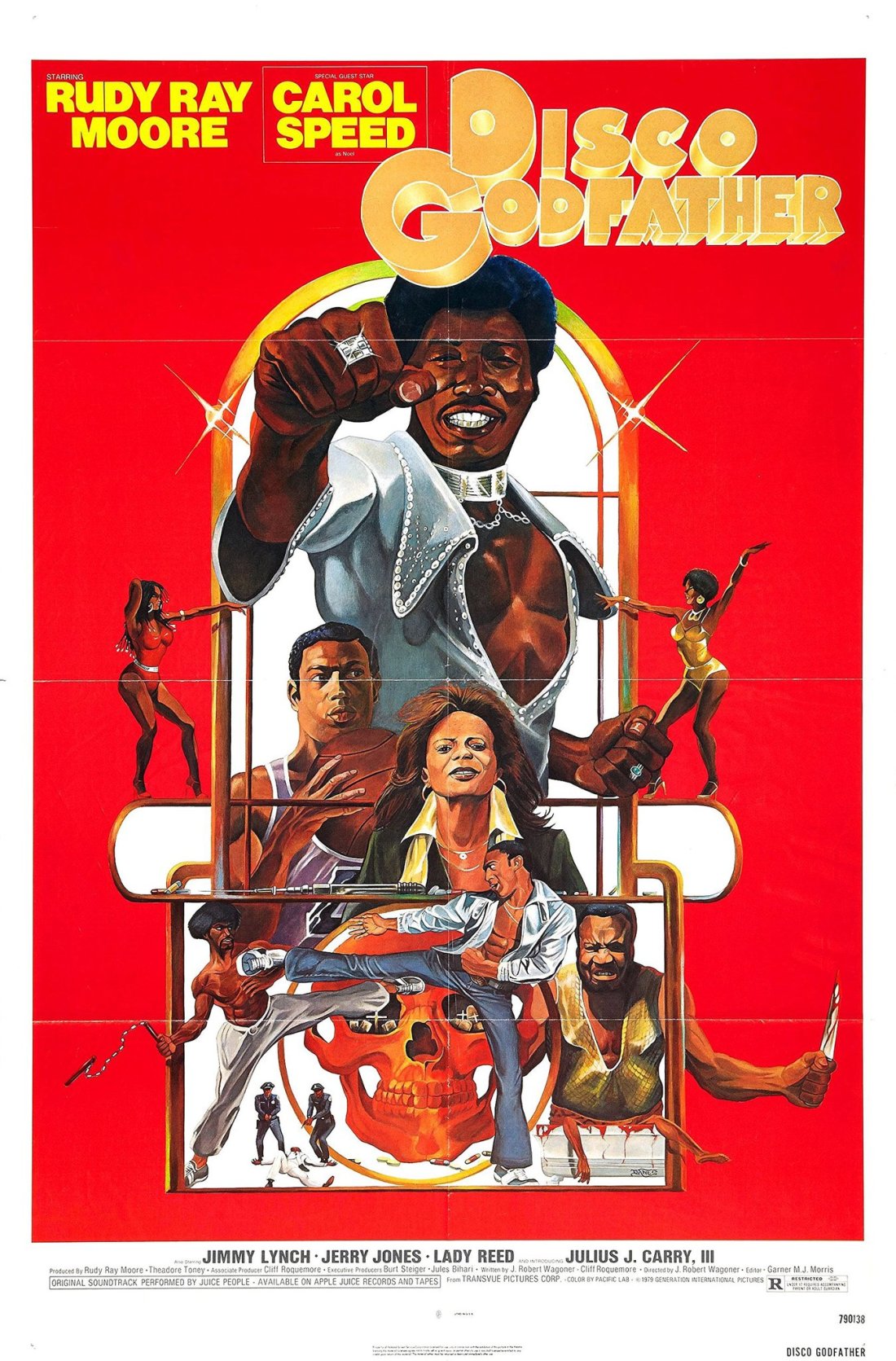
It (1927)

IT (1927) ***1/2

“Hey, old timer, have you seen IT?”

“Yeah.”

“I bet, though, knowing you, that you liked the crusty old TV version from, like what, 1890 better than the new one.

[Silence for a couple beats]

“Well, which one did you prefer?”

“Neither.”

“What?”

“That’s right, I prefer the 1927 IT starring legendary ‘It’ girl Clara Bow over any Stephen King adaptations called IT. Boom!”

— Theoretical conversation circa ‘18


That quality possessed by some which draws all others with its magnetic force. With ‘It’ you win all men if you are a woman and all women if you are a man. ‘It’ can be a quality of the mind as well as a physical attraction.

— Definition of ‘It’


Clara Bow obviously had ‘It’ and she displays it throughout IT, the film that officially made her a sensation after it was released on February 19, 1927.

Bow’s 1927 can stand against Babe Ruth’s — .356 average with 158 runs scored, 29 doubles, eight triples, 60 home runs, 165 RBI, 137 walks vs. 89 strikeouts, and 110 victories and a 4-0 World Series sweep against Pittsburgh — and Charles Lindbergh’s, for his legendary nonstop flight from New York City to Paris.

Bow (1905-65) made six films in 1927: IT, CHILDREN OF DIVORCE, ROUGH HOUSE ROSIE, WINGS, HULA, and GET YOUR MAN.

She helped pave the way for every female sex symbol to come. For example, her skirt flew up during IT, a good 28 years before Marilyn Monroe’s most famous movie bit in THE SEVEN YEAR ITCH. WINGS also features a brief — I mean brief — Bow boob flash. Blink and you’ll miss it.

She also inspired a millinery fashion craze, for crying out loud.

From the June 10, 1927 edition of the St. Louis Dispatch — advertising Clara Bow Vacation Hats for $1.25 each — “Smart and clever are these Clara Bow Hats that are fashioned of a good quality felt in twelve attractive modes. In black, white, pink and all the Summer shades — trimmed with applique of felt in contrasting colors as well as soid effects. Are soft and crushable, easily packed in handbag or trunk.” Each hat purchased came with a 8 x 10 photograph of Bow wearing that hat. No additional charge.

In the August 16 edition of the Minneapolis Star Tribune, Clara Bow Hats were being sold for 98 cents and each hat came with a copy of Bow’s signature. Apparently, there were 12 styles and colors of hats.

From the June 19 Nebraska State Journal, “In Gold’s smart millinery collections you’ll find ‘it’ — the cutest cleverest group of Clara Bow hats and every one of ‘em has ‘it.’ These perky little felt novelties are only $1.45 but they look like a million dollars worth of Clara Bow’s vivacity.”

Bow also became tabloid fodder, like this report from the Los Angeles Times during the making of WINGS, “Clara Bow, Paramount star, is becoming destructive. The queen of the flappers wrecked one perfectly good Ford while learning to drive one for certain sequences in “Wings,” the road show which tells the story of the American Ace in France. Miss Bow plays the part of an ambulance driver. “Wings” is being directed by William Wellman, himself a flyer during the war.” The reports and the rumors became wilder.

Bow retired from acting in 1933 to move to a ranch in Nevada, where she focused her energies on being a wife and a mother.

IT provides an early example of a concept film and it uses product placement — plugging Cosmopolitan Magazine and giving source material writer Elinor Glyn a cameo where she expounds on ‘It.’

IT features a plot that’s older than the Hollywood hills: A salesgirl, Betty Lou (Bow), sets her sights on wealthy (and handsome) playboy Cyrus T. Walham (Antonio Moreno), who’s her boss. There’s plot complications left and right — not convolutions, though — like so many romantic comedies but this is a movie that moves easily beyond its plot because of the style of director Clarence Badger, the witty dialogue and inter-titles, and both the incredible style, spunk, and star power of Bow.

“I don’t go to church. Kneeling bags my nylons.” — ACE IN THE HOLE

“Alright, I’ll go manicure my gloves.” — BUGSY MALONE

“She gave me a smile I could feel in my hip pocket.” — FAREWELL, MY LOVELY

Supporting character Monty Montgomery (William Austin) gets one of the all-time great lines, “I feel so low, old chap, that I could get on stilts and walk under a dachshund.” File it alongside the three lines quoted right above.

Monty proved to be a pleasant surprise, a supporting character who at least made me smile from his very first to his very last appearance. Monty creates the film’s biggest laughs and in a different way than Bow, he’s nearly as unforgettable. I would argue his eyes are just as memorable. What could otherwise be melodramatic mugging benefits from the parameters of silent cinema and his reactions — especially his astonished double takes — are worth their weight in comic gold. He’s a genuine hoot. That statement works for IT as a whole. In movie terms, IT definitely has “it.”
Sleepaway Camp (1983)

SLEEPAWAY CAMP

SLEEPAWAY CAMP (1983) Two stars

This is one of those instances where I can remember seeing the poster long before the attached movie.

Undoubtedly like most of the jaded youth of my generation, I first saw the poster for SLEEPAWAY CAMP back in the late 1980s. It’s the one that stayed with me the most over the decades.

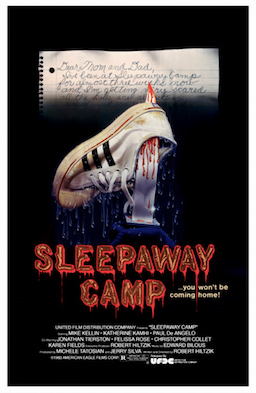
It has the dominant image of a dripping wet shoe being stabbed all the way through by a bloodied knife. Above, there’s a letter from a camper, “Dear Mom and Dad, I’ve been at Sleepaway Camp for almost three weeks now and I’m getting very scared. …” Right below the hand holding the knife are the title dripping blood from its bold type and the tag “You won’t be coming home!”

Now, hours after watching SLEEPAWAY CAMP for the first time, it’s just as unforgettable as the poster.

To a great degree, SLEEPAWAY CAMP chucks our traditional notions of what constitutes a “good” or a “bad” movie right out the fucking window. It’s more of an experience, an event, a rite of passage, something where you can ask friends and family if they have ever seen it. If they have or haven’t, dynamite conversation will follow either way. For sure, though, it would make a great watch party — of course, following proper social distancing protocol at this point in history.

Here’s a few notes on the experience:

— Melodrama is defined as such, “A sensational dramatic piece with exaggerated characters and exciting events intended to appeal to the emotions.” Addendum: See SLEEPAWAY CAMP. Early on, after the obligatory flashback to traumatic events of the past, Desiree Gould’s Aunt Martha establishes the basic tone for the rest of the movie: Campy with overacting possible. Yes, SLEEPAWAY CAMP goes over-the-top, gleefully, merrily, in every scene, including the end credits.

— Being bat shit crazy for 84 minutes has been SLEEPAWAY CAMP’s meal ticket to cult movie immortality. Because, let’s face it, it’s not as well-made technically as similar low-budget precursors BLACK CHRISTMAS, ALICE SWEET ALICE, and HALLOWEEN. Not even remotely close.

— SLEEPAWAY CAMP uses a musical score that also functions as bludgeoning device and melodrama amplifier. I just checked for any injuries after being whacked upside the head at regular intervals by Edward Bilous’ sledgehammer score. I survived without a single bump — amazing, I know. Anyway, I looked up this Bilous fellow. IMDb linked me to edwardbilous.com and a Bilous quote from the Wall Street Journal, “Artists today need a new set of skills to be able to tell the unique story of their generation.” He’s the founding director for the Center for Innovation in the Arts and the artistic director for Beyond the Machine, A Festival of Electro-Acoustic and Interdisciplinary Art at Juilliard. He joined the Juilliard faculty in 1984.

— “Weird Al” Yankovic’s “Nature Trail to Hell” sounds like a spin on FRIDAY THE 13TH PART III and SLEEPAWAY CAMP. “Coming this Christmas to a theater near you / The most horrifying film to hit the screen / There’s a homicidal maniac who finds a cub scout troop / And he hacks up two or three in every scene / Please don’t reveal the secret ending to your friends / Don’t spoil the big surprise / You won’t believe your eyes when you see. …” and “See severed heads that almost fall right in your lap / See that bloody hatchet coming right at you / No, you’ll never see hideous effects like these again / ‘Till we bring you ‘Nature Trail to Hell Part 2.’” File “Nature Trail to Hell” alongside such “Weird Al” epics as “The Biggest Ball of Twine in Minnesota,” “Albuquerque,” “Trapped in the Drive-Thru,” and “Jackson Park Express.”

— In his final performance, veteran actor Mike Kellin (1922-83) surpasses Gould in scenery chewing. He chews scenery to such a degree that he could chew through every picture’s scenery within an entire multiplex. Kellin plays Camp Arawak owner Mel Kostic, who keeps downplaying everything until about the 50th dead body. At least it feels that way anyway. He’s one of those characters who becomes creepier and more detestable over the course of the movie, especially when he lines up dinner with a camp counselor in her late teens and assaults one of the main characters who he mistakenly believes to be the killer. Mel loses his shit late in the picture, and it’s not pretty.

— By this point in the review, I should have already discussed the plot. Eight years after a tragic boating accident near Camp Arawak, Aunt Martha sends her niece Angela (Felissa Rose) to camp with Ricky (Jonathan Tiersten), Angela’s cousin and Martha’s son who’s a veteran camper. Mean girls Judy (Karen Fields) and Meg (Katherine Kamhi), as well as a group of their male counterparts both teenage and prepubescent, are relentlessly cruel and nasty toward Angela and Ricky, especially the initially painfully shy and quiet Angela. Ricky’s friend Paul (Christopher Collet) takes a shining to Angela and he’s able to break her silence. Over time, however, the picture develops a dread pattern: Every character who’s cruel and nasty to Angela or Ricky bites the dust in spectacular fashion. Yes, just like everything else in the picture, including the crop-tops and short-shorts, the murder set pieces are over-the-top.

— At this relative late point in the slasher film craze, a mere five years since HALLOWEEN, films in the genre needed a major selling point and SLEEPAWAY CAMP includes one of those (awesome but infuriating) endings that redefines the reality of every scene that came before, just like FRIDAY THE 13TH and HAPPY BIRTHDAY TO ME. This beyond bizarre ending is the first and foremost reason we still talk about SLEEPAWAY CAMP all these years later.

The Legend of the 7 Golden Vampires (1974)

THE LEGEND OF THE 7 GOLDEN VAMPIRES

THE LEGEND OF THE 7 GOLDEN VAMPIRES (1974) ***

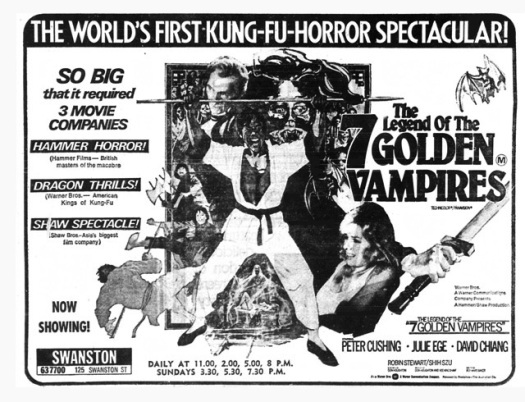
It was really only a matter of time before Hammer, the British masters of the macabre, and the Shaw Brothers, the Hong Kong masters of martial arts, would combine forces and make the world’s first martial arts vampire movie spectacular. An exploitation movie fan’s wet dream come true, in other words.

They created THE LEGEND OF THE 7 GOLDEN VAMPIRES in 1974, not the greatest vampire or martial arts movie ever made, of course, but still an enjoyable romp for those who have a hankering for (in no particular order, except for the last item) vampire hunting, neck biting, blood letting, boiling blood, severed hands, throat slitting, stabbings through the heart, vampires turning to dust, fake bats, fake castles, sword fights, martial arts combat between warriors and vampires & their minions, archery, breasts, romance, and one ridiculous, anticlimactic ending. Three stars, check it out.

Christopher Lee first played Dracula for Hammer in 1958 and he returned for PRINCE OF DARKNESS (1966), DRACULA HAS RISEN FROM THE GRAVE (1968), TASTE THE BLOOD OF DRACULA (1970), SCARS OF DRACULA (1970), DRACULA 1972 (1972), and THE SATANIC RITES OF DRACULA (1973). Lee’s animosity toward the series increased over time and he finally refused to participate in THE LEGEND OF THE 7 GOLDEN VAMPIRES after seven times as the Count. Lee read the script and said “No deal.”

That’s a bummer, especially since John Forbes-Robinson makes for a horrible Dracula. How horrible? They dubbed him with David de Keyser and Dracula only appears in a few minutes at the beginning and end of the picture. In the opening scene, Dracula kills a Chinese monk and takes on his form. (Reportedly, Forbes-Robinson was furious about being dubbed. Hey, it’s not the first time in history. A few years after GOLDEN VAMPIRES, SATURN 3 director Stanley Donen felt dissatisfied with Harvey Keitel’s Brooklyn accent and since Mr. Keitel refused participation in post-production, Donen dubbed over Keitel with a British actor using a Mid-Atlantic accent.)

Granted, we do have Peter Cushing for the fifth time as Professor Van Helsing. Who else would handle the plot exposition through dialogue scenes? How about that plot? Van Helsing, on a lecture stop in China, agrees to help seven siblings (six men, one woman) take back their ancestral mountain village that’s been taken over by seven “golden” vampires (including Dracula trapped in another body) and their living dead minions. Then again, I already described the plot in 44 words in the second paragraph.

THE LEGEND OF THE 7 GOLDEN VAMPIRES can stand with any of the goofiest Shaw Brothers spectaculars and it ranks among the best of the Hammer Dracula films.

Alice, Sweet Alice (1976)

ALICE, SWEET ALICE (1976) ***

They really tried hard with ALICE, SWEET ALICE, the horror film that’s best known for being Brooke Shields’ film debut.

It appeared in November 1976 at the Chicago International Film Festival, where it competed against such films as ALLEGRO NON TROPPO, GREY GARDENS, SMALL CHANGE, THE DEVIL’S PLAYGROUND, and Best Feature winner KINGS OF THE ROAD.

It received theatrical release (and mostly negative reviews) in 1977, 1978, and 1981. Viewers might have seen it as either ALICE, SWEET ALICE or COMMUNION (the original title) or HOLY TERROR depending on when they watched it.

The promotional forces especially played on the Brooke Shields angle in ‘78 and ‘81.

One of the ‘78 ALICE, SWEET ALICE ads proclaimed at its top, “PRETTY BABY Brooke Shields, America’s New Star,” a reference to Shields being in Louis Malle’s contemporaneous PRETTY BABY.

Three years later, the film returned as HOLY TERROR with a hard sell promotional campaign again built around exploiting Shields’ notoriety from her Calvin Klein advertisements and her film projects like THE BLUE LAGOON. Shields put up a fight, though, because she had more clout and ENDLESS SUMMER coming down the pike; “Brooke was concerned that film goers could only be disappointed if led into the theater with the promise that the film was of recent vintage or that she had a central part in it,” said her attorney. See, the original HOLY TERROR ads used a photo of Shields circa ‘81 rather than one of her from the film that was made during a different administration. Those naughty ad men, they did a bad, bad thing.

Roger Ebert made the advertising campaign for HOLY TERROR his “Dog of the Week.” “The ads promise that it stars Brooke Shields,” Ebert said. “That’s where the trouble begins, because HOLY TERROR was first released five years ago under the title of COMMUNION and then it was released three years ago as ALICE, SWEET ALICE. Now, when this movie was originally shot, Brooke Shields was a little girl, only 10 years old, and as Calvin Klein can tell you, she’s not 10 years old anymore. Shields has a supporting role in the movie as an apparently demented little girl and it’s an effective thriller alright, but how many title changes is it going to go through in an attempt to cash in on Brooke Shields’ recent popularity?” Gene Siskel replied, “Maybe they ought to try GONE WITH THE WIND.”

Truth in advertising: Shields, listed 10th in the cast in the end credits, appears in the picture for about the first 10 minutes. For those of us who think she’s one of the worst mainstream actresses ever committed to celluloid, that’s a major blessing in disguise. She’s not a demented little girl, though, but the first murder victim. Attending her first communion, her character Karen gets killed real good before she can receive it, strangled to death and then incinerated by a masked figure in a costume that should make one think back to the superior thriller DON’T LOOK NOW. Only this raincoat is yellow rather than red like DON’T LOOK NOW.

Deceptive promotional campaigns are not anything new. They’ve happened before and they will happen again. It happens all the time, and not only (but especially) during election years.

For example, John Travolta made his debut (briefly) in the ridiculous 1975 thriller THE DEVIL’S RAIN, which features Ernest Borghine, Eddie Albert, Ida Lupino, Tom Skerritt, William Shatner, and Keenan Wynn in the cast, as well as the special participation of Anton LaVey, high priest of the Church of Satan. Anyway, in the original 1975 ads, not a mention of Travolta. Instead, we have mug shots of “Satan on Earth” (Borghine), “Devil Destroyer” (Albert), “Demon Sacrifice” (Lupino), “Tortured Soul” (Shatner), and “Faceless Follower” (Wynn) right above the claim “Absolutely the most incredible ending of any motion picture ever!”

Preying on Travolta’s success in SATURDAY NIGHT FEVER and GREASE, THE DEVIL’S RAIN made a comeback. Siskel named it a “Dog of the Week” the same week in 1978 his colleague Ebert picked that awful monster movie SLITHIS. “My dog this week is a four-year old film named THE DEVIL’S RAIN that’s suddenly come back to a lot of theaters advertised as starring John Travolta,” Siskel said. “Well, that’s a complete lie. THE DEVIL’S RAIN stars Ernest Borghine as a Devil’s helper trying to hang on to some lost souls. Travolta is on screen for less than a minute, this was his first film. He had only one line of dialogue in it. Most of the time, he has red and green wax melting all over his face. Looks like he fell asleep on a pizza. … Beware of films you’ve never heard of promising big stars. One reason you’ve never heard of them, they’re lousy.”

These promotional campaigns definitely backfired in the case of ALICE, SWEET ALICE, because it’s a good little thriller often compared with the works of Alfred Hitchcock and called a prototype of the slasher film. That should have been more than enough to sell the film.

ALICE, SWEET ALICE involves a series of murders in 1961 in Paterson, New Jersey, around a church and an apartment building. Our title character, a 12-year-old girl played by a 18- or 19-year-old Paula Sheppard, becomes the first suspect and she’s sent to a psychiatric institution for evaluation. She was always mean to her little sister and besides, she’s just plain “weird.” Their parents are divorced and they live with their mother Catherine (Linda Miller) and attend St. Michael’s Parish Girls’ School. We also have the girls’ father Dom (Niles McMaster) and their aunt (Jane Lowry), Father Tom (Rudolph Willrich), his housekeeper Mrs. Tredoni (Mildred Clinton), the creepy obese landlord (Alphonso DeNoble), and assorted policemen and minor characters. Dom leaves behind his new wife to more or less become a detective on behalf of his oldest daughter, and that leads to his demise in a scene that echoes Donald Sutherland’s death at the end of DON’T LOOK NOW.

ALICE, SWEET ALICE reminds one of not only DON’T LOOK NOW, but also any number of giallos or Italian thrillers because of the anti-Catholic themes, dark humor, and familial dysfunction. Lucio Fulci’s DON’T TORTURE A DUCKLING and Dario Argento’s PROFONDO ROSSO quickly come to mind. Of course, all these films have their roots in Hitchcock.

Director, producer, and co-writer Alfred Sole, who shared the screenplay with Rosemary Ritvo, reveals the real killer around the two-thirds mark and that’s a departure from the modus operandi of the thriller.

ALICE, SWEET ALICE stands up long after the promotional campaign has become a faded memory. Anyway, I’ll still call it Brooke Shields’ best movie.

Goin’ Coconuts (1978)

GOIN’ COCONUTS (1978) 1/2*

In the distant future, one of the great mysteries of human behavior will be why there were so many teen idols after, oh, let’s say, 1955. Imagine trying to explain Tiger Beat, Joey Lawrence, Jonathan Taylor Thomas, NSYNC and the Backstreet Boys, and Justin Bieber to future generations.

I can only hope that future rational beings will reach the conclusion that many people (mostly girls, but also boys with such beacons of humanity as Britney Spears, Paris Hilton, Kim Kardashian, et cetera ) in the late 20th and early 21st centuries obsessed about the shallow and the superficial and the stupid and such attributes as perfect hair, perfect teeth, and dimples. “He / She has got such a perfect body. He’s so cute. She’s so hot.” All that jive can just go fuck off.

I thought about this “teen idol” angle during and after GOIN’ COCONUTS, the motion picture debut and finale of former teen idols Donny and Marie Osmond. Since I watched it after SLITHIS, I just might have survived the worst two movies I have ever seen back-to-back; I am blanking on whether or not I ever watched BATTLEFIELD EARTH after LEONARD PART 6 or vice versa.

Anyway, I hated just about every second of GOIN’ COCONUTS. Hated every musical number. Hated every bit of perfunctory dialogue. Hated every single attempt at humor. Hated the jewelry caper story and every single plot development that we have seen before from a million different movies and TV shows. Hated seeing legendary movie villains being reduced to buffoons for comedic purposes that miserably failed. Hated it the longer it went on. I rejoiced at the first sight of the end credits and turned off the movie. I didn’t even care all that much about the Hawaiian scenery, just because we had to watch this stupid movie take place within it.

I felt especially bad for actors like Kenneth Mars, Ted Cassidy, Khigh Dhiegh, and Harold Sakata. But, hey, not that bad, since they got paid and had the opportunity to make a movie in Hawaii. That sounds great right about now. I could go for that, even a movie as shitty as GOIN’ COCONUTS.

The reason I felt bad for them was they had to play cosmically inept. Like, for example, Sakata’s Ito could not take out Donny Osmond, for crying out loud. The filmmakers made the dread mistake of costuming Sakata (1920-82) in the same hat that he wore in GOLDFINGER as super henchman Oddjob. Sure we all remember what Oddjob did with his hat in GOLDFINGER; let’s just say that he wears the hat throughout GOIN’ COCONUTS and that’s that. It’s so insulting to see a World War II veteran and an Olympic silver medalist in weightlifting (Sakata represented the United States in the 1948 Summer Olympics in London) reduced to playing the fool, thwarted at every churn of the plot by a couple teen idols and their perfect teeth.

Dhiegh (1910-91) played a key role in THE MANCHURIAN CANDIDATE as brainwashing expert Dr. Yen. Yes, THE MANCHURIAN CANDIDATE, one of the most intelligent movies ever made. Then, 16 years later, Dhiegh appeared in GOIN’ COCONUTS, which should have borrowed from THE WIZARD OF OZ its musical theme … “If I Only Had a Brain.” Again, it simply defies all credibility that Dhiegh’s character would be outsmarted by a pair of coconuts.

In GOIN’ COCONUTS, Mars (1935-2011) more or less gives us a variation on his characters from the Mel Brooks comedies THE PRODUCERS and YOUNG FRANKENSTEIN, only without the laughs.

Cassidy (1932-79) played Lurch on “The Addams Family” and would it have been too much to ask director Howard Morris (who played Ernest T. Bass on “The Andy Griffith Show”) and screenwriters William Marc Daniels and Raymond Harvey to include a gag where Cassidy’s Mickey answers the phone with “You rang.” Yes, of course, it would have been too much to ask. That’s silly to ask if you’ve survived GOIN’ COCONUTS.

It was a pathetic sight every time watching these villains shoot their guns at Donny and Marie. They should have been sent back to marksmanship class or had their diabolical henchmen licenses revoked.

Aside from the end credits, there was something else great about GOIN’ COCONUTS. Since it failed at the box office, Donny and Marie made only this one movie rather than a series of Donny and Marie spectaculars. They returned to their variety show where they belonged with their aw shucks gee whiz nature and perfect teeth intact.

Slithis (1978)

SLITHIS (1978) 1/2*

SLITHIS is one of the worst movies ever made, I feel safe in saying that, and it did for radioactive mutant monsters what A*P*E did for giant apes.

Maybe I would feel a little better after watching it had I received a “Slithis Survival Kit” like viewers did back in 1978 when this cinematic plague called SLITHIS was unleashed on theaters and drive-ins.

I read about this survival kit in Roger Ebert’s review and I found images of the four-page document through the magic of the Internets.

WARNING!

SLITHIS A CREATURE SPAWNED FROM THE WASTE OF A NUCLEAR ENERGY PLANT … WANTS YOU TO SURVIVE.

FOLLOW THESE INSTRUCTIONS!

  1. REMOVE PICTURE OF SLITHIS BY CUTTING ALONG THE DOTTED LINE.
  2. KEEP PICTURE OF SLITHIS ON YOUR PERSON AT ALL TIMES.
  3. AT NIGHT, WHEN SLEEPING, PLACE PICTURE OF SLITHIS UNDER PILLOW.
  4. JOIN THE SLITHIS FAN CLUB … HE WILL REMEMBER YOU WHEN HE STALKS YOUR NEIGHBORHOOD.

SLITHIS FAN CLUB

FOR MY PERSONAL SAFETY AND SURVIVAL PLEASE SIGN ME UP FOR THE SLITHIS FAN CLUB … I SOLEMNLY SWEAR TO UPHOLD THE FOLLOWING RULES AND REGULATIONS.

  • TO HELP ESTABLISH THAT SLITHIS IS A VICTIM OF OUR SOCIETY.
  • TO PROMOTE A BETTER UNDERSTANDING OF THE SLITHIS AND THE ENVIRONMENTAL CONDITIONS THAT CREATED IT.
  • TO ASSURE OTHERS THAT WITH THE SURVIVAL KIT THEY NEED NOT FEAR THE SLITHIS.

NAME

ADDRESS

CITY STATE ZIP

PLEASE SEND ME MY FREE PHOTO OF THE SLITHIS AND MY OFFICIAL MEMBERSHIP CARD.

(SEE BACK OF CARD FOR FURTHER INFORMATION)

NOTICE

PLEASE DEPOSIT THIS PORTION OF THE OFFICIAL SURVIVAL KIT IN MEMBERSHIP BOX LOCATED IN THE LOBBY OR CONCESSION STAND OF THIS THEATRE … YOU MAY PICK UP YOUR FREE PHOTO AND MEMBERSHIP CARD 3 WEEKS FROM NOW AT THIS THEATRE … or enclose 25¢ FOR POSTAGE & HANDLING AND MAIL TO

SLITHIS FAN CLUB

SUITE 200

1024 WALNUT ST.

DES MOINES, IOWA 50309

That’s absolutely patently ridiculous and far better than the movie itself. I wish I had thought about the Slithis Fan Club when our family vacation stopped in Des Moines.

I am being perfectly blunt with you when I warn you that coffee or any strong stimulant (s) would be a better survival kit for SLITHIS. How about taking a drink every time a character says “Slithis”? No, wait, never mind, alcohol’s a depressant and SLITHIS has been known to create depression within its viewers for at least a few hours. Viewers in 1978 were reportedly incredibly slow in returning home, since they just sat inside their cars unable to move and they were even unable to speak for hours. Hundreds even thousands of people sat in their cars in silence. It took a long time to process SLITHIS.

Because SLITHIS is deadly dull. Deadly dull. It is quite possible that SLITHIS wiped out an entire population of drive-in denizens through its sheer dullness.

After all, dullness is one of the worst possible sins that a monster movie can commit and SLITHIS commits that sin in spades. Its 85 minutes surpass watching GONE WITH THE WIND or the final act of RETURN OF THE KING.

The dialogue is banal, no, wait, it is so beyond banal that we need to invent a new word for the dialogue in SLITHIS.

I know that Warner Bros. plans to unleash GODZILLA VS. KONG on the world at some point during 2020, but I hope that some quick-buck smooth operator can beat that release into theaters with SLITHIS VS. A*P*E. Given the beating that humanity’s taken so far in the first three months of the 20th year of the 21st Century, SLITHIS VS. A*P*E seems only fitting.

Ice Castles (1979)

ICE CASTLES

ICE CASTLES (1978) **

Not that I have a problem with either figure skating or movie romance — I like THE CUTTING EDGE, for example — but ICE CASTLES is not a very good movie and that’s because it makes one (like yours truly) mad due to its relentlessly manipulative nature.

We know entering ICE CASTLES that it centers on a blind figure skater and her personal and amateur figure skating travails. Naturally, she does not start out the movie blind, so that means we are waiting for her freak accident. That makes it the pièce de résistance of the picture and that makes the picture quite sick and perverse because her disability itself becomes more important than her state before or after her disability.

When skater-on-the-rise Alexis “Lexie” Winston tries a difficult triple jump and takes a mighty fall, we see it drawn out in explicit slow motion. None of her other jumps play out in this fashion. She ends up with a blood clot in her brain and loses 90 percent of her sight. There goes her shot at the 1980 Winter Olympics, right?

Director and screenwriter Donald Wyre and fellow screenwriter Gary L. Baim undercut their own movie with such a focus on the accident.

They gave first-time actress and former amateur figure skater Lynn-Holly Johnson one helluva challenge for her debut. Let’s see here, her 16-year-old character goes through not only a debilitating accident, but she breaks up with her jealous boyfriend (Robby Benson), hooks up with a television reporter (David Huffman) who helped out her career and made all her figure skating cohorts upset by all her publicity, argues with her father (Tom Skerritt) at different points throughout the picture, eventually hashes it out with her former boyfriend, and makes her triumphant comeback — despite her blindness — for a grand finale. Johnson gives a good performance and it’s certainly better than her work in subsequent films THE WATCHER IN THE WOODS, FOR YOUR EYES ONLY, and WHERE THE BOYS ARE ‘84.

Benson can be one of the most irritating movie actors and he’s especially awful with emotional scenes; he so often turns them into bad soap opera with fake anger his dread specialty. Benson does that a handful of times during the last half of ICE CASTLES, especially in the scene at the dinner table when the four main characters (I have not mentioned Colleen Dewhurst as rink operator and trainer Beulah Smith, but she’s the fourth main character) are debating whether or not Lexie should return to competition. The melodrama hits its high point when Benson’s Nick Peterson feasts on the line “Don’t give me that. Not trying is pointless and cruel. Not trying is wondering your whole life if you gave up too soon. Who the hell needs that?” It’s all so phony baloney, but it’s nowhere as bad as Benson in HARRY & SON. In that horrible movie, I wanted Paul Newman’s character Harry to punch out his son Howard as played by Benson. Time Out London called it “a curiously indigestible phenomenon, like being forced to eat five courses of avocado by an overbearing dinner-party host.” One of Benson’s immortal lines in HARRY & SON, “Want a Cherry Coke, pa?”

American adult contemporary singer Melissa Manchester performed her two nominated songs at the 1980 Academy Awards ceremony: “Through the Eyes of Love (Theme from Ice Castles)” and “I’ll Never Say Goodbye” from THE PROMISE, another soap opera. “It Goes Like It Goes” (wow, oh wow, what a title) beat out both Manchester numbers for “Best Original Song.” “Rainbow Connection” from THE MUPPET MOVIE was obviously robbed. For many years, the Academy seemed to nominate the most forgettable songs 90 percent of the time.

I promise that I’m not a hater of figure skating or movie romance, but I will often bristle at manipulation and melodrama — ICE CASTLES, despite some good elements at work, offers large portions of both manipulation and melodrama.

Then again, RogerEbert.com writers Christy Lemire, Sheila O’Malley, and Susan Wloszczyna contributed to a 2017 piece titled “Through the Eyes of Love: On the Timelessness of ‘Ice Castles.’” But, then again, so what?

Disco Godfather (1979)

DISCO GODFATHER

DISCO GODFATHER (1979) *1/2

I kept having flashbacks throughout DISCO GODFATHER.

I asked myself several times, “Am I tripping balls or have I not seen this film a few hundred times?” Then, I said, “I know, I know, this is my first time watching it, but it still feels like I have seen DISCO GODFATHER before.” Later, “It’s only a movie. It’s only a movie. It’s only a movie.” Finally, “I’ll have my revenge. I’ll write a review.”

The plot: Rudy Ray Moore plays retired cop Tucker Williams turned nightclub owner and famed DJ “Disco Godfather.” His nephew Bucky (Julius J. Carry III) gets hooked on angel dust and it warps him something fierce. Tucker decides to return to his roots and wipe out this angel dust plague. See what I mean about having seen DISCO GODFATHER before?

After the dust has settled so to speak on this movie, I mostly remember the Disco Godfather saying “Put your weight on it!” It feels like Mr. Disco Godfather says “Put your weight on it” a million times. Apparently, it’s actually only 24 times that he uttered that infamous line. I am shocked and thoroughly disappointed.

“Put your weight on it” still, though, ranks among the greats in the cinematic annals of lines / incantations / mantras.

Cheech & Chong said “Man” 285 times in UP IN SMOKE, far out, man. Characters say the name “Carol Anne” 121 times in POLTERGEIST III. With their lesser weight, both UP IN SMOKE and POLTERGEIST III had to make up for it through sheer volume of repetition.

We also cannot forget “With great power comes great responsibility” from the Sam Raimi SPIDER-MAN films (originally from the comic books written by Stan Lee). From what I understand, this phrase has become known as the Peter Parker Principle. To be honest, I have not ever written much on the SPIDER-MAN films because “Weird Al” Yankovic already criticized the first Raimi SPIDER-MAN magnificently with “Ode to a Superhero,” which is set to the tune of Billy Joel’s “Piano Man.” Here’s the part about “With great power comes great responsibility”:

“With great power comes great responsibility / That’s the catch phrase of old Uncle Ben / If you missed it, don’t worry, they’ll say the line / Again and again and again.” Yeah, that’s exactly what I thought, “Weird Al,” and you wrote “Ode to a Superhero” after just the first SPIDER-MAN film.

Anyway, through the virtual magic of searching the Internet, I found a link to Rudy Ray Moore’s “Put Your Weight on It” in song form. Rudy Ray Moore and the Fillmore Street Soul Rebellion released a single in 1971 with “Put Your Weight on It” the B-side to a monologue and “Easy Easy Baby.” Hold on for about 2 minutes, 43 seconds, I must cast aside this “Weird Al” playlist that started by listening to “Ode to a Superhero” and instead listen to “Put Your Weight on It.” I’ll report back very soon with my findings.

Holy bat shit, Robin, I found a version that’s 4 minutes, 55 seconds. It’s from the Rudy Ray Moore Singing Album “The Turning Point,” from 1972. I’ve got Mr. Rudy Ray down for saying “Put your weight on it” 21 times. I did not count the “Keep your weight on it,” which he seems to say about as many times as the name of the song. I’m not going back for another listen any time soon.

Moore (1927-2008) was a multimedia “ghetto expressionist” (his preferred nomenclature for his act) who recorded his first comedy album “Below the Belt” in 1959. Moore debuted the Dolemite character in the early 1970s and he released albums with titles like “Eat Out More Often” and “This Pussy Belongs to Me.” He then successfully financed the motion picture DOLEMITE in 1975, followed by THE HUMAN TORNADO and THE MONKEY HUSTLE in 1976, PETEY WHEATSTRAW in 1977, and DISCO GODFATHER in 1979. He’s been called “The Godfather of Rap.” Dolemite unleashed lines like “You no-business, born-insecure, jock-jawed motherfucker” and “I’m gonna let ‘em know that Dolemite is my name, and fuckin’ up motherfuckers is my game.” This influence on subsequent generations of black entertainment is undoubtedly why DISCO GODFATHER seemed so old hat and overly familiar watching it for the first time in 2020.

Schlock (1973)

SCHLOCK

SCHLOCK (1973) ***

Schlock (/SHläk/): cheap or inferior goods or material; trash.

For quite some time as I watched it, I could not make heads or tails out of John Landis’ 1973 extremely low-budget feature film debut SCHLOCK.

I mean, I understood that it’s a good old-fashioned spoof of good old-fashioned monster movies, sure, from the moment I read a plot synopsis and that its title speaks louder than a thousand words, you bet, but it kept veering between tones. Our title character (played by none other than Landis himself) seemed menacing and imposing one moment and then funny the very next. He’s the missing link and “The Banana Monster” and the poster promises “A love stronger than KING KONG.”

There was one sequence though in particular that changed my tune about SCHLOCK.

Schlock (blanking on his full name right now) watches DINOSAURUS! from 1960 and THE BLOB from 1958 in a movie theater, both classics directed by Irvin S. Yeaworth and produced by SCHLOCK producer Jack H. Harris. We see choice scenes from both films, like a dinosaur fight and that classic moment in THE BLOB when its title character attacks first the projectionist and then the patrons to rudely interrupt the showing of DAUGHTER OF HORROR (renamed from DEMENTIA). Showing THE BLOB also provided Landis an opportunity to work Steven, er, Steve McQueen into his little $60,000 movie.

Not only that, but Schlock learns about vending machines and cleans out a candy counter. Bet he loved them jujubes with his sharp teeth. I love what Schlock does when this incredibly tall man sits in the seat one row in front of him. If only life could be that way. Then again, proper authorities cannot handle Schlock.

At the point Schlock went movie watching, I learned to stop worrying and like (not love) SCHLOCK.

Landis’ love for SEE YOU NEXT WEDNESDAY starts out early in his directorial career, by promoting it with “First, BIRTH OF A NATION! Then, GONE WITH THE WIND! 2001: A SPACE ODYSSEY! LOVE STORY! SEE YOU NEXT WEDNESDAY! And now … SCHLOCK!” A line spoken in 2001 turned into a running gag throughout most Landis films and even the music video for Michael Jackson’s “Thriller.”

So many low-budget movies have a great back story.

Landis and crew, including makeup artist Rick Baker early in his career, made SCHLOCK during 12 days in the summer of 1971, but it was not released until 1973. Johnny Carson found out about the film and he booked Landis on “The Tonight Show.” With this spotlight opportunity, Landis showed clips from SCHLOCK, which helped the first-time director find a distributor in Jack H. Harris Enterprises. Harris put up $10,000 if Landis put 10 minutes of running time on SCHLOCK.

I enjoyed SCHLOCK every bit as much as the Joan Crawford classic TROG (1970) and the similarly low-budget KING KUNG FU (1976).

Of course, I did not forget, but I will see you next Wednesday.

Black Christmas (1974)

BLACK CHRISTMAS

BLACK CHRISTMAS (1974) Three stars

Watching BLACK CHRISTMAS for the first time, one might be surprised just how many standards of the slasher film can be seen during this 1974 Canadian chestnut from director Bob Clark.

Let’s see, we have an opening shot later repeated by John Carpenter’s HALLOWEEN, a killer who racks up a rather impressive body count, POV shots from the killer’s perspective, obscene phone calls from the killer following every killing, plot twists (including the location of the caller), “The Final Girl,” and a shock ending, as well a holiday theme. BLACK CHRISTMAS basically synthesized elements that were already present during previous films like PSYCHO, PEEPING TOM, and Mario Bava movies BLOOD AND BLACK LACE and TWITCH OF THE DEATH NERVE into a single horror film narrative.

The plot also echoes “The Babysitter & The Man Upstairs” urban legend, so we already know the location of the caller. Still, the characters do not, so it’s a jolt hearing “The call is coming from inside the house.” Several movies, notably BLACK CHRISTMAS and WHEN A STRANGER CALLS, have relied on this angle for their chills and thrills.

A real-life case has been credited for inspiring the urban legend.

On Mar. 18, 1950, 13-year-old babysitter Janett Christman was raped and strangled to death in Columbia, Missouri, three days before her 14th birthday. Mr. and Mrs. Ed Romack found the body when they returned home, but, fortunately, their 3-year-old son Gregory was still alive, sleeping in his room. From the AP story, “Prosecuting Attorney Carl Sapp said blood was smeared through the house, indicating the girl put up a terrific struggle. … Footprints were found in a sleet-covered area near a broken window in the house. Police believe the intruder crawled through the window. The state highway patrol also is processing fingerprints found at the scene.”

More from the report, “An electric iron cord was twisted around the girl’s throat. Her scalp had been pierced several times by an instrument, apparently similar to a small lead pipe.”

Christman may have attempted to call the police around 11 p.m. the night of her death. Columbia policeman Roy McCowan took a call from a frightened girl who told him to “come quick.” “I urged her to calm down and just tell me where she was,” he said. “Then there was silence — not the sound of a receiver being hung up — just silence.” The Romacks’ phone was discovered “improperly placed on the instrument.”

Christman’s murder remains unsolved.

Just a few years earlier in Columbia, Stephens College student Marylou Jenkins, a white woman, was raped and murdered with an electric cord (reportedly from a lamp) twisted around her throat. An all-white jury convicted black man Floyd Cochran of the crime and he was executed Sept. 26, 1947 in the Missouri State Penitentiary Gas Chamber in Jefferson City. Cochran was originally arrested for murdering his wife with a shotgun and then he confessed to raping and murdering Jenkins.

For his last meal, Cochran ordered but did not partake in consuming a T-bone steak, french fries, scalloped corn, cream gravy, bread, butter, cake, and coffee. He died at the age of 36.

From 1938 through 1989, Missouri put to death 40 inmates in the gas chamber at Jefferson City, with John Brown the first on Mar. 3, 1938 and George “Tiny” Mercer the last on Jan. 6, 1989. Mercer was the first person from Missouri executed since 1965.

Just about seemingly every horror movie in existence shoots for a slambang ending, so we leave it discussing just what happened inside our heads or with all our friends and loved ones who have also seen this movie. BLACK CHRISTMAS gives us a rather unconventional ending, in that we are left unsure of the fate of protagonist Jess (Olivia Hussey) as she’s alone in the sorority house with the killer. Also, we never find out the real identity of the killer other than he’s named “Billy” and very rare indeed is the horror movie (especially a slasher) without a great big reveal in the grand finale. You just might have to be a fan or at least more forgiving of an ambiguous ending to appreciate BLACK CHRISTMAS. Either way, though, it will be discussed.

Like the later HALLOWEEN, BLACK CHRISTMAS thrives on atmosphere. That’s what they both do best and why fans appreciate them all these decades later.

Both films have rather distinguished casts for low-budget horror movies. Hussey came to fame during her teenage years for her performance as Juliet in Franco Zeffirelli’s 1968 ROMEO AND JULIET. Keir Dullea played astronaut Dave Bowman in both 2001: A SPACE ODYSSEY (1968) and later 2010 (1984); Dave uttered the famous words, “Open the pod bay doors please, HAL.” Margot Kidder (1948-2018) appeared previously in Brian De Palma’s 1973 shocker SISTERS and subsequently made her fame as Lois Lane in four Superman movies. Character actor John Saxon’s six-decade career includes ENTER THE DRAGON, TENEBRAE, A NIGHTMARE ON ELM STREET, and FROM DUSK TILL DAWN.

Director, screenwriter, and producer Clark (1939-2007) is best known for his two radically different nostalgia pieces, PORKY’S and A CHRISTMAS STORY. Yes, please wrap that magnificently designed brain around the fact that Clark directed both BLACK CHRISTMAS and A CHRISTMAS STORY. Louisiana born Clark found his greatest success up north in Canada. PORKY’S supporting actors Doug McGrath and Art Hindle both appear in BLACK CHRISTMAS.

Kidder almost steals the show in BLACK CHRISTMAS as the drunken, profane sorority girl Barb. She rips into her dialogue with extra relish. Hussey makes for a good entry point and rooting interest. Saxon knows how to maximize his screen time.

For horror movie fans who have not yet seen BLACK CHRISTMAS, I fully recommend amending it immediately.