

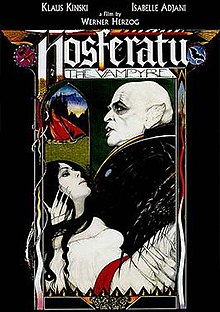
NOSFERATU (1979) ***1/2
German director Werner Herzog’s NOSFERATU THE VAMPYRE has often been described as a “slow burn” horror film and every critic seems to want to sound a fire alarm that it’s not the average “creature feature” with cheap thrills every few minutes and that it will disappoint most horror movie fans.
The former is certainly true and I cannot speak for the latter except to say this horror movie fan liked it. I’ll be honest, I did not much enjoy it the first time watching it a good 20 years before my return viewing. I remember having a more neutral reaction that first time. Not sure why.
Looking up “slow burn,” I find that it means “a filmmaking style, usually in narrative productions, wherein plot, action, and scenes develop slowly, methodically toward a (usually) explosive boiling point.”
NOSFERATU definitely fits methodical and perhaps only slow to viewers raised on Attention Deficit Cinema. I’d rather say that Herzog’s remake and F.W. Murnau’s original 1922 masterpiece subtitled A SYMPHONY OF HORROR both move at their own leisurely pace. They play more like fever dreams than the average horror movie.
NOSFERATU does not fit the back end of that slow burn definition, because there’s not an explosive boiling point. Certainly not anything resembling the stereotypical big bang grand finale to a standard Hammer Dracula picture.
Herzog marches to the beat of his own drum. That’s for sure and thank God for that, just as we should be thankful for every great director. I consider his AGUIRRE, THE WRATH OF GOD to be the best film I have seen from 1972 and I would put it on a list of the greatest films ever made. LITTLE DIETER NEEDS TO FLY and GRIZZLY MAN are on my top 10 lists for 1997 and 2005, respectively. Les Blank’s documentary BURDEN OF DREAMS, which chronicles Herzog’s great adventure making FITZCARRALDO, also makes my top 10 list for 1982. Ramin Bahrani’s 18-minute PLASTIC BAG, a top 10 entry for 2010, utilizes Herzog as its narrator.
I know that NOSFERATU was my first time watching a Herzog movie and I believe I had not yet seen the Murnau original. To be sure, I was more equipped watching NOSFERATU for a second time.
More than anything else, images stand out. Brilliant images are the heart of both the 1922 and 1979 films and both Murnau’s and Herzog’s filmography.
Musophobes should not watch NOSFERATU, because rats take over the screen at crucial points late in the picture. The rats are the source of some legendary stories: Herzog said the rats were better behaved during the shoot than star Klaus Kinski and since real grey rats proved to be unavailable, white rats were given a grey makeover, for example.
The rats call to mind the monkeys from AGUIRRE.
Of course, there’s every time Dracula (Kinski) is on the screen. Since copyright was not a concern for Herzog like it had been in 1922 for the first NOSFERATU, Herzog returned names like Dracula, Jonathan Harker, and Lucy to his version. Dracula’s look echoes Max Schreck’s iconic Count Orlok and both vampires are radically different from the classic bloodsuckers played by Bela Lugosi and Christopher Lee, as well as just about every other vampire in cinematic history. Herzog and Murnau both show how it is more of a curse to be a vampire and make it far less of a power trip. Herzog’s Dracula and Count Orlok are not suave and debonair, and their striking physical appearances echo vampire folklore. We also have far more complex reactions to the vampires played by Schreck and Kinski, since we feel more empathy for them.
Around her mid-20s at the time she made NOSFERATU, French actress Isabelle Adjani already had a strong claim on the title of most beautiful woman in the world. NOSFERATU did nothing to refute that.
Thinking about the various Jonathan Harkers over time, Bruno Ganz’s performance ranks better than David Manners in the 1931 DRACULA and Keanu Reeves in the 1992 DRACULA. He certainly goes through a wider emotional range than either Manners or Reeves, who are both “mannered” in their performances.
Ultimately, NOSFERATU leaves one with feelings different from how we normally react to a vampire picture. There’s not the standard euphoria that we experience, for example, when Lee’s Dracula spectacularly bites the dust. Instead, we are more pensive and melancholic than excited and thrilled.
 Attack of the Killer Librarian