Fiend Without a Face (1958)

FIEND WITHOUT A FACE

FIEND WITHOUT A FACE (1958) ****

The 1958 British independent horror production FIEND WITHOUT A FACE contains everything this science fiction and horror fiend wants from a film of that era: a square but likeable hero (Marshall Thompson), a shapely heroine (Kim Parker), a mad scientist (Kynaston Reeves), townspeople who blame everything on the wrong people, atomic fallout, and horrible, terrifying stop motion animation monsters (created by the special effects team of Flo Nordhoff and Karl-Ludwig Ruppel) that are loads of fun.

It also has an evocative title.

The final 20 minutes or so of FIEND WITHOUT A FACE are phenomenal and push this film into the stratosphere.

The fiends of the title are floating killer brains who started as one brain materialized from the thoughts of Professor R.E. Walgate, a man who specializes in telekinesis. The nearby airbase’s nuclear power radar experiments have dire consequences and the original fiend escapes from Walgate’s lab and wreaks murder and mayhem on the surrounding community. The fiends replicate themselves through attacks on humans (looting their brains and spinal cords) and they remain invisible until the final 20 or so minutes after they crank up the nuclear power to DANGER! They must be stopped!

These fiends are one helluva brainstorm, literally. They have antennae and tentacles, and one can see their influence on later creature features creatures. (The ALIEN films leap to mind. George Romero must have watched at least the last 20 minutes of FIEND WITHOUT A FACE before he made the first NIGHT OF THE LIVING DEAD.)

When the fiends are shot in the brain (love that concept), they naturally gush out this great-looking brain glop and I honestly wish these death scenes lasted another 20 minutes. They are so much fun, and it’s just as great when our hero breaks out an axe. The fiends (love that word) finally turn into goo after our hero blows up their great power source real good.

When the fiends are in their invisible stage, we hear slurping sounds when they strike their victims’ brains and spinal cords. Awesome, totally awesome, because it’s not happening to us, of course.

Credited director Arthur Crabtree (reports have it that star Thompson worked on the film himself after Crabtree walked off the picture because directing sci-fi proved to be too much for his fragile little mind) and his team did a fantastic job with the fiends when they’re invisible or visible. FIEND WITHOUT A FACE pulls off the nifty little trick of building up high audience expectations toward a great final act, then it delivers the goods and maybe even exceeds expectations during that final act.

Believe it or not, FIEND WITHOUT A FACE apparently caused quite a storm of controversy when it was first released in early July 1958. The British Board of Film Censors demanded cuts be made before it would be certified for release and the picture still received an ‘X.’ It’s lucky to not have met the same fate as banned-for-many-years pictures like BATTLESHIP POTEMKIN (1926-54), FREAKS (1932-63), and ISLAND OF LOST SOULS (1932-58), for example.

Legend even has it that British Parliament discussed why the censors allowed FIEND WITHOUT A FACE to be released.

Over time, I’ve come to realize that I love 1950s horror and sci-fi: THE DAY THE EARTH STOOD STILL, THE THING FROM ANOTHER WORLD, HOUSE OF WAX, GODZILLA, THEM!, CREATURE FROM THE BLACK LAGOON, INVASION OF THE BODY SNATCHERS, THE INCREDIBLE SHRINKING MAN, ATTACK OF THE CRAB MONSTERS, FIEND, THE H-MAN, THE BLOB, THE FLY, HORROR OF DRACULA, PLAN 9 FROM OUTER SPACE, BUCKET OF BLOOD, and THE KILLER SHREWS all have made personal top 10 lists for their respective years and the decade also featured at least five of Hitchcock’s best works (STRANGERS ON A TRAIN, REAR WINDOW, THE WRONG MAN, VERTIGO, NORTH BY NORTHWEST) and other films that are horrifying in their own distinct ways, like film noir KISS ME DEADLY and war film FIRES ON THE PLAIN.
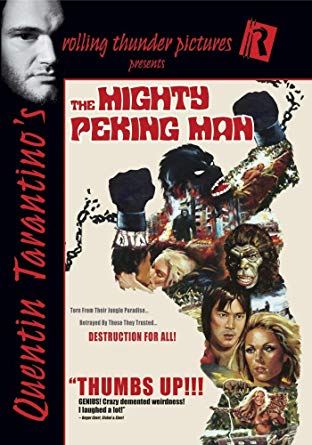
The Mighty Peking Man (1977)

THE MIGHTY PEKING MAN

THE MIGHTY PEKING MAN (1977) ***

The Shaw Brothers (Runme 1901-85 and Run Run 1907-2014) have rarely ever let me down and they provided some of the greatest entertainments of all-time, like THE ONE-ARMED SWORDSMAN, FIVE FINGERS OF DEATH, INFRA-MAN, THE 36TH CHAMBER OF SHAOLIN, and CLAN OF THE WHITE LOTUS.

The Shaw Brothers did not (and still do not, in death) cheat us.

For example, in THE MIGHTY PEKING MAN, their 1977 spin on King Kong, Mighty Joe Young, and Tarzan (not to mention Godzilla) that’s not quite peak but still good Shaw Brothers, we don’t have to wait very long whatsoever to see the title character. No, life is short, time is precious, so director Ho Meng-hua gives us our first monster encounter in the first minute of screen time. Okay, to be exact, it’s 1:45 into the movie, but that still beats most every other entry in this distinguished genre.

That establishes a tone for a very generous entertainment package. Find a copy and buy it for somebody, and it’s the gift that keeps on giving.

THE MIGHTY PEKING MAN not only provides a sympathetic monster in the grand tradition, but also (in no particular order) a plucky explorer hero (Danny Lee) who’s been betrayed by his lover with his playboy brother so he’s drowning his sorrows in booze when he’s recruited for a jungle mission, a scantily-clad leading lady (Evelyne Kraft, a regular Swedish Fay Wray) who’s grown up with the animals in the jungle after her parents died in a plane crash (she’s been raised by the Mighty Peking Man, in fact), an earthquake, elephants, tigers and leopards (oh my!), a fight between a leopard and a snake, quicksand, vine swinging, flashbacks to key moments in both the hero’s and the leading lady’s life, callous and shady businessmen, heartless authority figures, mucho destruction of miniatures galore, and a grand finale that boggles the mind even after everything that came before.

My favorite scene, however, begins around the 33-minute mark.

It involves the Semi-Obligatory Lyrical Interlude, a term made famous by the late Roger Ebert. Here’s the definition from Ebert: “Scene in which soft focus and slow motion are used while a would-be hit song is performed on the sound track and the lovers run through a pastoral setting. Common from the mid-1960s to the mid-1970s; replaced in 1980s with the Semi-Obligatory Music Video.”

The Simon and Garfunkel songs in THE GRADUATE epitomize the Semi-OLI.

The one in THE MIGHTY PEKING MAN rates below Louis Armstrong singing “We Have All the Time in the World” over George Lazenby and Diane Rigg in ON HER MAJESTY’S SECRET SERVICE and the foreboding use of Roberta Flack’s “The First Time Ever I Saw Your Face” in Clint Eastwood’s PLAY MISTY FOR ME. Ebert himself said Eastwood filmed the first Semi-OLI that works.

In THE MIGHTY PEKING MAN, our hero and leading lady embrace and lock lips for the first time (watch her eyes after this first kiss) and they unleash the awesomely banal love song “Could It Be I’m in Love, Maybe.”

This is one helluva old-fashioned love song and one helluva Semi-OLI.

I mean, I believe it’s the only Semi-OLI in the history of motion pictures to incorporate a leopard.

Not only that, but the leading lady seems more interested in the leopard than our poor, poor hero. You really sympathize for this guy even more after this scene.

Let’s get back to those lyrics for a second here.

“The love you gave me then showed me a thing or two / I guess I saw it in your eyes / And the look of love upon your face is too hard to disguise / Maybe just a smile will say [cannot make out, even after watching this scene 500 times] / Could it be I’m in love (Maybe? Baby?)” (To hell with it, I already chose “Maybe.” Why does life have to be so difficult?)

“I can’t begin to say what makes me feel like this / I never knew what love could do / But if this is love, it’s here to stay / [Don’t want to make this part out] / So all I have to hear is I’ll give it all to you.”

There’s more lyrics, but we all catch the drift and there’s not any need to drown in banality.

It all totals about 3:30 of pure junk food cinema bliss.

I definitely love it because it’s so utterly ridiculous.

Then again, utterly ridiculous describes THE MIGHTY PEKING MAN.

I should end this review with a consideration of the ending of THE MIGHTY PEKING MAN. Just imagine the ending of KING KONG times 10 times 10.

Fat City (1972)

FAT CITY

FAT CITY (1972) ****

I would not be surprised if writer and director John Huston (1906-87) had the nickname “The Great Adapter.”

Huston directed 37 feature films from 1941 through 1987 and his films adapted from works by Dashiell Hammett, Ellen Glasgow, Robert Carson, B. Traven, Maxwell Anderson, Robert Sylvester, W.R. Burnett, Stephen Crane, C.S. Forester, Pierre LaMure, Claud Cockburn, Herman Melville, Charles Shaw, Romain Gary, Alan LeMay, Philip McDonald, Tennessee Williams, the Book of Genesis, Carson McCullers, Ian Fleming, David Haggart, Hans Koningsberger, Noel Behn, Leonard Gardner, Desmond Bagley, Rudyard Kipling, Flannery O’Conner, Zoltan Fabri, Harold Gray, Malcolm Lowry, Richard Condon, and James Joyce.

Huston co-wrote some of those adaptations, but it was Gardner himself who adapted his own novel, “Fat City,” for the big screen.

In a 2019 interview with the Paris Review, celebrating the 50th anniversary of his novel, Gardner spoke about Huston and the film adaptation.

“Before I started to write it (the screenplay), he invited me to come over to his place in Ireland for a couple of weeks for a discussion about how it was going to go,” Gardner said. “He was a funny guy. He trusted me, I think, because we didn’t talk all day about the script. We talked maybe a half an hour. Then he wanted to paint. He was always painting.

“He’d been an amateur boxer. It was lucky because my objection to boxing movies back then was that they were all the same. It’s a fixed fight and the hero won’t take a dive and maybe they break his hands afterward. I thought there needed to be a boxing film done another way. He was all for it.”

FAT CITY set itself within the city of Stockton, California, population over 100,000 at the time of the making of the film. The scenes are played out in skid row bars, restaurants and living spaces, work on a migrant labor farm, bowling alleys, a boxing gym, and boxing venues in a gritty, street-level fashion. Huston and Gardner definitely created a boxing film that’s done another way.

Stockton, now with a population above 300,000, received a dubious recognition from Forbes Magazine in 2012: “The Most Miserable City in the U.S.”

“I think that this is such a rough place that people who are highly educated use it as a springboard to get jobs in other places, and what it leaves behind is not the cream of the crop. The really smart people don’t want to stay here. They don’t want to be here with the violence and the crime and everything,” said substitute teacher Ronald Schwartz in a story for PBS News Hour.

So things only seemed to get worse in Stockton since 1972.

Creedence Clearwater Revival released the song “Lodi” as the B-side to “Bad Moon Rising,” the lead single from their third album “Green River,” in April 1969. Farrar, Straus & Giroux published “Fat City” in 1969.

Lodi is approximately 15-20 miles north of Stockton.

Creedence songwriter John Fogerty has said that he picked Lodi because it had the coolest-sounding name. The song’s refrain “Oh Lord, stuck in Lodi again” has truly stuck with Lodi for more than 50 years, unfairly or not.

FAT CITY utilizes Kris Kristofferson’s “Help Me Make It Through the Night” and the lyrics and the way Kristofferson sings them suit FAT CITY perfectly. Kristofferson said that he got his inspiration for the song from an interview with Frank Sinatra, who said “Booze, broads, or a bible … whatever helps me make it through the night.”

Any of the characters in FAT CITY could have said that.

We follow two boxers in FAT CITY: 29-year-old Billy Tully (Stacy Keach) and 18-year-old Ernie Munger (Jeff Bridges). Tully meets Ernie in a Stockton gym, sees potential in the young man after they spar, and encourages him to get into the fight game. Tully recommends manager and trainer Ruben (the great character actor Nicholas Colasanto).

Keach and Bridges play off or against each other perfectly. Bridges, in his early 20s and on his fifth feature overall, fits the part of a promising up-and-coming talent like a glove; Bridges had already received an Academy Award nomination for Best Supporting Actor for his performance in THE LAST PICTURE SHOW. Keach’s own struggles to get a part like Billy Tully infuses his characterization of a washed-up boxer clawing and scratching (and drinking) his way through life; for example, Mike Nichols fired Keach from CATCH-22 a week into rehearsals. Keach’s propensity for overacting and Bridges’ for underacting factored in.

“FAT CITY is a good film,” Keach said in Dennis Brown’s “Actors Talk: Profiles and Stories from the Acting Trade,” “but 20 minutes were cut. Twenty minutes longer, FAT CITY is a great film, a classic. Unfortunately, 20 minutes longer made it 20 minutes more depressing.”

A theory: All good films are not depressing and all bad films are.

Boxing takes Ernie away from the pressures of a young wife (Candy Clark) and the start of a nuclear family. Tully, a shell of himself since his wife left him and since his defeat in the ring in Panama City, takes up with Oma (Susan Tyrrell), a character described as a “woozy boozy floozy” in the New York Times. Booze initially lubricates their relationship, of course, but it fizzles out spectacularly down the home stretch.

Tully tells Oma “You can count on me!” so many times that you wonder if he’s attempting to get himself to believe that more than even this woman.

Phantom of the Paradise (1974)

PHANTOM OF THE PARADISE

PHANTOM OF THE PARADISE (1974) **

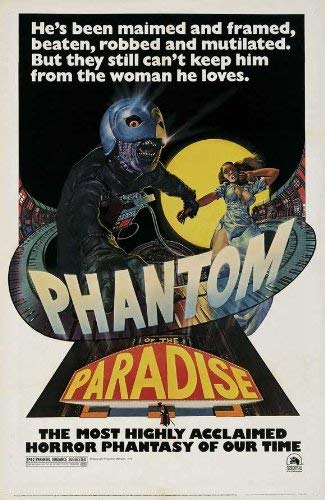
Brian De Palma’s PHANTOM OF THE PARADISE, a great big flop during its original release, is another cult film where I have to say, “I am glad you love this movie, but I don’t.” Big deal, it happens both ways on a regular basis.

It’s also one of those movies where I liked it less and less the more it was on, until I simply just wanted it to be over.

PHANTOM OF THE PARADISE gets called a “rock opera” and compared with THE ROCKY HORROR PICTURE SHOW, which came out about one year later.

Now, we’re getting to the heart of the problem. Both PHANTOM OF THE PARADISE and ROCKY HORROR are limp-wristed rock if they are in fact rock at all. Paul Williams, the songwriter and star of PHANTOM, he’s best known for writing Three Dog Night’s “An Old Fashioned Love Song,” the Carpenters’ “Rainy Days and Mondays,” Barbra Streisand’s “Evergreen” from A STAR IS BORN, and Kermit the Frog’s “Rainbow Connection” from THE MUPPET MOVIE. Not exactly the most rocking credentials.

Singer-songwriter and show tunes, with a little Sha Na Na and Meatloaf thrown in for extra measure, are not my idea of rock and that’s what PHANTOM and ROCKY HORROR offer listeners and viewers.

I already wrote a review comparing ROCKY HORROR against ROCK ‘N’ ROLL HIGH SCHOOL, a 1979 film that centers around the music of the Ramones.

This whole rock opera angle initiated my brilliantly engineered mind to recall Ken Russell’s TOMMY from 1975, another musical contemporaneous with both PHANTOM and ROCKY HORROR that’s far more deserving of being called a “rock opera.” That’s definitely true, because at one time The Who — the band responsible for the music for both the 1969 album and 1975 movie — owned the rights on “loudest rock band in the world.” They lived rock, long before they wrote a song like “Long Live Rock,” “Be it dead or alive.”

Russell, who’s every bit as good as De Palma at capturing wretched excess on celluloid, gives us non-singers Oliver Reed and Jack Nicholson, natural born entertainers Ann-Margret and Tina Turner, a Marilyn Monroe-themed cult led by “The Preacher” (Eric Clapton), and Elton John’s centerpiece “Pinball Wizard” number, taking advantage of a $5 million budget. Hell to the yes, I love me some pinball and Sir Elton’s melodramatic demise. Never mind what Ann-Margret does with champagne, beans, chocolates, and bubbles. What’s that Beach Boys line about excitation?

PHANTOM OF THE PARADISE (reportedly made for $1.3 million) takes on classic novels “Phantom of the Opera,” “The Picture of Dorian Gray,” and “Faust.” It also predates the Black Sabbath compilation album “We Sold Our Soul for Rock ‘N’ Roll.”

I prefer the 1925 silent PHANTOM OF THE OPERA because of Lon Chaney’s brilliant performance (his 1974 counterpart William Finley gives the best performance in the movie), the fact that melodrama works better in silent rather than sound films, and the fact that we do not hear the opera music. Yeah, that’s right, I do not particularly care for opera, rock or not. PHANTOM OF THE PARADISE does not rock enough.

I would have greatly preferred Robert Johnson’s music over Paul Williams’ tunes. Here I am and I can’t remember any of Williams’ songs from the film. Not a good sign.

I would not be surprised, though, to find out that Dario Argento cast Jessica Harper in SUSPIRIA (1977) because of her performance in PHANTOM OF THE PARADISE.

I’ll take SUSPIRIA.

TOMMY (1975) ***

TOMMY

Message from Space (1978)

MESSAGE FROM SPACE

MESSAGE FROM SPACE (1978) *

It took two tries to make it all the way through Kinji Fukasaku’s MESSAGE FROM SPACE, one of the first of many STAR WARS rip-offs that only make you appreciate more what George Lucas and gang did in their movies.

How does MESSAGE FROM SPACE rip off STAR WARS? Let us count the ways. A soap, er, space opera, characters named Meia and Hans, a robot, interplanetary strife and destruction, aerial dogfights in space, laser beams, and a musical score by Kenichiro Morioka that should have been enough for grounds for a lawsuit from 20th Century Fox, John Williams, and the London Symphony Orchestra.

I struggled through MESSAGE FROM SPACE and it was a real cinematic endurance contest to get through its 105 minutes. I only made it through about 30 minutes the first try.

At one point in time, I thought about cutting MESSAGE FROM SPACE a little slack for its often lousy special effects, until I read that MESSAGE FROM SPACE cost $5-6 million. Okay, that’s about half of what 20th Century Fox spent on STAR WARS the previous year, but the budget for MESSAGE FROM SPACE apparently established a record (long since broken, of course) for largest budget for a Japanese movie. There went the slack, she be gone.

Vic Morrow (1929-82) sadly found himself at that stage in his career when he appeared in awful movies like HUMANOIDS FROM THE DEEP, GREAT WHITE, and MESSAGE FROM SPACE. Work is work is work, right? In MESSAGE FROM SPACE, Morrow plays a character named General Garuda and receives top billing in the cast above Sonny Chiba. Garuda Indonesia is the airline of Indonesia. Morrow seems to be drinking in every scene and if you had to act with an imitation R2-D2 named Beba, you’d be a full-blown alcoholic too.

This is one of those films not exactly helped out by a bad dubbing job.

I am normally one equipped with more empathy and enthusiasm than the average cinematic pleasure seeker for movies like MESSAGE FROM SPACE. I mean, for crying out loud, I have given four stars to INFRA-MAN, DRUNKEN MASTER, and PLAN 9 FROM OUTER SPACE, three incredibly ridiculous movies that immediately came to mind.

I just found scant pleasure to be experienced from MESSAGE FROM SPACE.

Hard to believe, right, when MESSAGE FROM SPACE features eight Liabe seeds. They resemble walnuts, glowing, magical walnuts that are the unifying plot device; bet Nuts.com would do killer business with a MESSAGE FROM SPACE remake. Rather than The Force, MESSAGE FROM SPACE only manages doze nuts. Bad joke, I know right, but the bad movie made me do it. I promise, I promise, I would never write anything like that otherwise.

Nosferatu (1979)

NOSFERATU

NOSFERATU (1979) ***1/2

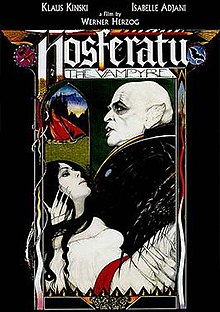
German director Werner Herzog’s NOSFERATU THE VAMPYRE has often been described as a “slow burn” horror film and every critic seems to want to sound a fire alarm that it’s not the average “creature feature” with cheap thrills every few minutes and that it will disappoint most horror movie fans.

The former is certainly true and I cannot speak for the latter except to say this horror movie fan liked it. I’ll be honest, I did not much enjoy it the first time watching it a good 20 years before my return viewing. I remember having a more neutral reaction that first time. Not sure why.

Looking up “slow burn,” I find that it means “a filmmaking style, usually in narrative productions, wherein plot, action, and scenes develop slowly, methodically toward a (usually) explosive boiling point.”

NOSFERATU definitely fits methodical and perhaps only slow to viewers raised on Attention Deficit Cinema. I’d rather say that Herzog’s remake and F.W. Murnau’s original 1922 masterpiece subtitled A SYMPHONY OF HORROR both move at their own leisurely pace. They play more like fever dreams than the average horror movie.

NOSFERATU does not fit the back end of that slow burn definition, because there’s not an explosive boiling point. Certainly not anything resembling the stereotypical big bang grand finale to a standard Hammer Dracula picture.

Herzog marches to the beat of his own drum. That’s for sure and thank God for that, just as we should be thankful for every great director. I consider his AGUIRRE, THE WRATH OF GOD to be the best film I have seen from 1972 and I would put it on a list of the greatest films ever made. LITTLE DIETER NEEDS TO FLY and GRIZZLY MAN are on my top 10 lists for 1997 and 2005, respectively. Les Blank’s documentary BURDEN OF DREAMS, which chronicles Herzog’s great adventure making FITZCARRALDO, also makes my top 10 list for 1982. Ramin Bahrani’s 18-minute PLASTIC BAG, a top 10 entry for 2010, utilizes Herzog as its narrator.

I know that NOSFERATU was my first time watching a Herzog movie and I believe I had not yet seen the Murnau original. To be sure, I was more equipped watching NOSFERATU for a second time.

More than anything else, images stand out. Brilliant images are the heart of both the 1922 and 1979 films and both Murnau’s and Herzog’s filmography.

Musophobes should not watch NOSFERATU, because rats take over the screen at crucial points late in the picture. The rats are the source of some legendary stories: Herzog said the rats were better behaved during the shoot than star Klaus Kinski and since real grey rats proved to be unavailable, white rats were given a grey makeover, for example.

The rats call to mind the monkeys from AGUIRRE.

Of course, there’s every time Dracula (Kinski) is on the screen. Since copyright was not a concern for Herzog like it had been in 1922 for the first NOSFERATU, Herzog returned names like Dracula, Jonathan Harker, and Lucy to his version. Dracula’s look echoes Max Schreck’s iconic Count Orlok and both vampires are radically different from the classic bloodsuckers played by Bela Lugosi and Christopher Lee, as well as just about every other vampire in cinematic history. Herzog and Murnau both show how it is more of a curse to be a vampire and make it far less of a power trip. Herzog’s Dracula and Count Orlok are not suave and debonair, and their striking physical appearances echo vampire folklore. We also have far more complex reactions to the vampires played by Schreck and Kinski, since we feel more empathy for them.

Around her mid-20s at the time she made NOSFERATU, French actress Isabelle Adjani already had a strong claim on the title of most beautiful woman in the world. NOSFERATU did nothing to refute that.

Thinking about the various Jonathan Harkers over time, Bruno Ganz’s performance ranks better than David Manners in the 1931 DRACULA and Keanu Reeves in the 1992 DRACULA. He certainly goes through a wider emotional range than either Manners or Reeves, who are both “mannered” in their performances.

Ultimately, NOSFERATU leaves one with feelings different from how we normally react to a vampire picture. There’s not the standard euphoria that we experience, for example, when Lee’s Dracula spectacularly bites the dust. Instead, we are more pensive and melancholic than excited and thrilled.

A Boy and His Dog (1975)

A BOY AND HIS DOG

A BOY AND HIS DOG (1975) ***

Forgive me for giving away the ending of A BOY AND HIS DOG: The Boy chooses The Dog over The Girl.

Then again, I am not sure I gave away the ending any one bit more than a title like A BOY AND HIS DOG. Yeah, right, it’s not called A BOY AND HIS GIRL.

Character actor L.Q. Jones, a favorite of the director Sam Peckinpah (1925-84), wrote, directed, and produced A BOY AND HIS DOG, adapted from Harlan Ellison’s 1969 short story “A Boy and His Dog.” Just take a look at the film’s poster: “The year is 2024 … a future you’ll probably live to see” and “a boy and his dog: an R rated, rather kinky tale of survival.” That part about A BOY AND HIS DOG being kinky, it’s no lie. Jones, in fact, makes a cameo in the porno movie within the movie.

In post-apocalyptic times, it quickly becomes apparent that a boy and his dog need each other more than ever before.

Especially this boy. He’s named Vic (Don Johnson). He’s 18 years old. He’s obsessed with sex and food, in just that order. Both his parents are gone. He lacks formal education and his ethics and morality are naturally twisted by the world he lives in. He’s a survivor, by any means necessary.

Meanwhile, his telepathic dog named Blood (voiced by Tim McIntire) is one helluva smart and savagely witty canine. He’s better than Benji! Benji, when he was voiced by Chevy Chase in OH! HEAVENLY DOG, never uttered anything like “I hope the next time you play with yourself, you go blind” or “Pull up your pants, Romeo.”

Vic and Blood have worked themselves out a nice little survival pact, at least until the lovely and sassy lass Quilla June Holmes (Susanne Benton). She knows how to appeal to Vic, but good old hound Blood knows a no-count hooch when he sees (and smells) one.

She’s been sent above ground by her powerful father from another world (Jason Robards) to scout talent for a sperm donor to perpetuate the species of underground survivors. Of course, Vic has got the super sperm necessary for the job, a fact Miss Holmes finds out firsthand. She ditches the boy and his dog and returns below ground, proving that Blood definitely sniffed out her wily ways.

Blood advises Vic not to chase the girl and go below ground, but the perpetually horny Vic lets his libido be his guide. Vic asks Blood to wait above ground for his return.

After boy and girl escape the underworld in harrowing fashion, they find Blood and he’s barely alive. That’s when The Boy faces his choice between The Dog and The Girl. Feed her to the dogs, indeed.

A BOY AND HIS DOG makes a strong case that dames are a dime a dozen even in a post-apocalyptic world, but dogs like Blood are truly a rare breed.

More American Graffiti (1979)

MORE AMERICAN GRAFFITI

MORE AMERICAN GRAFFITI (1979) *

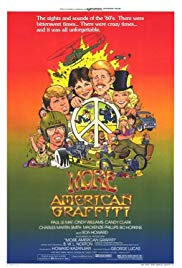
I missed the point of MORE AMERICAN GRAFFITI, the 1979 sequel to George Lucas’ highly influential smash hit from 1973, AMERICAN GRAFFITI.

Sure, I realize we are intended to catch up with John Milner (Paul LeMat), Steve and Laurie Bolander (Ron Howard and Cindy Williams), Debbie Dunham (Candy Clark), Carol “Rainbow” Morrison (Mackenzie Phillips), and Terry “The Toad” Fields (Charles Martin Smith) at different points in the 1960s, but I don’t know if the film had any other greater purpose than attempting to cash in on the AMERICAN GRAFFITI name for another box office bonanza.

You’re right: Richard Dreyfuss and Curt Henderson did not return for the sequel. He’s only the main character in AMERICAN GRAFFITI, for crying out loud. Just like there’s no Dreyfuss and Matt Hooper in JAWS 2. Like his friend Steven Spielberg did not direct JAWS 2, Lucas does not direct MORE AMERICAN GRAFFITI. Unlike Spielberg, though, Lucas had far more involvement with the AMERICAN GRAFFITI sequel, including editing duties.

We have Milner on New Year’s Eve 1964, The Toad in Vietnam on New Year’s Eve 1965, Debbie in San Francisco on New Year’s Eve 1966, and Steve and Laurie on New Year’s Eve 1967.

We shuffle between the four different New Year’s Eve days and director and screenwriter Bill L. Norton gussies up the 1965 and 1966 scenes with grainy newsreel style footage (1965) and split screen (1966). That helps us identify which year we’re seeing, for sure, but otherwise, both gimmicks do not work. Especially the split screen, a technique already overplayed after WOODSTOCK and Brian DePalma films like CARRIE. In MORE AMERICAN GRAFFITI, split screen takes away from every scene it’s used.

The original AMERICAN GRAFFITI focused on a single long day in 1962 and that made the parallel adventures of Curt, Milner, The Toad, and Steve much easier to follow and less distracting. Automobiles cruising the main drag and car radios playing Wolfman Jack’s radio show unified just about every scene.

AMERICAN GRAFFITI also proved to have a theme: It showed Curt, Milner, and The Toad all outside their comfort zones and getting to know somebody beyond their accustomed social circle: intellectual and future college boy Curt and the tough guy car club the Pharaohs, the James Dean “Rebel Without a Cause” Milner and a young teenage girl dumped off on him by her older sister and older friends, and the geeky and socially awkward Toad and the blonde bombshell Debbie. They all form a greater understanding of each other.

Lucas did not get across the theme in a pretentious, heavy-handed, preachy way. Just about every scene in AMERICAN GRAFFITI worked on some level, and it especially seemed incredibly accurate about what life was like in 1962.

Meanwhile, in MORE AMERICAN GRAFFITI, hardly any scenes work and the film never builds up any momentum. It seems to mark off the list of every cliche of the era and maybe it just feels that way even more after one million ‘60s nostalgia trips. MORE AMERICAN GRAFFITI plays like a Time Life movie.

MORE AMERICAN GRAFFITI loses steam early on when Debbie and her loser man friend Lance Harris (John Lansing) are pulled over and he’s busted for just a little joint by Officer Bob Falfa (gratuitous Harrison Ford cameo appearance) after a chase that feels like it takes forever … and that’s immediately followed by Steve and Laurie playing the Bickersons.

Considering how little works in MORE AMERICAN GRAFFITI, it’s even greater insult to injury when the final shot teases us with the death of a main character.

A New World Pictures Double Feature: Avalanche & Piranha (1978)

A NEW WORLD PICTURES DOUBLE FEATURE: AVALANCHE & PIRANHA (1978)

Two New World Pictures exploitation films entered the Great American box office sweepstakes in August 1978.

One became a surprise hit and the other dramatically flopped.

Roger Corman, a man of a million film productions, tossed his hat into the disaster movie ring with AVALANCHE, while PIRANHA riffed on the killer fish blockbuster JAWS.

PIRANHA, directed by Joe Dante and populated by experienced character actors like Bradford Dillman and Keenan Wynn and Dick Miller, recouped its budget and then some and spawned one sequel and at least two remakes.

Star actors Rock Hudson (1925-85) and Mia Farrow headline the human cast of AVALANCHE and New World invested a reported $6.5 million on the picture, a great deal more $ than PIRANHA. You know that it did not go very well for AVALANCHE when its greatest claim to fame is that it made “The Official Razzie Movie Guide” honoring the 100 most enjoyably bad movies ever made.

This bad movie enthusiast, however, did not enjoy AVALANCHE. I found it to be a long slog. I mean, I felt like the one climbing the mountain to get through its 90-odd minutes.

First and foremost, it’s a soap opera in the shape of a ski resort hosting a ski tournament and a figure skating competition. Egads! Magazine reporter Caroline (Farrow) divorced control freak and wealthy ski resort owner David (Hudson). You guessed it, David wants her back, wants her to use his last name rather than her maiden name, she keeps him at arm’s length, and she attaches herself to another man, which only infuriates Mr. Control Freak. Man oh man, that scene on the dance floor when David flips on Caroline, I wanted to bury my head in the snow.

That’s not all: We have David’s spirited mother, an elite skier who seems to be even better as lothario, competing figure skaters, competing lovers, a television reporter, and a nosy photographer. Remember, we need a body count.

That nosy photographer (Robert Forster) and David act out a scene near and dear to disaster movie connoisseurs everywhere. Nick Thorne, the nosy photographer’s name, warns David there’s an avalanche coming and that everybody’s in danger. Any of us could write the rest of the scene and, for that matter, the rest of the movie.

Disaster movies often create a dilemma in our hearts and minds: We desperately want the disaster to come and take us away from the phony baloney dialogue and situations. Yes, I’ll say it, the characters deserve to die a dramatic cinematic death sooner rather than later. … Then, when disaster strikes, disaster movies invariably give us scenes just as phony baloney as before. That’s what happens in AVALANCHE.

Director and screenwriter Corey Allen (1934-2010) blamed AVALANCHE’s disaster as a movie on budget cuts and a tight production schedule, whereas Corman said PIRANHA succeeded because it’s funny and very well directed.

I agree.

PIRANHA tips its humorous hand very early on when one of the main characters plays the classic Atari “Shark Jaws” arcade game. Then, we have classic lines like “They’re eating the guests, sir” and “People eat fish. Fish don’t eat people” and “Terror, horror, death. Film at eleven.” Those with a darker sense of humor may find a friend in PIRANHA. We can thank John Sayles for the script.

I’ve said it before and I’ll gladly say it again: Joe Dante is one of the best American directors. His credits include GREMLINS, GREMLINS 2: THE NEW BATCH, THE HOWLING, THE ‘BURBS, MATINEE, and SMALL SOLDIERS. I don’t think he’s ever let me down, and he does not let me down in PIRANHA.

PIRANHA goes cheerfully over-the-top.

For example, JAWS eliminates one kid. PIRANHA takes out virtually an entire summer camp in grisly detail. I’ve known people who hate PIRANHA because of this one sequence.

Roger Ebert began his one-star review, “I walked into PIRANHA wondering why the U.S. government would consider the piranha to be a potential secret weapon. After all, I reasoned, you can lead the enemy to water but you can’t make him wade. I was, it turns out, naive. PIRANHA is filled with people who suffer from the odd compulsion to jump into the water the very moment they discover it is infested by piranhas.”

Of course, the characters in PIRANHA have a compulsion to jump into piranha-infested waters. Honestly, that’s all part of the joke and part of the fun, especially when Kevin McCarthy works up a variant on his INVASION OF THE BODY SNATCHERS performance.

Just like it’s fun seeing Dick Miller doing his take on Murray Hamilton’s mayor in JAWS. Miller, of course, does not want to hear about top secret scientifically-engineered killer piranhas (created through Operation: Razorteeth) and he does not cancel his party for prospective home buyers. You can guess what happens to most of them home buyers. Yes, PIRANHA takes many of the elements from JAWS and pushes them to extremes.

I enjoyed PIRANHA quite a bit, for its tongue-in-cheek humor and film buff references. There’s brilliant little touches strewn throughout the film, like Phil Tippett’s stop-motion animation creation in McCarthy’s lab. He’s the scientific genius behind them super killer fish, who are released into the system by our heroes played by Dillman and Heather Menzies. Anyway, this stop-motion creation, part-fish and part-lizard, epitomizes the generosity of PIRANHA in general. The film gives us a lot to enjoy.

The credits for PIRANHA are first-rate: Dante, Sayles, Tippett, composer Pino Donaggio, editors Dante and Mark Goldblatt, and makeup effects creator Rob Bottin. They all have done some fine work during their careers, inc. PIRANHA.

Steven Spielberg, the director of JAWS, reportedly considered PIRANHA the best of the many JAWS rip-offs and his approval expressed to Universal stopped the studio from pursuing an injunction against New World for PIRANHA. Universal’s first JAWS sequel, JAWS 2, came out two months before PIRANHA.

AVALANCHE (1978) *; PIRANHA (1978) ***

Sextette (1978)

SEXTETTE

SEXTETTE (1978) ***

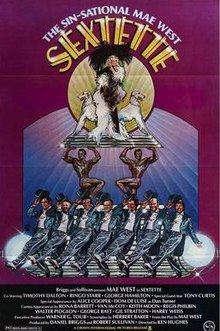
Mae West made her final theatrical film, SEXTETTE, in her mid-80s.

Please, just take a second and consider that statement.

How many people of any age, let alone somebody outside their golden years, have the chance to be the center of a Hollywood movie?

West, who made her first film NIGHT AFTER NIGHT in 1932 and then became a cinematic legend after SHE DONE HIM WRONG, I’M NO ANGEL, and BELLE OF THE NINETIES, had that chance more times than most people.

Your response to SEXTETTE will probably center upon how you feel about seeing West (1893-1980) performing the same act that made her fame and fortune … only 45 years older. Can you buy a woman her age being a sex symbol pursued by virtually every man in the movie? That’s the proverbial $64,000 question.

Granted, we’re not talking about just any woman, even an octogenarian. We’re talking about Mae West, a force of nature blessed with a splendid bosom and a splendid wit. But not in her advanced age, at least the splendid bosom part? Anyway, I think it’s more important whether or not you can believe the characters in the movie finding her sexy.

I believe West here as Marlo Manners, a world famous sex symbol and movie star who also does some important work for her country, repeats a line from Lady Lou in SHE DONE HIM WRONG, “Why don’t you come up some time and see me?”

Must be a slow news day in the world of SEXTETTE, because Marlo’s marriage to Sir Michael Barrington (Timothy Dalton), her sixth husband, seems to be all that’s covered. Regis Philbin’s coverage starts off the movie and then we have Gil Stratton and Dana, er, Rona Barrett. They all play themselves.

SEXTETTE is a tribute, albeit one that’s ridiculous, to Mae West.

There’s quite simply not any other film like it, then again there’s never been anybody quite like Mae West.

For example, West and Dalton sink their vocal chords into the Neil Sedaka and Howard Greenfield song made world famous by Captain & Tennille in 1975, “Love Will Keep Us Together.”

That comes after the infamous “Hooray for Hollywood” number and before the Jimmy Carter impersonator. You’ll never believe it until you see it yourself, but this Jimmy Carter rip-off eats peanuts. Crazy.

Ringo Starr and Keith Moon each make appearances, Starr a director and Moon a designer, and I wonder why they did not cast John Bonham and Charlie Watts. SEXTETTE came out a few months before Moon’s death in early September ‘78.

Alice Cooper sings a piano ballad in SEXTETTE in the same year that he played Uncle Sam, er, Father Sun in SGT. PEPPER’S LONELY HEARTS CLUB, a musical that gets my vote for one of the worst films of 1978 and one of the worst movies ever made. Cooper’s Father Son sings “Because” in SGT. PEPPER. Both Cooper songs from 1978 movies are worse than his “He’s Back (The Man Behind the Mask)” for 1986’s FRIDAY THE 13TH PART VI: JASON LIVES, believe it or not.

SGT. PEPPER brings us back to Mae West, who initially refused the four mop tops permission for her image to appear on the famous album cover, because, get this, she would never be part of any lonely hearts club.

Back to SEXTETTE.

Dom DeLuise (1933-2009) earns the most laughs in the picture, I mean he works hard for the money in SEXTETTE as he delays Marlo and Sir Michael consummating their marriage. Tony Curtis (1925-2010) tries on a Russian accent as one of Marlo’s five ex-husbands and I just want to point out that other Curtis films released in 1978 are THE MANITOU and THE BAD NEWS BEARS GO TO JAPAN. Could it be possible that SEXTETTE is the least ridiculous among those three movies?

George Raft (1901-80) recommended West for NIGHT AFTER NIGHT and plays himself in SEXTETTE, his penultimate film. Furthermore, West and Raft a couple two days apart in 1980 — West November 22 and Raft November 24.

I would be reticent, socially irresponsible even, not to mention that George Hamilton plays another ex-husband. Here’s a man who’s played Hank Williams, Evel Knievel, Dracula, and (later) Zorro, so I don’t think playing alongside Mae West intimidated him in the slightest. I bet he’s got some terrific stories.

NOTE: Crown International Pictures released SEXTETTE and Crown’s renowned for such films as THE BEAST OF YUCCA FLATS, THEY SAVED HITLER’S BRAIN, and ORGY OF THE DEAD, not to mention teenage sex comedies THE BEACH GIRLS, MY TUTOR, WEEKEND PASS, and TOMBOY.