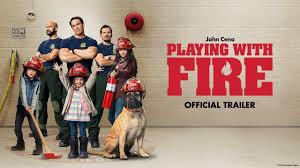
Playing with Fire (2019)

PLAYING WITH FIRE

PLAYING WITH FIRE (2019) One star

Imagine our surprise when the opening credits began at the Flick Theatre in Anderson, Missouri, and it was PLAYING WITH FIRE and not JOKER that we had for our entertainment or, in this case, lack of entertainment pleasure.

I would like to start the long road to recovery by writing this review.

PLAYING WITH FIRE belongs to a rather dubious sub-genre where passable, let alone good, movies are nearly impossible to find: The Big Man vs. Bratty Children. Let’s see, in the past 25-odd years, we have seen Hulk Hogan in MR. NANNY, Vin Diesel in THE PACIFIER, Ice Cube in ARE WE THERE YET?, Dwayne Johnson in TOOTH FAIRY, and now the latest perpetrator John Cena in PLAYING WITH FIRE.

I doubt any of those movies even approach Arnold Schwarzenegger’s KINDERGARTEN COP, the CITIZEN KANE of The Big Man vs. Bratty Children sub-genre.

I say doubt in the previous sentence since luckily, I’ve missed most of those movies because life is short and I only have a finite amount of time watching movies, so why put myself through something that’s akin to a root canal without sedative.

Personally, I feel like every one of those movies barring one (the one starring Arnold) should be shortened to a poster, because everything we need to know about MR. NANNY, THE PACIFIER, ARE WE THERE YET?, TOOTH FAIRY, and PLAYING WITH FIRE can be contained in a 24 x 36.

Hell, I recommend watching KINDERGARTEN COP again every single time a new Big Man vs. Bratty Children movie slithers into multiplexes everywhere.

There’s not a single unpredictable moment in PLAYING WITH FIRE.

I must in all honesty report that I almost, almost, laughed out loud a couple times during PLAYING WITH FIRE. I smiled a couple times.

More often than not, however, the 96 minutes of PLAYING WITH FIRE afforded me the opportunity to practice my poker face or hone my groan.

The last firefighter movie we saw at the Flick was ONLY THE BRAVE and now we have one good firefighter movie and one bad firefighter movie on the dossier. I do wish the nearest fire department would have stopped in and put out PLAYING WITH FIRE.

PLAYING WITH FIRE should not be confused with the 1984 New World production THEY’RE PLAYING WITH FIRE … just as John Cena and his bust should not be confused with Sybil Danning and her bust.

Youngsters might not remember Ms. Danning. She and Lou Ferrigno clashed while making HERCULES and Ferrigno legendarily made Danning wear a cloak so she would not upstage the bodybuilder turned actor. The nerve of that big lug, who demanded that Danning be changed from the good princess to the villain and the picture be made kid-friendly because Ferrigno did not want to disappoint any fans he earned from “The Incredible Hulk.”

A strong female presence like Ms. Danning would have been welcomed in PLAYING WITH FIRE.

Instead, they just waste Judy Greer. Greer and Cena share no chemistry whatsoever.

That is true and here’s another truth: If you play with fire and watch PLAYING WITH FIRE, you will get burned.

Clash of the Titans (1981)


CLASH OF THE TITANS (1981) Three-and-a-half stars

Harryhausen vs. Harry Hamlin.

That’s what CLASH OF THE TITANS amounts to in the long run for this viewer.

Artist, designer, visual effects man, writer, and producer Ray Harryhausen (1920-2013) mastered the dying art of stop-motion animation. His credits include MIGHTY JOE YOUNG, THE 7TH VOYAGE OF SINBAD, JASON AND THE ARGONAUTS, ONE MILLION YEARS B.C., and CLASH OF THE TITANS, Harryhausen’s final production in which he goes out with a big bang.

Harryhausen is the real star of CLASH OF THE TITANS, and not Harry Hamlin or even big-name actors Laurence Olivier, Ursula Andress, Maggie Smith, Burgess Meredith, and Claire Bloom.

I like CLASH OF THE TITANS a lot because of all them stop-motion creations.

Let’s see, we have scorpions, the Stygian witches, Calibos and his vulture, a two-headed hound of Hell, the Kraken, the mechanical owl Bubo, and, of course, Medusa.

The Medusa sequence is the pièce de résistance of CLASH OF THE TITANS and responsible for at least three stars alone.

Harryhausen himself favored Medusa among his many creations.

The snake-haired Medusa, we all know that she’s deadly with arrows and she can turn a person to stone if you make contact with her eyes. Personally, I pretend that every salesperson in a shopping mall is Medusa and eye contact must be strictly avoided. Perseus (Hamlin) tricks Medusa with his reflection and he lops off her head. Then, our hero uses Medusa’s head to turn the formidable Kraken to stone.

A wide range of filmmakers have been inspired by Harryhausen’s work, including Steven Spielberg, Joe Dante, James Cameron, Tim Burton, Peter Jackson, and Sam Raimi.

In 2010, Academy Award winning animator Nick Park talked with the BBC about his three favorite Harryhausen moments. He finished up with Medusa from CLASH OF THE TITANS after picking two from JASON AND THE ARGONAUTS.

“It was so well done and frightening,” Park said. “It’s all the same technique but going to different heights of intricacy.

“I thought it was a combination of really good lighting and shadow. I do admire a lot of CGI, but there’s something not real about it.

“In the Medusa that Ray did it’s there and it’s grounded, there’s real light hitting real surfaces. Somehow your brain knows it’s not real with CGI.”

I’ll be honest, I am far more interested in Harryhausen’s creatures than the rather convoluted plot involving Perseus, Andromeda (Judi Bowker), Calibos, Cassiopeia, and the gods pulling all the strings.

That’s what I meant by starting this review “Harryhausen vs. Harry Hamlin.”

Most of CLASH OF THE TITANS plays like a soap opera, not helped out by pretty boy Hamlin and Bowker, who seem like they should be on “Days of Our Lives.”

Google is a wondrous invention: With just two magic words and one little click, I found the 1987 People article on Hamlin, “The Sexiest Man Alive” double issue no less, and the opening paragraph of “Last of the Great Romantics” just hooks me in against my better instincts.

“The name seems wrong for The Sexiest Man Alive, Harry is a name for an uncle, or a guy who asks you to the prom because his mother made him. Of course, Harold would be worse. So Harry it is. Harry Robinson Hamlin, to be precise … the Harry everyone’s just wild about.” (Personally, I prefer Harry Truman or Harry Potter, quite possibly since neither will ever be proclaimed “The Sexiest Man Alive.”)

The article comes back around for a swipe at CLASH OF THE TITANS.

“And there’s always the possibility of doing a remake of CLASH OF THE TITANS. ‘I brought my toga home,’ says Harry, raising hopes of another glimpse of those knees. He’s kidding, of course. Frivolous flicks are a thing of the past for The Sexiest Man Alive. Besides, says Harry, laughing, ‘I used the toga to wash my car.’”

Frivolous flicks a thing of the past for Hamlin? Hamlin’s career has included 105 episodes of “L.A. Law,” 21 of “Movie Stars,” 12 of “Veronica Mars,” eight apiece of “Army Wives” and “Shameless,” and 15 of “Mad Men,” as well as a plethora of TV movies and other shows.

Hamlin should count himself lucky to be associated with CLASH OF THE TITANS.

Because Harryhausen trumps Harry Hamlin every single time.

House (1977)

HOUSE

HOUSE (1977) Four stars

The year 1977 produced four of the definitive WTF movies in the history of cinema: ERASERHEAD, SUSPIRIA, EXORCIST II, and HOUSE, an item from the Japanese studio (Toho) responsible for Akira Kurosawa, Godzilla, Mothra, Rodan, and the H-Man.

Toho really outdid itself with HOUSE, which even surpasses GODZILLA VS. THE SMOG MONSTER in nonstop funky weirdness. Janus Films describes HOUSE as an episode of “Scooby Doo” directed by Dario Argento.

Bottom line: HOUSE just might be even weirder than ERASERHEAD, more colorful than SUSPIRIA, and more whacked out bat shit crazy than EXORCIST II. You have been warned.

First-time director Nobuhiko Obayashi pulls out all the stops in realizing a rather simple tale on the surface: teenage girl Gorgeous (Kimiko Ikegami) and her six friends Prof (Ai Matsubara), Melody (Eriko Tanaka), Mac (Mieko Sato), Kung Fu (Miki Jinbo), Sweet (Masayo Miyako), and Fantasy (Kumiko Oba) pay Gorgeous’ aunt (Yoko Minamida) in the country a visit. It just so happens that the aunt died in this house many years ago waiting on her fiancee to return from World War II and her spirit remains and feasts on unmarried girls. This is a haunted house movie where the house is hungry, very hungry indeed.

Obayashi’s at-the-time pre-teen daughter Chigumi Obayashi contributed ideas to her father. She came up with several childhood fears, her father relayed the fears to screenwriter Chiho Katsura, and they incorporated her ideas into the finished product. You’ll be able to recognize her contributions almost instantly and they contribute to the uniqueness.

Just as a fun exercise, I looked up the plot keywords for HOUSE on IMDb: “refrigerator,” “banana,” “watermelon,” “bloody spray,” “dismemberment,” “decapitation,” “full frontal nudity,” and “severed head” are some of the more interesting 75 keywords and they only scratch at the surface of the overall bizarre nature of the entire enterprise.

More than 30 years after its original release, HOUSE seemingly came from out of nowhere to develop a cult following in the United States, playing first as a midnight movie in Nashville and then at a film festival in Austin in 2009 before heading to DVD.

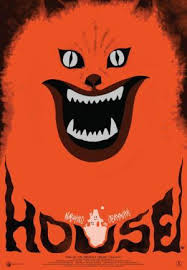
I first encountered HOUSE through its cover image for the Criterion Collection release on October 26, 2010. Maybe you remember seeing that artwork, as well. Nashville graphic designer and Ben Folds drummer Sam Smith came up with the distinctive image: “I used the first idea that came to me after watching a screener of the film — Blanche the cat’s psycho-screaming mug — and adapted it to stand alone as a symbol of the uncanny and over-the-top assault that our midnight-movie audience was in for,” Smith said. The poster first appeared for the film at the Belcourt Theatre in Smith’s hometown.

Then, I read the reviews for HOUSE and they’re nearly as over-the-top as the film itself.

Online reviewer Dennis Schwartz wrapped up his mixed review, “The director uses freeze-frames, jump-cuts, video effects to change dimensions, spiral effects, color tints, and assorted other techie tricks to play the scary pic card more for laughs than to be gruesome. It’s an experimental visual pic that becomes overwhelmed with low-brow slapstick comedy, a ridiculous killer house and garish visuals. But it’s a one-of-a-kind film that has its admirers, who just can’t resist such weird childish nonsense.”

Michael Atkinson opined in the Village Voice, “But though it plays like a retarded hybrid of ROCKY HORROR and WHISPERING CORRIDORS, it is, moment to moment, its own kind of movie hijinks. It even won a directorial-debut critics’ prize back in the day. Gigglers and cultists, pony up.”

I watched James Rolfe’s review for Monster Madness X from 2016. Rolfe started his review with a pause and a WOW! Of course, Rolfe picked HOUSE for one of the “WTF Wednesday” reviews.

I finally caught up with HOUSE in late summer 2019 and it lived up to expectations. It calls to mind a few pictures: EVIL DEAD II, THE SPIRIT OF THE BEEHIVE, THE 5,000 FINGERS OF DR. T, DAISIES, SUSPIRIA, and MY NEIGHBOR TOTORO. Like those films, though, HOUSE ultimately stands alone as an unique work because it creates its own world. I find that I respond more forcefully to fictional works that do that, rather than just rehash more of the same old already damaged goods. I want to be challenged, inspired, etc. I’ve never seen a haunted house movie quite like HOUSE.

HOUSE haunts one’s thoughts and gains in strength upon deeper reflection. At this moment of typing, I am thinking about Gorgeous’ aunt and how much time she spent waiting alone in that house for the love of her life to return from World War II. He never did, and they both died, she in that darn house and she’s cursed to haunt it for eternity because of her bitterness about the war. Then, I start thinking about the sheer enormity of the loss endured by the human race from Sept. 1, 1939 through Sept. 2, 1945: An estimated 70-85 million people died or three percent of the world’s population in 1940; 50-55 million civilians and 21-25 million soldiers no longer lived on this planet from a variety of causes, death on a mass scale that doubled World War I; the atomic bomb and the Holocaust two of humanity’s depressing advancements in death.

Obayashi was born in Hiroshima in 1938 and he lost all his childhood friends when the United States dropped an atomic bomb on Hiroshima on Aug. 6, 1945. Hiroshima and Nagasaki, as well as post-WWII nuclear testing, inform many Japanese films of the last almost 75 years.

Conan the Barbarian (1982)

CONAN THE BARBARIAN

CONAN THE BARBARIAN (1982) Three stars

For the longest time, at least since Al Gore invented the Internets, I have thought the ultimate version of CONAN THE BARBARIAN is the 3-minute, 52-second version on YouTube that scores select scenes from the movie with Iron Maiden’s “Run to the Hills.”

As I watched CONAN THE BARBARIAN again, I kept hoping that Basil Poledouris’ score would be replaced by Bruce Dickinson’s wail and the soaring guitars of Dave Murray and Adrian Smith. Alas, it was not to be.

Lyrically, though, it’s not a perfect fit, since Conan seeks revenge against Thulsa Doom, who’s played by none other than James Earl Jones.

Iron Maiden released “Run to the Hills” on February 12, 1982 and THE NUMBER OF THE BEAST album on March 22.

CONAN THE BARBARIAN came out on May 14, 1982.

Both works proved to be controversial.

Critics thought CONAN THE BARBARIAN was either too violent or that it fell too short of the violence in the source material. That was the biggest controversy for John Milius’ film.

Of course, with an album title like THE NUMBER OF THE BEAST, Iron Maiden were called Satanists and boycotts, record burning, and demonstrations were organized by religious groups in the United States. Just picture old women smashing hundreds of copies of THE NUMBER OF THE BEAST to bits with their hammers.

“The Number of the Beast,” though, is not 867-5309.

Sword and sorcery films were big in the 1980s, a fantasy sub-genre defined as “sword-wielding heroes engaged in exciting and violent adventures. An element of romance is often present, as is an element of magic and the supernatural.”

CONAN THE BARBARIAN inspired a steady stream of imitations and knockoffs, like the DEATHSTALKER series: A big man with a big sword, busty women, and plenty of sex, violence, and head-splitting gore. Not that there’s anything wrong with that.

I had forgotten (shame on me) the amount of nudity during the first hour of CONAN and here I thought that I never forget a nude scene. (For what it’s worth, I remembered Sandahl Bergman’s shining moments in CONAN.)

Then, down the home stretch, CONAN turns up the violence to an operatic level. There’s also an orgy late in the picture.

Arnold Schwarzenegger was born to play Conan and he played him twice, less effectively though a second time. Arnold also played supporting role Lord Kalidor in RED SONJA, so three of his four films made for sultan of schlock producer Dino DeLaurentiis were sword and sorcery. Ed Pressman and fellow producer Edward Summer had considered Charles Bronson, Sylvester Stallone, and William Smith for the Conan role, but they found Arnold to be the embodiment of Conan the Barbarian after they watched a rough cut of PUMPING IRON. The success of both CONAN and THE TERMINATOR made Arnold a star.

Before CONAN, Arnold found mixed success in the motion picture business. In his 1969 debut HERCULES IN NEW YORK, Arnold’s thick Austrian accent required a dub job and the film credits him as “Arnold Strong ‘Mr. Universe’” partly to play against the name of co-star Arnold Stang. If you watch HERCULES IN NEW YORK, you will be amazed that Arnold ever had a motion picture career. I’ve seen it several times and it gets me every single time.

Other than PUMPING IRON, Arnold’s best early career role is Joe Santo in STAY HUNGRY, where he played alongside Jeff Bridges and Sally Field in a supporting role. This is a role that stands alone in a Schwarzenegger filmography populated with action and comedy.

CONAN started Arnold’s decade long run of solid action movies. Why did this seemingly muscle-bound guy with a ridiculous accent become at one point the biggest movie star in the world? Siskel & Ebert pondered that very question in an entire show dedicated to Arnold called “Arnold Schwarzenegger: The Unlikeliest Star.”

A joy of performance is the one element that Arnold exudes in all his best films and it’s what separates him from his competition.

Arnold meets his match in Broadway dancer Sandahl Bergman and when she and Arnold pair up, CONAN truly kicks into gear. The 6-foot tall Bergman (this Shawnee Mission East High graduate liked to say that she’s 5-12 rather than 6-0 because no girl should have to be 6-0) possesses an impressive physicality that’s not dwarfed by Arnold or any of her male co-stars and she exudes the same joy of performance as Arnold.

There’s certainly not been another woman, not Grace Jones in CONAN THE DESTROYER or Brigitte Nielsen in RED SONJA, paired more effectively on screen with Arnold than Bergman.

James Earl Jones became a popular villain after STAR WARS came out in 1977; Jones lent his voice to Darth Vader because director George Lucas did not want David Prowse’s English accent for Vader. Never mind Jones’ role as the older Kokumo in EXORCIST II: THE HERETIC, which was released not long after STAR WARS during the summer of ‘77. Just imagine the collection Jones possibly built from his villainous roles in the STAR WARS films, THE HERETIC, and CONAN. Not only Darth Vader’s helmet, but also his locust costume from THE HERETIC and possibly the snake from CONAN after his transformation. Later in the 1980s, Jones began playing kindly older men and that’s where he’s been ever since.

In addition to Jones, Max von Sydow (most famous for his work with Ingmar Bergman and THE EXORCIST) and Mako (Academy Award nomination for Best Supporting Actor for THE SAND PEBBLES) also lend their gravitas to the proceedings.

When he was the Governor of California, did Arnold read the following dialogue, “To crush your enemies, to see them driven before you, and to hear the lamentations of their women,” or say the following prayer, “Crom, I have never prayed to you before. I have no tongue for it. No one, not even you, will remember if we were good men or bad. Why we fought, or why we died. All that matters is that two stood against many. That’s what’s important! Valor pleases you, Crom … so grant me one request. Grant me revenge! And if you do not listen, then to HELL with you!”

Let’s hope there’s a soundboard with Arnold’s CONAN dialogue out there somewhere. This would restore a smidgen of my faith in humanity.

Time After Time (1979)

TIME AFTER TIME

TIME AFTER TIME (1979) Three-and-a-half stars

Screenwriter and director Nicholas Meyer created some nifty concepts for his 1979 directorial debut TIME AFTER TIME: what if writer Herbert George Wells (1866-1946) really did invent a time machine, what if surgeon John Stephenson (“Jack the Ripper”) steals Wells’ time machine and travels from 1893 London to 1979 San Francisco, what if Wells tracks down Stephenson in San Francisco and becomes more like Sherlock Holmes (Meyer wrote the novel and screenplay THE SEVEN-PER-CENT SOLUTION), and what if Wells falls in love with a modern woman and they find themselves in danger from Mr. Stephenson.

Malcolm McDowell as Wells, David Warner as Stephenson, and Mary Steenburgen as Amy Robbins flesh out Meyer’s concepts.

McDowell brought a devilish charm to Alex in A CLOCKWORK ORANGE, another high concept picture with literary roots, and he’s a lovable English eccentric in TIME AFTER TIME.

Warner makes for a suitably menacing antagonist, who’s more in his element in late 20th Century America than he was in late 19th Century England. Meyer works the juxtaposition of Wells and Stephenson to maximum impact.

Steenburgen plays a character who almost instantly falls in love with Wells. There’s just something about the way that she tells Wells that she will believe him. She later played basically the same character in Robert Zemeckis’ BACK TO THE FUTURE PART THREE, and it works in both films.

McDowell and Steenburgen fell in love making TIME AFTER TIME together and they were married from 1980 to 1990.

They do have that extra special glow during TIME AFTER TIME, and they do create a screen couple that we fervently desire to stay together.

I have at least liked virtually every movie I have ever seen that incorporates time travel, from BACK TO THE FUTURE and TIME AFTER TIME to THE TERMINATOR, MEN IN BLACK 3, and X-MEN: DAYS OF FUTURE PAST. I find time travel movies endearingly silly and goofy in the best possible way, if nothing else, and the best ones are profound.

TIME AFTER TIME especially has fun with Wells being a stranger in a strange land … and time. Mileage will invariably vary on these gags. Of course, we have to keep in mind this Wells (1893 model) would not know about the 1906 San Francisco earthquake or about the Golden Gate Bridge which opened in 1937.

Meyer’s other credits include writing the delightfully whacked out INVASION OF THE BEE GIRLS and writing the two best STAR TREK films, THE WRATH OF KHAN and THE VOYAGE HOME. Meyer said that he tried out ideas for THE VOYAGE HOME that he did not use in TIME AFTER TIME.

TIME AFTER TIME works as comedy, science fiction, romance, and thriller. I revisited it recently as the second half of a double feature with BREAKING AWAY and both films left me feeling all nice and fuzzy inside.

NOTE: Of course, it must be a September 21 thing, since H.G. Wells, Stephen King, Bill Murray, Chuck Jones, Leonard Cohen, Ethan Coen, and David Coulier were all born Sept. 21 in their respective years.

Breaking Away (1979)

BREAKING AWAY

BREAKING AWAY (1979) Four stars

BREAKING AWAY is one of those films that makes me feel incredibly good inside and it belongs on a list with such films as ONE FLEW OVER THE CUCKOO’S NEST, ROCKY, THE BLACK STALLION, CHARIOTS OF FIRE, HOOSIERS, and THE SHAWSHANK REDEMPTION for being uplifting cinematic experiences of the highest order.

It would be enough that BREAKING AWAY ends on a high emotional note, but the film, written by Steve Tesich and directed by Peter Yates, gives us a half-dozen great characters who have left an indelible mark on so many viewers. I’ll discuss these characters far more than I will THE BIG RACE, because they are far more unique and special than a feel good finish that has unfortunately become an industry standard over the decades.

We shall begin with our four main protagonists, Dave (Dennis Christopher), Mike (Dennis Quaid), Cyril (Daniel Stern), and Moocher (Jackie Earle Haley). They are 19 years old and going nowhere fast. They have decided to waste away their lives together and not work or go to college. They are derogatorily known as “cutters” to Indiana University students in Bloomington, since they are the sons of the stone cutters that built the campus. BREAKING AWAY provides us a rare opportunity to hear working class sentiments expressed onscreen. This is also undoubtedly the best movie ever made in Bloomington, Indiana.

All four protagonists, as well as both of Dave’s parents, are developed and sharply delineated. They are as real as the people in our lives.

Dave becomes obsessed with all things Italian, especially cycling and Team Cinzano. Dave takes his obsession so far that the family cat Jake has been renamed Fellini, Dave speaks Italian and plays opera records, he shaves his legs, he wants his parents to have another child because Italians have big families, and he pretends to be an Italian exchange student named Enrico Gimondi to impress a cute coed because he feels that just regular old Dave Stoller won’t cut it with this beauty. Dave drives his parents up a wall, especially his former stone cutter and current used car salesman father; “I want some American food, dammit! I want French fries!” We’ll return to the father soon.

Mike and Cyril both discuss their former athletic careers, Mike football and Cyril basketball.

“You know, I used to think I was a really great quarterback in high school,” Mike said as the contemporary Hoosiers practiced in front of our protagonists at Memorial Stadium. “I still think so too. Can’t even bring myself to light a cigarette, cause I keep thinkin’ I gotta stay in shape. You know what really gets me though? I mean, here I am, I gotta live in this stinkin’ town and I gotta read in the newspapers about some hot shot kid, new star of the college team. Every year it’s gonna be a new one. And every year it’s never gonna be me. I’m just gonna be Mike. Twenty-year-old Mike. Thirty-year-old Mike. Old mean old man Mike.”

Cyril bemoans the fact that his athlete’s foot and jock itch have gone away. “I was sure I was going to get that scholarship. My dad, of course, was sure I wasn’t. When I didn’t, he was real understanding, you know. He loves to do that. He loves to be understanding when I fail.”

Moocher predates Marty McFly, only Moocher hates being called “shorty.” He gives a sound explanation for being short in stature, “It’s my metabolism. I eat three times a day and my metabolism eats five times a day.”

We mentioned Dave’s father earlier and he’s the best character in BREAKING AWAY. Paul Dooley should have won the Academy Award for Best Supporting Actor in 1980, but he was not even nominated for his performance as Dad. Barbara Barrie, who played Mom, did get nominated for Best Supporting Actress.

Please just take an opportunity and think in this moment about how often we see a positive father on film. We’ve seen so many deadbeat dads, absentee fathers, child abusers, goofballs from another planet, etc., that it almost seems like a miracle when we see a more positive portrayal of a movie father. It should not be that way.

Dave exasperates his father in ways that older teenagers and young adults have so often throughout history and then in a way unique to Dave with his Italian obsession. In the long run, though, father loves son and vice versa, most evident in a great scene when father and son take a walk and talk about how they really feel.

“I was proud of my work,” Father tells Son. “And the buildings went up. When they were finished, the damnedest thing happened. It was like the buildings were too good for us. Nobody told us that. It just felt uncomfortable, that’s all.”

After conflict between cutters and campus kids escalates and spills over into a fight in the student union, IU officials determine the cutters are allowed to enter a team in the Little 500 bicycle race. They become “The Cutters.”

IU graduate Tesich based his Academy Award winning screenplay on real people and real events: Dave Stoller takes root from Dave Blase, Tesich’s fraternity brother and Little 500 teammate who put together 139 of the 200 laps (a record) for the winning Phi Kappa Psi team in 1962. Blase also inspired Stoller’s love of everything Italian.

British director Yates (1929-2011) made a large claim of his fame on directing BULLITT, that 1968 Steve McQueen vehicle with the legendary car chase in San Francisco. The bicycle race that ends BREAKING AWAY, it’s every bit as thrilling as the chase in BULLITT. BREAKING AWAY is the better movie.

In closing, I leave BREAKING AWAY a little note.

Adoro BREAKING AWAY ed è una mossa speciale perché solleva gli spiriti e mi fa venire voglia di parlare una lingua straniera con il mio gatto.

Terror Train (1980)

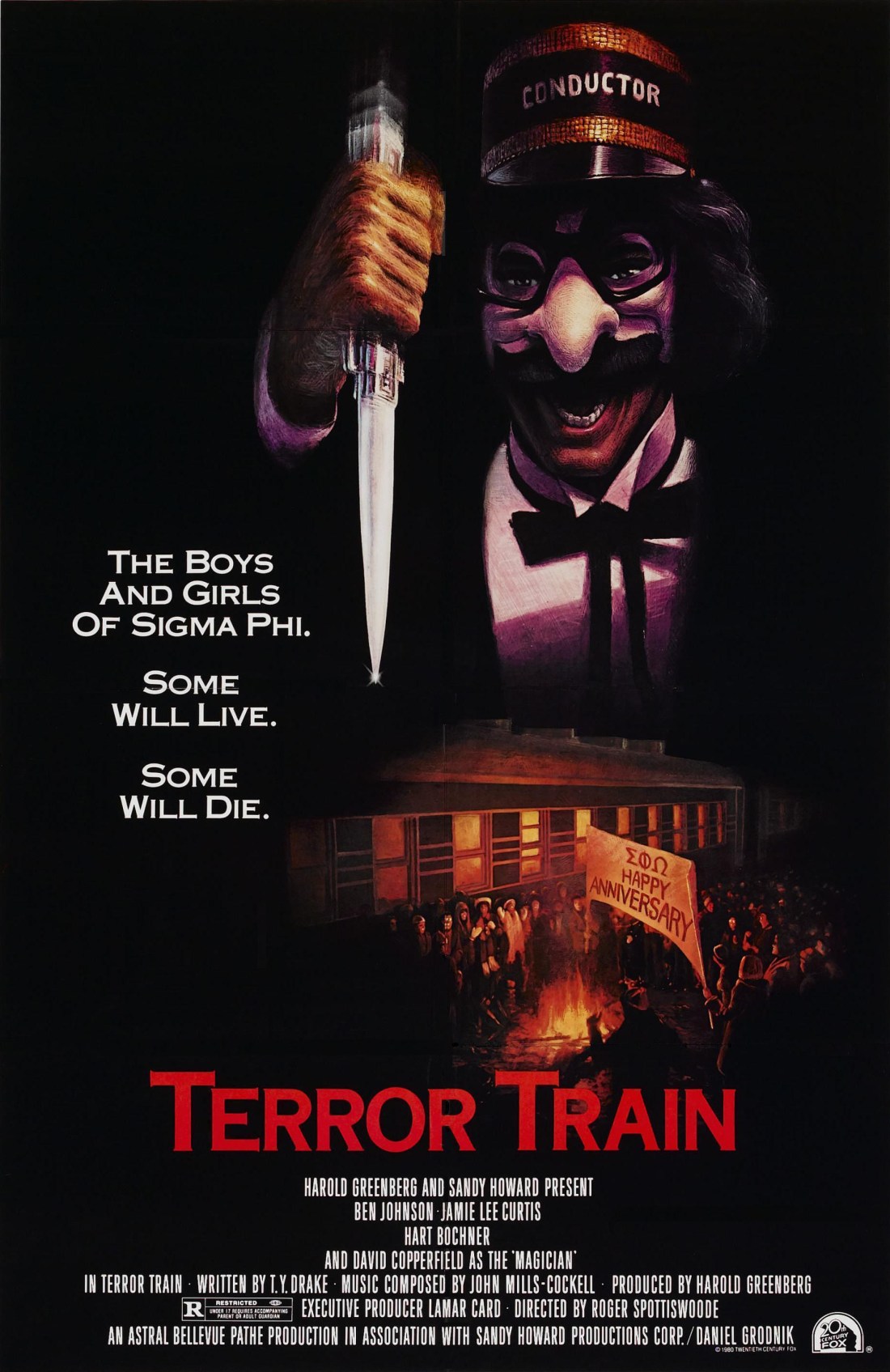
TERROR TRAIN.jpg

TERROR TRAIN (1980) Two stars
An above-average cast and cinematographer John Alcott’s work aboard a novel setting for a horror film distinguish TERROR TRAIN but otherwise, it’s a bumpy ride for 90-plus minutes.

TERROR TRAIN succeeds in making the sales pitch “HALLOWEEN on a train” come true.

Scream queen Jamie Lee Curtis headlined the cast and this was her fourth horror movie of a career that began with a big bang in HALLOWEEN. She appeared in three horror movies alone in the calendar year 1980: THE FOG in February followed by Canadian productions PROM NIGHT (July) and TERROR TRAIN (October). HALLOWEEN II rounded out the Curtis horror movie quintology in October 1981 and she had successfully become typecast. Curtis broke free by the end of the decade, proving herself especially adept at comedy.

HALLOWEEN was a great scary movie and Curtis’ next four ranged from the average (THE FOG, HALLOWEEN II, TERROR TRAIN) to the abysmal (PROM NIGHT). They made her Laurie Strode character in HALLOWEEN II a shell of herself from the first movie: Curtis never quite perfected her limp and it was depressing to see her in that hobbled state after being such a refreshing, resourceful character in the original. She never lost her scream, though.

Like seemingly every other slasher of the era, TERROR TRAIN starts in the past. In the original HALLOWEEN, 6-year-old Michael Myers murdered his teenage sister Judith. In FRIDAY THE 13TH, two camp counselors are murdered. In PROM NIGHT, there’s a prank gone horribly wrong. TERROR TRAIN belongs in the prank gone horribly wrong category.

Curtis plays Alana Maxwell, who reluctantly takes a central role in the sexual initiation prank against fraternity pledge Kenny (Derek MacKinnon). Kenny, of course, goes schizo almost immediately after this prank and he’s sent to a psychiatric hospital. Three years later, these same fraternity and sorority creeps host a New Year’s Eve costume party on a moving train … and they have an uninvited guest. This costume party angle affords the filmmakers another novelty: Kenny can assume the identity of every person he kills, so he can be the guy in the Groucho Marx mask or the great lizard costume and catch his next victim by complete surprise.

These fraternity and sorority characters are by and large noxious pieces of work, especially Doc (Hart Bochner) and Mo (Timothy Webber). Their inevitable deaths feel like they take forever, mainly because we have to endure more and more of their odious behavior. Then, when we get there, their deaths are letdowns compared to similar moments in other slasher films. I mean, for crying out loud, even PROM NIGHT, an otherwise awful movie, gives us a great decapitation replete with a head roll.

And now for something completely different: Slashers often found room for at least one veteran cast member. They picked Ben Johnson (1918-96) as the veteran cast member in TERROR TRAIN and he thankfully gets a more substantial role than, let’s say, Glenn Ford in HAPPY BIRTHDAY TO ME. As the conductor Carne, Johnson shows the cool of a world champion rodeo cowboy and Academy Award winning supporting actor (LAST PICTURE SHOW). In fact, he’s almost too cool in the midst of all the murder and mayhem. Overall, he’s a welcome presence.

David Copperfield (the magician, not the Charles Dickens character) makes his motion picture debut, apparently because producer Sandy Howard liked magicians. Copperfield stretches his chops by playing “The Magician,” does a routine that slows down the movie even more in the middle, and bows out none too gracefully after being an obligatory red herring.

Harry Houdini (1874-1926) made only silent movies: feature-length THE GRIM GAME, THE MAN FROM BEYOND, and HAIDANE OF THE SECRET SERVICE. Silence could have served TERROR TRAIN well.

John Alcott (1931-86) received a mention in the opening paragraph for his cinematography. His credits include the Stanley Kubrick films 2001, A CLOCKWORK ORANGE, BARRY LYNDON, and THE SHINING (released about five months before TERROR TRAIN), and I mentioned him in the review of the 1975 World War II film OVERLORD. OVERLORD seamlessly combined archival footage director Stuart Cooper found from the Imperial War Museum with contemporary footage shot by Alcott. Alcott’s challenge in TERROR TRAIN naturally centered on space and lighting, and he proved up to the challenge. You can file TERROR TRAIN in the great-looking slasher films after HALLOWEEN and MY BLOODY VALENTINE.

Ultimately, though, TERROR TRAIN succeeds at train and fails at terror.

King Kong vs. Godzilla (1963)

KING KONG VS. GODZILLA

KING KONG VS. GODZILLA (1963) Three stars

The Japanese champion Godzilla had last appeared in GODZILLA RAIDS AGAIN in 1955 or in the American version GIGANTIS, THE FIRE MONSTER in 1959.

The American champion King Kong (guess we claim the big lug, though we kidnapped him from Skull Island and brought him to the Big Apple) had last appeared in SON OF KONG in 1933. Yes, they rushed out a sequel nine months after the seminal KING KONG.

With a title like KING KONG VS. GODZILLA, maybe we can take a guess at the content of the third GODZILLA and third KING KONG film. Three is the magic number, right? At least it was in Japan, where its success at the box office inspired Toho to continue the Godzilla series.

Both monsters appear in color for the first time.

Like a lot of Jackie Chan films, the Godzilla films appeared in radically different forms when they invaded America after their original release.

It started with the very first GODZILLA in 1954, released two years later in America as GODZILLA, KING OF THE MONSTERS. This new version excised 16 minutes of footage from the original, mainly the political, social, and anti-nuclear themes so vital to the Japanese version. Remember that GODZILLA came out less than a decade after Hiroshima and Nagasaki. The American producers sponsored new footage and inserted American journalist Steve Martin (Raymond Burr), used mostly in flashbacks and voice-over narration. Japanese-American actors and look-alikes had to be used to attempt to make it seem like Martin had been in the original film. Martin speaks into a tape recorder, “George, here in Tokyo, time has been turned back two million years. This is my report as it happens. The prehistoric monster the Japanese call ‘Godzilla’ has just walked out of Tokyo Bay. He’s as tall as a 30-story building.”

In America, KING KONG VS. GODZILLA follows that KING OF THE MONSTERS format, as we get a series of talking head scenes before we finally get down to the heavy-duty monster battle royal in the let’s say last half. Several years ago, I wrote a negative review of KING KONG VS. GODZILLA because I wanted to yell at United Nations reporter Eric Carter to shut his big fat trap and just let the title characters fight. On the latest watch or two, after purchasing a VHS copy (GoodTimes big box, no less, with a blurb from Leonard Maltin, “Above average special effects”) recently, I enjoyed the film a lot more than I had before.

Now, I think of the Eric Carter and the blah, blah, blah gang as the wrestling commentators on a big pay-per-view hyping up Hulk Hogan vs. Andre the Giant, for example. King Kong vs. Godzilla and Hulk Hogan vs. Andre the Giant have equal stature in my estimation.

I just love monsters fighting and the Godzilla films delivered that for nearly a 15-year period beginning with KING KONG VS. GODZILLA and continuing through Ghidorah, Mothra, Rodan, Ebirah, the Smog Monster, Gigan, Megalon, and Mechagodzilla. Technically, it started with GODZILLA RAIDS AGAIN when Godzilla fought Anguirus … or when Kong battled a T-Rex in the original KONG.

What was the genesis of KING KONG VS. GODZILLA?

Stop motion animator pioneer Willis O’Brien (1886-1962), who did the work for both KONG films, created a story outline where Kong battled Frankenstein’s Monster. O’Brien gave the outline to producer John Beck to develop a project, but Beck took the project instead to Toho behind O’Brien’s back. The rest is history, including Frankenstein’s Monster.

Some of us are probably thinking right about now that it does not seem like a fair fight between Kong and Godzilla. Over the years, Godzilla’s size has varied greatly from 164 feet tall in 1954 to 492 feet tall 60 years later. Kong, meanwhile, stands at 24 feet at his highest height in 1933. KING KONG VS. GODZILLA makes Kong 147 feet tall.

Machine gun fire topples Kong from the Empire State Building, while Godzilla seems virtually indestructible despite the best efforts of the military. Well, let’s just say that lightning gives Kong incredible powers; later in the Godzilla series, lightning would have the same effect on Godzilla. Maybe one day we’ll have a film combining Frankenstein’s Monster, Godzilla, King Kong, and Jason Voorhees, and we’ll call it LIGHTNING STRIKES.

A legend grew up around KING KONG VS. GODZILLA that Kong won in the American version and Godzilla won in the Japanese version. That’s not true. I mean, for crying out loud, Kong gets top billing in the title.

Predator and The Most Dangerous Game


PREDATOR (1987) & THE MOST DANGEROUS GAME (1932)

It’s been duly noted over the years that PREDATOR combines elements from ALIENS and RAMBO into one blockbuster.

Until only recently, I did not realize PREDATOR also updated a 1932 horror movie named THE MOST DANGEROUS GAME for modern times and weaponry. That relatively unknown classic centers around the concept of a big game hunter (Leslie Banks) who moved on from animals to humans on his own island reserve. The big game hunter finally meets his match in another legendary hunter (Joel McCrea) shipwrecked on the island, due to the big game hunter’s dastardly design of sabotaging ships and hosting then hunting the shipwrecked survivors. The two great hunters contest their most dangerous game on the same jungle sets as KING KONG. Ernest B. Schoedsack co-directed both MOST DANGEROUS GAME and KING KONG, films released several months apart. Fay Wray and Robert Armstrong appeared in both. I say go check out THE MOST DANGEROUS GAME.

In a two-star review for THE PREDATOR, I summed up the difference between the 1987 original and the 2018 retread.

“PREDATOR ‘87 does not have perfunctory dialogue and dead weight, and it does not drag. It plays like ‘a lean, mean fighting machine’ (in the great words from STRIPES) and it’s a streamlined entertainment that moves faster than this, er, last year’s model (an Elvis Costello reference following STRIPES).

“The cast of the original PREDATOR amounted to 16 actors.

“By comparison, THE PREDATOR features approximately 50 credited and 20 uncredited cast members.

“Favorite character: ‘Sobbing veterinarian.’ Second favorite: ‘Cantina bartender.’ Show: ‘Halloween mom.’”

Let’s face it: PREDATOR star Arnold Schwarzenegger could do very little wrong at this stage in his career and he’s a presence missing from the PREDATOR movies that have followed. This is a different Schwarzenegger film in one key aspect: When his Dutch faces off against the title character in the final act, it’s an incredibly tense final showdown because, for a change, we are not sure Schwarzenegger’s character will make it out alive. Kevin Peter Hall’s Predator knocks Schwarzenegger around real good, something that we just don’t see every day. Hall stood at 7-foot-2 and he towers over everybody, including Schwarzenegger.

The film’s marketing campaign proved to be misleading, since Schwarzenegger is not the predator, he’s the prey.

The supporting cast around Schwarzenegger forms one of the most macho in history, with such luminaries as Carl Weathers, Jesse Ventura, and Bill Duke around to chew the scenery. Their machismo ultimately descends into terror as the title character begins systematically eliminating them. They sure do make great trophies for the intergalactic hunter. They’re the best of the best, at least on this planet.

PREDATOR director John McTiernan (DIE HARD) and crew made the film in the real jungles of Mexico rather than some back lot. Like PLATOON, PREDATOR turns the jungle into another character and it exerts a force seemingly every bit as potent as the title character. If that intergalactic hunter don’t kill you, then the damn jungle will for sure.

Like JAWS, behind-the-scenes difficulties benefited the finished product. Originally, Jean-Claude Van Damme signed on to play the Predator, but was fired during production for reasons that nobody has ever been able to agree on. Apparently, some of his footage survived and made the final cut. The 5-foot-10 Van Damme would have made a radically different Predator, one definitely not quite as imposing and intimidating and one more ninja-like than Hall, who played the role in the first two PREDATOR movies before his 1991 death.

The first Predator suit failed, so the filmmakers called on special effects guru Stan Winston (1946-2008) to solve the problem. Winston is another one of those behind-the-scenes figures who developed a legendary reputation and just reading some of his credits justify the legend: PREDATOR, ALIENS, THE TERMINATOR and TERMINATOR 2, STARMAN, A.I., FRIDAY THE 13TH PART III (uncredited), THE THING, and PUMPKINHEAD (Winston also made his directorial debut with this 1988 horror feature).

Like a classic horror movie, we have a gradual build-up to the full reveal of the monster in PREDATOR. Characters also build him up in our imaginations with their dialogue. Of course, we see the effects of an escalating body count and this only fuels our anticipation for seeing this predator in his true form. When we do see this intergalactic villain, it’s worth the wait. The final showdown between Schwarzenegger and Predator definitely lives up to our expectations, and it’s on par with the big fights in KING KONG VS. GODZILLA and FREDDY VS. JASON, though PREDATOR is overall a better film than both KING KONG VS. GODZILLA and FREDDY VS. JASON.

You have not lived a full cinematic life until you have seen Schwarzenegger’s Dutch tell the Predator, “You’re one ugly motherfucker,” as he takes off his mask.

PREDATOR (1987) Three-and-a-half stars; THE MOST DANGEROUS GAME (1932) Three-and-a-half stars

Good Guys Wear Black (1978)

GOOD GUYS WEAR BLACK

GOOD GUYS WEAR BLACK (1978) Two-and-a-half stars
The late Steve McQueen gave his friend Chuck Norris some advice for his motion picture career. McQueen said that Norris talked too much in GOOD GUYS WEAR BLACK and that, in the future, he should let his supporting actors do more talking, since it would have the effect of making what Norris says more important.

I quoted McQueen in a review of A FORCE OF ONE, Norris’ third feature. McQueen’s right about GOOD GUYS WEAR BLACK: Norris does talk too much and he should have allowed his talented supporting cast more of an opportunity to carry the speaking.

Norris stars in GOOD GUYS as John T. Booker and there’s Anne Archer as Booker’s romantic interest and smaller roles for James Franciscus, Dana Andrews, and Jim Backus. It is especially nice to see Andrews on the screen, because we remember him from classics like LAURA and especially THE BEST YEARS OF OUR LIVES. Backus deserved better, especially since, all things considered, he probably enjoyed C.H.O.M.P.S. more than what he did GOOD GUYS.

Because I saw the later film before the earlier one, GOOD GUYS’ plot reminded me of the 1985 Arnold Schwarzenegger vehicle COMMANDO. Booker’s surviving Vietnam War comrades are being systemically eliminated five years after the first scene in the movie when they survive a death trap set for them. We have a shady diplomat on the verge of becoming Secretary of State, who is blackmailed into pursuing the elimination of the Black Tigers, the elite group of CIA assassins headed by Norris’ Booker. This plot was written on the back of a much larger napkin than COMMANDO.

GOOD GUYS, like A FORCE OF ONE, exists as middle-of-the-road Norris, not quite as inspired as his best films CODE OF SILENCE and LONE WOLF McQUADE, but still better than his starring debut BREAKER! BREAKER! and THE OCTAGON, his fourth picture.

CODE OF SILENCE and LONE WOLF are his best pictures mainly because they have the best supporting casts. They also have their fair share of exciting moments.

I mean, who could ever forget that classic scene in LONE WOLF when David Carradine’s treacherous villain buries Norris alive in his super-charged Dodge Ramcharger. After coming to and pouring beer on himself, Norris and his Dodge rise up out of the ground and he gets out and guns down several of Carradine’s anonymous henchmen. Capping it all off, Norris tells his young partner to get him a beer. Epic.

There’s just one scene in GOOD GUYS that even approaches that great LONE WOLF scene.

Booker faces down an assassin, who just blew up the plane carrying Archer’s reporter character and Booker’s romantic interest Margaret, and eventually Booker takes out this formidable foe with a flying kick through the bad guy’s windshield as he attempts to run over Booker. This moment alone is worth the price of a rental or a more long-term purchase, and it could play as the front end of a highlight reel with LONE WOLF.

Unfortunately, the rest of GOOD GUYS does not live up to that incredible flying kick, reportedly performed by Norris’ brother Aaron, but it still has a certain value, especially in seeing Norris portray a college professor and a race car driver in addition to being a cold-blooded assassin. Boy, that Norris sure could do anything.

NOTES: In 2017, a 22-year-old John T. Booker, from Topeka (Kansas), was sentenced to 30 years in prison for his vehicle bomb detonation attempt at Fort Riley. Booker wanted to kill American soldiers and assist the Islamic State of Iraq and al-Sham (ISIS) in their fight against the United States.

There’s also a Dr. John T. Booker who’s an Associate Professor of French at the University of Kansas. His teaching and research focus on the French novel of the 19th and 20th centuries.

Kansas seems to have the market cornered on the John T. Booker name.