The Blair Witch Project (1999)


THE BLAIR WITCH PROJECT (1999) Four stars

I occasionally find myself looking back fondly on all the multiplex experiences I had during 1999 and 2000.

Please bear with me as I rattle off the titles: THE PHANTOM MENACE, SOUTH PARK BLU, SLEEPY HOLLOW, AMERICAN BEAUTY, GLADIATOR, THE PATRIOT, THE LEGEND OF DRUNKEN MASTER, and CROUCHING TIGER, HIDDEN DRAGON. Just for variety and to balance the bad with the good, there was also DRACULA 2000, THE LADIES MAN, ROMEO MUST DIE, and THE SKULLS. There’s even one more.

I shall never forget when I watched THE BLAIR WITCH PROJECT on the first night it played at the Pittsburg 8.

This was a major event for my generation (let’s say those of us born from 1965 through 1981), because the BLAIR WITCH hype was inescapable that summer and fall in 1999 and the seemingly inevitable backlash proved even stronger and more lasting. For at least a couple years, you just had to watch THE BLAIR WITCH PROJECT and form your own strong opinion. You either loved or hated THE BLAIR WITCH PROJECT with no middle ground whatsoever and everybody felt like expressing their opinion about it, something that cannot be said for the average movie. Nowadays, though, how many people give this 20-year-old movie the time of day.

Anyway, I myself walked into the late show that night stoked, not only because of the insane buzz around the film but also because of the four-star review written by Roger Ebert that I read when the film opened July 16. “At a time when digital techniques can show us almost anything, THE BLAIR WITCH PROJECT is a reminder that what really scares us is the stuff we can’t see. The noise in the dark is almost always scarier than what makes the noise in the dark. Any kid can tell you that. Not that he believes it at the time” finishes off Ebert’s review. BLAIR WITCH later rounded out Ebert’s list of the 10 most influential films of the 20th Century.

Of course, leading up to whenever we first watched it, we heard all the noise about THE BLAIR WITCH PROJECT being the “scariest movie ever made.” How many times have we heard that about the latest horror movie and then found it out to be a lie, a hype, a con?

Sitting down in the Pittsburg 8 that night, though, we knew that we were in for a treat, a transcendent experience. THE BLAIR WITCH PROJECT, whether you love it or hate it, delivered.

I have never seen a movie in a theater setting before or after create such an intense reaction. As the end credits rolled, members of the packed house cheered and booed. I remember more people cheering, but the boos were both louder and longer. Debates broke out across the theater as we slowly exited. I loved the film and defended it in the midst of some intense hostility from individuals who felt they had been cheated. They expected something different than what they got from THE BLAIR WITCH PROJECT. And hated main protagonist Heather Donahue and found her incredibly annoying. And hated hated hated that darn ending. I started thinking even more positively about the film after each hate-filled editorial I heard.

A strange thing happened in the first couple years after THE BLAIR WITCH PROJECT: I encountered several people who enjoyed the sequel BOOK OF SHADOWS more than the original. It was here that I developed a little theory: People who hated THE BLAIR WITCH PROJECT but liked or even loved BOOK OF SHADOWS wanted a more traditional horror movie or at least one more beholden to the conventions of the late 20th Century horror movie. Meanwhile, people who loved THE BLAIR WITCH PROJECT loved it partly because it broke away from the conventions of contemporary horror movies. It was not SCREAM, not I KNOW WHAT YOU DID LAST SUMMER, not URBAN LEGENDS, et cetera, populated by late 20th Century pretty boy or hip actors and lovely actresses with that nudge-nudge wink-wink we’re so contemporary and hip tone. I know I dig BLAIR WITCH mostly because it is different from the horror movies of its time and belongs to another tradition. At the time, most of us had probably never seen a found footage movie before, although everybody who believed the whole “true story” bit should have known better. I mean, come on, after THE TEXAS CHAINSAW MASSACRE and FARGO, you fell for that jive?

THE BLAIR WITCH PROJECT set itself up perfectly for a backlash of epic proportions. We already mentioned anything touted as “the scariest movie ever made” will create large numbers of viewers laughing and scoffing at such a ridiculous claim. The film made nearly $250 million on a $60,000 budget … with the help of a groundbreaking marketing plan that ultimately backfired, at least in terms of perception of the film itself.

Here’s the third paragraph of a story by MWP Digital Media, “So perhaps you’d be surprised to learn the most successful viral marketing campaign of all time took place before social media existed. Even before mainstream use of the Internet. The most successful viral marketing campaign of all time centred on a small, low-budget indie flick in 1999 called THE BLAIR WITCH PROJECT.” Just thinking about it even now, yeah, it’s crazy to conceive of a frenzied audience in small college town Pittsburg, Kansas, for a low-budget horror movie with no-name performers.

The filmmakers decided to use a website to promote their little movie, not just any website though since this one creates an entire world treating THE BLAIR WITCH PROJECT like it really happened rather than it being a fictional work. More than 20 years later, we can still check out blairwitch.com/project. We’re greeted with a familiar title card upon visiting the site, “In October of 1994, three student filmmakers disappeared in the woods near Burkittsville, Maryland while shooting a documentary. A year later their footage was found.”

There’s “Mythology,” a timeline of major events in the history of the Blair Witch: February 1785, November 1786, November 1809, 182, August 1825, March 1886, November 1940-May 1941, and several dates from October 1994-October 1997. The front page of “Mythology” ends on this note, “The found footage of their children’s last days is turned over to the families of Heather Donahue, Joshua Leonard, and Michael Williams. Angie Donahue contracts Haxan Films to examine the footage and piece together the events of October 20-28, 1994.”

We can see a picture of “Montgomery College film students Michael Williams, Joshua Leonard, and Heather Donahue less than a week before their disappearance” and several stills from their documentary.

The “Aftermath” section includes evidence, search, interviews, and news. Evidence includes crime scene photos from the Frederick County Sheriff’s Office and anthropology professor David Mercer describing how there is no scientific explanation for a certain event. Search provides a MISSING poster for Donahue, Leonard, and Williams with their photos, measurements, and features; “Last seen camping in the Black Hills Forrest area, near Burkittsville.” If you look closely, you can see the famous 555 extension listed for the Frederick County Sheriff’s Office. Interviews are clips featuring such figures as Sheriff Ron Cravens and search party members. News offers clips from coverage by Channel 11 and Channel 6.

“The Legacy” takes in discovered footage, audio, and Heather’s journal, which was found buried beneath a 100-year-old cabin in the woods. Her journal amounted to 37 pages; from Page 21, “It is freezing and we are still out here. We’re completely fucking lost now, we’ve decided basically to just keep heading south, but it doesn’t seem to be getting us anywhere fast and weird shit keeps happening which is, to be totally honest, sitting here with gloves and sweaters in a cold tent in the middle of nowhere and the guys asleep – beginning to scare me. I’m hungry. I’m cold. I want to see what we shot. We didn’t light a campfire tonight because we wanted to lay low. Not that there’s anything left to cook on it anyway. I feel like we are bound to cross a road of something soon, it’s not like Maryland has wilds that go on forever or some shit. We have got to get out of here. As much as I would like…”

Personally, I appreciate that THE BLAIR WITCH PROJECT deals in myths and legends and makes a valiant effort to create its own timeless story. It belongs most to a tradition of American storytelling that started with Washington Irving (1783-1859), namely his 1820 work “The Legend of Sleepy Hollow.” This tradition also involves more local stories, like, for example, haunted McCray Hall at Pittsburg State; “Sightings of a lady in a black dress. The Pipe organ is heard playing at night. Sudden temperature variations. Strange movements from corners of eyes” highlights the listing on “Dark Kansas.” BLAIR WITCH remembers the power of imagination.

Daniel Myrick and Eduardo Sanchez, BLAIR WITCH directors, talked about the genesis for their movie in Little White Lies, “We came up with the basic premise for what eventually became THE BLAIR WITCH PROJECT back in the early ‘90s. We were studying at the University of Central Florida at the time, and like most college students we didn’t have any money. … One day we got to talking about this show called “In Search of…,” which Leonard Nimoy hosted in the ‘70s. We started thinking about all these pseudo-documentaries like THE LEGEND OF BOGGY CREEK, IN SEARCH OF NOAH’S ARK, CHARIOTS OF THE GODS, exploratory, investigative films linked to paranormal encounters, and how they really freaked us out as kids. So we rented a bunch of those movies and we were surprised how much they still freaked us out. …

“We shot [BLAIR WITCH] in two sections: Phase One, which is everything in the woods, and then Phase Two, which ended up being used for the “Curse of the Blair Witch” TV documentary. The Phase One stuff was shot over about eight pretty intensive days. It was a continuous shoot, where the actors were the cameramen and all the dialogue was improvised.”

Lead performer Donahue took a great deal of the backlash against BLAIR WITCH, as she was the most publicly visible; she won Worst Actress from the Golden Raspberry Awards, for example, beating out Melanie Griffith in CRAZY IN ALABAMA, Milla Jovovich in THE MESSENGER: THE STORY OF JOAN OF ARC, Sharon Stone in GLORIA, and Catherine Zeta-Jones in ENTRAPMENT and THE HAUNTING. Her acting career persisted until 2008, for example she appeared in the billion times worse than BLAIR WITCH romantic comedy BOYS AND GIRLS, and she left the profession to grow medical marijuana. She then became an author and delivered the 2012 memoir “Growgirl: How My Life After the Blair Witch Project Went to Pot.”

Two movies from 1999 became parodied to what seemed like no end at the time, THE MATRIX and BLAIR WITCH. This endless parodying did not help either film. I especially got beyond exasperated at MATRIX parodies. Anybody who lived during that era knows which two scenes that we’re talking about without even mentioning them. Just say THE MATRIX and BLAIR WITCH, and we can bet they’re the first scenes that come to mind.

Myrick and Sanchez filmed apology scenes for both Donahue and Williams, and decided upon Donahue for the finished product because she had the most reason to apologize. Reactions to her apology are the most extreme in a film that creates extreme reactions. Ebert said that it reminded him of explorer Robert Scott’s notebook entries as he froze to death in the Terra Nova expedition (1910-13). Others have laughed at it like it was the funniest thing they have ever seen.

Leonard and Williams have both maintained acting careers, Leonard being far more busy. BLAIR WITCH marked the feature debuts for Donahue, Leonard, and Williams and I like them all because they have an everyman appeal not typically found in horror movies of the late 90s and early 00s.

The promotion for BLAIR WITCH proved so effective that Donahue’s mother even received sympathy cards from people who believed that her daughter was either dead or missing. Sanchez’s experience in web design proved to be a godsend. It was probably just some elective that he barely thought about at the time he took it.
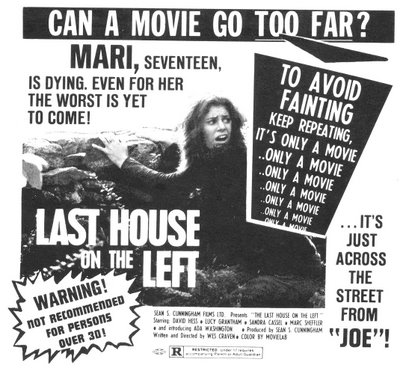
The Last House on the Left (1972)

LAST HOUSE ON THE LEFT

THE LAST HOUSE ON THE LEFT (1972) Three stars
Former academic Wes Craven (1939-2015), who also did some work on pornographic films under different aliases, made a big bang with his feature debut THE LAST HOUSE ON THE LEFT, one of the great shockers of the seventies.

It’s an exploitative American modern take on Ingmar Bergman’s THE VIRGIN SPRING (1960), a film itself based on a 13th Century Swedish folk ballad. THE VIRGIN SPRING won the Academy Award for Best Foreign Language Film at the 1961 Academy Awards.

The film’s classic tagline, “To avoid fainting, keep repeating: It’s only a movie, only a movie, only a movie. …” Viewers had a variety of extreme reactions, of course which only helped to hype the film en route to $3.1 million in returns on a $87,000 budget.

Theaters and drive-ins showed LAST HOUSE in many different prints, because individual machinists took it upon themselves to make their own cuts. Normally, the most shocking bits would end up missing. Good luck finding an uncut version of the film.

It received some of the nastiest reviews imaginable, which made seeing the film again seem like more of an event, a happening. Writing for the New York Times, Howard Thompson said, “When I walked out, after 50 minutes (with 35 to go), one girl had just been dismembered with a machete. They had started in on the other with a slow switch blade. The party who wrote this sickening tripe and also directed the inept actors is Wes Craven. It’s at the Penthouse Theater, for anyone interested in paying to see repulsive people and human agony.” Roger Ebert wrote just about the only positive review at the time of the film.

I first watched it about 10 years back and I thought it was a powerful work. I wrote a very positive review somewhere and I gave it three-and-a-half stars. I found it less powerful after subsequent viewings.

Craven and crew made some appalling choices that create a split personality movie.

Watching LAST HOUSE for the first time, you might notice the buffoonish antics of the Sheriff (Marshall Anker) and the Deputy (Martin Kove). Their comedic relief never works and in fact they play like failed slapstick comedy dropped in from another movie. I noticed this element upon first viewing and it was the reason I graded THE LAST HOUSE ON THE LEFT three-and-a-half rather than four stars.

PSYCHO. Herrmann. SUSPIRIA. Goblin. HALLOWEEN. Carpenter.

Well, you’ll never find THE LAST HOUSE ON THE LEFT soundtrack filed alongside those indelible horror movie scores and their composers. That’s why I started a new paragraph.

David Hess, who plays the main villain Krug, wrote and performed four songs for the movie: “The Road Leads to Nowhere” (the best song of the bunch), “Wait for the Rain,” “Sadie and Krug (Baddies’ Theme),” and “Now You’re All Alone.”

Upon more viewings, this music stuck out like a sore thumb, one that poked me right straight in the eye. I’m not sure why I overlooked the music the first time around.

Krug the character, played by Hess the actor, would have killed Hess the singer and songwriter, just slit his throat for singing one of those ridiculous songs. Believe it or not, Hess wrote “Speedy Gonzales,” which became a big hit for Pat Boone in the year 1962.

I still deduct one-half star from LAST HOUSE for the rumbling bumbling stumbling cops and a good quarter star for them Hess songs.

Hess (1936-2011) is so good as the bad guy in LAST HOUSE that we can understand precisely why he became typecast as villain. He played one of the henchmen in Craven’s SWAMP THING.

Sandra Peabody and Lucy Grantham play Mari and Phyllis, who are kidnapped, tortured, raped, and murdered by Krug and company. They have the most difficult roles.

Filming LAST HOUSE proved to be a horrifying ordeal for Peabody, especially since Hess believed in method acting and even threatened assaulting her for real during a rape scene. Peabody dropped out from acting in 1974, after being cast in movies like VOICES OF DESIRE and MASSAGE PARLOR MURDERS! She went into screenwriting, producing children-orientated entertainment, and being an acting coach.

Fred Lincoln (1936-2013) played Weasel, one of Krug’s nasty associates, and LAST HOUSE marked Lincoln’s only non-pornographic role. Lincoln directed more than 300 films; the Internet Movie Database lists 340 directorial credits for the New York native.

Jeramie Rain, who played the vicious Sadie, was married to Richard Dreyfuss from 1983 to 1995 and their union produced three children. She once hitched a ride with real-life serial killers Charles Manson and Tex Watson. That’s fitting because LAST HOUSE seems to have been heavily influenced by the Manson Family and their murders.

Richard Towers and Eleanor Shaw, under different names, play Mari’s parents Dr. John and Estelle Collingwood, highly respectable upper middle class folk. Krug and his gang disguise themselves as traveling salesmen and they call upon the Collingwoods. Both parties eventually discover the others’ identities: The Collingwoods find out their guests killed their daughter and Krug and company discover that Dr. John and Estelle are Mari’s parents.

Dr. John and Estelle devise some elaborate booby traps and Craven displays his fondness for booby traps for the first time. Booby traps also played a role in both THE HILLS HAVE EYES and A NIGHTMARE ON ELM STREET. I believe that Craven should have directed at least the first HOME ALONE, given his predilection for booby traps.

This juxtaposition of seeing a socially respectable upper middle class couple getting down-and-dirty to exact revenge has been one of the most fascinating elements at work in LAST HOUSE. You just might find yourself asking, “What would I do if I found myself in a similar situation?”

Though it’s not a classic on the same level as both NIGHT OF THE LIVING DEAD and THE TEXAS CHAINSAW MASSACRE, LAST HOUSE is essential viewing for horror fans.

The Burning (1981)

THE BURNING (1981) Two stars
The late, great director Howard Hawks (1896-1977) once said that a good movie is “three great scenes and no bad ones.”

No way that Hawks could have possibly had a movie like THE BURNING in mind, since he died a few years before the release of the 1981 slasher and even before the boom of that genre. John Carpenter paid Hawks tribute in HALLOWEEN with characters watching THE THING FROM ANOTHER WORLD on TV.

THE BURNING does have three great scenes but also several bad ones.

Let’s get the three great scenes out of the way first.

There’s an effective jump scare in an early hospital scene, before the opening credits. It makes up for a couple clunker false alarms later on in the picture.

Several early period slasher films include a scene where one character would regale both the rest of the characters and the audience with an origin story of the killer. THE BURNING, FRIDAY THE 13TH PART 2, and MADMAN all have a similar campfire story. These scenes are fun, because most of us can remember at least once being enthralled and freaked out by somebody’s ghastly yarn around the fire. Cropsy is based on a real-life New York urban legend, the Cropsey Maniac, a genuine campfire tale which obviously had a major impact on the creative forces, including Bob and Harvey Weinstein and Brad Grey (later three of the most powerful men in Hollywood), behind THE BURNING.

The “infamous raft massacre” scene, when Cropsy takes out five teenagers with his garden shears. This is the pièce de résistance of THE BURNING and the one scene when the film deserves its reappraised “classic” status. Splatter effect maestro Tom Savini earned his paycheck for this sequence alone and it can stand side-by-side with his best work.

In some quarters, THE BURNING has been called one of the best slasher films and a classic that flew under the radar.

Truth be told, I’ve always been underwhelmed and sometimes even disgusted by it, except for the three great scenes. I first watched it on late night Cinemax in the early 2000s and a few years later, I taped it off IFC.

The three great scenes probably make up less than 10 percent of the running time. Some of the camp scenes also work on a basic level.

Most often, though, THE BURNING alternates a jeering, leering tone with moments of brutal violence, a juxtaposition that makes for strange bedfellows.

We especially find that leering tone in the nude scenes of Carrick Glenn and Carolyn Houlihan. Houlihan, who won Miss Ohio in 1979, reportedly felt very uncomfortable with her nude scene and it only gets much worse for her Karen character as she receives first a temper tantrum from her would-be boyfriend after she changes her mind about sex and then Cropsy’s garden shears as she looks for her clothes scattered in the woods. Houlihan only appeared in two features, her second and final role “Bathing suit model” in A LITTLE SEX.

Ned Eisenberg and Larry Joshua play jerks in Eddy and Glazer, respectively. Joshua makes undoubtedly one of the oldest summer campers in screen history, as he turned 29 years old three months before the May 1981 release of the film. We just have absolutely no idea what Glenn’s Sally even sees in the first place in a creep like Glazer. Eddy, he’s not quite as bad as Glazer, but his scene with Karen leaves us liking the guy appreciably less.

Guess it goes to show what kind of movie we’re dealing with when Brian Matthews’ Todd and Brian Backer’s Alfred (possible nod to Hitchcock) take on Cropsy at the end. We find out Todd was one of the campers who participated in the fiery prank on Cropsy that horribly backfired during the prologue and we first see Alfred peeping on Sally in the shower. Alfred does grow on us, especially as he becomes friends with four of his fellow male campers.

Cropsy’s first murder, naturally of a prostitute, represents one of the worst aspects of the slasher film: a self-contained murder sequence that wastes precious time (sometimes minutes on end) and contributes nothing of virtue to the film.

THE BURNING holds interest today predominantly as a time capsule film.

It was part of a wave of low-budget horror films that attempted to cash in on the runaway success of HALLOWEEN. There proved to be a glut of these films in 1981.

Several famous performers and behind-the-scenes figures got their start with THE BURNING. Holly Hunter, Jason Alexander (with a head of hair), and Fisher Stevens made their screen debuts. THE BURNING marked one of the first productions of Miramax, known for their film production and distribution; Miramax (named after the Weinsteins’ parents Miriam and Max) started in 1979 in Buffalo, New York, close to where they filmed THE BURNING.

Maybe that leering, jeering tone should come of no surprise considering Harvey Weinstein’s role in THE BURNING as writer and producer.

Former production assistant Paula Wachowiak recounted her worst experience on THE BURNING with the Buffalo News in October 2017. She went to Harvey Weinstein’s hotel room, because she needed him to sign checks, and he greeted her at the door wearing nothing but a towel, which he naturally dropped when she entered his room. He wanted a massage. Wachiowiak spurned him. The Buffalo News article features the headline, “’You disgust me’: Buffalo woman tells of 1980 encounter with Weinstein.”

Fright Night (1985)

FRIGHT NIGHT

FRIGHT NIGHT (1985) Three-and-a-half stars

In a not-at-all shocking revelation, Crispin Glover admitted that he did FRIDAY THE 13TH: THE FINAL CHAPTER (1984) because he needed the money and that he does not think much of the slasher film genre overall.

“I’ve only seen two of those films, I saw the original film [FRIDAY THE 13TH] and the one that I’m in,” Glover told Yahoo! Movies. “I remember when I saw the original one, not too long before it I’d seen the original TEXAS CHAINSAW MASSACRE, and when I saw the first FRIDAY THE 13TH, I thought, ‘Well, this is extremely derivative.'”

Not sure what Glover thinks of FRIGHT NIGHT, but surely he can relate to the dialogue from horror movie host Peter Vincent (Roddy McDowall) after he’s fired by that darn TV station wrapped up in demographics and ratings.

“I have just been fired because nobody wants to see vampire killers anymore, or vampires either. Apparently, all they want to see are demented madmen running around in ski-masks, hacking up young virgins.”

FRIGHT NIGHT gives us vampires and vampire killers, and it’s one of the best examples from a decade of horror movies that successfully mixed horror and comedy. That’s part of a grand tradition that started with all them Universal classics in the 1930s.

FRIGHT NIGHT both pays tribute to classic horror movies of the variety that we’d see on late night TV and updates them for contemporary audiences and mores, taking in the rising expectations for special effects and our increased demand for gore and nudity. Richard Edlund, whose previous credits include RAIDERS OF THE LOST ARK and GHOSTBUSTERS, delivers the gore effect goods late on in FRIGHT NIGHT and Chris Sarandon’s head vampire Jerry Dandridge is both a charming ladies killer and a nasty piece of work. He’s not one of them pretty boy puss vampires that we have seen in such bastardizations of the genre as TWILIGHT and DRACULA 2000.

The name Peter Vincent itself descends from actors Peter Cushing and Vincent Price, who are symbolic of the horror movies obviously loved by director and screenwriter Tom Holland. Cushing slayed Dracula several times in Hammer films, as he played Van Helsing in HORROR OF DRACULA, DRACULA A.D. 1972, THE SATANIC RITES OF DRACULA, THE BRIDES OF DRACULA, and THE LEGEND OF THE 7 GOLDEN VAMPIRES. He should not be mistaken for Christopher Lee, who played Dracula so many times that a Hollywood traffic cop once pulled over the actor and asked him if he should be out in the daylight.

I wonder if Cushing (1913-94) and Price (1911-93) saw FRIGHT NIGHT and what they made of both the film and the Peter Vincent character. (McDowall said that he used “The Cowardly Lion” from THE WIZARD OF OZ as his inspiration for Peter Vincent. As a guest at one of McDowall’s parties, Price said FRIGHT NIGHT was wonderful and McDowall gave a wonderful performance.)

McDowall’s Vincent is one of those characters that elevate a film. Fortunately, there’s a few more memorable characters in FRIGHT NIGHT.

William Ragsdale plays our bright-eyed high school protagonist Charley Brewster who just might be Peter Vincent’s biggest fan. He never misses a “Fright Night” episode. Mr. Brewster encounters great difficulty getting anybody to believe him that his next-door neighbor, the charming and good-looking Jerry, is a vampire. Everybody thinks it’s just a byproduct of Charley’s overactive imagination only made worse by horror movies.

Peter ultimately believes Charley and the old washed-up actor becomes a real-life vampire hunter, paired up with the horror movie fanatic. They believe in each other.

Amanda Bearse is Charley’s girlfriend and Jerry’s target for his vampire bride, since she resembles the lady in that painting on his wall or Bearse’s Amy is the reincarnation of Jerry’s long-lost love. Stephen Geoffreys, who looked like he was Jack Nicholson’s son, almost steals every scene that he’s in as Evil Ed, Charley’s friend.

FRIGHT NIGHT has made a lasting impression on me. I first watched it as part of a horror movie marathon during a friend’s slumber party. It was the film that I remembered most fondly and it stuck with me for several years before watching it again.

Frenzy (1972)

FRENZY

FRENZY (1972) Four stars
Legendary director Alfred Hitchcock (1899-1980) used the theme of the falsely accused several times: THE LODGER (1929), MURDER! (1930), THE 39 STEPS (1935), YOUNG AND INNOCENT (1937), THE TROUBLE WITH HARRY (1955), THE WRONG MAN (1956), NORTH BY NORTHWEST (1959), and, for the last time, FRENZY.

FRENZY, Hitchcock’s penultimate film in a 53-film career that lasted from silent through sound, found Hitchcock returning to not only one of his favorite themes but also to his native land of England for the third and final time since his exodus to Hollywood that began in 1940 with REBECCA, Hitchcock’s only Academy Award for Best Picture winner.

I have not seen every one of Hitchcock’s falsely accused movies (MURDER! and THE TROUBLE WITH HARRY have eluded me thus far in life), but I believe it is safe to say that Richard Ian “Dick” Blaney (Jon Finch) in FRENZY presents us with the Hitchcock falsely accused protagonist with the greatest odds against him in proving his innocence during the movie. Blaney’s not an inherently likeable character, he’s not played by a big charismatic movie star like Henry Fonda or Cary Grant, so it does take some time for this Blaney to grow on us. We have all had stretches in our lives where we’ve been down on our luck and it seems everything’s against us. Blaney has it even worse.

We viewers know Blaney’s not the killer. That’s because we are shown the true identity of “The Necktie Killer,” a serial killer and rapist terrorizing London town, early on in the picture, Blaney’s friend Bob (Barry Foster). Blaney definitely seems like the most obvious suspect as the circumstantial evidence piles up against him, with a little help from his old friend Bob. We root for Blaney to prove his innocence and for Bob to be caught because this “Necktie Killer” is one of the nastiest pieces of work that we have ever seen on a movie screen.

FRENZY takes it down to the very end of the movie before playing its final hand. The film is a reminder why Hitchcock is still called “The Master of Suspense” decades after his death.

Where did the themes of the falsely accused and fear of the police come from in Hitchcock? A childhood experience, of course.

One day, Hitchcock’s father decided upon an unique punishment for the troublesome young lad. You can just imagine how much of a devious little brat Hitchcock was as a child.

“I must have been about 4 or 5 years old,” Hitchcock told Francois Truffaut in 1966. “My father sent me to the police station with a note. The chief of police read it and locked me in a cell for five or 10 minutes, saying, ‘This is what we do to naughty boys.’”

Truffaut followed up with the question why did Hitchcock’s father punish him.

“I haven’t the faintest idea,” Hitchcock said. “As a matter of fact, my father used to call me his ‘little lamb without a spot.’ I truly cannot imagine what it was I did.”

Hitchcock was in his early 70s when he made FRENZY, and it’s not a work that one would necessarily associate with an older man. It pulsates with a certain anger, especially through the down-on-his-luck protagonist, and that’s a state associated with younger men.

There’s a rape and murder sequence in FRENZY that’s even more unsettling than anything in PSYCHO, since it goes on far longer than any of the murders in PSYCHO.

Anthony Shaffer’s screenplay also expresses a tremendously morbid sense of humor that befits Hitchcock. For example, a doctor in a pub says, “We haven’t had a good juicy series of sex murders since Christie. And they’re so good for the tourist trade. Foreigners somehow expect the squares of London to be fog-wreathed, full of hansom cabs and *littered* with ripped whores, don’t you think?”

In the midst of all this murder and mayhem, we get an unique relationship between Chief Inspector Tim Oxford (Alec McCowan) and his wife (Vivien Merchant) that’s both funny and touching. Mrs. Oxford serves her husband a variety of culinary delights and then dishes up her own take on the case of “The Necktie Killer” and these Blaney and Bob characters.

FRENZY is a powerful work by a grand master, one of many great films by Hitchcock.

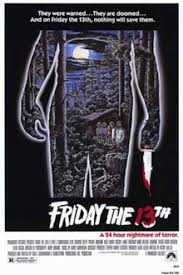
Friday the 13th (1980)

FRIDAY THE 13TH (1980).jpg

FRIDAY THE 13TH (1980) One-and-a-half stars

Of all the horror movies over the decades that have been labelled “classic,” FRIDAY THE 13TH is the one arguably least deserving of that label.

Plain and simple, it’s a bad movie. One-dimensional characters, corny dialogue that even makes references to much much much better movies like CASABLANCA, filler scenes, and perhaps the least convincing mass murderer in screen history are some of its crimes against cinema.

Harry Manfredini’s musical score derived from PSYCHO and JAWS and Tom Savini’s make-up and special effects are both very good, and their work earns the film one half-star each.

I can only see FRIDAY THE 13TH being considered a classic if you count all the sequels and imitations.

My personal favorite FRIDAY THE 13TH movies are PART III, THE FINAL CHAPTER (perhaps the most schizophrenic movie ever made, a cross between leering teenage sex comedy and brutal violence), and JASON LIVES. They succeed more at having a sense of humor and a sense of fun than all the other installments. The rest of the movies all have their isolated moments.

If you have seen the sequels before the original, you might be shocked by the film that started it all. It is very sluggish, at times, and there’s no hockey-masked homicidal maniac in the middle of the mayhem.

Sean Cunningham (director) and Victor Miller (screenwriter) made FRIDAY THE 13TH to cash in on HALLOWEEN, which earned $60-70 million on a $300,000 budget. When there’s an unexpected runaway success like that, naturally the clones and variations start appearing in droves and they did after HALLOWEEN for at least five years.

Cunningham and Miller worked together previously on a family film called MANNY’S ORPHANS, released nearly two months before HALLOWEEN. Cunningham began with adult movies THE ART OF MARRIAGE and TOGETHER, produced Wes Craven’s THE LAST HOUSE ON THE LEFT, and directed a sexploitation comedy named CASE OF THE FULL MOON MURDERS before consecutive family pictures in 1978.

In other words, he saw FRIDAY THE 13TH as the way to make inroads in the brutal movie business. Honestly, who could blame Cunningham, especially as many others had a similar brainstorm.

Cunningham, of course, lacked the finesse and skill of HALLOWEEN director-writer-composer John Carpenter. FRIDAY THE 13TH does benefit, however, from its own low budget production — $550,000 — so it is effective in fits and starts despite itself. It is far more of an exploitation film than HALLOWEEN, and proved nearly as profitable. We saw FRIDAY THE 13TH movies in every year of the 1980s except for 1983 and 1987.

What FRIDAY THE 13TH did was establish a campground setting, add more corpses, er, characters, and amplify the gore, elements that quickly became the norm for an onslaught of “dead teenager” movies. Like virtually every horror movie since CARRIE (1976), it also has one final jump scare. The sequels — namely PART 2, THE FINAL CHAPTER, and THE NEW BEGINNING — upped the nudity and sex quotient. (FRIDAY THE 13TH fans should check out Mario Bava’s BAY OF BLOOD, a 1971 film that undoubtedly influenced the first two FRIDAY THE 13TH installments. If you’ve not seen the Bava film before, you might be surprised. It’s also much better than any of the FRIDAY THE 13TH movies.)

The original FRIDAY THE 13TH exists in that post-HALLOWEEN storytelling mode, where there’s a prologue detailing terrible events that happened in the past and will dovetail with the events of the present. Just about every horror film made after HALLOWEEN includes a bloody, sordid back story.

In FRIDAY THE 13TH, we head back in time to Friday, June 13, 1958, Camp Crystal Lake, when camp counselors Barry and Claudette sneak inside a storage cabin for a little lovin’ and they are murdered. We come to find out that one year before, a 11-year-old boy named Jason Voorhies apparently drowned in Camp Crystal Lake, due to negligent camp counselors.

You could build a nifty little collection of these back story / terrible event in the past scenes.

Let’s see, HALLOWEEN began on Halloween 1963 with 6-year-old Michael Myers killing his older sister Judith.

In PROM NIGHT, it’s 1974 when 11-year-olds Wendy, Jude, Kelly, and Nick cause the accidental death of 10-year old Robin.

In TERROR TRAIN, a sexual initiation prank at a college fraternity’s New Year’s Eve party leads a young man named Kenny to become traumatized and committed to a psychiatric hospital.

In THE BURNING, it’s a fiery prank on a cruel, alcoholic summer camp caretaker named Cropsy that leads to five years in the hospital before his release and revenge.

MY BLOODY VALENTINE waits a bit to spring its 20 years ago flashback story on us.

Anyway, you get the point.

Steve Christy (Peter Brouwer) decides that he will reopen a renovated Camp Crystal Lake. That’s his big mistake, one that results in eight deaths — seven of them Christy and his staff — on Friday, June 13, 1979.

Final Girl Adrienne King does have a great scream and some of the same wholesome All-American appeal as Jamie Lee Curtis. We also find out that she’s very talented at making coffee. Alice Hardy is virtually the only likable character among the lot, although we’re aghast that she ever had a love affair with the creepy Steve Christy. Girl, what were you thinking? There goes the whole idea of the Final Girl being a virgin.

As far as the boys go, Kevin Bacon later became a big star but he’s not around long in FRIDAY THE 13TH. Harry Crosby, son of the legendary actor and singer Bing (1903-77), attended the London Academy of Music and Dramatic Art and earned his MBA from the Fordham Graduate School of Business Administration before becoming a successful investment banker. Anyway, he’s killed in FRIDAY THE 13TH.

That all leads us to Mrs. Pamela Voorhees, played by Betsy Palmer (1926-2015), who we find out committed all the murders in a final act reveal. This middle-aged, albeit crazy, middle-aged lady, who at first seems like a kindly middle-aged lady, created all that mayhem. Early in this review, I called Mrs. Voorhees “perhaps the least convincing mass murderer in screen history” and I stand behind that claim. I just don’t believe that she could have accomplished such murderous feats, especially as she begins her attack on Alice by slapping her silly. Palmer brings on the camp — as in campy — during her screen time.

Film critic Gene Siskel (1946-99) hated FRIDAY THE 13TH so much that he first gave away the movie’s reveal and Palmer’s fate and then he provided the addresses for the chairman of the board of Gulf & Western Industries (who owned Paramount back then) and Palmer. Siskel rated FRIDAY THE 13TH “no stars.”

Palmer herself thought very little initially of the film and took on the assignment so she could buy a Volkswagen Scirocco. She called the script “a piece of shit” and she thought no one would go see FRIDAY THE 13TH.

In her later years, Palmer embraced the film and the role.

Nowadays, the next FRIDAY THE 13TH might be a documentary on the legal copyright battle between Miller and Cunningham.

As of Oct. 19, 2019, 655 folks have signed the change.org petition “Victor Miller & Sean Cunningham, End The Lawsuit and Work Together To Let Jason Live Again.”

The petition reads, “We, the fans of Friday the 13th ask both Victor Miller, Sean Cunningham along with Horror Inc to end the lawsuit and find resolution over the copyright claim by working together.

“Allowing the battle to take place in court helps no one, especially not the fans of the series. Relying on a courts decision will take years with neither side truly profiting within that time frame. Even after the courts decision one side will likely appeal the case and that will lead to even more years of not profiting on the franchise.

“By coming to a mutual agreement you both compromise and get something you want. You find common ground and you can work together to profit both sides. You’d also be supporting the fans that have supported you and the franchise for so many years. We want to continue to watch the franchise grow under your direction. Please support us as we have supported you. Thank you.”

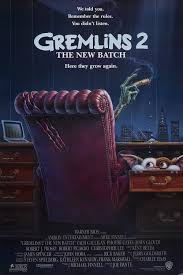
Gremlins 2: The New Batch (1990)

GREMLINS 2

GREMLINS 2: THE NEW BATCH (1990) Four stars

I watched GREMLINS 2: THE NEW BATCH for the first time sometime that summer after it first attacked multiplexes on June 15, 1990.

I wanted to see it badly, since I absolutely loved the original GREMLINS and felt hyped up additionally by the TV ads. I saw it at the Pittsburg 8 during a calendar year (1989-90) that brought multiplex trips to BATMAN, BACK TO THE FUTURE PART II, PARENTHOOD, and TEENAGE MUTANT NINJA TURTLES.

GREMLINS 2 did not let me down, I loved it then and I love it now after having seen it several times, and it has remained one of the most pleasurable multiplex experiences of my life. It’s lingered in my head all these years.

For example, every time since watching GREMLINS 2, when I hear Frank Sinatra’s “New York, New York,” I cannot help but replace it with the Gremlins’ grand production number inside my head. Watching the horribly overrated SHAME (2011) quite a few years back, I wished that GREMLINS 2 and SHAME were spliced together and the little beasties would ruin Carey Mulligan’s showcase rendition.

I’ve heard that GREMLINS 2 is an acquired taste and that you have to be in a certain mood to watch it. Well, I can say that I have acquired that taste and I don’t know, I’m always in the mood to watch a good movie.

“Silly rather than scary like the first GREMLINS” is the verdict on GREMLINS 2 and what people really mean when they spew the party line about being in that certain mood.

— GREMLINS 2 is a running commentary on sequels — everything from merchandising to an endless supply of new characters to sharp but affectionate jabs at the rules of the GREMLINS world and movie sequels in general.

It attempts to be an anti-sequel.

“When I was asked to do the sequel, which I originally turned down because it was so hard to make the first one,” director Joe Dante said in a 2015 interview. “The only reason I decided to make the sequel was because years later they had tried to make a sequel and couldn’t figure out how to do it, and they really wanted another one. So they said to me, ‘If you give us a couple of cans of film with gremlins in them next summer, you can do whatever you want.’ And they gave me three times the money we had to make the first one. So I made GREMLINS 2, which was essentially about how there didn’t need to be a sequel to GREMLINS.”

— We all know the three rules from GREMLINS: Don’t get them wet; Don’t expose them to bright light (especially sunlight, it will kill them); Don’t feed them after midnight.

Naturally, in GREMLINS 2, supporting characters in a control room challenge the hero Billy after he shares the rules.

“What if one of them eats something at 11:00, but then he gets something stuck in his teeth?”

“Like a caraway seed or a sesame seed?”

“And after 12:00, it comes out. Now, he didn’t eat that after midnight.”

It goes on.

“Wait, what if they’re eating in an airplane and they cross a time zone? I mean, it’s always midnight somewhere.”

I am sure many of us asked the burning question, “Isn’t it always after midnight?”

— Mr. and Mrs. Murray Futterman, whom we all thought met their demise in GREMLINS, return for the sequel. That guy Dick Miller (1928-2019) and Jackie Joseph (born 1933) reprise their roles, partly because it’s a Joe Dante movie and what’s a Joe Dante movie without Dick Miller.

— GREMLINS sparked much controversy over its ‘PG’ rating and parents complained about the film, a fact incorporated into GREMLINS 2.

From a 1984 article in The Christian Science Monitor, “Recent releases such as INDIANA JONES AND THE TEMPLE OF DOOM and GREMLINS have spurred controversy about their PG ratings. Many parents felt the violent content and some of the special effects warranted a stiffer rating. A significant number of directors, producers, and theater owners agreed and pushed for a change.”

Hence, the PG-13 rating was born and it debuted with the release of RED DAWN on Aug. 10, 1984.

— Film critic Leonard Maltin, a fan of Dante and his work, gave a negative review to GREMLINS.

“A teenager’s unusual new pet spawns a legion of vicious, violent monsters who turn picture-postcard town into living hell. Comic nightmare is a cross between Capra’s IT’S A WONDERFUL LIFE and THE BLOB; full of film-buff in-jokes but negated by too-vivid violence and mayhem.”

Maltin then makes a gratuitous cameo appearance in GREMLINS 2, where he’s mauled by the new batch for his negative review of the original film. Maltin’s famous last words, “Ow. I was just kidding. Ah. It’s a 10. It’s a 10.”

— At one point in GREMLINS 2, the title monsters disrupt their own film and it takes a threat from Hulk Hogan to get the picture back on track. …

“Okay you guys, listen up! People pay good money to see this movie! When they go out to a theater they want cold sodas, hot popcorn, and no monsters in the projection booth! Do I have to come up there myself? Do you think the Gremsters can stand up to the Hulkster? Well, if I were you, I’d run the rest of GREMLINS 2! Right now! Sorry folks, it won’t happen again.”

— Phoebe Cates became famous predominantly for two scenes: doffing her bikini top to the tune of the Cars’ “Moving in Stereo” in FAST TIMES AT RIDGEMONT HIGH and her ‘Why I hate Christmas’ speech in GREMLINS. In GREMLINS 2, Cates’ Kate starts on a speech why she also hates Lincoln’s birthday.

— GREMLINS and GREMLINS 2 main protagonist Billy Peltzer’s inept inventor father Rand (Hoyt Axton) played a pivotal role in the first movie. Rand Peltzer gets an upgrade in GREMLINS 2. We get eccentric billionaire Daniel Clamp (John Glover), a combination of Donald Trump and Ted Turner, whose technological innovations inside his wonderful Clamp Tower never seem to work properly. I get a kick from the building announcements, for example “Tonight, on the Clamp Cable Classic Movie Channel, don’t miss CASABLANCA, now in full color with a happier ending.”

The title characters take over Clamp Tower, creating all sorts of memorable scenes.

— I should perhaps mention the diabolical Dr. Catheter (Christopher Lee), identical twins Martin and Lewis played by identical twin actors Don and Dan Stanton, Grandpa Fred (Robert Prosky) clearly inspired by Grandpa (Al Lewis) from “The Munsters,” the appearance of the Batman logo, and a talking Gremlin named Brain (voiced by Tony Randall) who gets an opportunity to sum up the ethos of the beasts.

“The fine points: diplomacy, compassion, standards, manners, tradition … that’s what we’re reaching toward. Oh, we may stumble along the way, but civilization, yes. The Geneva Convention, chamber music, Susan Sontag. Everything your society has worked so hard to accomplish over the centuries, that’s what we aspire to; we want to be civilized.”

Of course, in the very next moment, Brain takes out his gun and shoots dead a goofy acting Gremlin.

Civilization is very hard to come by.

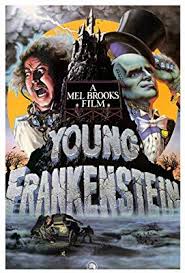
Young Frankenstein (1974)

YOUNG FRANKENSTEIN

YOUNG FRANKENSTEIN (1974) Four stars

Over a 20-year period from the late ‘60s to the late ’80s, Mel Brooks directed a series of inspired comedies: THE PRODUCERS, THE TWELVE CHAIRS, BLAZING SADDLES, YOUNG FRANKENSTEIN, SILENT MOVIE, HIGH ANXIETY, HISTORY OF THE WORLD PART I, and SPACEBALLS.

I’ll choose YOUNG FRANKENSTEIN as his best (i.e. my favorite) work.

It’s not his funniest work, per se, but you could put it on a DVD following FRANKENSTEIN, BRIDE OF FRANKENSTEIN, SON OF FRANKENSTEIN, and THE GHOST OF FRANKENSTEIN and it would be perfect. In fact, YOUNG FRANKENSTEIN nearly gives you the feeling that it’s a lost classic from Universal Studios during their reign of terror.

Brooks and co-writer and star Gene Wilder obviously loved Universal classics like FRANKENSTEIN. Brooks’ last feature film, DRACULA: DEAD AND LOVING IT, came in 1995, so Brooks took on Universal’s two most legendary monsters.

We can be sure the big boys at 20th Century Fox did not want YOUNG FRANKENSTEIN made in black & white. Some folks are guaranteed to say, “Black & white will never work again,” but what about every time it has worked over the years.

Wilder and Brooks based their characters on Mary Wollstonecraft Shelley’s original classic novel. They might as well have credited the screenwriters for the old Universal FRANKENSTEIN pictures.

All the technical people deserve their fair share of the credit for YOUNG FRANKENSTEIN: John Morris’ musical score, Gerald Hirschfeld’s cinematography, John C. Howard’s editing, Dale Hennesy’s production design, Robert De Vestel’s set decoration, Dorothy Jeakins’ costume design, and Edwin Butterworth’s, Mary Keats’, and William Tuttle’s work in the makeup department.

YOUNG FRANKENSTEIN benefits from using some of the same sets the original FRANKENSTEIN used.

Beyond the overall look and style of the picture, though, both the performances and the jokes are their usual grab bag that’s found in a Mel Brooks film.

Wilder’s obits called him “A Master of Hysteria” and he gave some of his defining performances in Mel Brooks comedies, namely THE PRODUCERS, BLAZING SADDLES, and YOUNG FRANKENSTEIN. There’s even the legendary “I’m hysterical and I’m wet” scene in THE PRODUCERS. Honestly, though, I prefer Wilder when he’s more calmer, more restrained and that patented hysteria did not work as well in his later pictures.

Wilder’s hysteria fits Dr. Frederick Frankenstein, the grandson of Victor Frankenstein, because British actor Colin Clive (1900-37) specialized in a bit of hysteria in FRANKENSTEIN and BRIDE OF FRANKENSTEIN.

Brooks himself does not appear as a main character in YOUNG FRANKENSTEIN, which differentiates it from later Brooks productions like SILENT MOVIE, HIGH ANXIETY, and HISTORY OF THE WORLD PART I.

Marty Feldman (1934-82) was perfect for the role of Igor (pronounced “EYE-gore”), Frankenstein’s hunchback compadre. Madeline Kahn (1942-99), Cloris Leachman, and Teri Garr insure that it’s not all about the boys — Kahn eventually makes a perfect bride for The Monster after being engaged to Frankenstein, Leachman plays a character and a name (Frau Blucher) loved by horses, and Garr’s cleavage deserves its own screen credit. Kenneth Mars’ police inspector Hans Wilhelm Friedrich Kemp calls to mind Dr. Strangelove in addition to his FRANKENSTEIN precursors. Gene Hackman makes a cameo as the blind hermit who befriends The Monster.

That brings us to The Monster, played by the great character actor Peter Boyle (1935-2006). I’ll make a case for Boyle being the second best actor to play The Monster, behind only the immortal Boris Karloff (1887-1969) who initiated the role. Boyle definitely gives a better performance than his TAXI DRIVER co-star Robert DeNiro did as “The Creation” in Kenneth Branagh’s MARY SHELLEY’S FRANKENSTEIN (1994). Of course, Boyle is the only Monster required to perform a soft-shoe number and he enjoys a domestic life.

Brooks practiced “saturation comedy,” a style where the jokes fly past fast and furious. It’s been said to not worry if you missed one joke because another one will be coming any moment. Brooks’ comedies are not quite as saturated as the works of the Zucker Brothers and Jim Abrahams during AIRPLANE!, TOP SECRET!, and THE NAKED GUN, which have jokes in virtually every inch of the frame. Saturation comedies are special because they believe in the intelligence of the audience, that we’re smart enough to get the jokes.

I’ll say that my favorite moment in YOUNG FRANKENSTEIN involves a revolving bookcase.

Re-Animator (1985)

RE-ANIMATOR

RE-ANIMATOR (1985) Four stars

Watching director Stuart Gordon’s feature debut for the first time in a theater and the first time in a couple years, I became impressed all over again by a horror movie that’s so gory and gross that it crosses over from gory and gross into surreal and comical.

DAWN OF THE DEAD (1978) and EVIL DEAD II (1987) are two more examples.

I also became impressed once again by the performances of Jeffrey Combs as Herbert West and the late David Gale as Dr. Carl Hill. Their work helps elevate RE-ANIMATOR.

I absolutely love Combs’ performance in RE-ANIMATOR. West’s a mad scientist pushed to the absolute limit of madness, but he’s not the least bit campy. He’s intense and 1,000 percent committed to his life’s work. West never waivers from this intensity, not even in the face of death or being kicked out of medical school. Mr. West has developed a reagent that can re-animate dead bodies, and his experiments graduate from a house cat to humans. West will see it through.

The poster’s tagline: “Herbert West has a good head on his shoulders … and another one on his desk.”

That another one belongs to Dr. Hill, whose ego and libido are epic and legendary.

Gale (1936-91) plays Dr. Hill in sleaze mode. This is a character that you absolutely love to hate. You want to see him bashed over the head with that shovel, but you also enjoy when his disembodied head takes command over the rest of his body and then takes control of the situation against West and his reluctant partner Dan Cain (Bruce Abbott). West hates Dr. Hill from the get-go and it’s fun to watch their mutual hatred for each other develop over RE-ANIMATOR.

Dr. Hill lusts after both Cain’s fiancee Megan (Barbara Crampton) and West’s reagent, and his intense lusting only makes this character even more hatable.

Crampton plays a tougher role than any of the boys: She gasps and screams a lot, understandably so, and she’s naked a couple times, including for one of the most interesting sex scenes around since it alternates between disturbing and comical. Let’s just say the disembodied head of Dr. Hill attempts to carry out his depraved sexual fantasies.

RE-ANIMATOR follows Mr. West and Dr. Hill into some ripped, twisted territory, but it’s also delightfully funny.

In a review of AN AMERICAN WEREWOLF IN LONDON, I rattled off a bunch of titles from the 80s that effectively balanced horror and comedy: EVIL DEAD II, FRIGHT NIGHT, GREMLINS, GHOSTBUSTERS, KILLER KLOWNS FROM OUTER SPACE, and, yes, of course, RE-ANIMATOR.

Those films carry on the proud tradition of the great 1930s horror films that successfully integrated comedy into horror, without one sacrificing the other. You can laugh one moment and be frightened the next, or delighted that next moment, all legitimate reactions.

Guess it’s the highest praise for RE-ANIMATOR when you say that it could have been directed by James Whale (1889-1957), who brought us FRANKENSTEIN, THE OLD DARK HOUSE, THE INVISIBLE MAN, and BRIDE OF FRANKENSTEIN.

The Blob (1958)

THE BLOB 2

THE BLOB (1958) Four stars

Watching the original BLOB just the other day, once again it hit me how much THE BLOB seems to be influenced by the 1955 classic REBEL WITHOUT A CAUSE.

THE BLOB leads Steven McQueen and Aneta Corseaut respectively call to mind James Dean and Natalie Wood (McQueen even a few years older than Dean playing a high schooler), there’s a more friendly policeman in both films (Ray in REBEL WITHOUT A CAUSE, Dave in THE BLOB), and they both are iconographic time capsule films that appeal to all generations.

Plain and simple, THE BLOB is a goofy, ridiculously fun time at the movies.

It sets the tone with that glorious theme song over the opening credits — “Theme from the Blob” by the Five Blobs and it’s a real catchy little ditty written by Burt Bacharach and Mack David. It sure beats “Raindrops Keep Falling on My Head.”

“Beware of the Blob, it creeps

And leaps and glides and slides

Across the floor

Right through the door

And all around the wall

A splotch, a blotch

Be careful of the Blob.”

What’s the Blob? A modified weather balloon in early shots and colored silicone gel in later shots. From outer space.

It’s also been compared to cherry Jell-O.

THE BLOB was inspired by a real event that happened in  1950 Philadelphia. The Philadelphia Inquirer headline on Sept. 27, 1950: FLYING ‘SAUCER’ JUST DISSOLVES. Joe Keenan and John Collins, a pair of veteran police officers who probably both thought they had seen just about everything before the night in question, spotted a mysterious object falling from the sky, of course, just like in THE BLOB and KILLER KLOWNS FROM OUTER SPACE, for that matter. They pursued this mysterious object and eventually encountered a large mass which they described as “purple jelly.” Collins decided that he would reach out and touch the mysterious object … by that point, backup (two more officers) had arrived, so four policemen were taking on the case. Collins had much better luck than the old man at the beginning of both ’58 BLOB and ’88 BLOB. He survived. Within 30 minutes of the first sighting, this blob-like object disappeared. The police told their story to the local media the next day, and the rest is history.

Made for $240,000 (though numbers vary, as low as $110,000 has been reported), THE BLOB predates later George Romero horror films made in Pennsylvania.

THE BLOB filmed at Valley Forge Studios — destroyed by a fire in 1962 — and the towns of Phoenixville, Downingtown, Chester Springs, and Royersford. These locations give THE BLOB an unique flavor and I do enjoy how eventually young and old alike work together to defeat the monster.

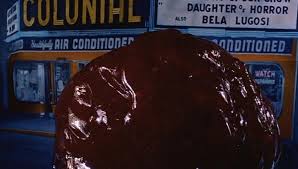
Phoenixville (2018 estimated pop.: 16,957) features the historic Colonial Theatre, one of the town’s claims to fame. Since 2000, Phoenixville and the Colonial commemorate THE BLOB with the annual “Blobfest.” The 21st edition will be held July 10-12, 2020. Every year, of course, they reenact the famous run out from the Colonial when the title character attacks. In addition to THE BLOB, FORBIDDEN PLANET and TEENAGERS FROM OUTER SPACE will be featured in 2020.

(BTW, Phoenixville ranks in the top 10 in the U.S. in breweries per capita. Let’s see, there’s Root Down, Crowded Castle, Stable 12, Rebel Hill, Rec Room, Iron Hill, Sly Fox, Baba’s Brew, A Culture Factory, Stickman Brews, Tuned Up, Steel City, et cetera, on the map.)

It just doesn’t get much better than when the title character attacks The Colonial during DAUGHTER OF HORROR, a real movie that’s the altered version of the 1955 movie DEMENTIA. The Kino Video DVD cover highlights three great reviews for DEMENTIA. Variety: “May be the strangest film ever offered for theatrical release.” Preston Sturges: “A work of art. It stirred my blood and purged my libido.” New York Censor Board: “Overflows with horror, hopelessness, sadism, violent acts of terror and outbursts of panic.”

Anyway, the Blob hates the cold. In that case, though, the Colonial must not have been too “Healthfully Air Conditioned,” because the Blob seems to thrive as it engorges the poor projectionist and heads into the auditorium.

Sometimes, during a bad bad bad movie at the multiplex, I’ve wanted the Blob to strike our screen and send us running.