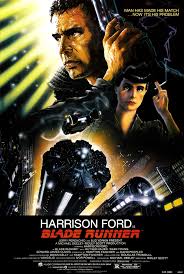
Blade Runner (1982)

BLADE RUNNER

BLADE RUNNER (1982) Four stars

Rutger Hauer’s death at the age of 75 brought me back a day later to BLADE RUNNER, one of the key movies in understanding the cinema of the last four decades.

It seems ironic that Hauer died in 2019, the same year as his character in BLADE RUNNER.

I can’t believe I’ve never written in detail about BLADE RUNNER, which has long been my No. 5 favorite movie of all-time behind CITY LIGHTS, DUCK SOUP, FREAKS, and TAXI DRIVER. Well, now is just as good a time as any to change that.

Watching the theatrical version from 1982, seeing BLADE RUNNER in any cut for what must have been the 100th time, faces especially stood out.

Title character Rick Deckard (Harrison Ford) as he takes in the death of main replicant Roy Batty (Hauer). We can read many different thoughts going through Deckard’s mind. The theatrical cut articulates it through Decker’s voice-over narration. I’ll get back to the narration later.

Batty throughout, from his entrance to his exit. Hauer’s so damn good that he almost steals the movie from both Ford and the incredible production design.

Batty’s punk pleasure model replicant lover Pris (Daryl Hannah) when she ambushes and assaults Deckard late in the picture.

J.F. Sebastian (William Sanderson) as he bears unfortunate witness to Batty settling his account with his creator Tyrell (Joe Turkel, best known as Lloyd from THE SHINING).

Leon Kowalski (Brion James) as he’s shot dead by replicant and Deckard romantic interest Rachel (Sean Young), just when it seemed Kowalski had Deckard near his demise.

Capt. Harry Bryant (M. Emmet Walsh) and his oily charm, and the enigma of Gaff (Edward James Olmos).

I’ve never exactly understood the criticism leveled at BLADE RUNNER that it’s great to look at but difficult to care about any of the characters.

I wonder if those critics saw the same movie.

I’ve always been moved by the plight of the replicants, the bio-engineered people who are “more human than human.”

The Nexus-6 model of replicants — represented by Batty, Pris, Leon, and Zhora (Joanna Cassidy) — look exactly like your average adult human being, but they have superior strength, speed, agility, resilience, and intelligence, especially combat model Batty. For the protection of the human race, replicants have a four-year life span and were given false memories.

Imagine finding out your childhood never happened.

The cold, hard facts of life.

Indeed.

The replicants bring a wide range of responses.

They’re slave labor off Earth … and illegal on Earth. “Quite an experience to live in fear, isn’t it? That’s what it is to be a slave.”

They’re at least complex villains, if they’re even the “bad guys.” We can make a strong case for Tyrell being more of a villain.

Then, we have the ambiguous title character who’ll probably always inspire debate: Is or isn’t Deckard a replicant? Ford argues human, director Ridley Scott replicant, but it’s been left for each viewer to determine.

Deckard plays like the detective hero lifted straight from THE BIG SLEEP or CHINATOWN and that comes across even more in the theatrical version with Ford’s gruff narration explicitly putting over Deckard’s world-weary cynicism.

Deckard gets no pleasure from his job “retiring” replicants. And the narration makes Deckard sound like he’s just woke up from a long hangover. (Ford’s hatred of the narration could not be more obvious.)

Later releases excised the voice-over narration, a device the executives wanted to make the film seem less confusing.

I watched the 1992 Director’s Cut first and so it took some adjustment to the narration. I find it works, except for one scene very late in the film where it’s sheer overkill. I mean, try it out:

“I don’t know why he saved my life. Maybe in those last moments he loved life more than he ever had before. Not just his life — anybody’s life; my life. All he’d wanted were the same answers the rest of us want. Where did I come from? Where am I going? How long have I got? All I could do was sit there and watch him die.” Do we need that? No.

That brings us to Batty’s final speech, “I’ve seen things you people wouldn’t believe. Attack ships on fire off the shoulder of Orion. I watched C-beams glitter in the dark near the Tannhauser gate. All those moments will be lost in time … like tears in rain … Time to die.”

In a sports column way back in 2012, I called Batty’s final speech my favorite movie dialogue.

In office conversation about this column, the late, great Morning Sun writer Nikki Patrick said that Hauer improvised Batty’s speech.

That made the speech even greater and Nikki even cooler.

The Marx Brothers & The Three Stooges

THE MARX BROTHERS & THE THREE STOOGES

Before Elvis and Chuck Berry, the Beatles and the Stones, Zeppelin and the Who, the Clash and the Sex Pistols, Nirvana and Pearl Jam, Woody Allen and Mel Brooks, Richard Pryor and George Carlin, Monty Python and Benny Hill, David Letterman and Jay Leno, and Jay and Conan, there was Buster Keaton and Charlie Chaplin, yes, but also the Marx Brothers and the Three Stooges.

There seems to be a notion that you can’t like both the Marx Brothers and the Three Stooges, and that you have to choose one over the other and the twain shall never meet.

I call bullshit on that notion.

There’s room for both in this mad, mad, mad, mad world.

However, I will admit upfront a preference for the Marx Brothers.

Granted, at the age of 8 through 10 or 11, I absolutely loved the Three Stooges and I learned only of the Marx Brothers from a scene in GOOD MORNING, VIETNAM. For a period of time on the school bus, my two cousins and I pretended that we were the Three Stooges and I played the Moe role. For many years after that obsessive period, though, I barely paid the Three Stooges a bit of attention. I don’t know, like fart jokes, they just seemed precisely like something that you instinctively move beyond as you get older and mature. I’ve revisited the Three Stooges’ work recently, though, and I’ve found enjoyment in them once again.

During college, I discovered the Marx Brothers and DUCK SOUP (1933) became one of my favorite all-time movies and Groucho Marx’s Rufus T. Firefly one of my favorite all-time characters. The Marx Brothers influenced my sense of humor tremendously, Groucho especially, and I don’t know how many co-workers or women I flirted with ever picked up any of the distinctive Marxist vibes.

I once argued with a college professor that DUCK SOUP retained value in the 21st Century because there’s still pompous jerks around who need to be deflated, not that I would have ever thought of naming that particular college professor as one.

In the end, I’ll choose Marxist anarchy over Stoogian anarchy because I prefer absurdist verbal wit over slapstick brutality.

The Marx Brothers paved the road for Mel Brooks, Woody Allen, Monty Python, Rodney Dangerfield, Bill Murray, Dan Aykroyd, Peter Sellers, Carl Reiner, Robin Williams, AIRPLANE!, Borat, Bugs Bunny, and “South Park.” Their influence extended to music — you cannot tell me their satirical and sartorial choices in military dress at the end of DUCK SOUP did not have an impact on the “Combat Rock” era Clash, Queen named two of their albums after Marx Brothers spectaculars (A NIGHT AT THE OPERA, A DAY AT THE RACES), and Alice Cooper and Groucho reportedly became good friends late in Groucho’s life. Groucho died in 1977, a year that also included the deaths of Elvis Presley and Charlie Chaplin (Elvis and Groucho separated by a mere three days in August 1977). The Ramones also had that great song “I’m Against It” on 1978’s ROAD TO RUIN, itself a reference to Hope and Crosby.

The Three Stooges influenced Sam Raimi, John Hughes, John Landis, John Belushi, John Candy, Chris Farley, the Farrelly Brothers, Mel Gibson, SMOKEY AND THE BANDIT, and wherever violent slapstick can be found in animation or live-action.

Now, I present 10 Marx Brothers and Three Stooges classics, five from each comedic team.

It should be duly noted the Marx Brothers starred in feature-length pictures (13 from 1929 to 1949) and the Three Stooges produced shorts (190 from 1934-1959).

HORSE FEATHERS (1932) — You don’t have to attend college for 10 years to appreciate HORSE FEATHERS. Oh, it definitely helps, don’t get me wrong. I must say I adopted Groucho’s opening song “I’m Against It” as my credo during college (I didn’t give a hoot that I had no son during the song adoption process): “I don’t know what they have to say / It makes no difference anyway / Whatever it is, I’m against it / No matter what it is or who commenced it / I’m against it / Your proposition may be good / But let’s have one thing understood: Whatever it is, I’m against it / And even when you’ve changed it or condensed it / I’m against it / I’m opposed to it / On general principles, I’m opposed to it … For months before my son was born / I used to yell from night till morn / ‘Whatever it is, I’m against it’ / And I’ve been yelling since I first commenced it / I’m against it.” I just now realized that “I’m Against It” as credo may have been responsible for 10 years of college. I met a lot of Connie Baileys during college, and they for sure were not “college widows,” but, yeah, everyone still says ‘I love you.’

DUCK SOUP (1933) — I don’t know how many damn times I’ve laughed myself silly at this damn movie. I just love how Groucho comes out firing innuendos and witticisms from the get-go and I’ve used several of them in real life like “I could dance with you till the cows come home. On second thought, I’d rather dance with the cows till you came home” and “[Fill in the blank] here may talk like an idiot and look like an idiot. But don’t let that fool you. He really is an idiot.” I must say that I always wanted to conduct official business at staff meetings just like Groucho’s Rufus T. Firefly does in the darkest chamber of Freedonia, especially the business about new and old business and the workers demanding shorter hours. DUCK SOUP upset Benito Mussolini and flopped at the box office, precipitating the brothers’ move from Paramount to MGM and the loss of one brother (Zeppo) from their movies. That’s what you get for truly being ahead of your time. DUCK SOUP is all killer, no filler Marx Brothers madness, and earns the highest (second highest) recommendation.

PUNCH DRUNKS (1934) — Moe Howard, Larry Fine, and Curly Howard starred together in 97 short films from 1934 to 1947, and there were many, many more featuring different Stooge permutations for Columbia Pictures. In their second production, Moe’s a struggling boxing manager, Curly’s a shy waiter, and Larry’s a fiddler. Curly turns into the world’s greatest heavyweight boxer, though, under the influence of the tune “Pop Goes the Weasel.” Rosin up that bow, Larry, and say ‘Bye, Curly, hello, K.O. Stradivarius.’ We can understand the effects of “Pop Goes the Weasel” in 1934 through later songs. In the late-1960s, for example, it’d have been the MC5’s “Kick Out the Jams.” In the early 1980s, Motorhead’s “Ace of Spades” or AC-DC’s “Hells Bells.” In the early 2000s, Drowning Pool’s “Bodies” would’ve perfectly suited a PUNCH DRUNKS remake. Personally, over the years, I’ve found much therapeutic value in such lovely, lilting songs as the Stooges’ “Search and Destroy,” the Clash’s “Cheat,” and the Misfits’ “Where Eagles Dare.”

MEN IN BLACK (1934) — Before Tommy Lee Jones and Will Smith, there was Doctor Howard, Doctor Fine, and Doctor Howard hot off the heels of PUNCH DRUNKS in this hospital spectacular that puts “Laughter is the Best Medicine” to the ultimate test. I know it was during the Great Depression, but one should consider how much dire straits a hospital must have been in to call on Doctor Howard, Doctor Fine, and Doctor Howard. MEN IN BLACK spoofs on the Clark Gable and Myrna Loy film MEN IN WHITE, which earned the distinction of being one of the first films condemned by the Legion of Decency. MEN IN BLACK competed against winner LA CUCARACHA and WHAT, NO MEN! for Best Short Subject – Comedy at the Academy Awards, the Three Stooges’ lone nomination in this category. The Three Stooges worked the broken glass running gag better than BETTER OFF DEAD (1985).

HOI POLLOI (1935) — Greek rooted phrase “Hoi polloi” means the masses or the common people, and elitist snobs use it derisively for people they believe are beneath them. Some pompous fools might even say the Three Stooges are “hoi polloi” or lowest common denominator entertainment. You might remember the good old “Nature vs. Nurture” discussion from school or at least TRADING PLACES when Ralph Bellamy and Don Ameche placed their bets on Dan Aykroyd and Eddie Murphy. Nature argues that genes and hereditary factors determine human behavior, whereas nurture centers around childhood experiences and how individuals are raised. Many great minds — from John Locke to Steven Pinker — have entered the dialectical fray in the last say 400 years, but the work of Doctor Howard, Doctor Fine, and Doctor Howard should not be neglected in the halls of history. HOI POLLOI is their 18-minute dissertation, replete with those patented Three Stooges slaps, eye pokes, head conks, and nose honks. Believe that’s even the name of a 1-minute, 42-second YouTube clip. There’s also some real good dancing in HOI POLLOI, and it left me with the urge to listen to Pulp’s or William Shatner’s “Common People.”

NIGHT AT THE OPERA, A (1935) — MGM producer Irving Thalberg (1899-1936) made sure the Marx Brothers were more “commercial” and “normal” after their five anarchic pictures at Paramount — especially DUCK SOUP — failed. A NIGHT AT THE OPERA, their MGM debut, gives us less Groucho, Chico, and Harpo and more standard romantic leads Allan Jones (not an improvement from Zeppo, who was a perfect parody of this kind of leading man) and Kitty Carlisle. We don’t want this romantic carp, er, crap, er, carp anywhere near our Marx Brothers madcap antics and wasn’t this a betrayal for our boys? For crying out loud, at the end of DUCK SOUP, all four Marx Brothers pelt Margaret Dumont with fruit when she begins singing a sweet victory song. One picture two years later, our boys embraced opera and let Jones and Carlisle sing their songs. What a letdown! Come on, man, I wish our heroes used fruit on Jones and Carlisle. I wish Zeppo stayed in their act. That said, Groucho, Chico, and Harpo still perform some of their best gags in A NIGHT AT THE OPERA and that’s a must to get somebody who hates opera through 96 minutes of a plot centered around opera.

DAY AT THE RACES, A (1937) — Despite not being the biggest fan of phones in real life, I’ve long been a fan of great telephone scenes in the movies, everything from Ray Milland’s final scene in FROGS (referencing DIAL M FOR MURDER, no doubt) and DR. STRANGELOVE to ONCE UPON A TIME IN AMERICA and IT’S A WONDERFUL LIFE. Groucho’s Dr. Hackenbush gives us a beautiful prank stall call scene and the boys get to ruffle the stuffed shirts of both Leonard Ceeley and Sig Ruman in A DAY AT THE RACES. I’ve always found it easier to get through A DAY AT THE RACES than A NIGHT AT THE OPERA, surely because it’s not opera. Yes, because it’s not opera and I’ll stop calling you Shirley. Allan Jones still needs a pie in the face whenever he opens that pretty boy mouth to sing, but Maureen O’Sullivan — TARZAN movies — proves to be a major upgrade from Kitty Carlisle and this is the MGM picture that most captures the spirit of the Marx Brothers at Paramount.

YOU NAZTY SPY! (1940) — A pioneer in mocking Hitler, well before THE DEVIL WITH HITLER and DER FUEHRER’S FACE and even before Charlie Chaplin’s THE GREAT DICTATOR. YOU NAZTY SPY premiered January 19, 1940, beating Chaplin’s first full-fledged talking picture by 286 days. Moe plays dictator Moe Heilstone, Larry’s propaganda minister Larry Pebble, and Curly’s field marshal Curly Gallstone. At least nobody’s “kidney stone.” After some evil shenanigans by evil cabinet ministers, Moe, Larry, and Curly take over Moronica and prove that old Rufus T. Firefly line true from the start of DUCK SOUP, “If you think this country’s bad off now / Just wait ‘till I get through with it.” The sung laws of Firefly’s administration included the line “Pop goes the weasel,” ironically the ditty featured in PUNCH DRUNKS. Yes, both YOU NAZTY SPY and its follow-up I’LL NEVER HEIL AGAIN could play right alongside DUCK SOUP … in fact, all three could join THE GREAT DICTATOR, TO BE OR NOT TO BE, THE DEVIL WITH HITLER, DER FUEHRER’S FACE, STALAG 17, and THE PRODUCERS in a marathon friendly to fascist dictators. Reportedly, YOU NAZTY SPY was both Moe’s and Larry’s favorite Three Stooges short.

I’LL NEVER HEIL AGAIN (1941) — Moe Heilstone (dictator), Larry Pebble (propaganda minister), and Curly Gallstone (field marshal) return again for this sequel released July 4, 1941, months before the United States’ official entry into World War II. The boys are paired again with director Jules White and screenwriters Clyde Bruckman and Felix Adler, despite the fact their characters were fed to the lions or something disturbing like that in YOU NAZTY SPY. One must wonder if Adolf Hitler and Joseph Goebbels ever came across YOU NAZTY SPY and I’LL NEVER HEIL AGAIN and how exactly they reacted. There’s much debate on whether or not Hitler saw THE GREAT DICTATOR. Chaplin himself wanted to know what Hitler thought of it. There were reports that Moe Howard rushed from the production to his daughter’s birthday party while still being dressed in full-on Hitler. Bet the switchboards in Hollywood went crazy on that one. It predated the mass hysteria in PLAN 9 FROM OUTER SPACE.

NIGHT IN CASABLANCA, A (1946) — German emigre Sig Ruman enjoyed a distinguished career in the films of the Marx Brothers, Ernst Lubitsch, and Billy Wilder and when you Google Sig Ruman you’ll encounter “Sig Ruman Marx Brothers” as keyword very quickly. He appeared in A NIGHT AT THE OPERA, A DAY AT THE RACES, and A NIGHT IN CASABLANCA, finding work in the most temporal Marx Brothers films. He’s like a windup machine that specializes in anger … and the Marx Brothers masterfully wind up that machine. Ruman’s incredible at both the double take and the overreaction. Watching A NIGHT IN CASABLANCA for the first time in several years, Ruman came to mind because he’s so great as the comic villain. Both the Marx Brothers and the Three Stooges needed comic villains, because sure they aggravate virtually everybody in their films but it’s more fun when it’s a comic villain who’s beyond exasperated.

The Marx Brothers: HORSE FEATHERS (1932) Four stars; DUCK SOUP (1933) Four stars; NIGHT AT THE OPERA, A (1935) Three-and-a-half stars; DAY AT THE RACES, A (1937) Four stars; NIGHT IN CASABLANCA, A (1946) Three-and-a-half stars

The Three Stooges: PUNCH DRUNKS (1934) Three-and-a-half stars; MEN IN BLACK (1934) Three-and-a-half stars; HOI POLLOI (1935) Three-and-a-half stars; YOU NAZTY SPY (1940) Four stars; I’LL NEVER HEIL AGAIN (1941) Four stars

The Rocky Horror Picture Show vs. Rock ‘N’ Roll High School

THE ROCKY HORROR PICTURE SHOW VS. ROCK ’N’ ROLL HIGH SCHOOL

I’ve never understood the appeal of THE ROCKY HORROR PICTURE SHOW and how it became the ultimate cult film.

Lord knows I’ve tried, but it’s still neither good nor bad enough to be any good for me.

First time I watched it was late-night TV during my early teenage years. This same late-night program later showed WOLFEN and those are the only two films I can remember watching from that program. (Upon further reflection, I also recall watching HOWARD THE DUCK and THE BREAKFAST CLUB under such circumstances.) Who would have ever guessed that I liked ROCKY HORROR most on this first viewing.

Second time I saw it was part of Starz’ “Midnight Movies” circa 2005. Starz presented a documentary called MIDNIGHT MOVIES based from the book written by film critics J. Hoberman and Jonathan Rosenbaum, then played the movies featured in the doc. I remember watching THE HARDER THEY COME and ROCKY HORROR.

Third time did not prove to be a charm. Two of my ex-girlfriend’s friends could not believe that she had never seen ROCKY HORROR, so they immediately rushed out to the nearest video store and snagged a copy. My ex-girlfriend and I sat there in stunned disbelief at ROCKY HORROR.

The second and third viewings of ROCKY HORROR turned out to be washes and I liked it less each viewing.

I don’t know, I’ve always expected something more outrageous, something more shocking than GREASE in drag.

In fact, I’ve long equated ROCKY HORROR with GREASE: They’re both downright positively absolutely wholesome in dealing with the source material of transgressive art.

Hip to be square, indeed.

Next to FREAKS, BEYOND THE VALLEY OF THE DOLLS, ERASERHEAD, and SHOWGIRLS, for example, ROCKY HORROR especially seems like a lame little song-and-dance picture.

As a social phenomenon, ROCKY HORROR is undeniable.

As a stand-alone film without the cult audience in the living room, it’s not so hot.

Feed me THE LITTLE SHOP OF HORRORS (1986) instead.

Hell, give me ROCK ’N’ ROLL HIGH SCHOOL, a 1979 production from the Roger Corman factory.

It’s a teenage rebellion picture and as the late, great Joey Ramone (1951-2001) once said, we haven’t had one of those since the Revolution. Think he meant the American Revolution, not the Industrial or the Television or the Rocky Horror.

ROCK ’N’ ROLL HIGH SCHOOL benefits greatly from a pair of fun fun fun performances at the heart of the picture: P.J. Soles as Ramones loving Riff Randell, who introduces herself as rock ’n’ roller, and Mary Woronov as the fascist Principal Togar, who’s the type to burn rock ’n’ roll albums and crush any individuality. She’s the Principal of Vince Lombardi High, and Riff Randell is her nemesis. Togar hates the Ramones, and I believe she point blank asks them, “Do your parents know you’re Ramones?”

In her quest to quash rock music, Togar introduces a nifty little device that I don’t remember seeing anywhere else: The Rock-O-Meter, which measures, I do believe, the comparative loudness of rock bands. The meter starts with Muzak at the bottom and proceeds through Pat Boone, Debbie Boone, Donny & Marie, Kansas, Peter Frampton, Foreigner, Jethro Tull, Led Zeppelin, Ted Nugent, the Rolling Stones, the Who, and, finally, the Ramones at the very top. Yeah, it’s a long way to the top, if you wanna rock ’n’ roll. When you reach that level, it’s not a good time to be a lab mouse (it’s just as bad as being a drummer in Spinal Tap).

Oh, it would have been a nifty little joke to have ROCKY HORROR between Donny & Marie and Kansas.

There’s also a role in ROCK ’N’ ROLL for cult film director Paul Bartel (1938-2000), who evolves from a rock ’n’ roll hater to a Ramones lover. It’s a great moment in dance and cinema when Bartel’s Mr. McGree shakes a tail feather to the Ramones’ cover of “Do You Wanna Dance?” after band and students have taken over the halls of Lombardi High.

That guy Dick Miller (1928-2019) shows up late, late in the pic as a scull-cracking would-be fascist police officer. Roger Corman once named Miller “the best actor in Hollywood” and he’s a favorite of fans of flicks like A BUCKET OF BLOOD, GREMLINS and GREMLINS 2, and PIRANHA. Arnold even blew him away in THE TERMINATOR.

Clint Howard plays Eaglebauer, a procurer at Vince Lombardi who sets up shop in a Brownsville Station dream.

Over the years, I began to notice the majority of my favorite movies are blessed with a multitude of great supporting characters and great character actors. BOOGIE NIGHTS and THE BIG LEBOWSKI, for example, leap quickly to mind.

Guess it goes to show the overall quality of ROCK ’N’ ROLL HIGH SCHOOL when I have mentioned five performers — Soles, Woronov, Bartel, Miller, and Howard — and not gone into detail about the Ramones.

Delving into the Ramones’ song catalog became one of the enduring pleasures of my life and their songs from “Beat on the Brat” and “Rockaway Beach” to “Rock ’N’ Roll High School” and “The KKK Took My Baby Away” have earned a place inside my punk rock heart alongside the Clash, the Sex Pistols, the Buzzcocks, et cetera.

It’s the punk rocker (and the antisocial free spirit) inside me that prefers ROCK ’N’ ROLL HIGH SCHOOL over THE ROCKY HORROR PICTURE SHOW.

THE ROCKY HORROR PICTURE SHOW (1975) One-and-a-half stars; ROCK ’N’ ROLL HIGH SCHOOL (1979) Three-and-a-half stars

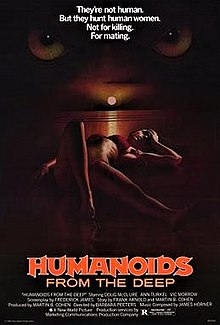
Humanoids from the Deep (1980)

HUMANOIDS FROM THE DEEP

HUMANOIDS FROM THE DEEP (1980) One star
Exploitation film legend Roger Corman loved ripping off / paying homage to JAWS, first with PIRANHA then a couple years later with HUMANOIDS FROM THE DEEP. The great white shark in JAWS and the piranhas did not prey almost exclusively on busty supporting players and extras so this was cinematic evolution at work here.

Yes, these humanoids are horny bastards: They should meet up with the horny aliens from the SPECIES films and we’d have ourselves a party. The humanoids resemble Swamp Thing, only uglier and with no poignant qualities. Do you want a Humanoid from the Deep this Valentine’s Day? They do not take a subtle approach to scoring with the ladies. These humanoids score with busty young women by raping them and leaving almost nothing but a mess behind. Legend has it that Uncle Roger went back in after the director turned in a final cut and shot additional scenes focused on sex and gore. This sounds like CALIGULA or any of the more repugnant Corman productions.

Uncle Roger shows his JAWS hand early on during HUMANOIDS FROM THE DEEP: There’s a child eaten and an explosion in the first 10 minutes of the film, elements of scenes from JAWS and JAWS 2, respectively. Yes, it’s that kind of movie.

In certain sequences, there are jump scares every few moments, soundtracked by gasps, phone calls, and jarring musical score and then we’re brutalized with a “real” scare every so often. These scare tactics backfire miserably.

We have good old Doug McClure as our reluctant proletariat hero, strong working class family man. Just a couple weeks before watching HUMANOIDS I saw McClure survive AT THE EARTH’S CORE. In that classic, he played a fellow named David and Peter Cushing played Doc as we’ll never forget in scene after scene where characters say David and Doc and Doc and David and Doc and David. Here McClure’s Jim and the HUMANOIDS FROM THE DEEP characters do not share the same romance with “Jim.”

A Native American named Johnny Eagle (who would have been played by Will Sampson if the film had a larger budget) opposes the evil shenanigans of a venal capitalist played by Vic Morrow, who’s seeking a cannery deal for the people of Noyo, yes, Noyo. Eagle sounds forewarnings of portentous doom so naturally he’s set up to be a villain and later turns out to be a hero. Oh, sweet irony!

I mean, just once I’d love to see a film with the Native American as the venal capitalist and the white man as the conscientious environmentalist hero. Anyway, Eagle finds a fight without looking too hard and his presence at the Noyo Salmon Festival spawns a horrible fight scene, indicative of white pattern Native American bashing. Luckily, for all of us, a tear did not stain Johnny Eagle’s face.

Of course, Noyo holds a big carnival for its annual Salmon Festival. Nothing and I mean nothing will stop these Noyo yo-yo’s from holding their carnival, not even mutant killer fish slash humans. So, naturally, our Humanoids from the Deep play the role of the spoiler.

For some bizarre reason, this overdrawn attack-massacre sequence brought out fond memories flashing back on a similar overdrawn sequence in GIANT SPIDER INVASION. A lot of humanoids are killed good, a lot of bit players are taken a bite out of by humanoids, and it’s all broadcast over live radio by a disc jockey calling himself “Madman” although he’s not played by real-life DJ Don Steele, who showed up in both DEATH RACE 2000 and ROCK ’N’ ROLL HIGH SCHOOL, as well as GRAND THEFT AUTO.

None of these scenes are remotely entertaining or interesting and that basically describes HUMANOIDS FROM THE DEEP.

Been there, seen that, and please roll the final credits.

Tourist Trap (1979)

TOURIST TRAP


TOURIST TRAP (1979) Three stars

TOURIST TRAP belongs to a rather fine and distinguished horror movie tradition I’ll call “American Gothic” (forget the famous 1930 painting by Grant Wood).

Other films that fit the bill are several Universal productions, Val Lewton productions beginning with CAT PEOPLE, HOUSE OF WAX, PSYCHO, NIGHT OF THE LIVING DEAD, THE LAST HOUSE ON THE LEFT, TEXAS CHAINSAW MASSACRE, EATEN ALIVE, THE HILLS HAVE EYES, and FUNHOUSE. As you can see, directors Wes Craven (1939-2015) and Tobe Hooper (1943-2017) both liked this mode.

“American Gothic” horror films are heavy on atmosphere, whether they’re filmed in black & white or color. They often delight in exposing the darker underbelly of American society after such happenings as the closing of the local slaughterhouse or the roadside wax museum that once existed on the right side of the road before it was bypassed. They sometimes take on the disintegration of the family unit or any number of issues plaguing our society. “American Gothic” films are rich in metaphorical readings.

Since it belongs to such a fine tradition, you’ll be able to recognize TOURIST TRAP right off the bat and see that it’s a dab of HOUSE OF WAX layered on top THE HILLS HAVE EYES or any of the seemingly hundreds of horror movie plots that begin with car trouble and the wrong gas station and end after several deaths.

Later on, you’ll note that it’s also a pinch of PSYCHO and a dash of TEXAS CHAINSAW MASSACRE — Chuck Connors plays wax museum proprietor Mr. Slausen in the grand old Anthony Perkins as Norman Bates style (a hallmark “American Gothic” element)  and production designer Robert Burns worked on both TEXAS CHAINSAW and THE HILLS HAVE EYES.

Just like the Bates Motel had seen better days before PSYCHO, so had Mr. Slausen’s “Slausen’s Lost Oasis.” Nowadays, Mr. Slausen’s wax museum would have been profiled by Roadside America, the guide to “uniquely odd tourist attractions,” and it could have survived and even thrived off this exposure.

If you find wax figures, mannequins, human replicas, et cetera, repellent or they weird you the fuck out, then you will enjoy TOURIST TRAP.

I especially recommend seeing the film before stopping in at Jesse James Wax Museum right off the highway in Stanton, Missouri.

It’s your patriotic duty.

TOURIST TRAP creates a creepy, claustrophobic atmosphere transcendent of the standard issue plot.

From the brilliant opening scene all the way to the bitter end about 90 minutes later, there’s somebody eyeball stalking the protagonists in every scene in TOURIST TRAP.

That somebody’s usually a wax figure, mannequin, human replica, etc., and that’s just creepy, for lack of a better word.

For many years, TOURIST TRAP itself met the fate of “Slausen’s Lost Oasis,” seemingly forgotten and consigned to being a relic of a bygone era of horror movies. Never mind Stephen King’s recommendation in his 1981 book “Danse Macabre.”

The film has made a comeback in recent years.

Cinemassacre’s “Monster Madness” featured TOURIST TRAP in 2014.

In July 2018, Joe Bob Briggs opened “The Last Drive-In with Joe Bob Briggs” by showcasing TOURIST TRAP.

It just goes to show you that nobody can ever keep an “American Gothic” horror film down for too long.