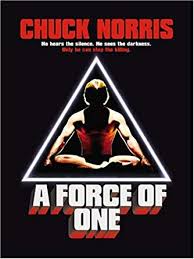
A Force of One (1979)

A FORCE OF ONE

A FORCE OF ONE (1979) Two-and-a-half stars
We should all thank Steve McQueen (1930-80) for the acting career of Chuck Norris, because it was McQueen who encouraged Norris to get into acting.

After all, without Norris’ acting career would there ever have been “Chuck Norris Facts?” Or the lever on “Conan?”

So, thank you, Steve McQueen.

McQueen also had some important advice for Norris after GOOD GUYS WEAR BLACK (1978).

“They said I was the worst thing in 50 years,” Norris said in a 1983 New York Times article. “Well, I wasn’t good, but my feelings were hurt. I said, ‘I’m not trying to be Dustin Hoffman; I just want to project a strong positive hero image on the screen.’ I went to Steve, and he said, ‘In GOOD GUYS, you talk too much. Too much dialogue. Let the character actors lay out the plot. Then, when there’s something important to say, you say it, and people will listen. Anyway, you’ll get better as an actor. You should have seen me in THE BLOB.’”

McQueen seemed to be onto something regarding the quality of Norris movies, because Norris’ best pictures LONE WOLF McQUADE and CODE OF SILENCE both rely on strong casts around Norris: David Carradine, Barbera Carrera, Leon Isaac Kennedy, Robert Beltran, L.Q. Jones, Dana Kimmell, R.G. Armstrong, Sharon Farrell, and William Sanderson (LONE WOLF); Henry Silva, Bert Remsen, Molly Hagan, Dennis Farina, Mike Genovese, and Ralph Foody (CODE OF SILENCE).

A FORCE OF ONE, alas, features a decent supporting cast around Norris — Jennifer O’Neill (she actually receives top billing), Clu Gulager, Ron O’Neal, and Charles Cyphers — and they handle the awfully generic material rather well. We should be grateful for a good supporting cast because. …

I mean, how many times have we seen this plot filmed on TV or even in the movies? We’ve all been here many, many, many times before, sitting through cops, drugs, cop killers, drug lords, et cetera.

Screenwriter Ernest Tidyman’s credits include SHAFT, THE FRENCH CONNECTION, and HIGH PLAINS DRIFTER, heavy duty action credentials.

Tidyman (1928-84), however, was not impressed by A FORCE OF ONE, called it his least successful effort, and said that he only wrote the script to buy his mother a house.

I understand Tidyman’s disappointment with his script.

That said, I enjoyed most of A FORCE OF ONE because it combines a standard issue cops and criminals plot acted out by a good cast with martial arts and a “very subtle” anti-drug message that plays like one of those infamous 1980s TV commercials, only featuring roundhouse kicks.

Wish they would have showed A FORCE OF ONE in D.A.R.E.

Oops, never mind, since all us kiddos are supposed to resist violence.

A FORCE OF ONE loses points and a positive review because of two negative elements.

Dick Halligan’s music hits the viewer like a roundhouse upside the head. I would love to make a joke here referencing either “blood,” “sweat,” or “tears” because Halligan founded the jazz-rock band Blood, Sweat & Tears and played in that group from 1967 through 1972. I just don’t have it today.

All plot roads lead to a final karate showdown between Norris and the main heavy. This is what we wait for all 80 minutes.

Unfortunately, the final karate showdown quickly devolves into slow motion and distorted / echoed vocal effects, plus Halligan’s music returns with a vengeance.

The Pride of the Yankees (1942)

THE PRIDE OF THE YANKEES

THE PRIDE OF THE YANKEES (1942) Two stars
A “Yeah right!” movie, why that’s THE PRIDE OF THE YANKEES.

We all know what “Yeah right!” movies are, right, because, yes, they make us say “Yeah right!” It could be any plot element, a plot twist, a casting decision, et cetera.

Watching THE PRIDE OF THE YANKEES again, it left me saying “Yeah right!” more than anything I’ve seen since, oh, perhaps, CRASH (2005).

We’ll start with a defining “Yeah right!” scene.

Of course, I know, THE PRIDE OF THE YANKEES is the cinematic equivalent of those books we read in elementary school about George Washington and Abraham Lincoln. You might remember the larger-than-life stories about George and his cherry tree and Honest Abe wrestling.

THE PRIDE OF THE YANKEES does that with a bat and a glove.

Our Gehrig tall tale starts with a hospital room filled with reporters. Yankee slugger Babe Ruth (Babe Ruth) promises a boy named Billy that he will hit a home run to center field … against St. Louis in the 1926 World Series.

Why, not to be outdone, our hero Lou Gehrig (Gary Cooper) comes over to visit Billy on his own and promises the boy two home runs … in the same game, yes, the same game that Ruth’s supposed to hit a homer. What a lucky boy!

Ruth and Gehrig both get their homers out of the way in the first inning.

Well, Gehrig needs his second homer and it’s not going to be easy.

Sports writers Sam Blake (Walter Brennan) and Hank Hanneman (Dan Duryea) spend the movie bantering back-and-forth with Blake always supporting and Hanneman always doubting Gehrig. Blake and Hanneman bet on whether or not Gehrig will hit a second homer. They keep raising their stakes as the game moves on and Gehrig accumulates strikeouts. I should probably mention that Blake witnessed Gehrig making his promise.

All roads lead us to the ninth inning and why that dirty St. Louis pitcher, he’s gonna intentionally walk Gehrig.

Of course, a promise is a promise, though, and Gehrig finds a way to fulfill it in the absolute most dramatic fashion.

Later in the film, near the end of his life, Gehrig’s visited by an older Billy on Lou Gehrig Day. Billy tells Gehrig that his shining example and two homers that day inspired Billy’s full recovery.

As the reporter said in THE MAN WHO SHOT LIBERTY VALANCE, “When the legend becomes fact, print the legend.”

Opening credits: “This is the story of a hero of the peaceful paths of everyday life.

“It is the story of a gentle young man who, in the full flower of his great fame, was a lesson in simplicity and modesty to the youth of America.

“He faced death with that same valor and fortitude that has been displayed by thousands of young Americans on far-flung fields of battle. He left behind him a memory of courage and devotion that will ever be an inspiration to all men.

“This is the story of Lou Gehrig.”

Signed by famous writer Damon Runyon (1880-1946). Far out.

Yes, THE PRIDE OF THE YANKEES — made shortly after Gehrig’s death in 1941 at the age of 37 — lays it on thick right from the start.

Gehrig remains one of the greatest baseball players — his 2,130 consecutive games played streak stood as record until Cal Ripken, Jr., passed it on Sept. 6, 1995.

Great baseball players do not guarantee great movies — Babe Ruth, for example, received THE BABE RUTH STORY (1948) and THE BABE (1992), both even worse than THE PRIDE OF THE YANKEES.

In a certain mood, THE PRIDE OF THE YANKEES might be a moving experience.

Otherwise, it might be a “Yeah right!” movie for the ages.

Caddyshack (1980)

CADDYSHACK

CADDYSHACK (1980) Three-and-a-half stars
Harold Ramis’ CADDYSHACK gives the consumer four movies for the price of one.

1) Rodney Dangerfield vs. Ted Knight.

2) Chevy Chase and his meandering philosophical musings and lady man ways.

3) Bill Murray and his bizarre shenanigans.

4) The caddies and their little melodramas.

Most films don’t even give us one.

We have four distinct comedic styles at work in CADDYSHACK: Dangerfield (1921-2004) comes on and thankfully never stops doing variations on his night club act; Knight (1923-86) plays the ultimate snob and perfect counterpoint to Dangerfield; Chase gives us Zen wisdom filtered through deadpan absurdity; and Murray creates a world of his own that combines Dalai Lama and Cinderella stories, gross out snooty old ladies Baby Ruth taste testing, hunting and blowing up animatronic gophers real good, and Bob Marley joints.

Murray’s like a gopher within CADDYSHACK itself, burrowing underneath Dangerfield vs. Knight and the caddies.

CADDYSHACK plays like a 98-minute throwback to the Marx Brothers, the Three Stooges, and W.C. Fields.

First-time director Ramis (1944-2014), in fact, envisioned Murray as Harpo Marx, Dangerfield as Groucho, and Chevy as Chico. Guess that made Ted Knight the villainous Sig Ruman (A NIGHT AT THE OPERA, A DAY AT THE RACES) and Cindy Morgan a more risqué Thelma Todd (MONKEY BUSINESS, HORSE FEATHERS).

Improvisation and cocaine fueled CADDYSHACK.

It seems like Ramis and gang threw away the script written by Brian Doyle-Murray, Ramis, and Douglas Kenney (Ramis and Kenney worked together on NATIONAL LAMPOON’S ANIMAL HOUSE) just to make it all up as they went along, especially Chase, Dangerfield, and Murray.

This is one example of how the makers of a film went in expecting to make a certain film and came out with something completely different. The original plan had been to make the movie focused on the caddies, of course with a title like that, but the comedians took over and stole the show.

To be fair, however, the caddies have their fair share of funny moments and Doyle-Murray steals every scene that he’s in as caddy master Lou.

Chris Nashawaty’s book “Caddyshack: The Making of a Hollywood Cinderella Story” details just how much of a miracle it was even that the movie got finished.

“I had never seen cocaine before I got to the set of CADDYSHACK,” actor Peter Berkrot said. “This was really good cocaine. Pure, like they had just beaten it out of a leaf in Columbia and somebody had carried the leaf to us and turned it into powder in front of us just so we knew how pure it was,” said actor Hamilton Mitchell.

Ramis and Kenney (1946-80) turned in an original cut that ran four hours. A consultant recommended a through line with Danny Noonan (Michael O’Keefe) and his quest for a caddy scholarship and his relationship with a waitress (Sarah Holcomb, who played the mayor’s daughter in ANIMAL HOUSE).

Like classics by the Marx Brothers, the Three Stooges, and Fields, though, we don’t require much of a plot when there’s so much funny going on.

Over the years, I’ve come to appreciate Knight’s asshole Judge Elihu Smails just as much as Dangerfield’s Al Czervik and Murray’s Carl Spackler.

Smails is every bit as quotable as Czervik, Spackler, and Chase’s Ty Webb.

My favorite Smails line comes right after Noonan says that he would like to go to law school after he graduates but his parents do not have enough money to put him through college.

Smails says, “Well, the world needs ditch diggers, too.”

July 1980 undoubtedly ranks among the great months for comedies: AIRPLANE! debuted July 2, USED CARS on July 11, and CADDYSHACK on July 25.

Bette Davis: Tougher than Anybody Else

BETTE DAVIS: TOUGHER THAN ANYBODY ELSE
Like most people in my generation, I first encountered Bette Davis (1908-89) through popular music rather than her 123 movie or TV roles from 1931 through 1989.

Oh, let’s see, Davis made a starring performance in Kim Carnes’ “Bette Davis Eyes,” a hit that spent nine weeks at No. 1 on the Billboard Hot 100 and proved to be 1981’s biggest song. You might vividly remember that one and songwriters Donna Weiss and Jackie De Shannon gave their heroine — er, their femme fatale — not only Bette Davis eyes, but also “Harlow gold hair” and “Greta Garbo’s standoff sighs.”

Davis also made the hall of fame in songs by Madonna and the Kinks.

Madonna Ciccone and Step Pettibone (Ciccone-Pettibone has got a better ring to it than Lennon-McCartney or Strummer-Jones) co-wrote “Vogue” and Madonna’s rap (her best) finishes off with “Bette Davis, we love you” after running through Garbo, Monroe, Dietrich, DiMaggio, Brando, James Dean (called Jimmy Dean, not the sausage manufacturer), Kelly, Astaire, Hayworth, Bacall, Hepburn, and Lana Turner.

Like the other two songs that came later in time, Ray Davies’ lyrics on “Celluloid Heroes” mention Garbo and she gets top billing (first mention) before the song moves on to Rudolph Valentino, Bela Lugosi, Davis, George Sanders, Mickey Rooney, and Marilyn Monroe. Davies groups Davis with Valentino and Lugosi, capping off six lines with “But stand close by Bette Davis / Because hers was such a lonely life.” (Davis named her 1962 autobiography “The Lonely Life.”) For the record, Garbo gets six lines, Monroe four, and Valentino, Lugosi, Sanders, and Rooney two each.

— The first Bette Davis movies I saw were ALL ABOUT EVE (1950) and WHAT EVER HAPPENED TO BABY JANE? (1962), both highly enjoyable for different reasons.

Their common ground, though, centers around Davis.

ALL ABOUT EVE, that’s the one featuring her famous line “Fasten your seat belts. It’s going to be a bumpy night.” Margo Channing — a highly-regarded but aging and difficult stage actress — must not have been a great stretch for a Davis in her early 40s.

Other actresses considered for the role were Ingrid Bergman, Marlene Dietrich, Susan Hayward, Gertrude Lawrence, and Barbara Stanwyck. Think we can all agree that Davis was the perfect choice for Margo Channing.

You can almost feel Davis herself speaking through dialogue like “Lloyd, I am not twenty-ish. I am not thirty-ish. Three months ago I was forty years old. Forty. 4-0. That slipped out. I hadn’t quite made up my mind to admit it. Now I suddenly feel as if I’ve taken all my clothes off” and “Bill’s 32. He looks 32. He looked it five years ago. He’ll look it twenty years from now. I hate men.”

BABY JANE capitalized on the real-life feud between Davis and Joan Crawford, where most of the fun comes from speculating how much reality crossed over into their fictional characters.

Just a casual search on the Internet will bring up all sorts of quotes from Davis on Crawford and I might as well as share a few within this space: “You should never say bad things about the dead, you should only say good … Joan Crawford is dead. Good”; “There may be a heaven, but if Joan Crawford is there, I’m not going”; “Why am I so good at playing bitches? I think it’s because I’m not a bitch. Maybe that’s why Miss Crawford always plays ladies”; and “The best time I ever had with Joan Crawford was when I pushed her down the stairs in WHAT EVER HAPPENED TO BABY JANE?”

Davis never had a problem being the villain and that’s one of the things that made her so great. Let’s face it, sometimes we like the villains infinitely more than bland, square heroes.

She played a strong character in almost every single role.

Davis became the first performer to be nominated for 10 Academy Awards, all for Best Actress, and she won statuettes for DANGEROUS (1935) and JEZEBEL (1938), her first two nominations.

— Recently, I caught up with OF HUMAN BONDAGE (1934), FOG OVER FRISCO (1934), and THE PETRIFIED FOREST (1936).

OF HUMAN BONDAGE — her 22nd film — is renowned for being the film that made Davis a star.

Davis’ character Mildred Rogers has been described as “callous,” “manipulative,”  “cold,” “shrewish,” et cetera, and Davis really sinks her teeth into “You cad, you dirty swine! I never cared for you, not once! I was always makin’ a fool of ya! Ya bored me stiff; I hated ya! It made me SICK when I had to let ya kiss me. I only did it because ya begged me, ya hounded me, and drove me crazy! And after ya kissed me, I always used to wipe my mouth! WIPE MY MOUTH!”

That’s her big scene with Leslie Howard’s Philip Carey, an overly sensitive, club-footed man who’s in love with Mildred despite the fact that she treats him like trash.

— FOG OVER FRISCO came out 26 days before OF HUMAN BONDAGE in 1934 and it’s a fast-moving crime melodrama over in 68 minutes. Action-packed and the big chase scene called to mind BULLITT and THE DEAD POOL, believe it or not.

Davis considered this one of her favorite pictures, though her character Arlene Bradford does not make it to the final reel.

Maybe here’s why FOG OVER FRISCO rated among her favorites: Davis received top billing after Warner Bros. boss Jack Warner caught drift of the Bette buzz from rushes of the film and she found out while filming FOG OVER FRISCO that Warner agreed to loan Davis out to RKO to make OF HUMAN BONDAGE.

Davis also said that FOG OVER FRISCO had a good script and that it was superbly directed by William Dieterle over a shoot that lasted around 20 days (Monday, January 22, 1934 through Saturday, February 10, 1934).

Davis plays characters on opposing ends of the social spectrum in FOG OVER FRISCO and OF HUMAN BONDAGE. In both films, though, she has a weak male admirer. She’s the stronger character, as usual.

— A lot of the fascination watching THE PETRIFIED FOREST came from seeing both Davis and Humphrey Bogart in roles early in their career.

Bogart had done 10 feature films before THE PETRIFIED FOREST and he first played the Duke Mantee role in the 1935 Broadway production alongside Leslie Howard. Warner Bros. wanted Edward G. Robinson (LITTLE CAESAR) for the film adaptation, but Howard refused to appear in the film unless Bogart got the chance to revisit Mantee, a character and performance inspired by John Dillinger. The rest was history. (Bogart and Lauren Bacall named their daughter Leslie Howard Bogart, born 1952, in honor of their friend.)

Bogart is just dynamite in THE PETRIFIED FOREST.

Like OF HUMAN BONDAGE, Davis plays a waitress and Howard’s love interest. Unlike that earlier movie, however, her Gabrielle Maple’s almost instantly smitten with Howard’s Alan Squier and their fates are reversed from OF HUMAN BONDAGE.

The New York Times’ review of the film said of her performance in THE PETRIFIED FOREST, “There should be a large measure of praise for Bette Davis, who demonstrates that she does not have to be hysterical to be credited with a grand portrayal.”

Gabrielle’s a very sympathetic character, a dreamer and an aspiring artist.

— Davis once said, “I survived because I was tougher than anybody else.”

ALL ABOUT EVE (1950) Four stars; WHAT EVER HAPPENED TO BABY JANE? (1962) Four stars; OF HUMAN BONDAGE (1934) Three-and-a-half stars; FOG OVER FRISCO (1934) Three-and-a-half stars; THE PETRIFIED FOREST (1936) Three-and-a-half stars

The Manchurian Candidate (1962)

DAY 81, THE MANCHURIAN CANDIDATE

THE MANCHURIAN CANDIDATE (1962) Four stars
John Frankenheimer’s political thriller is one ripped, twisted movie, borrowing famous words from Hunter S. Thompson.

It should make one reconsider both Frank Sinatra and Angela Lansbury, for example.

I did.

Before I first watched THE MANCHURIAN CANDIDATE, I held Sinatra in very little (miniscule) esteem. Maybe it was Phil Hartman’s savage impersonation on “Saturday Night Live.” Maybe it was Sinatra’s appearances on Jerry Lewis’ MDA telethon on Labor Day and when you only have three channels and one of them’s gone all weekend, all booked up, man, we’re talking about Pits City. Maybe it was his crooning that provided the soundtrack for seemingly innocuous yuppie consumption (we all know what seemingly innocuous really means) and little old swooning ladies and every movie that wants to evoke a certain mood just by slapping one of Ol’ Blue Eyes’ standards on every few minutes. Maybe it was the fact that he lived and breathed crusty, old guard establishment, whose reactions to Elvis and the Beatles were not surprising. There was just something about that man that gave me the creeps.

Why, of course, like any child of the 1980s and 1990s, I knew Lansbury from “Murder, She Wrote” and I know I saw her in old Disney entertainments somewhere along the line. I knew that she wasn’t quite this doddering old lady, because, man, if I saw her Jessica Fletcher coming my way, I would have moved to another town or put a down payment on a passport and an one-way plane ticket and move to another country because I know that homicide’s afoot and I want no damn part of it. The homicide rate in Cabot Cove, Maine, must have rivaled Chicago.

So, yeah, in many different ways, THE MANCHURIAN CANDIDATE warped my fragile little mind, including seeing Sinatra as a legitimate dramatic actor and Lansbury as the most wicked mother in screen history. I have no doubt she plays the most wicked mother in screen history, because I don’t want to see anybody else more wicked.

I don’t know if reading or having somebody tell you the plot summary for THE MANCHURIAN CANDIDATE can even adequately convey how messed up the movie’s events are, like this one I just read on the Internets: “Near the end of the Korean War, a platoon of U.S. soldiers is captured by communists and brainwashed. Following the war, the platoon is returned home, and Sergeant Raymond Shaw (Laurence Harvey) is lauded as a hero by the rest of his platoon. However, the platoon commander, Captain Bennett Marco (Sinatra), finds himself plagued by strange nightmares and, together with fellow soldier Allen Melvin (James Edwards), races to uncover a terrible plot.”

Strange nightmares, you can say that again, because they incorporate those Communist brainwashing sessions.

It seems that Shaw’s platoon are surrounded by sweet little old ladies, when in fact they are Chinese and Soviet officials performing their brainwashing routine. Shaw murders two of his men, one by strangulation and one by gunshot through the head. Yet when they come back home, Shaw’s a military hero, just all part of the plan.

These nightmares are very disturbing to watch, of course, and establish the movie’s disorienting tone. We rarely catch a break.

This was one dark movie for 1962 and like DR. STRANGELOVE (1964), it holds up today because of that darkness. In her 1962 review, Pauline Kael said that it may be the most sophisticated political satire ever made in Hollywood. Here we are, decades later, and her statement holds true.

There’s a lot about the plot I don’t want to consider in this space, but there’s still a lot one can discuss considering THE MANCHURIAN CANDIDATE.

For example, it was released October 24, 1962, right in the midst of the Cuban Missile Crisis during which Cold War tensions between the United States and the Soviet Union reached their coldest.

On November 22, 1963, John F. Kennedy was assassinated in Dallas. (THE MANCHURIAN CANDIDATE builds up to an assassination.)

For over two decades, THE MANCHURIAN CANDIDATE became withdrawn from circulation.

Some believe it was because JFK’s assassination had such a toll on Sinatra that he sat on the film.

Apparently, Sinatra had made such a poor deal with United Artists on the film that his attorneys planned for Sinatra to buy the movie’s rights himself and bury his mistake. Sinatra’s plan succeeded in 1972.

Eventually, though, the New York Film Festival organized a 25th anniversary screening of the movie in 1987 and its success led to a theatrical re-release in 1988. Apparently, Sinatra got a better deal this second time. We all got a better deal when THE MANCHURIAN CANDIDATE saw the light of day once again.

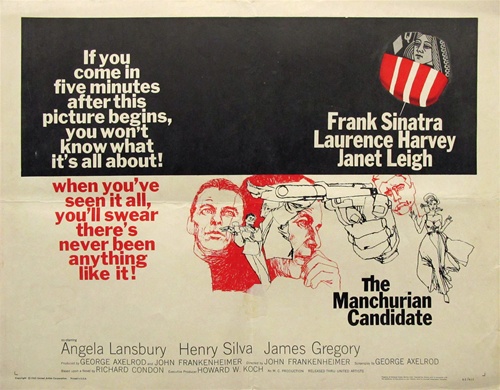
The film’s tagline certainly gets at the truth of the matter: “If you come in five minutes after this picture begins, you won’t know what it’s all about! When you’ve seen it all, you’ll swear there’s never been anything like it!”

Black Belt Jones (1974)

DAY 54, BLACK BELT JONES

BLACK BELT JONES (1974) One star
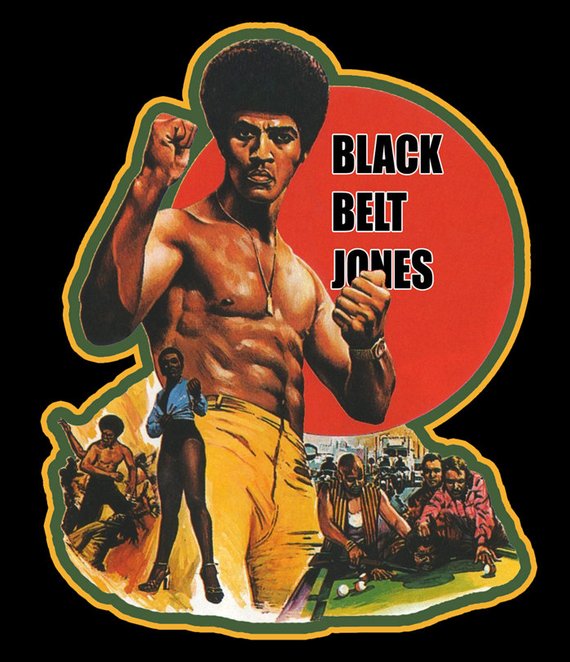
Jim Kelly (he of the “unorthodox” martial arts style in ENTER THE DRAGON) and Gloria Hendry (she played a role in LIVE AND LET DIE) are the stars of BLACK BELT JONES, a blaxploitation karate film half-ENTER THE DRAGON and half-SHAFT.

Their best scene involves a half-seduction, half-fight on a beach, replete with one liners, back flips, and explicit musical score, as well as one bystander’s acoustic guitar smashed and busted balloons. Finally, we have a continuation of this scene with first Kelly and Hendry in tight embrace and then holding hands on the beach until we get a morning after scene before we’re ready for the film’s heaviest action.

I did not believe a second of BLACK BELT JONES. I believed more in ENTER THE DRAGON and DRUNKEN MASTER, even if just for the length of the movie. The plot of BLACK BELT JONES defines standard issue yet its details are disgustingly inappropriate.

Sometimes the punches and kicks appear not to have actually hit their mark. Sometimes the villains are outrageously incompetent. We get a lot of those high flying slow motion sequences with deafening sound and vocal effects like grunts and groans and taped ping pong paddles struck against Naugahyde sofas. Any time any character raises their fists and feet during this film they make loud noises. This movie should have been called ATTACK OF THE SOUND EFFECTS. Granted, I realize that this complaint likely could apply to virtually every “old school” martial arts film, but I only make this complaint because BLACK BELT JONES fails on so many levels.

You should observe Scatman Crothers’ death scene. Yes, Scatman Crothers, a great character actor like Slim Pickens and Bradford Dillman. Ah, Scatman Crothers, a nice black man with a great big smile. You may remember him from ONE FLEW OVER THE CUCKOO’S NEST, THE SHINING (axed by Jack Torrance), and TWILIGHT ZONE: THE MOVIE. I’m trying to forget he was in ZAPPED!

In this film, Scatman plays a property owner whose property lies on the mother lode of a great big real estate development project. He’s the last property owner denying progress — here it’s a karate school rather than roller boogie rink (ROLLER BOOGIE) or barbershop (WHO’S THE MAN?).

Anyway, local heavies lean heavily on Scatman’s character, Wesley “Papa” Byrd, and he dies from the weakest punch in history. Not just cinematic history, but the history of history. To honor this man, the coroner listed cause of death as heart attack rather than “weakest punch in history.”

Back to the real plot of BLACK BELT JONES.

There’s one (several, I get confused) of those patented karate movie moments where a hero’s slow motion kick dispatches a goon through a distant plate glass window garnering the goon some frequent flier miles.

There’s a lot of windows broken during BLACK BELT JONES, by the way.

Just once I’d love a hero to remain in slow motion while a goon stays in normal speed and moves out of the path of destruction so the hero flies straight out the damn window, still in slow motion of course.

In the second paragraph, we mentioned the film’s heaviest action. Here it is: an obligatory car chase, some gun shots, and the great big final karate showdown involving lots and lots and lots of bubbles (it’s a long story) with no showerhead and rubber ducky in sight. This is obviously the cleanest fight scene in film history.

After the sordid content that came before in BLACK BELT JONES, I can understand the urge to come out clean.

Friday the 13th Part III (1982)

DAY 30, FRIDAY THE 13TH PART III

FRIDAY THE 13TH PART III (1982) Three stars
On their movie review program “Sneak Previews,” Gene Siskel and Roger Ebert hated just about every slasher film (Ebert called them “Dead Teenager” movies) that came down the pike after HALLOWEEN. They lambasted MANIAC, THE BURNING, MADMAN, MY BLOODY VALENTINE, HE KNOWS YOU’RE ALONE, MOTHER’S DAY, and HAPPY BIRTHDAY TO ME (nearly all those picked “Dogs of the Week”), but seemed to save their greatest reserves of spleen for the FRIDAY THE 13TH series. That’s okay, they weren’t alone in condemning the series.

Coming of age in the late-1980s and early-1990s, slasher films played a formative role in my filmgoing experience. One way or another, I caught up with all the Jason, Freddy, Michael Myers, Chucky, et cetera, movies. Why were these films so popular amongst young people? Must have felt that we were rebelling against the decorum set for us young people by our elders. Also sure that we were reveling in the forbidden.

PART III was my very first FRIDAY THE 13TH movie (saw it about 30 years ago) and that must contribute to why it’s among my favorites in the series all these years later.

It’s not a good movie in any traditional way shape or form and it has a lot of the same underlying problems as the other movies in the long-running series, but it’s very entertaining and silly at least until the body count starts piling up. Hey, let’s face it, though, we don’t watch movies like FRIDAY THE 13TH for the same reasons that we watch other movies. We go for the body count, No. 1, then the other exploitation movie elements like gore, nudity, and general vulgarity. The characters are often superficial archetypes, the dialogue is nothing to write home about, and it’s all very predictable. To some degree, we like it that way.

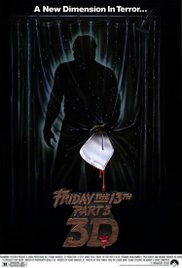
With it being originally filmed in 3-D, that only adds to the silliness of PART III because there must be at least 50 gimmick shots for the sake of the 3-D, including ones where Jason squeezes our male protagonist’s head until his eyeball heads straight for us and Jason’s first kill wearing his iconographic hockey mask. Additionally, we have a disco variation on Harry Manfredini’s score over the gonzo opening credits and some new character archetypes for the slaughter, like a married couple with the male partner suggesting Tommy Chong and a would-be motorcycle gang who gives Jason his first opportunity to kill outside his race.

Just keep in mind the FRIDAY THE 13TH movies have a transcendent appeal; for example, Kim Jong-il (1941-2011) loved him some Jason along with Rambo and Godzilla and rapper Big Daddy Kane used Jason for a rhyme in “Ain’t No Half Steppin.'”

For whatever reason, PART III generates more suspense than any other entry in the series. Steve Miner, assistant director on the first movie, remains the only person to direct more than one installment and that just might be the difference maker. Miner directed PART 2 and PART III.

I mentioned problems and there’s about 10 minutes of my life (multiplied by every time I see this sequence unless I fast-forward) that I will never get back when Jason dispatches Harold and Edna early in the movie, two unfortunate proprietors of a lakefront store. I call this hallmark of the genre “filler killings,” ones that pad running time or serve a body count (PART V fills that bill) and no greater purpose to the movie as a whole. Of course, haters of the genre would say that “filler killings” describe the entire movie.

Also, we have another shock ending that’s only shocking in just how non-shocking it turns out to be. Just about every slasher film in the era had a shock ending. This one almost defies belief.

Larry Zerner, who plays the asshole prankster Shelly, became an entertainment lawyer and Tracie Savage covered the Heidi Fleiss and O.J. Simpson trials as TV reporter, so undoubtedly PART III both served them well in their later careers.

Jason acquires his trademark hockey mask from Shelly. Jason’s played in PART III by British trapeze artist Richard Brooker, who apparently believed that playing a psychopathic killer was his entry way into a successful movie career. “It felt great with the mask on,” Brooker said. “It just felt like I really was Jason because I didn’t have anything to wear before that.”

After his screen debut as Jason, Brooker (1954-2013) appeared in DEATHSTALKER, “Trapper John, M.D.,” and DEEP SEA CONSPIRACY. Brooker later went into TV directing, for example “Bill Nye the Science Guy.” A fan-made documentary FRIDAY THE 13TH: THE MEMORIAM DOCUMENTARY appeared on YouTube in early 2018, which memorialized Brooker by interviews with FRIDAY THE 13TH luminaries and an on-screen dedication to his memory.

Final girl Dana Kimmell appeared in the Chuck Norris action spectacular LONE WOLF McQUADE after FRIDAY THE 13TH PART III. There’s a meme out there, “Chris Higgins survived her encounter with Jason because Chuck Norris wanted Chris Higgins to survive her encounter with Jason.” That’s great and everything, but there’s an alternate ending to PART III where Jason decapitated Chris (Kimmell).

Still, that gets me thinking about what would happen if Chuck Norris met Jason Voorhees in a movie.

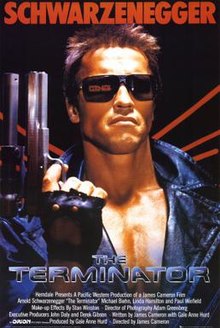
The Terminator (1984)

DAY 29, THE TERMINATOR

THE TERMINATOR (1984) Four stars
James Cameron said that John Carpenter’s HALLOWEEN inspired him to make THE TERMINATOR, and it’s easy to see that with Arnold Schwarzenegger’s T-800 and Michael Myers, both (virtually) unstoppable killing machines.

Apparently, while in Rome around the time of PIRANHA II: THE SPAWNING, Cameron had a dream about a metallic torso equipped with kitchen knives in hand and dragging itself from an explosion, which almost sounds exactly like a scene late in THE TERMINATOR. This dream became the basis for the film.

Then again, late author Harlan Ellison (1934-2018) claimed that Cameron was inspired by Ellison’s 1964 Outer Limits episode “Soldier” (adapted from Ellison’s own short story) where a future soldier goes back in time to save a present-day woman from another future soldier. I believe Ellison (although he liked the movie) used that nasty ‘P’ word, plagiarism. Ellison received a financial settlement from Hemdale and Orion Pictures, and home video releases of THE TERMINATOR subsequently read “The Producers Acknowledge the Works of Harlan Ellison.”

THE TERMINATOR benefits greatly from the casting of the central roles: Schwarzenegger as the literal force of death and destruction, Michael Biehn as the feisty freedom fighter of the future brought back to the present Kyle Reese, and Linda Hamilton as the present-day young woman Sarah Connor who initially can’t quite believe that she’s in the middle of such a ridiculous plot until Reese (and the corpses) convince her. They fit the roles to a T.

Schwarzenegger has largely played heroic characters and in fact, he’s on the good side for the rest of THE TERMINATOR series. Playing the villain, though, he benefits greatly from speaking few lines (keep in mind his first movie, HERCULES IN NEW YORK, dubbed Schwarzenegger); granted, we have less of the great humor that permeates COMMANDO, PREDATOR, and TOTAL RECALL, but it’s still there with Schwarzenegger as villain with his infamous line “I’ll be back,” for example.

That good spirit and joy of performance still comes through for Schwarzenegger in THE TERMINATOR.

Schwarzenegger plays a more interesting variation on Michael Myers and Jason Voorhees, because those roles in theory can be played by anybody. (Please don’t tell that to Ted White or Kane Hodder.)

Reese explains the situation to Sarah Connor, “That Terminator is out there! It can’t be bargained with. It can’t be reasoned with. It doesn’t feel pity, or remorse, or fear. And it absolutely will not stop … ever, until you are dead!”

Schwarzenegger originally read for the Kyle Reese role and Cameron wanted Lance Henriksen to be the Terminator. Wow, Henriksen as the Terminator just boggles the mind, although Cameron used Robert Patrick to great success as T-1000 in TERMINATOR 2: JUDGMENT DAY. Kristianna Loken as T-X in TERMINATOR 3, well, let’s just say epic fail.
Biehn works better in the Reese role because of all the dialogue and in some ways, he’s like Donald Pleasence’s Dr. Sam Loomis in HALLOWEEN. He understands T-800, even though, of course, nobody believes him until it’s too late.

The Dr. Silberman character (Earl Boen) gets one great scene interrogating Reese and then playing the video back for the Paul Winfield and Henriksen police characters. Dr. Silberman just got out of the police station in the nick of time, and he returns for the sequel.

THE TERMINATOR works as horror movie, as science fiction, and as action, in a streamlined combination of some of the best aspects of HALLOWEEN, BLADE RUNNER, and THE ROAD WARRIOR.

On top of all that, we have a great love story and this element gives THE TERMINATOR the slight edge over JUDGMENT DAY.

Just that scene alone when Reese explains why he accepted the assignment to come back through time and save Sarah Connor, mother of a future resistance leader.

“John Connor gave me a picture of you once,” Reese said. “I didn’t know why at the time. It was very old … torn, faded. You were young like you are now. You seemed just a little sad. I used to always wonder what you were thinking at that moment. I memorized every line, every curve. … I came across time for you, Sarah. I love you; I always have.”

When you go see a movie called THE TERMINATOR, bet you weren’t expecting a genuinely touching love story.

It’s the element of the unexpected that makes for the most rewarding experiences, movies or in general.

Suspiria (1977)

DAY 24, SUSPIRIA

SUSPIRIA (1977) Four stars
This is one of those rare films where what would normally be weaknesses actually turn out to be strengths and help the film become a seminal work.

For example, older actors playing high school students (Jessica Harper and Stefania Casini were both in their late 20s) and dubbing only add to the weirdness and disorienting nature of SUSPIRIA, director and writer Dario Argento’s first installment in the “Three Mothers” trilogy.

SUSPIRIA is first and foremost a visceral experience, a treat for the eyes and the ears with first-rate production and sound design. It was one of the last films to use imbition Technicolor (used previously for THE WIZARD OF OZ and GONE WITH THE WIND) and it looks absolutely marvelous with its vivid colors.

You won’t be able to keep your eyes off the screen, even if you want to cover them during some of the more squeamish moments. Just remember the film’s tagline: “The only thing more terrifying than the last 12 minutes of this film are the first 92.”

Italian progressive rock band Goblin, who previously scored Argento’s 1975 classic giallo DEEP RED and later scored TENEBRE (1982), adds tremendously to the disorientating effect; Goblin’s scores for DEEP RED and SUSPIRIA rank with John Carpenter’s main HALLOWEEN theme and Bernard Herrmann’s work for Alfred Hitchcock’s thrillers.

Disorientation is what SUSPIRIA achieves thematically above anything else. We’re never quite sure what’s going to happen next, despite the fact that we think we know what to expect, even in an Argento movie, from all our experience watching scary movies. We know that everything will be heightened in an Argento movie, just like other Italian horror movies by such maestros as Mario Bava and Lucio Fulci.

However, like a lot of those other films, all the elements in SUSPIRIA work together even if logically nothing makes any sense in the moment.

Urban Dictionary lists SUSPIRIA as “One of the greatest movies ever made — Dario Argento’s 1977 horror film, about a young girl at a German dancing academy, who discovers that the faculty are witches, plotting against her life in a series of ritual voodoo killings, involving sacrifices and vestal virgins on a pagan altar. … I first saw SUSPIRIA at the age of 10, and was terrified.”

Guess that’s one way to use “Suspiria” in a sentence.

NOTE: The 2018 remake directed by Luca Guadagnino was released October 26. The movie stars Dakota Johnson and Tilda Swinton, as well as Jessica Harper and Chloe Grace Moretz, and Thom Yorke (Radiohead) provided the soundtrack.

Jaws 2 (1978)

JAWS 2

JAWS 2 (1978) Two stars
When you watch JAWS 2, you just get the feeling that human star Roy Scheider wasn’t a happy camper during the film’s production.

Then you read more about the film and you find out that it’s true.

Scheider had a multi-picture agreement with Universal, makers of the JAWS films, and when he left THE DEER HUNTER, Universal made a deal with Scheider that if he did JAWS 2, it would be counted as the two films remaining on his contract. Fundamental problem: Scheider did not want to appear in JAWS 2.

We can feel Scheider’s resentment on the screen.

Scheider clashed with director Jeannot Szwarc to the point that it produced a physical confrontation between the men. They even carried it over into letters.

Scheider: “Working with Jeannot Szwarc is knowing he will never say he is sorry or ever admitting he overlooked something. Well, enough of that shit for me!”

Szwarc: “Time and pressure are part of my reality and priorities something I must deal with.

“You have been consulted and your suggestions made part of my scenes many times, whenever they did not contradict the overall concept of the picture.

“If you have to be offended, I deplore it, for no offense was meant. At this point in the game, your feelings or my feelings are immaterial and irrelevant, the picture is all that matters.”

When you’re watching JAWS, you don’t get the sense of a troubled production.

We do throughout JAWS 2.

Despite all that behind-the-scenes hullabaloo, also including a change of director and more technical difficulties with that damn mechanical shark, JAWS 2 became a huge financial success as it racked up nearly $78 million at the box office. Why? A hard sell advertising campaign centered around the immortal tagline “Just when you thought it was safe to go back in the water”; “Merchandising, merchandising, where the real money from the movie is made,” in the words of SPACEBALLS; and, let’s face it, at that point in time, folks wanted more of the shark and JAWS 2 delivers “more shark.”

In fact, I give the shark in JAWS 2, oh, let’s see here, three stars, maybe three-and-a-half stars on a charitable day.

The people in JAWS 2, though, sink to one star.

Averaging out both numbers gives JAWS 2 two stars.

Yes, the characters in JAWS 2 (and the following sequels) suck.

The fundamental difference between JAWS and its sequels: JAWS gives audiences three great characters in Chief Brody (Scheider), Matt Hooper (Richard Dreyfuss), and Quint (Robert Shaw). Amity mayor Larry Vaughn (Murray Hamilton), why he’s not too far behind. You care about the characters in JAWS.

Brody and Vaughn return in JAWS 2, but they’re competing against the shark and other less interesting human characters.

Instead of the core of adults in JAWS, we have an endless array of teeny boppers in JAWS 2 who just can’t hold a candle to Hooper and Quint. Dreyfuss did not return for the sequel, as he and JAWS director Steven Spielberg made CLOSE ENCOUNTERS OF THE THIRD KIND. And it’s quite obvious why Quint’s not back for JAWS 2.

All we need to know about the plot of JAWS 2 is that it’s the namesake of “The Jaws 2 Syndrome,” or when a sequel repeats the worst element of the original movie. We all know that Chief Brody will have to take out the shark, but the ringer it runs him through en route does more than try our patience, it’s blowed up real good.