
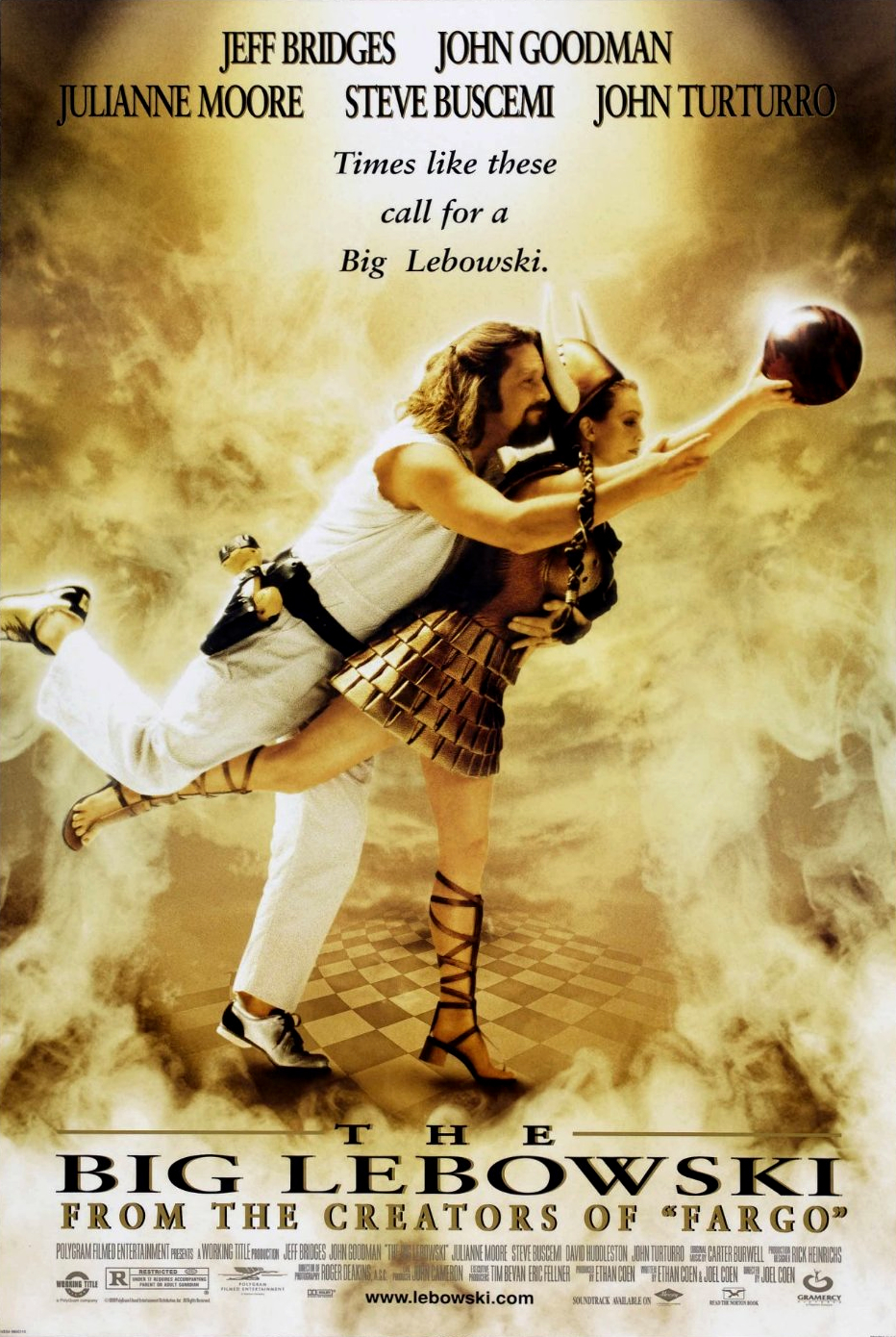
The Big Lebowski (1998)

THE BIG LEBOWSKI

THE BIG LEBOWSKI (1998) Four stars
The Coen Brothers’ THE BIG LEBOWSKI starts with a brilliant idea: Why not take a blissed out former 1960s radical who loves his White Russians and his bowling with his two best mates and place him right smack dab in the heart of a labyrinthine plot straight from THE BIG SLEEP.

You might remember Howard Hawks’ 1946 classic, starring Humphrey Bogart and Lauren Bacall. That’s the one where writer Raymond Chandler famously said of the identity of the murderer of the Sternwoods’ chauffeur, “I don’t know.” Apparently, neither did Hawks or any of the various writers — William Faulkner, Leigh Brackett, Jules Furthman, and Phiip Epstein — involved with the screen adaptation of Chandler’s 1939 novel.

How does Jeffrey “The Dude” Lebowski react to such a convoluted plot?

I believe he explains it as such, “This is a very complicated case. You know, a lotta ins, lotta outs, lotta what-have-you’s. And, uh, lotta strands to keep in my head, man. Lotta strands in old Duder’s head. Luckily I’m adhering to a pretty strict, uh, drug regimen to keep my mind, you know, limber.”

Main characters “The Dude” and Walter Sobchack are known to be inspired by a couple Hollywood eccentrics: Jeff Dowd and John Milius.

Dowd was a member of the Seattle Liberation Front, a radical anti-Vietnam War protest group that became known as the Seattle Seven. Lebowski mentions this fact in THE BIG LEBOWSKI.

Dowd then became a producer’s representative, a consulting producer, creative consultant, post-production consultant, producer, and executive producer. Those are some of his credits.

Ethan and Joel Coen first met Dowd around the time of their feature debut BLOOD SIMPLE.

I remember coming across him in the writings of Roger Ebert, for example a story from the 1999 Toronto Film Festival called “Dude Keeps Building a Rep.”

It starts out with Dowd telling Ebert that he’s got to see a movie called GOAT ON FIRE & SMILING FISH. Ebert’s in the press office at the Toronto Film Festival, only out of his hotel room four minutes before Dowd could find the critic. Dowd hands Ebert two Xeroxed sheets stapled together promoting GOAT ON FIRE & SMILING FISH.

Ebert wrote, “The Dude’s name is Jeff Dowd. He is tall and large and has a lot of unruly curly hair and a big mustache. If you saw the Coen Brothers movie THE BIG LEBOWSKI, Jeff Bridges was playing a character based on him, although the Dude is a great deal more abstentious than the Bridges character. If he were not, the movie would have been called THE LATE LEBOWSKI. The Coens and Dowd go back a long way, to 1984, when he was telling me, ‘You gotta see this one. It’s called BLOOD SIMPLE. These are the Coen Brothers.’”

Dowd “repped” THE BLACK STALLION, CHARIOTS OF FIRE, HOOSIERS, THE STUNT MAN, and THE BLAIR WITCH PROJECT, just like he did GOAT ON FIRE & SMILING FISH.

Dowd to Ebert, “Just so people see them. I’d walk up and down the lines for hit movies, handing out brochures for what we were showing. The way I figure it is, who goes to movies? People who go to movies, that’s who. They may or may not read Premiere magazine. They may or may not watch TV. But they go to movies. So if Warner Bros. spends $40 million to promote a movie and they’re standing in line to see it, why not tell them about my movie?

“A lot of the movies, they’re not what they seem to be. You take THE BLACK STALLION. The studio said it would never appeal to children because the first 18 minutes were without dialogue. I hold a test screening. A little girl, 5 years old, is in front of me. She tells her mommy she has to pee. She gets up and stands on the aisle, still watching the screen, and she stands there for the next 10 minutes. Her knees are knocking together, she has to pee so bad, but she can’t stop watching. The whole history of THE BLACK STALLION was changed, right then and there.”

The St. Louis-born Milius’ writing credits include JEREMIAH JOHNSON, MAGNUM FORCE, APOCALYPSE NOW, 1941, and CLEAR AND PRESENT DANGER. He both wrote and directed THE WIND AND THE LION, BIG WEDNESDAY, CONAN THE BARBARIAN, and RED DAWN. He’s not directed anything since 1997.

Milius says that Hollywood blacklisted him for his conservative beliefs.

He’s the disreputable one of the Film Brat Generation, whose friends and colleagues include Steven Spielberg, George Lucas, Francis Ford Coppola, and Brian DePalma.

A 2017 Indie Film Hustle story comes with the tagline “John Milius: The Craziest Director in Hollywood?”

“He’s a really funny guy, a really good storyteller,” Ethan Coen said of Milius in a book on THE BIG LEBOWSKI. “He was never actually in the military, although he wears a lot of military paraphernalia. He’s a gun enthusiast and survivalist type. Whenever we saw him, he’d invite us out to his house to look at his guns — although we never took him up on it.”

You can hear Milius’ storytelling abilities on commentaries for APOCALYPSE NOW, 1941, and CONAN THE BARBARIAN, for example.

Milius contributed Robert Shaw’s famous U.S.S. Indianapolis speech in JAWS (uncredited), some of Dirty Harry’s best lines, and all that stuff about surfing in APOCALYPSE NOW.

It helps that John Goodman, like Milius, is a native of the St. Louis area.

Bridges and Goodman have been two of the best actors working in the movies.

They’re probably as close to a guarantee of quality as anybody you can name.

“The Dude” and Walter are likely the characters they will be most associated with all their lives.

There’s lots of inspired madness throughout THE BIG LEBOWSKI.

Like the trippy production number called “Gutterballs,” combining bowling and Busby Berkeley, all scored by Kenny Rogers and the New Edition’s “Just Dropped In (To See What Condition My Condition Was In),” Rogers’ first Top 10 hit.

Like the German nihilists who have a band and album that are parodies of / homages to Kraftwerk, with the band name Autobahn and the album cover that’s similar to THE MAN-MACHINE.

Like utilizing gems like Bob Dylan’s “The Man in Me” and Captain Beefheart’s “Her Eyes Are A Blue Million Miles.”

Like Mr. Lebowski’s rant about the Eagles. Reportedly, Allen Klein (1931-2009) wanted $150,000 for usage of the Rolling Stones’ “Dead Flowers,” but he waived that licensing fee because he so loved the scene where “The Dude” hates on the Eagles. You’re not the only one, Mr. Klein.

THE BIG LEBOWSKI joins TWILIGHT ZONE: THE MOVIE and AN AMERICAN WEREWOLF IN LONDON for some of the best utilization of Creedence Clearwater Revival in a moving picture.

Coupled with BOOGIE NIGHTS (1997), THE BIG LEBOWSKI helped start my love affair with Julianne Moore, which continued over many, many years in everything from THE END OF THE AFFAIR to CHLOE.

Character actors Steve Buscemi, John Turturro, Ben Gazzara, David Huddleston, and Philip Seymour Hoffman all lend their abilities to the menagerie.

Never mind Sam Elliott’s voiceover narration.

I vividly remember coming across THE BIG LEBOWSKI when it came on Showtime in the late 1990s. I played the VHS dub I had for several friends and it became one of our favorite movies.

I’ve seen it many, many, many times over the years. It’s my favorite Coen Brothers movie, certainly far ahead of the overrated FARGO and NO COUNTRY FOR OLD MEN.

An old friend would seemingly only want to play THE BIG LEBOWSKI, FEAR AND LOATHING IN LAS VEGAS, and THE CROW, although he would also play the hell out of CITY LIGHTS, BLADE RUNNER, and SOME LIKE IT HOT as well, for that matter.

It’s been a while since I’ve watched it and I just might have to change that very, very soon.

Patton (1970)

DAY 79, PATTON

PATTON (1970) Four stars
That darn cat Patton has been wanting me to get around to writing this review all month.

He’s especially been frustrated with his humanoid friend the last couple days. “Will you stop writing about sports long enough to sit down and write on PATTON? Will you do it for me?” He’s been asking such tough questions the last couple days.

I told him, “I worked a 13-hour day Saturday and wrote up over 4,200 words for Tuesday’s paper. I covered a few games in person and I’m dog tired. Then, I stayed up all night Sunday formatting everything into the system and posting it online.”

Patton the Cat did not want to hear such excuses. He said, “Don’t be a candy ass, suck it up Buttercup, and write me a few hundred words on PATTON. It’s where I got my name, you know, of course.” He knows how to bust a fellow’s balls, that’s for sure, that darn cat.

Just in a dirty look, one which he normally directs at the dog.

Alright, I’ll get you that darn review. Sure thing, boss, and I’ll give it everything I got just for you because I know you’ll come over and check out Facebook.

Fortunately, I’ve watched PATTON quite a few times over the years. Many years ago, I would slide the VHS into the player and just sit back and relax for nearly 3 hours. I did that on a regular basis. Sometimes, I would fall to sleep and take a little nap.

On a certain level, I’m a sucker for epics like BRIDGE ON THE RIVER KWAI, LAWRENCE OF ARABIA, THE TEN COMMANDMENTS, and even ones of more recent vintage like THE PATRIOT and THE LORD OF THE RINGS trilogy, for example. There’s just something innately appealing about the form itself. Like a baseball game, you can just lose yourself inside an epic for three hours at a time.

PATTON wisely starts out with a speech based on George S. Patton’s rabble-rouser to the Third Army. Of course, we see an abbreviated and less profane version, but it’s an effective curtain raiser that gets at the heart of the character and how we find this contradictory, larger-than-life character so fascinating despite any objections we might have to this man of war.

“Now, I want you to remember that no bastard ever won a war by dying for his country. He won it by making the other poor dumb bastard die for his country.

“Men, all this stuff you’ve heard about America not wanting to fight, wanting to stay out of the war, is a lot of horse dung. Americans, traditionally, love to fight. All real Americans love the sting of battle.

“When you were kids, you all admired the champion marble shooter, the fastest runner, the big league ball players, the toughest boxers. Americans love a winner and will not tolerate a loser. Americans play to win all the time. Now, I wouldn’t give a hoot in hell for a man who lost and laughed. That’s why Americans have never lost and will never lose a war. Because the very thought of losing is hateful to Americans.

“Now, an army is a team. It lives, eats, sleeps, fights as a team. This individuality stuff is a bunch of crap. The bilious bastards who wrote that stuff about individuality for the Saturday Evening Post don’t know anything more about real battle than they do about fornicating.

“Now, we have the finest food and equipment, the best spirit, and the best men in the world. You know, by God, I actually pity those poor bastards we’re going up against. By God, I do. We’re not just going to shoot the bastards. We’re going to cut out their living guts and use them to grease the treads of our tanks. We’re going to murder those lousy Hun bastards by the bushel.

“Now, some of you boys, I know, are wondering whether or not you’ll chicken-out under fire. Don’t worry about it. I can assure you that you will all do your duty. The Nazis are the enemy. Wade into them. Spill their blood. Shoot them in the belly. When you put your hand into a bunch of goo that a moment before was your best friend’s face, you’ll know what to do.

“Now there’s another thing I want you to remember. I don’t want to get any messages saying that we are holding our position. We’re not holding anything. Let the Hun do that. We are advancing constantly and we’re not interested in holding onto anything — except the enemy. We’re going to hold onto him by the nose, and we’re gonna kick him in the ass. We’re gonna kick the hell out of him all the time, and we’re gonna go through him like crap through a goose!

“Now, there’s one thing that you men will be able to say when you get back home, and you may thank God for it. Thirty years from now when you’re sitting around your fireside with your grandson on your knee, and he asks you, “What did you do in the great World War II?” — you won’t have to say, “Well, I shoveled shit in Louisiana.”

“Alright now you sons-of-bitches, you know how I feel. Oh, I will be proud to lead you wonderful guys into battle anytime, anywhere. That’s all.”

That speech definitely sets the mood for the rest of the picture, and George C. Scott commands the screen.

Francis Ford Coppola and Edmund H. North’s screenplay effectively plays both sides of the street and director Franklin J. Schaffner (PLANET OF THE APES) helmed a film that can appeal to both hawks and doves, a divide that was especially sharp in 1970 America.

(Or you can simultaneously or alternately be attracted to and repulsed by Patton and PATTON.)

Historical movies undoubtedly say more about the era when they are made, rather than whatever era in time they are depicting.

For example, three events from a turbulent April-May 1970 are tied together.

PATTON premiered on April 2.

Richard Nixon announced the invasion of Cambodia on national TV on April 30.

The Kent State shootings happened on May 4 after four days of protest by college students against invading Cambodia.

PATTON was Nixon’s favorite movie.

Philip D. Beidler wrote “Just Like in the Movies: Richard Nixon and Patton,” which appeared in “The Georgia Review” in the fall of 1995.

Beidler’s opening paragraph: “I began this examination of the strange and often dreadful reciprocity between American life and American entertainment—a commemorative essay, one might call it, in several meanings of that term—by adducing two parallel narratives, both essentially factual and both spanning roughly the same period twenty-five years ago. Each began in early April 1970 and ended slightly more than a month later, after the US Army invasion of Cambodia and the killing of four students by Ohio National Guardsmen at Kent State University. The first involves a US president and his obsession with a war movie. The second involves a US Army lieutenant and his experiences in a war being conducted at that time by that president. The president was Richard Nixon. The war movie was PATTON. The army lieutenant was me. The war, of course, was Vietnam.”

I am unable to read past the first page of Biedler’s essay because I do not have a JSTOR account.

Nixon, of course, instantly identified with PATTON and Patton, because I am sure Nixon was aware that he’s one of those people who many folks loved to hate, just like Patton. We have little doubt that PATTON inspired Nixon to get on with Cambodia.

Nixon’s official response to Kent State: “We think we’ve done a rather good job here in Washington in that respect. As you know, we handled the two demonstrations, Oct. 15 and Nov. 15 of last year, without any significant casualties. That took a lot of doing, because there were some rough people who were involved. A few were rough. Most of them were very peaceful.

“I would hope that the experience that we have had in that respect could be shared by the National Guards, which of course are not under Federal control but under state control. … I do know that when you have a situation with a crowd throwing rocks and the National Guard is called in, that there is always a chance that it will escalate into the kind of tragedy that happened at Kent State. … I saw the pictures of those four youngsters in the Evening Star the day after that tragedy. I vowed then that we were going to find methods that would be more effective to deal with these problems of violence, methods that would deal with those who would use force and violence and endanger others, but at the same time would not take the lives of innocent people.”

Kent State inspired Neil Young to write “Ohio” and it was released in June 1970, “Tin soldiers and Nixon coming / We’re finally on our own / This summer I hear the drumming / Four dead in Ohio” and “Gotta get down to it / Soldiers are cutting us down / Should have been done long ago / What if you knew her / And found her dead on the ground / How can you run when you know?”

Young on the song in the liner notes to 1977’s DECADE, “It’s still hard to believe I had to write this song. It’s ironic that I capitalized on the death of these American students. Probably the biggest lesson ever learned at an American place of learning. My best CSNY cut. Recorded totally live in Los Angeles. David Crosby cried after this take.”

And the sad saga pushed Jerry Casale, then a Kent State student, into forming Devo and using “De-evolution” (a.k.a. backward human evolution) as the conceptual framework of the band. Jeffrey Miller and Allison Krause, two of the four killed on May 4, were Casale’s friends.

“Until then I was a hippie,” Casale said in a 2005 interview. “I thought that the world is essentially good. If people were evil, there was justice … and that the law mattered. All of those silly naïve things. I saw the depths of the horrors and lies and the evil. The paper that evening, the Akron Beacon Journal, said that students were running around armed and that officers had been hurt. So deputy sheriffs went out and deputized citizens. They drove around with shotguns and there was martial law for 10 days. 7 p.m. curfew. It was open season on the students. We lived in fear. Helicopters surrounding the city with hourly rotating runs out to the West Side and back downtown. All first amendment rights are suspended at the instant the governor gives the order. All of the class-action suits by the parents of the slain students were all dismissed out of court, because once the governor announced martial law, they had no right to assemble.”

The Legend of Drunken Master (2000)

DAY 53, THE LEGEND OF DRUNKEN MASTER

THE LEGEND OF DRUNKEN MASTER (2000) Three-and-a-half stars
Once upon a time, there was a commonly held belief that Jackie Chan and his movies would never succeed in America.

Chan’s first two attempts to capture the American market both failed, 1980’s THE BIG BRAWL (Robert Clouse) and 1985’s THE PROTECTOR (James Glickenhaus).

Clouse (ENTER THE DRAGON, BLACK BELT JONES, GAME OF DEATH) and Glickenhaus (THE EXTERMINATOR, THE SOLDIER, SHAKEDOWN) did not see eye-to-eye with Chan and vice-versa, as Chan felt more confined to the generic American style of movie violence rather than his own more idiosyncratic style during both films. Chan even released his own edit of THE PROTECTOR.

Glickenhaus once said in an interview, “Well, you know that’s still the most successful Jackie Chan movie internationally and always will be because the American audience, the mainstream audience, will never sit still for Jackie’s style of action.”

Wrong, and wrong again.

In 1995, in the third attempt on cornering the American market, New Line Cinema (Freddy Krueger’s studio) finally succeeded with an English dubbed, shortened RUMBLE IN THE BRONX (17 minutes of cuts from the Hong Kong version, two additional scenes filmed for the international market). On a budget of $8.5 million, RUMBLE IN THE BRONX earned $40 million in America, then we saw the deluge of Jackie Chan pictures.

There were SUPER COP, JACKIE CHAN’S FIRST STRIKE, and MR. NICE GUY, for example, leading up to RUSH HOUR in late 1998.

Ah, yes, RUSH HOUR, one of my memorable multiplex experiences because of the way good fortune smiled down on me. Two friends and I went out for pizza and a movie, originally intended to be Adam Sandler’s THE WATERBOY. Already at that point in life, I had tired of Sandler movies after finding so very little of interest or laughter in BILLY MADISON and HAPPY GILMORE; I liked Sandler on “Saturday Night Live,” for what it’s worth. After devouring our large order of cheesesticks, we headed to the Pittsburg Cinema 8 and discovered that THE WATERBOY sold out. Bummer, man, but at least not for me. We discussed it over and finally decided that we take a chance on RUSH HOUR rather than have driven to Pittsburg for virtually nothing.

This was my first exposure to Jackie Chan and I liked it. I liked RUSH HOUR for Chan far more than motormouth Chris Tucker. Of course, it’s a formula picture, “the buddy cop” picture that somehow had survived debacles like A COP AND A HALF (1993), remember that one with Norman D. Golden II and Burt Reynolds. Chan had been successfully integrating comedy and martial arts in his movies for years, and so he was right at home in RUSH HOUR with both elements. Chan and Tucker played well off each other and so naturally, they made two more RUSH HOUR films each less successful than the one before it.

At the turn of the 21st Century, a friend and I watched THE LEGEND OF DRUNKEN MASTER at the Joplin 14.

Around this time, I had discovered the first DRUNKEN MASTER on video and had purchased a couple Chan films on video.

In other words, I became a fan, a big fan.

THE LEGEND OF DRUNKEN MASTER, dubbed into English and re-edited for the American market, is the sequel to the 1978 film that helped make Chan a star. It was originally released in 1994 as DRUNKEN MASTER 2.

I don’t enjoy it nearly as much as the first DRUNKEN MASTER, a film that’s highly reminiscent of both ROCKY and ANIMAL HOUSE, as well as Bruce Lee, but the sequel definitely finishes on an incredibly high note with a rousing fight scene apparently directed by Chan himself.

This fight scene pits Chan against his personal bodyguard Ken Lo, a member of the famous Jackie Chan Stunt Team, the group of martial artists and stuntmen that worked alongside Chan on his movies.

Kinetic would be one word for this fight scene. Epic another. Fiery one more. “Do not try it at home” overkill.

Chan and Lo move so fast and are so fleet of foot and fist that it’s downright amazing, a ballet with kicks and punches.

It’s also funny in the way that Chan and his “drunken boxing” can be.

It makes use of the props that are in the scene’s immediate environment, a Chan trademark that originates from his affinity for silent movie comedians Charlie Chaplin, Buster Keaton, and Harold Lloyd.

Just a couple days ago, we looked at WAY OF THE DRAGON and that featured the epic fight scene between Lee and Chuck Norris. We could pair that scene with Chan and Lo.

After THE BIG BRAWL and before THE PROTECTOR, Chan took supporting roles in two CANNONBALL RUN films directed by Hollywood stuntman turned filmmaker Hal Needham and featuring a cast of thousands headlined by Needham’s friend, Burt Reynolds. Hong Kong production company Golden Harvest produced both CANNONBALL RUN films. The great thing that came from CANNONBALL RUN was that Needham’s tradition of a bloopers reel during the end credits inspired Chan to do the same for his future films. Both CANNONBALL RUN films, thanks to Chan’s popularity, were big in Japan.

Don’t Torture A Duckling (1972)

DAY 26, DON'T TORTURE A DUCKLING

DON’T TORTURE A DUCKLING (1972) Three-and-a-half stars
The third time proved to be the charm for me and the films of Italian director Lucio Fulci (1927-96), who earned the nicknames “The Godfather of Gore,” “The Spaghetti Splatter King,” and “Horror Maestro.”

About 10 years ago, I watched THE BEYOND and THE HOUSE BY THE CEMETERY (both 1981), two installments of Fulci’s “Gates of Hell” trilogy, and I found them to be two of the most wretched exercises in godawful dubbing, pathetic dialogue and characters and situations recycled from better horror movies (HOUSE BY THE CEMETERY just screams THE SHINING), and laughable gore I have ever seen.

I hated those movies, and I think hate might actually be an understatement. We need a word here that goes beyond hate.

(I have reviews of them buried somewhere.)

Of course, naturally, I came across the DVD of Fulci’s 1972 giallo DON’T TORTURE A DUCKLING in the multimedia collection of the Leonard H. Axe Library on the campus of beautiful Pittsburg State University in lovely Pittsburg, Kansas, U.S.A.

I believe I grabbed KING KONG VS. GODZILLA on VHS and Ingmar Bergman’s PERSONA on DVD in a heartbeat that fateful day in 2009. Another day brought EL NORTE and Akira Kurosawa’s THRONE OF BLOOD.

DON’T TORTURE A DUCKLING presented a conundrum for me, though, right there smack dab in the middle of the Axe.

The Devil on my shoulder (borrowed from ANIMAL HOUSE) fired off a plot summary, “A reporter and a promiscuous young woman try to solve a series of child killings in a remote southern Italian town rife with superstition and a distrust of outsiders.”

Sounds good, I thought, because of the reporter and promiscuous young woman part of his presentation.

Hey, I was in college and had just started my career as hotshit, er, hotshot reporter for the Collegio, the school newspaper.

The Devil jumped out to the early lead, because I never heard anything he said past the point of “A reporter and a promiscuous young woman.”

Not to be outdone, The Angel on my other shoulder (also borrowed from ANIMAL HOUSE) reminded me that I hated THE BEYOND and THE HOUSE BY THE CEMETERY so much.

For his little spiel, The Angel changed his voice into the dub they used for child protagonist Bob in THE HOUSE BY THE CEMETERY. (Just search for “Bob from The House by the Cemetery” on YouTube and there’s a compilation of all his dialogue scenes. Give it a shot and crank that sucker up. You can thank me later. Hopefully, not with a sharp punch or kick to the groin, though. That compilation’s 3 minutes, 23 seconds of pure dubbed torture they should have used at the Guantanamo Bay detention camp.)

I wanted to cover my ears and run right out of the Axe.

With that voice, The Angel sounded more like the Devil.

The Angel, however, did have a point with THE BEYOND and THE HOUSE BY THE CEMETERY. I mean, for crying out loud, life is too short to watch crap like that.

The Devil came back with the fact DON’T TORTURE A DUCKLING includes a fantastic nude scene for the fabulous Barbara Bouchet. (I later discovered The Devil neglected to include the entire story behind this nude scene and that it will likely make you uncomfortable because she’s offering her body to an adolescent boy to initiate him into the world of sex. Damn you, Devil, and your manipulations!)

By the way, The Devil spoke in the voice of Curtis Armstrong’s character from RISKY BUSINESS.

The Devil even gave me the same basic (albeit profane) wisdom Tom Cruise’s Joel received in the movie. The Devil used this wisdom for his final pitch.

“Sometimes you gotta say WHAT THE FUCK, make your move. Brock, every now and then, say WHAT THE FUCK. WHAT THE FUCK brings freedom. Freedom brings opportunity, opportunity makes your future. Grab the movie, check it out, and go watch it.”

Another by the way, isn’t it great that I found a movie like DON’T TORTURE A DUCKLING at the Axe Library?

That’s more irony than “Ironic” by Alanis Morrissette, yeah I really do think.

Personally, I think it’s awesome that I studied hard for long hours at the Axe.

I brought DON’T TORTURE A DUCKLING home, rigged my VCR to my DVD player and broke all forms of international copyright laws, and I still have copies today.

Great success, just like Borat once said.

The Parents Guide for DON’T TORTURE A DUCKLING on IMDb ends on this note of understatement, “A very dark movie.”

Disturbing would also work, but I simply got caught up in the mystery and the themes of Catholic guilt, sexual repression, psychological trauma, and how small towns and communities find scapegoats and carry out their own ripped, twisted vigilante justice. I stayed riveted to the very end and that’s a sign the giallo worked. Fulci had a lot more restraint and tact than he did in THE BEYOND and THE HOUSE BY THE CEMETERY, and that’s the only way to succeed with such lurid subject matter, especially child murders.