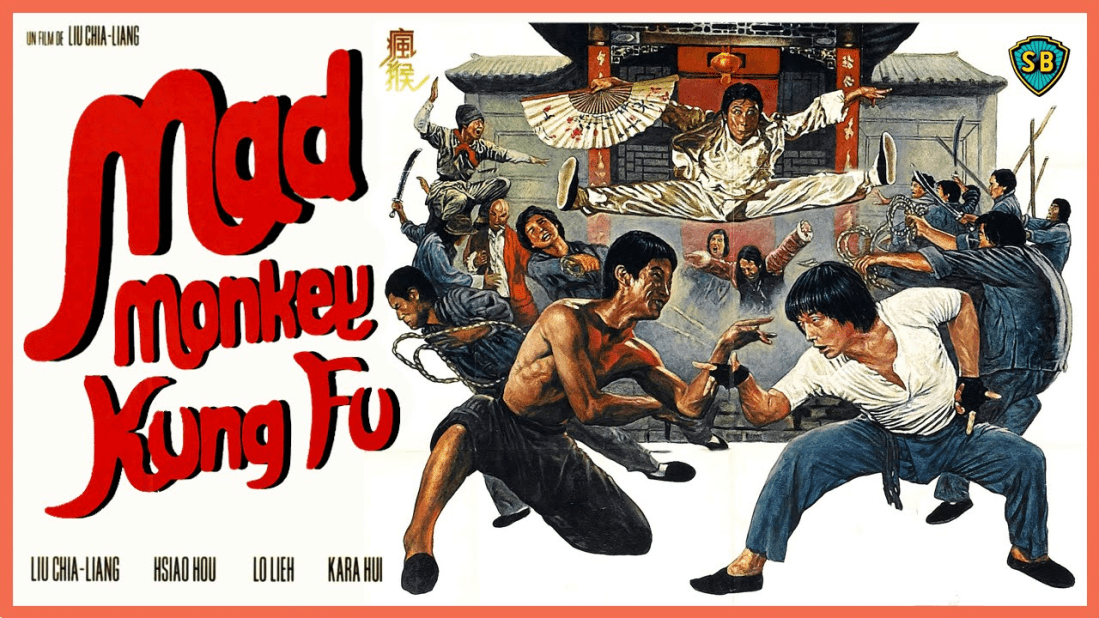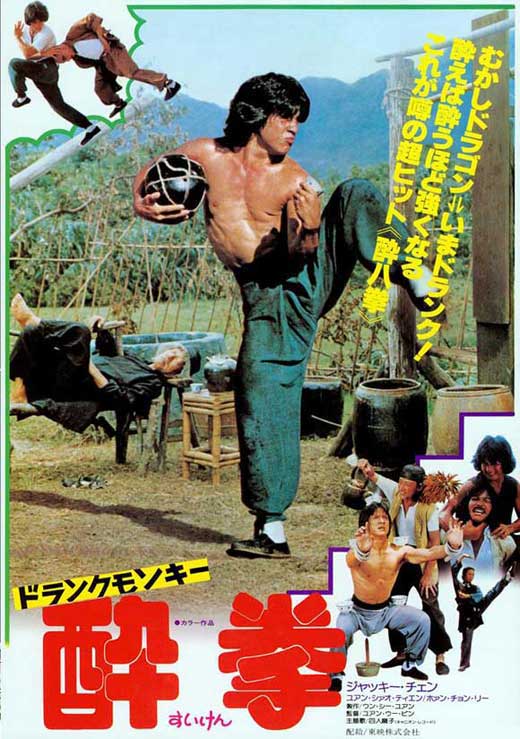
Mad Monkey Kung Fu (1979)

DAY 97, MAD MONKEY KUNG FU.png

MAD MONKEY KUNG FU (1979) Three stars
Been told I’ve been difficult to shop for when it comes to movies.

Yeah, I guess I can see that, but I don’t know, I believe that you should buy a truly unique product like MAD MONKEY KUNG FU and you can’t go wrong.

I broke in 2019 with this Shaw Brothers spectacular from 40 years ago, one which I bought a couple months back during a spree. Sometimes, titles alone just grip you in the supermarket, like Charles Bukowski’s NOTES OF A DIRTY OLD MAN, and you are compelled to put down the hardly earned immediately on that product. After the title, I saw the center MAD MONKEY KUNG FU cover image (double hooked) and then I found out that it was a Shaw Brothers production from their golden era (triple hooked). Nobody could change my mind or wallet.

I didn’t even need to see a plot summary to buy that sucker. I found this one on the Internet: “A martial artist seeks revenge on those who assaulted the elderly master who taught him a specialized form of kung fu.” Not sure about that one, especially the elderly part. I like this one better on IMDb, “A disgraced former Kung Fu expert makes a living as a merchant with the help of a hot headed friend. When the men are harassed by gangsters, the merchant decided to teach his friend monkey boxing so they can defend their business.” A smidge better plot summary, though a title like MAD MONKEY KUNG FU and a background in consuming martial arts entertainment can probably have you working out the plot in short time.

MAD MONKEY KUNG FU truly kicks into gear around the 49-minute mark and gives us an effective final hour that leaves us on a high note. Yeah, it’s not as great as other Shaw Brother spectaculars, like INFRA-MAN, THE 36TH CHAMBER OF SHAOLIN, and FIVE DEADLY VENOMS, because unlike those other films, MAD MONKEY KUNG FU drags in certain spots and needs, oh, what’s the phrase, where’s Archie Bell and his Drells when you need ’em, tightening up.

That final hour includes training sequences and faithful readers know that I am a sucker for training sequences. They are excellent in MAD MONKEY KUNG FU, and I wish they had started a lot sooner.

In 2015, Screen Rant’s Victoria Robertson ranked the 10 best training montages in movies and her list included 10) BATMAN BEGINS, 9) BLOODSPORT, 8) EDGE OF TOMORROW, 7) THE EMPIRE STRIKES BACK, 6) G.I. JANE, 5) MULAN, 4) ROCKY, 3) TEAM AMERICA: WORLD POLICE, 2) THE INCREDIBLES, and 1) THE KARATE KID. I suppose only American films were considered for the list, but I am suspicious of any training montage list that misses THE 36TH CHAMBER OF SHAOLIN and DRUNKEN MASTER.

Now, I would add MAD MONKEY KUNG FU to such a list.

All the spectacular acrobatics on display in MAD MONKEY KUNG FU brought on flashbacks of a recent mini-vacation to Branson and a two-hour show of the Acrobats of China on a Saturday afternoon.

I enjoyed both the Acrobats of China and MAD MONKEY KUNG FU for similar reasons, swept up in an old-fashioned story that’s old-fashioned for a very good reason but also captivated by the amazing physicality of the performers. Martial artists have that ability more than other action stars and I am dazzled by the three main performers in MAD MONKEY KUNG FU.

Chia-Liang Liu (1936-2013) serves as both the star and the director, and he was 42 around the time of the making of MAD MONKEY KUNG FU, definitely not elderly like it said in that one plot summary. Among his 26 directorial credits are some dynamite entertainments: THE 36TH CHAMBER OF SHAOLIN, RETURN TO THE 36TH CHAMBER, THE 8 DIAGRAM POLE FIGHTER, and DRUNKEN MASTER II. He’s obviously a name who you can trust when it comes to martial arts movies.

Hou Hsiao, the young disciple in the film, is most famous for MAD MONKEY KUNG FU and his physicality, including the ability to imitate a monkey, will stick with you arguably more than anything else in the movie. Reportedly, in a 2004 interview, Hsiao said that he doesn’t watch any of the 40-odd movies that he was in, except for MAD MONKEY KUNG FU. Hsiao worked as assistant stunt coordinator on the second 36TH CHAMBER film and the very, very entertaining CLAN OF THE WHITE LOTUS, and served as stunt coordinator for THE 8 DIAGRAM POLE FIGHTER.

Of course, we cannot leave behind Lo Lieh (1939-2002), the first kung fu superstar who became known predominantly for playing the heavy. For example, he’s the villain in THE 36TH CHAMBER OF SHAOLIN and CLAN OF THE WHITE LOTUS, as well as here. He’s great at it, and there’s just something about him that you love to hate and you want to see him served his revenge. A movie like MAD MONKEY KUNG FU needs an effective villain and Lieh fills that niche … so MAD MONKEY KUNG FU sewed up the critical roles of teacher, student, and villain.

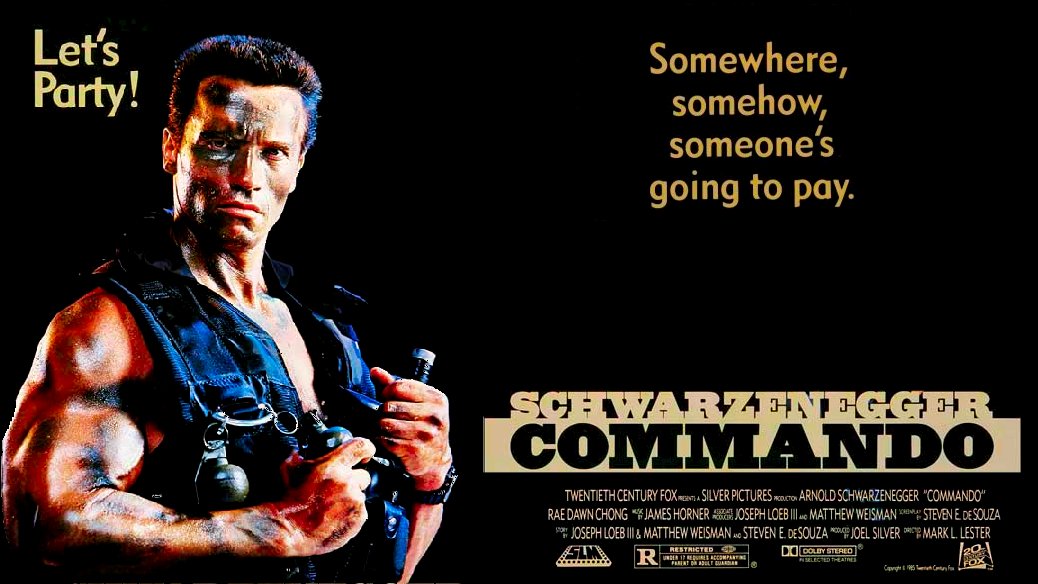
Commando (1985)

day 63, commando

COMMANDO (1985) Three-and-a-half stars
In some ways, COMMANDO is the ultimate comic book movie, although it’s merely based on a screenplay by Steven de Souza and a story by de Souza, Joseph Loeb III, and Matthew Weisman rather than something adapted from DC or Marvel.

It moves fast, thankfully so very, very fast because it keeps us from looking at logical mistakes, continuity errors, and the like. There’s a lot of them and we cruise right past them, because it’s onward and forward to the next bit of action. From the first scene, it’s nonstop action for 90 minutes, larger-than-life action with a larger-than-life hero who’s funnier than, for example, Howard the Duck.

Arnold Schwarzenegger made for a great villain in THE TERMINATOR and he made for a great comic book action hero in COMMANDO, a style that he would again utilize to great effect in PREDATOR and TOTAL RECALL. He’s the right size of personality and fighting style for John Matrix, and he’s believable in an unbelievable world that’s like a heightened macho take on terrorism in news reports.

Both the director Mark L. Lester and screenwriter de Souza are right at home with an exaggerated macho world. Lester directed THE CLASS OF 1984, the Punks vs. Teachers public school nightmare world epic from 1982 that should be required viewing for substitute teachers or anybody entering a public junior high or high school today for the first time. De Souza wrote screenplays for the first 48 HOURS and the first two DIE HARD pictures, so he proved himself at writing the mixture of action with comedy that worked for Schwarzenegger, Bruce Willis, and Eddie Murphy, especially Schwarzenegger, who seemed to have studied Clint Eastwood.

Just as Eastwood perfected reading lines like “Go ahead, make my day,” “Smith and Wesson … and me,” and “Why don’t you boys suck some fish heads, huh?” by the time of SUDDEN IMPACT, Schwarzenegger did the same in several of his films from THE TERMINATOR and PREDATOR to KINDERGARTEN COP and TERMINATOR 2. There’s a reason Schwarzenegger’s dialogue became the basis for soundboards. He just might be at his funniest on film throughout COMMANDO. (For the ultimate Schwarzenegger experience, try his 1983 “Arnold Schwarzenegger’s Total Body Workout.” Nirvana edited together clips from “Total Body Workout” to most humorous effect when the band played the U4 on November 22, 1989 in Vienna, Austria, Schwarzenegger’s native land.)

Take his exchanges with Sully, one of the prerequisite henchmen who’s a genuine sleaze (played by none other than David Patrick Kelly, who did this kind of creep in THE WARRIORS, 48 HOURS, and DREAMSCAPE, for example).

At one point early in the movie, Matrix tells Sully, “You’re a funny guy Sully, I like you. That’s why I’m going to kill you last.”

Later on, though, we get a great big payoff based on his promise that he would kill Sully last.

Did anybody remember this exchange when Schwarzenegger ran for Governor of California in the 2003 recall election?

You should remember Matrix’s line “I eat Green Berets for breakfast and right now, I’m very hungry” right alongside Nada’s “I have come here to chew bubblegum and kick ass … and I’m all out of bubblegum” from THEY LIVE.

In one of his funniest reviews, Roger Ebert on the “Siskel & Ebert” program boiled COMMANDO down to its essence: “Schwarzenegger tough guy, bad guys kidnap daughter, he blow ’em up real good.” Ebert said the script was written on the back of a small envelope.

They made some great choices for the actors who played the bad guys. In addition to Kelly, they picked Dan Hedaya, Vernon Wells, and Bill Duke. They’re actors who you love to hate, especially Hedaya, who’s been effective in that role in everything from BLOOD SIMPLE to THE HURRICANE. He made a great Richard Nixon in DICK.

Back when reviewing THE FLY (1986) a couple months ago, I touched on how it and DAWN OF THE DEAD (1978) work on several more levels than just merely being horror movies.

To a slightly lesser extent, the same holds true for COMMANDO within the action movie genre. Other Schwarzenegger films work on additional levels.

In THE TERMINATOR, for example, we get an unexpected tender love story between Kyle Reese (Michael Biehn) and Sarah Connor (Linda Hamilton).

In COMMANDO, we get the airline stewardess character named Cindy and played by Rae Dawn Chong, a part that Sharon Stone and Brigitte Nielsen wanted.

“The part was written for a Caucasian actress,” Chong said, “so I knew I had only one shot. My first reading with Arnold was this weird scene where he pulls a dildo out of my handbag. I knew other actresses were stumbling, because the character was supposed to shrug and say, ‘It gets lonely on the road.’ I thought that was so lame, so when my turn came I screamed and said, ‘That’s not mine!’ It got me the part. Was Arnold embarrassed about the dildo? Not even slightly. He didn’t break a sweat running a state, and he didn’t break a sweat handling a dildo then.”

Of course, there was a plan for a sex scene between Matrix and Cindy when they’re en route to the dictator’s island, but the studio did not like a Schwarzenegger and Chong pairing just as surely as Universal Pictures did not want a Schwarzenegger and Grace Jones pairing in CONAN THE DESTROYER. It worked out for the best in the long run, because that final scene of Matrix and his daughter boarding the plane with Cindy says all there needs to be said.

Cindy gives COMMANDO an extra dimension, a nice change of pace within a hypermacho world, and characters like her lift a genre picture even higher above others.

Infra-Man (1975)

day 36, infra-man

INFRA-MAN (1975) Four stars
I just looked at DRUNKEN MASTER, one of the most entertaining movies ever made, and here we are back with INFRA-MAN, another one.

Roger Ebert wrote an enthusiastic review in March 1976: “And so we’re off and running, in the best movie of its kind since INVASION OF THE BEE GIRLS. I’m a pushover for monster movies anyway, but INFRA-MAN has it all: Horrendous octopus men, a gigantic beetle man with three eyes who sprays his victims with sticky cocoons, savage robots with coiled spring necks that can extend ten feet, a venomous little critter that looks like a hairy mutant footstool, elaborately staged karate fights, underground throne rooms, damsels in distress, exploding volcanoes, and a whip-cracking villainess named Princess Dragon Mom.”

Believe it or not, Ebert originally gave INFRA-MAN only two-and-a-half stars and later changed his star rating to three after the re-release of MIGHTY PEKING MAN, another incredibly goofy movie by the same studio.

However, obviously, I don’t think Ebert went far enough, because INFRA-MAN should be four stars.

I just called DRUNKEN MASTER “sublime ridiculousness.”

That’s an understatement for INFRA-MAN.

No, seriously.

Not just because I’ve seen the movie in a print with a Mandarin soundtrack and Spanish subtitles.

It really is the most ridiculous movie I have seen, especially in the English dub.

This Shaw Brothers production combines super heroes, Kung Fu, and science fiction into one explosive 90-minute entertainment package influenced by the Japanese TV shows ULTRAMAN and KAMEN RIDER that were popular in Hong Kong.

It’s not only explosive because shit blows up real good throughout INFRA-MAN.

Seriously, there might be a land speed record for explosions in the movie.

Everything blows up.

Not convinced yet?

The short plot summary from IMDb: “Princess Dragon Mom and her mutant army have arisen, and only Infra-Man can stop them!”

A longer plot summary: “The ten million year-old Princess Dragon Mom (Terry Liu) attempts to conquer the Earth with her legion of mutant monsters. In response, Professor Chang (Wang Hsieh) creates Infra-Man, turning a young volunteer into a bionic superhero to save the world. However, the Princess kidnaps Chang’s daughter. Can Infra-Man save her and the planet before it’s too late?” (IMDb)

Princess Dragon Mom is one of the great villains of all-time, definitely ahead of her time in having cones on her breasts well before Madonna.

Not only that, which is no small feat, but when Infra-Man tries decapitating her when she’s in her dragon form with his energy blades, Princess Dragon Mom regenerates a new head. Every single time, and I mean every single time. Finally, he must use his solar beam to destroy her forever.

Princess Dragon Mom leads one of the more interesting groups of villains. Her minions include Witch-Eye, second-in-command who shoots great beams from eyes on her palms, and Skeleton Ghosts, who have explosive metal spears and wear black and white suits with a lovely skeleton decor that really holds it all together. Princess Dragon Mom’s villainous crew includes several monsters: Fire Dragon, Spider Monster (or the Will Not Stop Growling Spider Monster), Plant Monster, Mutant Drill, Long-Haired Monster, and Iron Armor Monster Brothers. How would you like to have portrayed any one of these minions or monsters?

Where does a performer go after playing Princess Dragon Mom? Did she get to keep any of the costume?

Terry Liu has some interesting titles among her 50 credits from 1973 to 2016, including THE BAMBOO HOUSE OF DOLLS, THAT’S ADULTERY (PART 1), SPIRIT OF THE RAPED, EROTIC NIGHTS, THE OILY MANIAC, and DEADLY HANDS OF KUNG FU.

She’ll always have a soft spot in my heart for her Princess Dragon Mom.

The rest of the world could call her Demon Princess Elzebub, but Princess Dragon Mom will more than suffice for me.

I’ll have more on the Shaw Brothers later.

Freaks (1932)

day 13, freaks

FREAKS (1932) Four stars
Tod Browning’s 1932 one-of-a-kind masterpiece had incredible difficulty passing muster with the British Board of Film Classification, failing twice before the third time’s a charm in 1963 when it was slapped with an X rating and the caveat “People should be warned of the nature of the film so that those to whom such sights are displeasing will not see it.”

That’s amazing, since 30 minutes of even more shocking content were excised after a disastrous test screening in January 1932. Apparently, one woman threatened suing MGM for giving her a miscarriage. Removed scenes and sequences possibly lost forever include a longer attack on female villain Cleopatra, her conspirator Hercules being castrated, several comedy sequences, and the original epilogue (replaced by a more traditional happy ending). When the film debuted February 20, 1932, it was 64 minutes in length and that’s what we have always seen.

It’s also amazing, of course, the film was even made in the first place, but MGM desperately wanted a piece of the horror market. Keep in mind that 1932 was a glorious year for horror: THE OLD DARK HOUSE, THE MUMMY, WHITE ZOMBIE, ISLAND OF LOST SOULS, VAMPYR, MURDERS IN THE RUE MORGUE, THE MASK OF FU MANCHU, and THE MOST DANGEROUS GAME.

Browning had the opportunity to direct anything he wanted after the Universal Studios hit DRACULA (1931) and his career would never be the same after FREAKS. Browning did not direct again until 1935’s MARK OF THE VAMPIRE.

What made the film so damn shocking? Perhaps it’s because the so-called straight characters are the freaks and the so-called freaks are everyday people just like you and I. Of course, there would be many people made to feel uncomfortable with the freaks’ matter-of-fact treatment.

Speaking of folks made uncomfortable, there’s always the account of MGM Studios’ reaction to the FREAKS cast from an article called “The Making of Freaks” (originally 1973 by Mark Frank).

“By late October 1931, carloads of freaks were beginning to arrive at M-G-M studio, much to the consternation of the personnel there, most of whom did not expect such a materialization of ‘talent.’ While the newcomers were getting acquainted with their new surroundings, popping in and out of alleyways, the weak-hearted secretaries went scurrying about in the opposite direction. During those first days of the freaks’ immigration, opposition to the production grew to alarming proportions. Louis B. Mayer, executive president, who had somehow allowed this enterprise to slip through his fingers, was now furiously against allowing the project to continue. Many of his executives, spurred on by producer Harry Rapf, were trying to organize a petition calling on (Irving) Thalberg to halt the ugly venture. Their argument concerned the Metro commissary, where they believed it would become unbearable to dine with Prince Randian or Zip the Pin-Head.

“Thalberg, having complete faith in his strange little undertaking, stood fast against the barrage of criticism, and continued his ardent support for the film. Within a few days, word came from the higher-ups that the freaks, with the exceptions of Harry and Daisy Earles and the Hilton Twins, were banned from the commissary. In order to accommodate them a private room, especially fitted for them to dine in, was constructed just off the set. Metro also had the cast quartered in a hotel in Culver City, where they were shipped every night as soon as work was over.”

Just another case of life imitating art or art imitating life, since one of the centerpiece scenes in FREAKS involves a wedding feast for “straight” Cleopatra (Olga Baclanova) and “freak” Hans (Harry Earles). Cleopatra and her real lover Hercules have conspired to kill Hans for his fortune, slipping poison into his wine. Straights are the real freaks, indeed. Hans’ sideshow friends have joined him for this special occasion and they decide they will accept Cleopatra as one of them. They pass “a loving cup” around the table and begin chanting “We accept her, one of us. We accept her, one of us. Gooble-gobble, gooble-gobble” (later inspiration for the chant in the Ramones’ “Pinhead”). Cleopatra is so disgusted by this development that, with the loving cup finally in hand, she goes on a rant, “You dirty, slimy freaks! Freaks, freaks, freaks! You fools! Make me one of you, will you?,” and she tosses the wine literally back in their faces.

FREAKS leaves an indelible mark on viewers and that’s mainly because of its unforgettable characters. That’s definitely why it’s one of my very favorite films and has been since I first watched it on video nearly 20 years ago.

Here’s a few briefs on some of these incredible characters:

• English born conjoined twins Daisy and Violet Hilton (1908-69) play basically themselves in FREAKS. They were born joined at their hips and buttocks and they shared blood circulation but no major organs. Their showbiz career began early, touring Britain at age 3, and they were exploited by their various managers throughout their careers; they formed their own jazz band and had been a hit on the vaudeville circuit. Their great moment in FREAKS involved one twin kissing her lover passionately while the other just stood there vicariously pleasured. The Hilton Sisters (better than Paris and Nicky) ended up working at a grocery store in Charlotte, North Carolina, and they were found dead at their home after neither reported for work on January 4, 1969.

• Johnny Eck (1911-91) was born Johnny Eckhardt in Baltimore, Maryland, 20 minutes after a twin brother. Johnny was born with no lower half, while his twin brother Robert was born a normal and healthy child. Eck not only appeared in sideshows and films, but he found time to be (most notably) an artist, a musician, and a photographer. Eck, hyped as “The Most Remarkable Man Alive,” performed for the Ripley’s Believe It or Not Odditorium at the 1933 World’s Fair in Chicago, to help support his family during the Great Depression. Eck and Browning became close friends.

• Prince Randian (1871-1934) plays “The Living Torso” in FREAKS and he gets another one of the great moments when he lights up a cigarette. This longtime carnival and circus performer earned names like “The Snake Man,” “The Human Torso,” and “The Human Caterpillar.” He fathered four children (three daughters and one son) with his wife, known as Princess Sarah.

• Real-life siblings Harry (1902-85) and Daisy Earles (1907-80) play Hans and Frieda, who are engaged before Cleopatra steals away Hans. Harry and Daisy were part of four siblings, along with Gracie and Tiny, known and billed as either The Doll Family or The Earles Family. They were all featured in the Ringling Brothers and Barnum and Bailey Circus for decades. Harry appeared in films THE UNHOLY THREE (both the 1925 silent and the 1930 sound remake, the first directed by Browning and both featuring Lon Chaney) and THE WIZARD OF OZ (where he’s a member of the Lollipop Guild). Daisy made her final screen appearance with a small part in Cecil B. DeMille’s THE GREATEST SHOW ON EARTH.

• Then there’s the iconographic Schlitzie (1901-71), a microcephalic who inspired Bill Griffith’s “Zippy the Pinhead” comic and the Ramones’ “Pinhead” (inspired by the film in general but especially Schlitzie and the wedding feast). Microcephalics were normally promoted as “pinheads” or “missing links.” From “The Making of Freaks”: “One of those selected (to be in FREAKS) was Schlitzie, the Pin-Head, who was a most unusual character. In a conquest of personality, it was claimed that she was a woman, since she dressed like one, but it was also rumored that she was a man. Furthermore, it was said that Schlitzie was neither one nor the other. This conflict of identity did not seem to affect her zeal to work in pictures, especially FREAKS, for on any day that she was not scheduled for filming she would make such a fuss at the hotel that they would have to bring her over to the set and let her sit there. She could very well afford this sort of behavior because, being very well managed, she had amassed a sizeable wealth in diamond rings and apartment houses.” Billed as female, Schlitzie was in fact male.

Day of the Dead (1985)

DAY 12, DAY OF THE DEAD

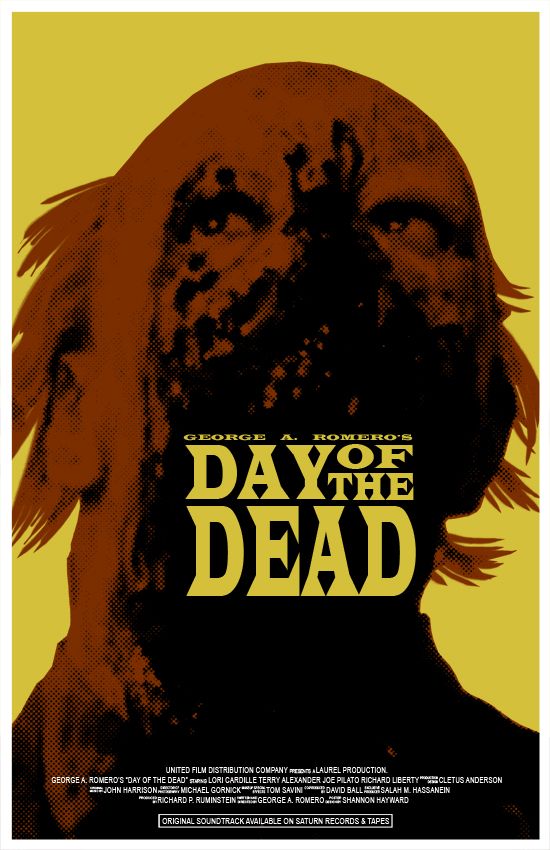
DAY OF THE DEAD (1985) Four stars
DAWN OF THE DEAD (1978) showed more hope for humanity than NIGHT OF THE LIVING DEAD (1968).

DAY OF THE DEAD (1985), the third entry in George Romero’s zombie series, heads in the opposite direction and it’s the bleakest installment of the entire run of films (six in total) as we see only just a sliver of hope for the human race. Honestly, we see more potential in the evolution of zombies throughout DAY OF THE DEAD than we do in mankind. Fans were blindsided after the more humorous DAWN OF THE DEAD.

The human characters in DAY OF THE DEAD mostly scream and shout at each other, they don’t listen to one another, and they’re just plain nasty and mean on a regular basis. You would think in a zombie apocalypse that they could put aside their differences and unite and fight toward a common goal, their survival. You would think they could get past their petty differences, their hostility for others who don’t fit their preconceived notions, their political and religious beliefs and prejudices, et cetera, but they are only human after all.

The action centers on an underground bunker where scientists are working on a solution to the zombie pandemic, while being protected from the hordes of zombies (who outnumber humans by 400,000 to 1) above by soldiers. Keep in mind that zombies, of course, are the test subjects and the soldiers are responsible for procuring more specimens. Whatever natural tensions exist between scientists and military professionals are only exacerbated by dwindling supplies, communication breakdowns, and not enough results from the scientists in the eyes of the soldiers.

Of course, we like some characters more than others and it’s quite obvious from the getgo that we are to be more sympathetic toward female scientist Dr. Sarah Bowman (Lori Cardille), black helicopter pilot John (Terry Alexander), and booze hound radio operator McDermott (Jarlath Conroy) than screw loose martinet Captain Henry Rhodes (Joseph Pilato) and mad scientist Dr. Matthew “Frankenstein” Logan (Richard Liberty).

That Romero always loved to mess with audience expectations.

Bowman’s an even stronger female character than Francine Parker in DAWN OF THE DEAD and it’s a joy watching her go toe-to-toe with Captain Rhodes and the boys.

Pilato makes for a great human antagonist and his demise provides us one of the great death scenes in any zombie movie.

Roger Ebert criticized the actors in DAY OF THE DEAD for overacting. Yes, these performances fit the definition of overacting with their exaggerated manner, but this overacting is for a very good reason. It demonstrates how much the human characters have lost the plot and degenerated into worse monsters than the zombies.

That’s apparent throughout by not only the behavior of the human characters but the behavior of the domesticated zombie Bub (Richard Sherman). Bub learns more than any of the characters in DAY OF THE DEAD and that’s a painful lesson for humanity.

DAY OF THE DEAD works today even more than when it was originally released on July 3, 1985.

Just go online and look at the comments section on especially a political story. Bask in relentless name-calling, abusive language, and hostility that only continue to get worse over time. You will probably come across words like “snowflake” and “libtard” (both especially popular since the 2016 Election) and other phrases from the main two sides of the political divide that show our increasing inability to have civil discussions about politics and religion. It should be alright to agree to disagree.

Reading an Oxford Dictionaries article from 2014 on the most common American political insults, it started with a quote from a Pew Research Center report conclusion, “Republicans and Democrats are more divided along ideological lines—and partisan antipathy is deeper and more extensive—than at any point in the last two decades.”

The article continued, “The lack of civility in our political discourse shines through in the frequency of taunts suggesting stupidity and irrationality. Such terms were brandished on both sides, but liberals were more likely to be called morons, fools, and loons, whereas conservatives were most often derided as nutjobs, nuts, and lunatics. Idiot was a favorite on both sides of the aisle.

“The type of adjective favored in insulting phrases varied by partisan affiliation as well. People insulting conservatives favored the adjective right-wing, which was more than twice as common as Republican and nearly four times more common than conservative. In contrast, the dominant adjective in negative epiphets for liberals was—liberal. Liberal was used more than four times as often as left-wing, and Democrat and Democratic accounted for only a fraction of the insults for liberals, with the former used twice as often as the latter.”

It concluded, “But there may be a ray of hope: partisans on both sides of the aisle accuse each other of being racists and bigots, demonstrating a consensus that intolerance and discrimination are universally reprehensible. And while there may not be much common ground between Democrats and Republicans, at least we can all agree on calling each other ‘idiots.'”

During a summer vacation in 2013, several months after the presidential election, a downtown Omaha, Nebraska artist displayed two posters combining both major parties’ candidates with silent movie classics, creating “Obamaratu” and “Mittropolis.” Of course, I bought both posters, because I love both NOSFERATU and METROPOLIS and I hated the 2012 Election. And the 2016 Election was amazingly even worse, a nonstop spitting contest between two jerks that brought thought and discourse to a new low. We’re being taken on a toboggan slide down the slopes of stupidity.

Every time I watch DAY OF THE DEAD, the shouting matches painfully recall so much of what life in 21st Century America has become. Increasingly strident, unpleasant, hateful negativity that’s become far less escapable with the social media boom providing us more convenient and diverse ways to hate. It’s so easy to be an asshole with the safe distance that social media entails. There’s very likely to be absolutely no repercussions for running one’s mouth online, especially when there’s an opportunity to hide behind the cloak of anonymity. Now, if we can develop the means to reach through our side of the screen and punch or kick the other person, we might actually get somewhere on the civility front. It would take just one legitimate punch in the mouth or kick in the crotch to curtail the snarkiness, and that goes for each party.

Being a sports writer by trade, I’ve found it bitterly ironic that over the nearly eight years in the sports writing business politics have become more “sports” than sports. Winning or losing and nothing else in between with much bellyaching, boohooing and bragging depending on which side of the outcome you’re on and increasingly partisan with passionate fans who can be fired up apparently so easily at rallies with platitudes and slogans mostly based on hating the other team. GO! FIGHT! HATE! TEAM!

Unfortunately, though, unlike sports, American politics gives us two basic teams, Democrats and Republicans. Why only two sides of the same coin? Should we not have far more diversity in thought or, if nothing else, evils? Pretend for a moment if the only NFL teams were the New England Patriots and the Dallas Cowboys or the only MLB teams were the New York Yankees and the Boston Red Sox.

One of my favorite concepts in George Orwell’s 1984 is the Two Minutes Hate. Absolutely brilliant. Every day in Oceania, Party members must watch a film depicting the Party’s enemies (namely the traitor Goldstein) and express nothing but their hatred for two minutes. It’s also a memorable scene in Michael Radford’s film adaptation.

In our rather informal way, how many minutes of hate do some of us get in? Bet we don’t limit it to two minutes every day. I’ll be honest, I am guilty of it too, I react violently to certain stimuli like a true automaton. There seems to be only two ways to react to Donald Trump, Hillary Clinton, Barack Obama, Kanye West, Colin Kaepernick, and LeBron James, using the most prominent examples.

“The horrible thing about the Two Minutes Hate was not that one was obliged to act a part, but that it was impossible to avoid joining in,” Orwell wrote. “Within thirty seconds any pretense was absolutely unnecessary. A hideous ecstasy of fear and vindictiveness, a desire to kill, to torture, to smash faces in with a sledge hammer, seemed to flow through the whole group of people like an electric current, turning one even against one’s will into a grimacing, screaming lunatic. And yet the rage that one felt was an abstract, undirected emotion which could be switched from one subject to another like the flame of a blowlamp.”

I generally avoid making explicitly political posts on Facebook, mainly because I do not want to contribute any more to the quagmire. This especially holds true after every mass shooting or the latest national anthem controversy, for example. Sure, I have my own beliefs and my own opinions, but a few years back I learned not to blurt them out because it doesn’t do any damn bit of good beyond possibly making me feel good.

Now we can generate memes that encapsulate our beliefs, our prejudices, and our thoughts in a most catchy (and generally rude) fashion, of course packaged together by somebody else. Orwell was clearly ahead of his time and one of the true meme pioneers before anybody even knew what the hell memes were. You might remember his greatest hits “Big Brother is Watching You” and “War is Peace / Freedom is Slavery / Ignorance is Strength.” Package them together with great images normally painting the target in a most unsavory light and why the Internet Wars are won.

Sometimes I’ll laugh at memes, sometimes I’ll look at them rather unamused, and sometimes I lose a smidgen of faith in intelligent thought, one bad meme at a time.

That said, I haven’t blocked or unfriended anybody on Facebook just because their political or religious beliefs are different than mine.

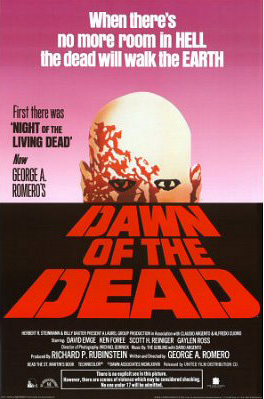
Dawn of the Dead (1978)

DAY 10, DAWN OF THE DEAD

DAWN OF THE DEAD (1978): Four stars
In a 2014 NPR interview, the late director George Romero (1940-2017) answered the question about how zombies were a vessel for commentary.

“I’ve sort of been able to bring them out of the closet whenever I need them,” he said. “They are multi-purpose, you can’t really get angry at them, they have no hidden agenda, they are what they are. I sympathize with them. My stories have always been more about the humans and the mistakes that they’ve made and the zombies are just sort of out there. … They’re the disaster that everyone is facing, but my stories are more about the humans.”

None of Romero’s zombie movies have been more about the humans than DAWN OF THE DEAD.

It gives us four characters that we grow to care about, Stephen (David Emge) and his girlfriend Francine (Gaylen Ross) and Peter (Ken Foree) and Roger (Scott H. Reiniger). Stephen’s a traffic reporter (light on traffic, heavy on zombies in this flick) and our four protagonists load up into his traffic helicopter and eventually take refuge and lock themselves within a secluded shopping mall (Monroeville Mall located in Monroeville, Pennsylvania, east of Pittsburgh). They kill all the zombies inside and literally clean up, with an endless array of consumer goods at their disposal. They’re like four big kids in a candy store. They become complacent fat cats in a sense, fattened up by self-indulgence, until a motorcycle gang descends upon the mall and these rough biker dudes have the unmitigated gall to go for the kingdom. Of course, our two remaining male protagonists take on the motorcycle gang to the bloody end.

These characters are much better than what Romero and fellow script writer John Russo gave us in the 1968 classic NIGHT OF THE LIVING DEAD.

First and foremost, Francine seems at one crucial point early on like she might be headed for the Judith O’Dea Barbra character in the first movie, a real drag of a helpless female who’s either in panic mode or a catatonic state throughout. Granted, Francine gave us other early signs that she would break the helpless female mode. Sure enough, Francine does break that stereotype and DAWN OF THE DEAD is all the better for it.

Not counting Russell Streiner’s indelible Johnny, who’s only in the movie for a few minutes, Duane Jones’ Ben was the best character in NIGHT OF THE LIVING DEAD. Likewise, Foree gives us another strong black male protagonist and Peter’s the best character here. In fact, Peter’s even stronger than Ben. He’s a Superfly T.N.T. bad ass mofo zombie killin’ action hero, he says all the great lines including “When there’s no more room in Hell, the dead will walk the Earth,” and he’s also far more upbeat than Ben. We end the flick happy little consumers when Peter decides that he will continue to fight rather than pull his trigger and end it all. Two downbeat endings in a row would have been truly horrible.

Romero told Rolling Stone in 1978, “Monsters do exist: in us, and among us.”

Through Stephen, Francine, Peter, and Roger, I think we can see the monster that’s inside us, especially after they become fat cats inside the mall. It’s because these characters all develop within our hearts and minds until they’re not just standard issue, interchangeable horror movie victims like characters in lesser movies. We understand them when they indulge themselves at the mall; they’re living out many people’s consumerist fantasies. We truly feel it when zombies happen to them. We’re there with them every step of the way during their incredible journey.

Not only are the human characters an improvement from Romero’s first zombie try, but the zombies truly come alive in DAWN OF THE DEAD.

At times, they are sinister and relentlessly terrifying. Other times, they are sad or they are funny at other junctures. Romero uses them like characters from different silent movie genres, for slapstick, for sentiment, and to scare us, and they also remind us of the Monster in BRIDE OF FRANKENSTEIN. The director said that he sympathized with his zombies and that’s apparent throughout DAWN OF THE DEAD. Like the four main protagonists, the main antagonists are not standard issue, interchangeable zombies. Anyway, they still just want to go shopping too, just like us.

Now, let’s talk about the gore.

Like the later EVIL DEAD movies and RE-ANIMATOR, the gore in DAWN OF THE DEAD passes through queasy to surreal and quite enjoyable.

On the other hand, in April 1979, former New York Times film critic Janet Maslin walked away from DAWN OF THE DEAD. Here’s the opening paragraph of her review:

“Some people hate musicals, and some dislike westerns, and I have a pet peeve about flesh-eating zombies who never stop snacking. Accordingly, I was able to sit through only the first 15 minutes of ‘Dawn of the Dead,’ George Romero’s follow-up to ‘Night of the Living Dead,’ which Mr. Romero directed in black and white in 1968. Since then, he has discovered color. Perhaps horror-movie buffs will consider this an improvement.”

No, I don’t view the color in DAWN OF THE DEAD an improvement over the B & W in NIGHT OF THE LIVING DEAD, but I do believe the 1978 movie improves on the earlier film in just about every single possible way. Better human characters and better zombies (who are still not all that different from us, despite their preference in food and their makeovers) especially make this a rare sequel that outdoes the original. Not to mention Romero’s biting satire on consumerism.

I mentioned DAWN OF THE DEAD in the review of THE FLY and it’s a fitting way to end this review.

“For example, George Romero’s DAWN OF THE DEAD (1978), a horror movie or a zombie picture that also passes through action and adventure, black comedy, silent and slapstick comedy, drama, gore galore, cinematic and social satire, surrealism, survivalism, and melodrama in addition to being great at the basic level of being a horror movie. All those extra traits put DAWN OF THE DEAD in the upper echelon.”

Night of the Living Dead (1968)

DAY 9, NIGHT OF THE LIVING DEAD

NIGHT OF THE LIVING DEAD (1968) Four stars
The other day on Facebook, I thought I saw a fan ask others not to bring politics into their appreciation of a classic on the NIGHT OF THE LIVING DEAD page.

Are you kidding?

As many fans would be quick to point out, George Romero’s films often have political themes and some of us fools love them even more for it.

I once wrote a review of the 2010 remake of Romero’s THE CRAZIES and lamented the fact the remake traded Romero’s sharp-edged content in for cheap trick, conventional jump scares.

That review included a mention of the scene in Romero’s original where a priest (infected by the virus) self-immolates because of soldiers rousing his flock, a harrowing moment that calls to mind Norman Morrison, the 31-year-old Baltimore Quaker pacifist who carried self-immolation out below Secretary of Defense Robert McNamara’s Pentagon office to protest American involvement in the Vietnam War, and the Buddhist monk Thich Quang Duc at a busy Saigon intersection to protest the corrupt South Vietnamese government’s persecution of Buddhist monks.

THE CRAZIES remake did not include such a scene, and that epitomized its lack of balls. (By the way, the references to the priest’s self-immolation in the movie, Morrison, and the Buddhist monk were all excised from the review that printed in the college paper, most likely for space considerations.)

Just thought it was strange that a Romero fan bitched about political conversation, because politics are part and parcel of each and every DEAD movie.

For example, it’s hard not to consider NIGHT OF THE LIVING DEAD in the broader context of 1968 (or any year) America.

The radio and TV news reports about flesh-eating ghouls in NIGHT OF THE LIVING DEAD would have been natural alongside such watershed events as the Tet Offensive, the My Lai Massacre, Lyndon B. Johnson’s announcement that he will not seek or accept presidential renomination, the assassinations of Martin Luther King and Robert Kennedy, and the riots riots riots all through a turbulent 1968.

(NIGHT OF THE LIVING DEAD was filmed in 1967 and officially released on October 1, 1968.)

When the black protagonist Ben (Duane Jones) gets mistaken for a ghoul, shot in the head and killed by a member of a white mob looking for ghouls, and thrown in a burn pile with the other ghouls at the end of the movie, of course viewers can draw parallels with MLK, Emmett Till, and numerous other horrifying incidents over the years. Or you can just take the scene at face value. Any way you read it, it’s a shocker of an ending.

Casting Jones as Ben changed the dynamic of the movie. Originally, this character was scripted as a white man (according to a 2010 article by Joe Kane that appeared in “The Wrap”), a resourceful but rough and crude-talking trucker. Jones brought a strong presence, an obvious intelligence, and an unmistakable rage to the part that would have been lacking with the original casting plan. The interactions between Ben and Harry Cooper (Karl Hardman) take on another dimension with the racial tension palpable between both men.

I’ll just go ahead and say it: NIGHT OF THE LIVING DEAD would have been a lesser movie without a black male in the lead.

At one point, again from the Kane article, the filmmakers thought about changing the ending to allow Ben to survive. Jones was not having any. “I convinced George that the black community would rather see me dead than saved, after all that had gone on, in a corny and symbolically confusing way,” he said. “The heroes never die in American movies. The jolt of that and the double jolt of the hero figure being black seemed like a double-barreled whammy.”

There’s a multitude of whammies in NIGHT OF THE LIVING DEAD.

Consider the plight of Mr. Cooper, his wife Helen (Marilyn Eastman), and their 11-year-old daughter Karen (Kyra Schon), who’s seriously ill after being bitten by one of the ghouls. Karen’s in the cellar for the duration of the movie.

Mr. and Mrs. Cooper, why you can just tell they do not get along very well. Understatement of the year. Nearly every word they say to each other, especially from her to him, carries an undercurrent of hostility. We feel there’s no love between the two.

Eventually, Karen dies and becomes one of the flesh-eating ghouls. She first eats her father and then bludgeons her mother with a trowel. The latter sequence calls to mind Detective Arbogast’s encounter with Mother in PSYCHO (1960).

You probably have noticed this sentence is the first mention of Barbra (Judith O’Dea), another main protagonist. She’s definitely the weak link in the movie, the epitome of the helpless female who spends nearly all her screen time in either panic mode or in a catatonic state. She’s not much of a help to anybody, and we delight in her fate near the end of the movie. (In the 1990 remake, Barbra’s more along the lines of Ellen Ripley in the ALIEN movies.)

Russell Streiner, one of the producers of the movie along with Hardman, plays Johnny and he’s absolutely fantastic during his screentime (just a few minutes) in the classic opening cemetery scene. He complains about virtually everything, he gives his uptight sister Barbra a hard time, and he delivers one of the great lines in horror movie history doing the latter, “They’re coming to get you, Barbra.”

Pearl Harbor (2001)

DAY 62, PEARL HARBOR

PEARL HARBOR (2001) One star
If you’re a fan of Turner Classic Movies, surely at one point or another you’ve come across the old-fashioned screen romance set in the midst of wartime be it World War I or World War II or (even) Vietnam.

A FAREWELL TO ARMS and WATERLOO BRIDGE are just a couple of the classic titles.

You might have noticed a hallmark or two at work from the Meet Cute and the romantic, lyrical interludes (before Simon & Garfunkel, Cat Stevens, and every other overly sensitive singer-songwriter provided the songs) to the departure scenes before the soldier goes off to fight and finally tragedy for the star-crossed lovers in such harrowing times for all humanity.

They become a microcosm.

Right or wrong, such cinematic hallmarks should be laughed right off the screen in postmodern times when they’re played wrong.

For example, Michael Bay’s PEARL HARBOR, one of the most insulting, most cloying excuses for mass entertainment ever made. (Keep in mind that Harrison Ford’s worst movie just might be HANOVER STREET, another weeper from Hell.)

PEARL HARBOR not only borrows scenes and themes wholesale from those earlier wartime romances, but it smuggles in good old-fashioned World War II films to form a half-soap opera and half-war epic for the Attention Deficit Cinema. It turns out to be all-crock and all-crook.

I don’t know about you, but the romantic triangle between would-be matinee idols Ben Affleck, Kate Beckinsale, and Josh Hartnett does not belong in the same picture with the Japanese attack on Pearl Harbor.

Be prepared for the attack on both elements.

How about that romantic triangle?

Let us break them down angle-by-angle-by-angle.

I’ve never been a big Affleck fan, Hartnett’s not much better, and Beckinsale nearly always proved to be easy on the eyes but difficult on every other sense.

They’re no Gary Cooper, Robert Taylor, Helen Hayes or Vivien Leigh.

Basically, we’re dealing with three dubious actors in the first degree, then …

Give them dialogue that would have sank greater actors, like “Returning from the dead wasn’t all that I expected … but that’s life”; “You are so beautiful it hurts,” “It’s your nose that hurts,” and “I think it’s my heart”; “You know, the only thing that scares me is that you might love him more than you love me,” and they’re flirting with disaster.

How dare them Japanese attack a romantic triangle? Do they have a heart?

There’s not one scene between the lovers in PEARL HARBOR that even approaches indelible screen moments like Burt Lancaster and Deborah Kerr’s love scene on the beach in FROM HERE TO ETERNITY and Humphrey Bogart and Ingrid Bergman’s farewell in CASABLANCA.

PEARL HARBOR unfortunately does not get any better in the war scenes and since this is historical fiction, we see fictional characters intertwined with impressions of real-life characters Franklin D. Roosevelt and Lt. Col. Jimmy Doolittle, who are portrayed respectively by Jon Voight and Alec Baldwin.

If the actors playing the romantic triangle get dialogue rejected by a soap opera, Voight and Baldwin chew on dialogue that’s just as recycled from old war movies, especially for Baldwin’s Doolittle.

Doolittle: “There’s nothing stronger than the heart of a volunteer” and “Victory belongs to those who believe in it the most and believe in it the longest. We’re gonna believe. We’re gonna make America believe too.”

I believe in victory, sure enough, and that’s every time I have survived the 3-hour, 4-minute cheesefest (that’s an insult to cheese) that will live in cinematic infamy.

There was the time my sister and I watched it in a suburban St. Louis multiplex because she refused to watch anything else. Oh, I would have paid extra to watch anything other than PEARL HARBOR or hell, I should have stayed home and watched paint dry. At least the paint won’t explode after an hour of the worst dialogue.

After the movie, I looked around for military recruiters creeping and crawling through an Affton theatre.

A few years down the line, our History in Film & Fiction class at Pittsburg State brought out Michael Bay’s disaster, and it still epically sucked or in the past tense of a hit song, it felt like the first time.

PEARL HARBOR’s lasting positive contribution to culture was that it provided the inspiration for one of the memorable songs in TEAM AMERICA: WORLD POLICE, Trey Parker and Matt Stone’s satire on lamebrained action movies, “Pearl Harbor Sucks.”

I could have quoted the lyrics for this review, believing in every line except for the one about how Cuba Gooding Jr. needed a bigger part.

Anyway, those lyrics are definitely better than this blurb found on Movieweb: “On a sleepy Sunday morning in December, as children played and families prayed, squadrons of Japanese warplanes screamed across the skies of a Hawaiian paradise and launched a surprise attack on the U.S. armed forces at Pearl Harbor. The infamous day that jolted America from peaceful isolationism to total war and altered the course of world history is relived in this epic tale of patriotism, passion and romance from producer Jerry Bruckheimer, producer/director Michael Bay and screenwriter Randall Wallace.

“PEARL HARBOR focuses on the life-changing events surrounding December 7, 1941, and the war’s devastating impact on two daring young pilots (Ben Affleck and Josh Hartnett) and a beautiful, dedicated nurse (Kate Beckinsale). It is a tale of catastrophic defeat, heroic victory, personal courage and overwhelming love set against a stunning backdrop of spectacular wartime action.”

Hey, please keep in mind that you don’t have to believe in the bullshit you write.

I, however, believe in every single word when I tell you that PEARL HARBOR sucks.

Drunken Master (1978)

DAY 35, DRUNKEN MASTER

DRUNKEN MASTER (1978) Four stars
There’s at least one more DRUNKEN MASTER fan out there in this great big world: 11-year-old Isaac Gonzalez from Carthage, Missouri.

Looking for a movie to watch one night, bored out of his skull after being grounded from his PlayStation 4 and his tablet, Mr. Gonzalez started thumbing around through hundreds of “old” and “older” movies, finally discovering a run of martial arts films, namely Jackie Chan films.

A wise old man finally asked Mr. Gonzalez, “Don’t you like THE KARATE KID?”

Mr. Gonzalez said, “Yeah.”

The wise old man then declared, “Well, I’ve got a movie that’s much better than THE KARATE KID. It’s awesome.”

Mr. Gonzalez said, “OK, put it on.”

Mr. Gonzalez, after subtitles were retired and the English dub reinstated early on, sat back and watched DRUNKEN MASTER in an apparent state of joy.

He laughed at the slapstick comedy, the vulgar humor, the silly banter, and the drunken boxing shenanigans. After all, doesn’t the Three Stooges’ humor transcend?

He enjoyed all the fight scenes and the great wide world variety of fighters thrown at Chan’s Wong Fei-hung.

The wise old man, after the 110 minutes were over and right before the 11-year-old boy had to go to bed on a school night, asked Mr. Gonzalez how the movie was and he said, “You were right, it’s better than THE KARATE KID. It’s awesome.”

Watching the film again with Mr. Gonzalez, paying attention to his reaction to it as well as my own, I was reminded that DRUNKEN MASTER rates as one of the most entertaining movies ever made.

It’s a blast.

This was still relatively early in Chan’s long career and two films released in 1978 helped make Chan a star, at least in Hong Kong, SNAKE IN THE EAGLE’S SHADOW and DRUNKEN MASTER. Both films have the same director and the same three actors in hero and villain roles.

I prefer DRUNKEN MASTER because, let’s see, it’s ROCKY meets ANIMAL HOUSE meets Bruce Lee.

It’s sublime ridiculousness.

Just imagine if Rocky Balboa drank alcohol before he came out against Apollo Creed and if Rocky’s trainer Mickey threw him a bottle in the middle of the fight and Rocky downed every single drop of it before knocking out Apollo.

Or if Bluto Blutarsky threw down and kicked the holy living hell out of Marmalard and Neidermeyer in a karate fight rather than start a food fight or throw a toga party. (Not that ANIMAL HOUSE had any influence on DRUNKEN MASTER. Both were released in 1978: ANIMAL HOUSE on July 28 in the United States and DRUNKEN MASTER on October 5 in Hong Kong. However, I would pair them in a double feature or perhaps group them with ROCKY for a triple feature.)

Lee tried some relatively bawdy humor early on during THE WAY OF THE DRAGON, but alas, that style worked better for Chan.

Just as it worked better for Chan developing his own brand of martial arts theater and not becoming “the next Bruce Lee.” Not possible, anyway.

DRUNKEN MASTER mixes raunch, slapstick, and (of course) great fight scenes in a way that I had never seen before.

It must have been almost 20 years ago when I first saw it; I rented a dubbed copy on VHS and was blown away.

Like I said not that long ago (certainly not been 20 years), I had never seen anything like DRUNKEN MASTER before and it especially enthralled me with its bountiful supply of colorful fighters with distinct fighting styles. Seems like there’s a great fight scene every few minutes, and they just keep getting better every single fight.

Yes, virtually every single character in this action spectacular can fight and these characters each get their moment in the sun over 110 minutes.

It also has a fantastic “Eight Drunken Gods” training montage.

Speaking of training, before we leave one should mention THE KARATE KID (1984) features a watered-down, more feel-good version of the mentor by comparison with the one in DRUNKEN MASTER. Beggar So (Yuen Siu-Tien) can be cruel and sadistic, at times, but he and Chan’s Wong Fei-Hung do form enough of a bond that helps carry us through.
Ironic that Chan played the mentor role in THE KARATE KID remake (2010).

With DRUNKEN MASTER, Chan started to find his niche as one of the most enduring of action movie stars.

He’s so damn likable partly because he gives you value for money. You know you’re likely to get your money’s worth when you put it down on Chan, through action or humor or both and you know that it’s Chan performing all those stunts himself. That man certainly risked life and limb to entertain us.

Chan also brought his influences from silent movie comedians like Buster Keaton, Charlie Chaplin, and Harold Lloyd, unique sources for inspiration. Chan even replicated a pair of the most famous stunts from Keaton and Lloyd, respectively.

Having a small role in CANNONBALL RUN, Chan was influenced by that Burt Reynolds-starring, Hal Needham-directed, cast-of-thousands car race comedy to feature a gag reel in his own movies, but rather than blown lines, Chan’s end credits often highlight stunts gone awry.

Chan belongs in the upper echelon of action stars, alongside such luminaries as Clint Eastwood, Arnold Schwarzenegger, Bruce Lee, Paul Newman, and Sylvester Stallone, who at their very best deliver the goods at a high level.

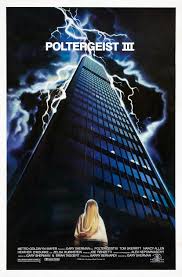
Poltergeist III (1988)

DAY 8, POLTERGEIST III

POLTERGEIST III (1988) One star
Cheech & Chong said “man” 295 times in UP IN SMOKE (1978).

By comparison, characters said “Carol Anne” 121 times in POLTERGEIST III.

Still, I have this nice dream where the movies are spliced together via the miracle of modern technology and somehow Cheech & Chong say “Carol Anne” rather than “man” 295 times. Yes, rather than the characters played by Tom Skerritt and Nancy Allen, Cheech & Chong are tracking down Carol Anne and fighting the evil spirits. Skerritt makes a cameo in this alternate POLTERGEIST III, since he played Strawberry in UP IN SMOKE and that will be his character this second time around.

I do have this strange habit of imagining alternate scenes or alternate entire movies pieced together from two different movies.

For example, I remember Carey Mulligan’s character singing “New York, New York” in SHAME (the Steve McQueen and not the Ingmar Bergman version) and then all of a sudden, I had this vision of the Gremlins’ grand musical production number of the same song in GREMLINS 2: THE NEW BATCH. Here was the big tender moment in SHAME and I wanted the Gremlins’ version instead to show up on the screen. It played out inside my head that Mulligan started before she was oh so rudely interrupted by the mass Gremlin chaos choir. I also sing the Gremlins’ version every time I come across Frank Sinatra’s standard, which must be one of the most overplayed songs in popular culture.

Fantasies like that help to pass time, especially during a bad movie like POLTERGEIST III where I often can’t stand the sight of what’s on screen.

In economics, the law of diminishing returns refers to a point at which the profit becomes less than the amount of money or energy invested.

In movies, diminishing returns refers mainly to sequels that are vastly inferior to previous films in the series. Just look at any number of movie series for examples.

This third POLTERGEIST tries our patience right from the start with its central premise and it only gets worse through its execution.

It’s rather sick.

I mean, that poor child Carol Anne (played by Heather O’Rourke).

Why couldn’t they just let her be after POLTERGEIST II: THE OTHER SIDE?

What she endured in the first two movies would be enough for several lifetimes, but she’s back for a third installment and without her parents (Craig T. Nelson and Jo Beth Williams) and brother (Oliver Robins). Carol Anne’s been sent to live with her aunt (Allen) and uncle (Skerritt) at their high rise apartment in Chicago.

We know that she’s going to be put through the wringer for the third time as soon as we see her, no matter that she’s 2,000 miles and 30 hours by car away from Southern California, location of the infinitely superior first POLTERGEIST.

(By the way, Nelson was approached to return for POLTERGEIST III but he reportedly said “Two was enough.” That’s nowhere as brilliant as what Roy Scheider thought about JAWS 3-D, “Mephistopheles couldn’t talk me into doing (it). They knew better than to even ask.”)

POLTERGEIST III saddles poor Carol Anne with a psychiatrist named Dr. Seaton (Richard Fire). Of course, in the movies, psychiatrists normally do more harm than good and well, this Dr. Seaton character follows that character pattern to a T. Dr. Seaton encourages Carol Anne to chat with him about her experiences, though he believes her to be delusional, and, of course, this discussion enables the evil spirit of Rev. Henry Kane to find Carol Anne and wreak havoc on her once again.

This Dr. Seaton is a real piece of work. He belongs in the annals of bad screen doctors alongside such notables as the paranormal investigator played by Robert Joy in AMITYVILLE 3-D and the psychiatrist played by Bruce Willis in COLOR OF NIGHT.

A demon first burns Joy’s Dr. Elliot West’s face and then drags him to Hell. One of just a couple highlights in AMITYVILLE 3-D.

Dr. Seaton gets pushed to his death down the empty elevator shaft of the 100-story John Hancock Center.

Willis’ psychiatrist lives through COLOR OF NIGHT.

Well, you know, two out of three ain’t bad.

The POLTERGEIST movies, especially this third installment, have long been tinged with sadness and talk of the “Poltergeist Curse” almost overshadows the movies.

Dominique Dunne, who played Carol Anne’s older sister, died at the age of 22 five months to the day after the release of POLTERGEIST. Dunne’s ex-boyfriend, John Thomas Sweeney, strangled Dunne in the driveway of her West Hollywood home. Dunne went into a coma and died five days later on November 4, 1982.

O’Rourke died at the age of 12 on February 1, 1988 under extremely unusual circumstances. She died of cardiopulmonary arrest caused by septic shock due to intestinal stenosis, and her manager said at the time, “It’s weird. She was completely healthy Saturday, they thought she had the flu on Sunday and she was dead on Monday.” She had been diagnosed with Crohn’s Disease (chronic inflammation of the intestines) in 1987.

Dunne and O’Rourke are buried at the Westwood Memorial Park in Los Angeles.

POLTERGEIST III (released June 10, 1988) was O’Rourke’s last film and it was dedicated to her memory.