Lone Wolf McQuade (1983)

day 39, lone wolf mcquade

LONE WOLF MCQUADE (1983) Three-and-a-half stars
Let’s get the facts straight on Chuck Norris.

That might be impossible at this point, even though I have the book “Chuck Norris vs. Mr. T” by Ian Specter on the shelf below Ray Bradbury and on top Benjamin Franklin. How’s that for strange literary bedfellows?

You might not know Specter by name, but you know his creation “Chuck Norris Facts” that blew up the Internet in the mid-2000s. He’s your typical, pencil-necked geek from an Ivy League school who thought it would be a laugh riot (and smart investment strategy) to parody Norris’ machismo. I thought his facts were a laugh riot and quoted them endlessly in between reciting Charles Bukowski’s “Notes of a Dirty Old Man.”

The humor was on the level of “Chuck Norris does not wear a condom. Because there is no such thing as protection from Chuck Norris.”

Since I technically majored in history in college, I got more of a kick out of the historically-based facts. Donald Trump would probably call them “alternative facts.”

Like, for example, I loved the one “JFK wasn’t killed by a bullet, Chuck Norris ran in and deflected the bullet with his beard … JFK’s head exploded out of sheer amazement.”

That’s the most cogent explanation for JFK’s assassination I’ve ever heard and damn, if they had existed back then, Chuck Norris Facts would have saved me from watching Oliver Stone’s JFK.

Apparently, Norris was in on the joke himself until he sued Mr. Specter late 2007 and early 2008.

Mr. Specter quotes from the suit letter in his “Chuck Norris vs. Mr. T” intro, “Mr. Norris is known as an upright citizen to whom God, country, and values are of paramount importance” and “Mr. Norris also is concerned that the book may conflict with his personal values and thereby tarnish his image and cause him significant personal embarrassment.”

The parties eventually reached a settlement in the spring of 2008.

In a roundabout way, we’re here to discuss LONE WOLF McQUADE, Norris’ best film (along with CODE OF SILENCE) and one of his first successful attempts to break free of the martial arts stranglehold.

The director Steve Carver and Norris worked together previously on EYE FOR AN EYE and here Carver wanted to mess with Norris’ squeaky clean image (critic Dave Kehr called Norris “a Boy Scout Clint Eastwood”), insisting that Norris grow a beard and drink beer. Norris, of course, was hesitant. You’ve not lived until you have seen Norris roll around in the mud with Barbara Carrera.

When I found this movie was rated PG by the Motion Picture Association of America, I thought it must have been a mistake. Did we see the same movie?

No, apparently not, and the MPAA pencil necks saw the light due to Norris persuasion. Just think they were all scared of that Norris roundhouse.

Norris said, “This is the second time I’ve appealed. They gave GOOD GUYS WEAR BLACK an R, but I persuaded them to make it a PG. My argument was the strong, positive image I project on the screen. The word karate, unfortunately, connotes violence to many people. Actually, it’s a means of avoiding violent situations, and a form of defense if you have no choice and you’re backed into a corner. … My films are very similar to the John Wayne movies of the ’40s. He’d go in a bar and Jack Palance would pick a fight with him, and then Wayne would take out half the saloon. It’s the same theme: A man is pushed into a situation where he has to resort to violence.”

What a bunch of hooey.

Norris avoided violence like I avoid metaphors.

I mean, seriously, why else would we watch a Norris action spectacular?

LONE WOLF McQUADE gives us a few more reasons to watch than the average Norris action spectacular.

Carver wanted to recreate the atmosphere of a Sergio Leone film, to put the viewer in that mythic, larger-than-life mindset.

L.Q. Jones and R.G. Armstrong are in the cast and just a year before LONE WOLF, they were seen together in THE BEAST WITHIN. The brief plot summary of that one: “A young woman gets raped by a mysterious man-creature, and years later her son begins a horrific transformation into a similar beast.” That beast would be a cicada.

Jones, who turned 91 in August, appeared in 163 movies and TV shows ranging from HANG ‘EM HIGH and Sam Peckinpah epics (Jones and Armstrong were both in PAT GARRETT AND BILLY THE KID) to CASINO and THE MASK OF ZORRO.

Armstrong (1917-2012), whose ‘G’ in his name stands for “Golden,” had memorable roles in PREDATOR, DICK TRACY (Pruneface), and CHILDREN OF THE CORN among his nearly 200 credits. In fact, I still cannot believe that he did not survive those Gatlin, Nebraska upstarts in the latter film. No respect for their elders. Damn kids.

I nearly always enjoy seeing Jones and Armstrong.

I love it, for example, when Armstrong’s superior officer leans on Norris’ J.J. McQuade to change his slovenly, “lone wolf” ways. McQuade’s a blemish on the wholesome, upstanding Texas Ranger image.

This is a scene that we’ve seen in many, many films involving cops, I mean you can guess what happens when a superior officer calls the protagonist or protagonists into his office. Sometimes, it’s fun to watch. More often, it’s a pain in the neck.

This one works, because of Armstrong. He’s one of the greats in crotchety, and it’s also enjoyable watching somebody dish it out to Norris for a change.

Dana Kimmell plays Norris’ daughter in the movie and she went from surviving Jason Voorhees to surviving being Norris’ daughter.

Of course, it’s rough on her in that macho, macho, macho world.

David Carradine (1936-2009) gives the flick a legitimate villain, not some candy ass pushover. Unlike Norris, Carradine played both good guy and bad guy roles throughout his career, and he’s credible at both. (Norris made a great villain in Bruce Lee’s WAY OF THE DRAGON, but he turned hero after that. Yawn.) Of course, we’re all waiting for Norris and Carradine to have their final showdown.

There’s one legendary scene in LONE WOLF McQUADE.

It’s relatively late in the proceedings.

McQuade is captured and beaten by Carradine’s Wilkes, and Wilkes orders his men to put McQuade in his customized Dodge truck and bury him alive.

You don’t bury McQuade alive, especially not in his Dodge.

McQuade finally comes to, opens up a beer and pours it over his head, and starts up his souped-up truck, which plows through the dirt en route to reality.

You can’t bury McQuade alive, you fools.

Outside his truck, McQuade then dispenses some anonymous henchmen and, in a heap on the ground, our exhausted Ranger tells his young Latino partner, “Get me a beer, kid.”

McQuade’s truck deserved a movie of its own.
Dr. Jekyll & Mr. Hyde (1931)

day 16, dr. jekyll and mr. hyde

DR. JEKYLL AND MR. HYDE (1931) Four stars
The duality of man.

It was featured in a memorable conversation in FULL METAL JACKET between a colonel and Private Joker:
Colonel: Marine, what is that button on your body armor?
Private Joker: A peace symbol, sir.
Colonel: Where’d you get it?
Private Joker: I don’t remember, sir.
Colonel: What is that you’ve got written on your helmet?
Private Joker: “Born to Kill,” sir.
Colonel: You write “Born to Kill on your helmet and you wear a peace button. What’s that supposed to be, some kind of sick joke?
Private Joker: No, sir.
Colonel: You’d better get your head and your ass wired together, or I will take a giant shit on you.
Private Joker: Yes, sir.
Colonel: Now answer my question or you’ll be standing tall before the man.
Private Joker: I think I was trying to suggest something about the duality of man, sir.
Colonel: The what?
Private Joker: The duality of man. The Jungian thing, sir.

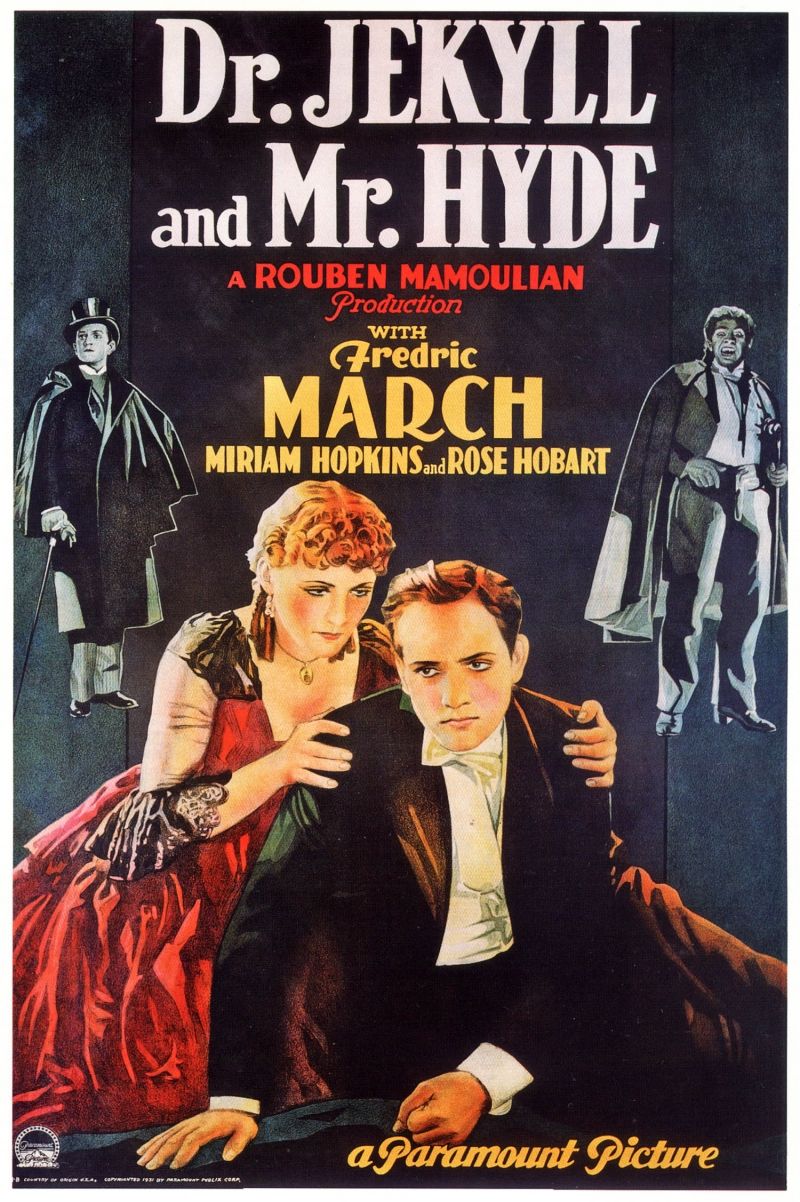
The duality of man is at the heart of DR. JEKYLL AND MR. HYDE in every form, be it Robert Louis Stevenson’s 1886 novella STRANGE CASE OF DR. JEKYLL AND MR HYDE and the 1931 and 1941 film versions with Fredric March and Spencer Tracy, respectively.

Dr. Henry Jekyll (March) believes that every man possesses two inside him (one good and one bad) and he puts this belief to the test with his creation of a formula that separates his good from his bad. He believes that if good and bad are separated, men will become truly liberated. Jekyll’s downfall will be his arrogance and his contempt for both his peers and the bounds for which one should not go.

Jekyll transforms into Mr. Edward Hyde, unleashing his inner demons on the world, especially a down-on-her-luck cabaret singer named Ivy Pearson (Miriam Hopkins). Jekyll saves Miss Pearson one night from a mugging and the very attractive young woman shows her appreciation to Jekyll in ways (bare legs, a kiss) that hasten Jekyll’s transformation into Hyde. It’s that leg that sticks with Jekyll, who’s engaged to be married to the socially respectable Muriel Carew (Rose Hobart) and you can go ahead and read socially respectable as dull. (The movie takes full advantage of coming before the Production Code that would have downplayed the sexual angle.)

Jekyll’s suave and sophisticated, well-respected, and known for both his decency and charitable works, but Hyde’s more a Neanderthal than a 19th Century Man with violent outbursts common and incredible physicality like brute strength and super jumping ability. Hyde is the darker side of Jekyll’s personality that he has repressed for so long, as a man of science turns into a homicidal maniac even without any potion.

Like many scientists in the movies, Jekyll messes around with things no man should and he pays the price dearly. There’s a dialogue scene between Jekyll and his friend Dr. Lanyon that gets to the gist of it:

Lanyon: You’re a rebel, and see what it has done for you. You’re in the power of this monster that you have created.
Jekyll: I’ll never take that drug again!
Lanyon: Yes, but you told me you became that monster tonight not of your own accord. It will happen again.
Jekyll: It never will. I’m sure of it. I’ll conquer it!
Lanyon: Too late. You cannot conquer it. It has conquered you!

March (1897-1975) was one of the best actors of his era on both stage and screen, winning two Academy Awards for Best Actor and two Tony Awards, and he gives two of the greatest performances in any horror film as Jekyll and Hyde, because they both take up residence in our mind.

For his work as Jekyll and Hyde, March tied with Wallace Beery (THE CHAMP) for the Academy Award for Best Actor. Should he not have won outright for playing two roles masterfully?

(Alas, March received one more vote than Beery. Unfortunately, though for March, Academy rules at that point in time considered an one-vote margin to be a tie. Thus, March and Beery tied for the award. This would not be the case any longer under Academy rules.)

DR. JEKYLL AND MR. HYDE, like many horror movies from the 1930s and 1940s, sticks with you long after it’s over and not only for its compelling themes and March’s performances but also for the use of POV shots and lap dissolves, transformation scenes, Hopkins’ performance as Ivy, and its evocation of a Victorian London that made Jekyll say “London is so full of fog, that it has penetrated our minds, set boundaries for our vision.”

Atmospheric has been used to describe the film directed quite masterfully by Rouben Mamoulian only a couple times.

Mamoulian pulls out all the stops in realizing the movie creatively.

Mamoulian on the transformation scene, “I asked, ‘What kind of sound can we put with this? The whole thing is fantastic. You put a realistic sound and it will get you nowhere at all.’ So again, you proceed from imagination and theory and if it makes sense, do it. I said, ‘We’re not going to have a single sound in this transformation that you can hear in life.’ They said, ‘What are you going to use?’ I said, ‘We’ll light the candle and photograph the light, high frequencies, low frequencies, direct from light into sound. Then we’ll hit a gong, cut off the impact, run it backward, things like that.’ So I had this terrific kind of stew, a melange of sounds that do not exist in nature or in life. It was eerie but it lacked a beat, and that’s where I had to introduce rhythm.

“So I said, ‘We need a beat.’ We tried all sorts of drums, but they all sounded like drums. When you run all out of ideas, something always pops into your head. I said, ‘I’ve got it.’ I ran up and down the stairway for two minutes until my heart was really pounding … and said, ‘Record me.’ And that’s the rhythm of the big transformation. So when I say my heart was in JEKYLL AND HYDE, it’s literally true.”

Invasion of the Bee Girls (1973)

DAY 99, INVASION OF THE BEE GIRLS.jpg

INVASION OF THE BEE GIRLS (1973) Three-and-a-half stars
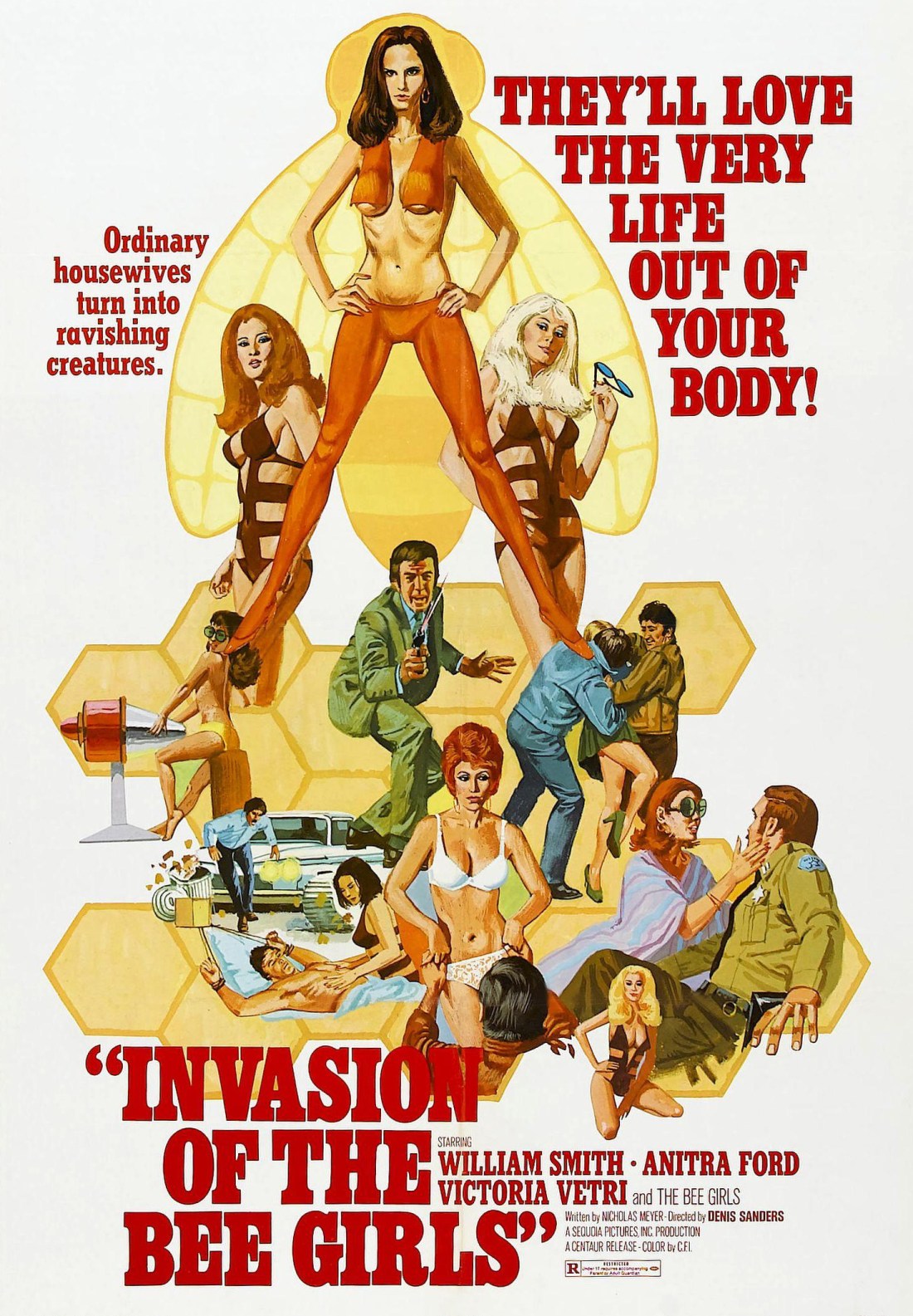
Granted, you know yourself better than anybody else, but tell me if this tagline / synopsis just doesn’t hook you in right away: “A powerful cosmic force is turning Earth women into queen bees who kill men by wearing them out sexually.”

I mean, sign me up to watch that movie!

Did Valerie Solanas ­— author of the SCUM (Society for Cutting Up Men) Manifesto and famous for her attempted assassination of Andy Warhol — write INVASION OF THE BEE GIRLS?

Not even close, because INVASION OF THE BEE GIRLS gives us a Grade-A B-nudie flick and you know that when the most prudish character is played by a former Playmate of the Year (Victoria Vetri, when she went under the name Angela Dorian).

Anyway, future STAR TREK II: THE WRATH OF KHAN and TIME AFTER TIME scribe and director Nicholas Meyer wrote this one and it’s something that he can be proud about. I mean, it’s something that I would be proud about writing.

Apparently not, since Meyer wanted to have his name removed from the credits before his manager talked the Hollywood newcomer down. Upon further research, Meyer’s script had been altered while he visited his family, hence that whole wanting his name stricken from the permanent record.

I bet folks ask him all the darn time about THE WRATH OF KHAN and TIME AFTER TIME, and understandably so, but how about INVASION OF THE BEE GIRLS, a film that I believe rates with THE WRATH OF KHAN and TIME AFTER TIME on an entertainment level.

I don’t know, I enjoyed this film like I enjoyed Russ Meyer classics FASTER, PUSSYCAT! KILL! KILL! and BEYOND THE VALLEY OF THE DOLLS and let’s face it that I’m amused by such a ridiculous premise and I’m turned on by the women in this film like I am the women in FASTER PUSSYCAT and BEYOND THE VALLEY.

In his IMDb profile, William Smith’s biography starts “Biker, bare-knuckle brawler, cowboy, Bee-Girl fighter, vampire hunter … William Smith has done it all.” Over a long career, you might remember him for being at odds with Joe Namath in the biker flick C.C. AND COMPANY (1970) or being Clint Eastwood’s fisticuffs opponent in ANY WHICH WAY YOU CAN (1980), which could go 15 rounds with THEY LIVE’s fight scene between Roddy Piper and Keith David.

Obviously, William Smith’s government agent Neil Agar can hang with the bizarre world of INVASION OF THE BEE GIRLS.

Ultimately, though, it’s not about him and the beautiful women, led by Anitra Ford’s Dr. Susan Harris and the Brandt Research Facility, and the dirty old men here make the horny scientists in TOWER OF EVIL (1972) chaste in comparison. Look up “horny scientist flick” and INVASION OF THE BEE GIRLS should be depicted with the incredible bee girl transformation sequence filed Exhibit A.

I can’t go without mentioning the line “They’re dropping like flies.” I love it every single line, every single time. If I would have had the opportunity to meet late character actor Cliff Osmond (1937-2012), I would have made him read me that line.

Other taglines for INVASION OF THE BEE GIRLS: “They’ll Love the Very Life Out of Your Body!”, “Ordinary housewives turn into ravishing creatures,” and “They’ll Turn You on from Dusk to Dawn.”

Other titles for INVASION OF THE BEE GIRLS: “The Honey Factor” (working); “Alien Predators” (bootleg); “Graveyard Tramps” (reissue). On French TV, the movie plays as INVASION OF THE BEE GIRLS.

You can find copies of INVASION OF THE BEE GIRLS everywhere, since its D-cups are public domain.

I came across it on at least two different cheapie 50-movie horror packs from Mill Creek that stack up public domain titles ranging from classics like NOSFERATU and NIGHT OF THE LIVING DEAD to less than classics, some of them so bad that I don’t want to even name them.

MGM packaged INVASION OF THE BEE GIRLS with INVASION OF THE STAR CREATURES during its epic “Midnite Movies Double Feature” DVD series.

There’s also INVASION OF THE BEE GIRLS packaged with THE DEVIL’S 8, UNHOLY ROLLERS, and VICIOUS LIPS on the “4 Cult Movie Marathon Volume One” DVD … and the Bee Girls also have a Scream Factory solo Blu-Ray release.

Full Metal Jacket (1987)

day 65, full metal jacket

FULL METAL JACKET (1987) Four stars
I’m a firm believer in the “Full Metal Jacket Fallacy.”

Why, that’s when fools argue the first half of Stanley Kubrick’s FULL METAL JACKET is just brilliant and the second half flat-out sucks donkey testicles.

I’ve heard that argument many, many times in high school, college, and probably will continue to hear it for all my living days. You’re all wrong and I have no problem saying that.

Yes, I would agree the first half’s superior to the second, especially thanks to the powerhouse performances by R. Lee Ermey (1944-2018) and Vincent D’Onofrio, but the second half does not suck.

Granted, I do believe Kubrick’s Vietnam begins with our main protagonist Private Joker (Matthew Modine) and his sidekick Rafterman (Kevyn Major Howard) picking up a Da Nang hooker. In dialogue sampled by infamous rap group 2 Live Crew, she says, “Me so HORNY. Me love you long time.” Anyway, she goes on to guarantee “Me sucky-sucky. Me love you too much” and later on, we hear “Sucky! Sucky! Five dolla!,” rather infamous words. She’s relentless, I’ll give her that.

So, yeah, I can see why people think FULL METAL JACKET sucks during its second half, since hearing “suck” so many times conditioned them into believing the Vietnam portion sucked. I get it now, after many years of being mystified.

FULL METAL JACKET, as many already know, made several great contributions to the English language and it furthered cursing more than just about any other film in cinematic history. Ermey, in particular, used profanity like other artists use clay.

For example, I learned such timid little phrases as “I didn’t know they stacked shit that high,” “Only steers and queers come from Texas” (an Oklahoma variation on this line used in AN OFFICER AND A GENTLEMAN), and “I bet you’re the kind of guy that would fuck a person in the ass and not even have the goddamn common courtesy to give him a reach-around.”

Not that I ever use such phrases, I promise.

That’s good, since I first watched FULL METAL JACKET around the age of 10 on home video. Right around that same moment in time, I first watched films like COMMANDO, THE TERMINATOR, PREDATOR, PLATOON, and STAND BY ME, all films that definitely had an impact on me, though I found their vulgarity funny at the time in a different way than years later. I did not know what most of the words meant upon first viewing, but found them funny in just how they sounded and how they were delivered. I picked up the meanings in later viewings, and I still find them all funny.

STAND BY ME, as well as THE BAD NEWS BEARS, especially proved revelatory, in that kids from different eras cussed.

I mean, STAND BY ME gave us the line “A pile of shit has a thousand eyes” and Tanner Boyle in THE BAD NEWS BEARS, why he’s one of the greatest foul-mouthed hooligans in history.

Ermey and D’Onofrio give two brilliant performances, but since they’re in a film directed by Kubrick (1927-99), they were not nominated for the Academy Awards.

That’s because Kubrick’s often considered the real star in his movies and he’s one of the greatest directors ever whose credits include THE KILLING (watch this one followed by RESERVOIR DOGS), PATHS OF GLORY, SPARTACUS, DR. STRANGELOVE, 2001, A CLOCKWORK ORANGE, BARRY LYNDON, THE SHINING, and EYES WIDE SHUT.

Kubrick made 13 feature films during his career from 1953 through 1999. He was a photographer for Look magazine in the late 1940s and early 1950s, and that background informs all his films. They all have indelible scenes.

Kubrick’s films grow better over time and they’re generally perceived more favorably after cold or hostile receptions during their first theatrical release. They have a timeless quality about them.

How often were the actors’ performances saluted by the industry?

Seemingly not very often.

Peter Ustinov won the 1961 Academy Award for Best Supporting Actor for SPARTACUS, probably the project least satisfactory personally to Kubrick.

Sue Lyon won the Golden Globe for Most Promising Newcomer for her work in LOLITA and James Mason, Shelley Winters, and James Mason were nominated along with Lyon.

Peter Sellers received a 1965 Academy Award Best Actor nomination for DR. STRANGELOVE. Sellers played three roles … and he lost the award to Rex Harrison, Professor Henry Higgins in MY FAIR LADY. (Lee Marvin won the next year for two roles in CAT BALLOU, so it must have been easier to win for two roles rather than three.)

All of the awards and nominations for 2001 were either technical (visual effects, cinematography, production design) or for Kubrick and writer Arthur C. Clarke, though Douglas Rain, as the voice of HAL 9000, gives one of the best performances in any film. How would you like to have been beaten out by a sentient computer? No, instead, the 1969 Academy Award nominees for Best Actor were Cliff Robertson in CHARLY, Alan Arkin in THE HEART IS A LONELY HUNTER, Alan Bates in THE FIXER, Ron Moody in OLIVER!, and Peter O’Toole in THE LION IN WINTER … with the prize to Robertson. Who remembers their performances? Honestly … we all remember HAL 9000, “Look Dave, I can see you’re really upset about this. I honestly think you ought to sit down calmly, take a stress pill, and think things over.”

Nearly all the kudos for A CLOCKWORK ORANGE were technical or for the director, like before, but Malcolm McDowell earned a Golden Globe nomination for his performance as larger-than-life Alex DeLarge.

BARRY LYNDON won 1976 Academy Awards for best production design, best costume design, best cinematography, and best original score.

Jack Nicholson won Academy Awards for Best Actor in 1976 (ONE FLEW OVER THE CUCKOO’S NEST) and 1998 (AS GOOD AS IT GETS) and for Best Supporting Actor in 1984 (TERMS OF ENDEARMENT), but he got no love for THE SHINING though his flamboyant performances before and after Kubrick received nominations. I mean, for example, is Nicholson’s performance in THE SHINING all that different from his one in ONE FLEW OVER THE CUCKOO’S NEST?

EYES WIDE SHUT received no Academy Award nominations, just like THE SHINING before it, although Tom Cruise and Nicole Kidman do some of their best work.

Back to FULL METAL JACKET.

Kubrick, Michael Herr, and Gustav Hasford received the film’s lone Academy Award nomination for Best Adapted Screenplay, while both Ermey and D’Onofrio were both separately nominated for Best Supporting Actor, Ermey by the Golden Globes and D’Onofrio by the Boston Society of Film Critics.

I doubt there were better performances from any films released in 1987.

Erney and D’Onofrio bring their characters Gunnery Sergeant Hartman and Private Leonard “Gomer Pyle” Lawrence to such life that they stay with us for the rest of the movie after their unfortunate, tragic demise at the end of the Parris Island sequence. Their characters stay with us forever, in fact, and I venture to say that’s a definition of a great performance.

If somebody mentions Gomer Pyle, for example, I think first of FULL METAL JACKET and not Jim Nabors of “The Andy Griffith Show” and “Gomer Pyle, U.S.M.C.” Please consider that, for a second.

D’Onofrio gained 70 pounds for the role of the overweight Gomer Pyle, who finds that he’s only got one true skill in basic training. Those 70 pounds surpassed what Robert DeNiro did for RAGING BULL, and that performance earned an Academy Award.

Ermey served as a U.S. Marine drill instructor during the Vietnam War and this real experience informed his performance as Hartman.

Kubrick allowed Ermey to ad lib his dialogue, something that does not jibe with Kubrick’s reputed uncompromising perfectionism. In fact, Google “Kubrick perfectionist” and see results like a Telegraph article titled “The relentless, ridiculous perfectionism of Stanley Kubrick.”

I don’t know, Kubrick earned his reputation for relentless perfectionism, of course, but what about Sellers in DR. STRANGELOVE or, for that matter, George C. Scott’s War Room stumble in that same film? Or McDowell’s “Singin’ in the Rain” number in A CLOCKWORK ORANGE? Or Nicholson’s “Here’s Johnny” in THE SHINING? Ad libs, ad libs, ad libs.

Kubrick and his films are complex, contradictory, and controversial, and that’s part of why they stand the test of time.

The 36th Chamber of Shaolin (1978)

day 38, the 36th chamber of shaolin

THE 36TH CHAMBER OF SHAOLIN (1978) Four stars
Wu Tang Clan founder RZA said that he’s probably watched THE 36TH CHAMBER OF SHAOLIN more than 300 times, beginning with a dub on TV (called THE MASTER KILLER) and then continuing through many, many viewings in seedy urban theaters.

RZA has shown the movie the same devotion that its central character Liu Yude / Monk San Te (Gordon Liu) shows in THE 36TH CHAMBER OF SHAOLIN.

THE 36TH CHAMBER OF SHAOLIN truly takes off into the stratosphere of the highest level of martial arts entertainment when our protagonist arrives at the Shoalin Temple around the 31st minute.

Training sequences have long been a staple of action movies, in everything from THE DIRTY DOZEN and FULL METAL JACKET to ROCKY, DRUNKEN MASTER, and THE KARATE KID, just a few prominent examples.

However, I’ve never seen anything quite like the training sequences in THE 36TH CHAMBER. They’re on another level, taken far more seriously than usual.

Training sequences in a lot of movies seem to end up being consolidated into a couple montages and topped off with an uplifting song along the lines of Bill Conti’s “Gonna Fly Now” (ROCKY). We’ve seen it time and time again, a standard of the action movie relentlessly satirized in TEAM AMERICA: WORLD POLICE.

THE 36TH CHAMBER gives us a good 45 minutes of training, helped out by the fact there’s 35 chambers in the Shaolin Temple. San Te advances more rapidly than any student ever before, six years that, through the magic of movies, goes by quickly. I could have gone for the entire movie being nothing but training sequences, though.

It all leaves you with an unbelievably giddy feeling as he cracks every level, bests every challenge. The challenges are not merely physical, and there’s a rigorous attention to detail rare for any genre.

San Te wants to create a 36th chamber to teach the common man the basics of Kung Fu. He’s rebuffed and sent back out into the larger world.

San Te sought sanctuary at the temple because, as a young student named Liu Yude, he took part in an uprising against the Manchu government.

Now, back in the world, equipped with his three section staff invention, San Te’s ready for combat against those heartless Manchu oppressors.

After vanquishing his foes, San Te eventually returns to the temple and establishes that 36th chamber.

Of course, he becomes a folk legend.

Beyond the usual suspects Bruce Lee and Jackie Chan, Gordon Liu is one of my absolute favorite martial arts stars. In addition to THE 36TH CHAMBER, notable titles in his filmography include CLAN OF THE WHITE LOTUS, RETURN TO THE 36TH CHAMBER, and EIGHT DIAGRAM POLE FIGHTER.

Western audiences likely know Liu best from his role in Quentin Tarantino’s KILL BILL movies, where he played Johnny Mo and Pai Mei in the two parts, respectively. Pai Mei in EXECUTIONERS FROM SHAOLIN and Priest White Lotus in CLAN OF THE WHITE LOTUS, both villains, inspired Tarantino’s Pai Mei.

(Please watch CLAN OF THE WHITE LOTUS if you want another screw loose entertainment. Liu defeats Priest White Lotus in one memorable final fight that incorporates the fine art of needlepoint.)

Liu had the necessary movie star charisma and joy of performing to carry viewers from one end of the picture to the next or stay interested through 35 chambers, to be more precise. Riveting is the word for it.

Liu’s at his best in THE 36TH CHAMBER and the movie does not waste any time in showcasing him, with an opening credits sequence that previews the final hour of the film when it kicks into a high level.

Lo Lieh played the villain General Tien Ta in THE 36TH CHAMBER and he also played both Pai Mei and Priest White Lotus. He played the heavy in a lot of Shaw Brothers films, but one should remember that he played the protagonist in FIVE FINGERS OF DEATH, a film (along with ENTER THE DRAGON) that broke martial arts films in the Western world. Lieh also directed himself as Priest White Lotus.

This is not his best villain, but that’s alright because the training sequences and Liu’s starmaking performance alone make THE 36TH CHAMBER one for the ages.

We know what RZA has to say on that.

“Me and Dirty (Ol’ Dirty Bastard) were probably the most fanatical about it,” RZA said in Rolling Stone. “36TH CHAMBER to me has had a strong spiritual connection that set me and Dirty on the path.

“It’s one film I’ve never gotten sick of. I’ve probably seen this movie more than any other, especially now that it’s something I perform with, but I don’t get tired of it. More than anything, I love watching people discover it. When I was in California doing it at the Egyptian Theater, that was the first time my son, 10 years old, watched the movie. And he loved it. Turning somebody onto a film that’s so dear to you is, to me, for me, the coolest thing.”

RZA provided a live score to THE 36TH CHAMBER at various Alamo Drafthouse Cinema screenings.

The Old Dark House (1932)

day 15, the old dark house

THE OLD DARK HOUSE (1932) Four stars
Stop me if you think you’ve heard this plot before: On a dark and stormy night, five travelers are caught up in one helluva storm and flooded out roads make it virtually impossible for travel by motorcar. Our travelers seek out overnight shelter from the storm and take refuge at the nearest house.

Next time, of course, our travelers might just take their chances with the rain and the mud rather than people like the ones they find inside that house or, if nothing else, keep walking and eventually find another house with different people inside.

THE OLD DARK HOUSE takes this old-fashioned plot (probably old-fashioned in 1932) and classes it up because of atmosphere, the cast, and the sharp screenplay by J.B. Priestley, Benn Levy, and R.C. Sherriff.

It’s directed by that master of 1930s cinema, James Whale, whose credits include WATERLOO BRIDGE, FRANKENSTEIN, THE INVISIBLE MAN, BRIDE OF FRANKENSTEIN, and THE GREAT GARRICK, some of the best from that era.

Whale’s movies generally have style for miles and miles, and intelligence and wit at their core to go along with their atmosphere.

THE OLD DARK HOUSE is no different, and cinematographer Arthur Edeson and production designer Charles D. Hall do wonders to create a sustained mood for 72 minutes. You’re in the hands of master craftsmen, as well as master performers.
Worlds collide in THE OLD DARK HOUSE.

The Femm house contains dread people who have dread secrets: brother and sister Horace (Ernest Thesiger) and Rebecca (Eva Moore), butler Morgan (Boris Karloff, still not speaking after FRANKENSTEIN), 102-year-old patriarch Sir Roderick Femm (played by a woman named Elspeth Dudgeon when the credits give John Dudgeon), and the pyromaniac named Saul (Brember Willis) who’s kept hidden in a locked room. Horace and Rebecca behave like they’re hiding something (namely their brother Saul) and Morgan, why he’s a mean drunk.

Our travelers are Philip Waverton (Raymond Massey) and his wife Margaret (Gloria Stuart) and Roger Penderel (Melvyn Douglas) and then Sir William Porterhouse (Charles Laughton) and his girlfriend Gladys DuCane (Lilian Bond), who come calling at dinner time.

You can basically guess what happens in THE OLD DARK HOUSE and while that normally sinks lesser pictures, you want the travelers to encounter the dread people and discover the dread secrets inside the Femm house, because you know that you will enjoy watching this plot unfold. We want to see who gets out of there alive in the morning.

There’s really not anything complicated about THE OLD DARK HOUSE, but it’s one of the best examples of the haunted house film, a branch of the horror genre that includes such films as THE SHINING, POLTERGEIST, AMITYVILLE HORROR, and the first two EVIL DEAD movies.

The late film critic Roger Ebert loved to say “It’s not what a movie is about, it’s how it is about it.”

THE OLD DARK HOUSE could be used as one of the exhibits for that argument.

Troll 2 (1990)

day 98, troll 2

TROLL 2 (1990) Three stars
It’s about time we get around to discussing the “good” bad movie, because none of the movies I have reviewed before fit the bill for this niche more than TROLL 2.

It took me years to finally watch the full movie, and I watched it twice on Christmas. Two on New Year’s Day for MAD MONKEY KUNG FU, and there you go, I wrote my “How I spent my winter vacation” essay. I’ll leave out the part about the 15 games at the Holiday Classic basketball tournament.

Of course, I had seen the infamous “Oh my God!” scene numerous times and I even watched THE BEST WORST MOVIE, a documentary from several years back on the TROLL 2 phenomenon directed by its child star, Michael Stephenson, all grown up. The documentary allows you to catch up with Darren Ewing, the first-time actor who played Arnold and uttered the line that should have made AFI’s 100 Years, 100 Quotes list. I mean, for crying out loud, couldn’t they have taken away one damn quote from CASABLANCA? Not only Ewing, but we catch up with several of the guilty parties from TROLL 2 in THE BEST WORST MOVIE.

TROLL 2 is not a good movie in any traditional sense of the concept, but it’s such a glorious train wreck that I was always entertained from stem to stern, all 94 glorious minutes. LEONARD PART 6 wishes it was this bad and this good.

We have an Italian director and crew who did not speak fluent English directing and writing an English language film, a ridiculous concept based on the screenwriter’s apparent contempt for vegetarianism (similarities with LEONARD PART 6 afoot), inexperienced and just plain bad actors behind every scene, and even an incompetent title, since TROLL 2 does not bear any direct relation to the 1986 film TROLL other than a marketing attempt by a studio that had no faith in a movie titled GOBLINS. See, there’s no actual trolls in TROLL 2 and its fictional town of “Nilbog,” which is oh wow Holy Toledo “goblin” spelled backwards. Haven’t seen that device for a while. Sheer genius.

Unfortunately, despite the Italian production with director and screenwriter Claudio Fragasso (under the pseudonym Drake Floyd) and vegetarian-hating screenwriter Rossella Drudi, there’s no soundtrack by Goblin, who did the work on several Dario Argento classics.

However, there’s a Boston based folk and punk quartet called Troll 2. On their website, they have releases “Death Magnanimous,” “Inheritance,” and “Nobody Cares.” They play the “Theme from Troll 2” twice on “Death Magnanimous,” their EP released in June 2018.

Lunaris Records released the soundtrack for the film and their hype includes “Composed by Italian maestro Carlo Maria Cordio, the soundtrack offers an eclectic mix of synth, bluegrass, and guitar rock jams.” Only $14! And they even provided samples on their site.

Why, you can’t piss on hospitality!

TROLL 2 was made on an estimated $200,000 budget and I’m not exactly sure where the money went. Oh, sure, probably on the special effects.

It was released October 12, 1990, not sure if that was theatrical or just straight to video infamy. Some of the other movies released that day include THE HOT SPOT, MEMPHIS BELLE, MR. DESTINY, and WELCOME HOME, ROXY CARMICHAEL. A week later, it was NIGHT OF THE LIVING DEAD, QUIGLEY DOWN UNDER, and WHITE PALACE.

I am not even sure that TROLL 2 made back its budget on first release. Not sure that I can even find a non-retrospective review. This is definitely one of those cases where I’d love to go back in time and see people’s original reactions to the movie.

Finding a poster for TROLL 2, I discovered that it says “Celebrate one of the most disrespected horror films in recent history and fall in love with this genuine failure. Troll 2 is coming to EAT a theater near you” at the bottom.

Guess the movie failed instantly and then became a success because it failed on such an epic scale.

On Rotten Tomatoes, there’s one positive review of the movie and 17 negatives, although the blurb for the positive review by Kevin Carr of 7M Pictures goes like “godawfulness in the best way imaginable.” No other movie deserves such a blurb, and the positive review is not very different from the negative ones.

In a 2010 review in the Chicago Reader, J.R. Jones gave TROLL 2 one star and BEST WORST MOVIE two. He attacks the “so bad it’s good” train of thought and starts off with a bang.

“Nobody knows the troubled movies I’ve seen. In the past eight years I’ve reviewed over 2,000 releases for the Reader, and at least half of them were bad. If we assume an average running time of 90 minutes, then since 2002 I’ve spent some 1,500 hours watching bad movies. For that reason I’m relatively immune to the blandishments of midnight-movie fans claiming that some egregious turkey, be it THE APPLE or THE ROOM or XANADU or THE TERROR OF TINY TOWN or PLAN 9 FROM OUTER SPACE, is ‘so bad it’s good.’ Life is short, given the choice, I’d rather watch something so good it’s good. I’ve yet to come across a movie so good it’s bad.”

At the start of 2019, TROLL 2 is ranked No. 26 on the IMDb’s Bottom 100. DISASTER MOVIE (2008) currently sits in the top spot and such icons of cinematic badness as No. 2 MANOS: THE HANDS OF FATE, No. 3 SUPERBABIES: BABY GENIUSES 2, No. 4 THE HOTTIE & THE NOTTIE, No. 10 SON OF THE MASK, No. 11 FROM JUSTIN TO KELLY, No. 16 BATTLEFIELD EARTH, No. 18 GLITTER, No. 19 GIGLI, and No. 25 JAWS THE REVENGE are “below” TROLL 2.

I am far more forgiving of TROLL 2 than I am, for example, BATTLEFIELD EARTH, a movie that wasted $73 million and still looks like shit. On Rotten Tomatoes, it has four positive reviews and 144 negative; four positives are from Scott Chitwood (IGN Movies), Bob Graham (San Francisco Chronicle), JoBlo (JoBlo’s Movie Emporium), and Luke Y. Thompson (New Times). That’s just more proof that every now and then we all find things in certain movies that many, many, many others do not.

On a certain fundamental level, though, I am sure that I can quote from BATTLEFIELD EARTH just as much as TROLL 2, especially with all them damn references to the home office.

I remember BATTLEFIELD EARTH’s head villain loved to throw around the insult “rat brain.” Oh, how that Terl makes me wanna hurl.

I don’t know, BATTLEFIELD EARTH just made me feel glad that I won’t be alive in the year 3000.

Guess there’s a fundamental difference between an unpleasant bad movie and a pleasant one. You just feel it when you see it. I wanted to flee the multiplex during such cinematic mishaps as WHITE NOISE and THE HAPPENING, but I was gripped and did not want to miss the next potential bad scene or line of dialogue. I mean, I would be punching myself silly had I missed that “What? No!” scene in THE HAPPENING, but, other than that unintentional bit of hilarity, THE HAPPENING was THE CRAPPENING. M. Night Shyamalan’s PRETENTIOUS LOAD OF CRAP.

I knew coming into TROLL 2 that it would be awful, godawful in fact, and it did not disappoint on that level. For that, I give it a positive review. I am glad being in the movie’s not on my résumé, although I’m not sure that I’ll put liking TROLL 2 on mine.

All Quiet on the Western Front (1930)

day 64, all quiet on the western front

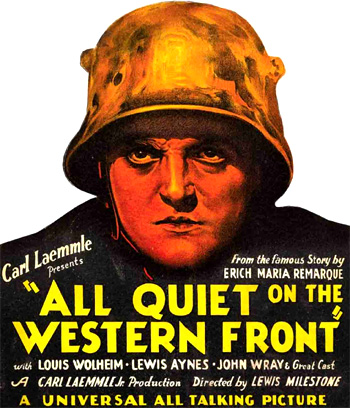
ALL QUIET ON THE WESTERN FRONT (1930) Four stars
Working on a master’s degree in history (world history emphasis), the last three credit hours I needed were from an internship.

In the summer of 2005, I worked a three-week, 120-hour internship at the National Archives (no, I did not see Benjamin Gates or Nicolas Cage playing another character, for that matter) on Bannister Road, Kansas City. I worked a week on a file project, utilized a spatula to remove “sensitive” staples from at least 100-year-old Fort Leavenworth prisoner files (another week), spent a day looking up family history, and visited what became the National WWI Museum and Memorial. In the past, before September 11, 2001, of course, interns were allowed to keep both their federal employee badges (needed to enter the facility) and their spatula. I settled for a picture of the badge.

At that point in time in the WWI museum, they only had the gift shop completed and open to the public, so I bought a Buffalo Soldier T-shirt (absolutely loved that design) and German author Erich Maria Remarque’s remarkable book “All Quiet on the Western Front,” a book originally released in 1929 and made into an Academy Award for Best Picture winner in 1930.

I wanted to go back to the Archives as full-time employee, but alas, it did not come to be after multiple tries. Finally, in 2008, after three years of frustration and substitute teaching (just another phrase that means “frustration”), I returned to Pittsburg State and embarked on a new path that led to where I am today.

(Of course, when I did the internship, I enjoyed telling people, “I work for the government. … I could tell you, but I’d have to kill you.”)

I watched the movie before I read the book and both are essentials. However, I’ll just focus on the movie (directed by Lewis Milestone) within this space.

We follow a group of German young men, predominantly Paul Baumer (Lew Ayres), from when they’re idealistic prep school students who are inspired to enlist by their jingoistic teacher to their inevitable disillusionment after being hit straight in the face with the brutal realities of World War I. Death, mutilation, rations, starvation, trench warfare, on down the line, and finally Paul asks the fundamental questions of life and death and what exactly is he fighting for.

When he returns to his old classroom where his former teacher still gives the students the same old propagandistic spiel as before, Paul confronts him and the students, “We used to think you knew. The first bombardment taught us better. It’s dirty and painful to die for your country. When it comes to dying for your country, it’s better not to die at all! There are millions out there dying for their countries, and what good is it?”

The students yell and scream COWARD at Paul.

Of course, one would be easily tempted to say that it’s much easier telling an anti-war story from a German perspective, since war is more Hell for the “losing” side. Notice the difference in World War II movies from Germany and Japan versus movies from Great Britain and the United States, for example.

Francois Truffaut (1932-84), first a film critic and then a director himself whose credits include THE 400 BLOWS, JULES AND JIM, and THE WILD CHILD, reportedly told Gene Siskel in a 1973 interview, “I find that violence is very ambiguous in movies. For example, some films claim to be anti-war, but I don’t think I’ve really seen an anti-war film. Every film about war ends up being pro-war.”

Anyway, Truffaut became famous for saying “There’s no such thing as an anti-war film”; for example Roger Ebert used it when reviewing PLATOON. The actual original Truffaut anti-war film quote seems to be quite elusive.

The thinking behind the quote (whether Truffaut said it or not) is that movies glorify whatever behaviors are being shown or war movies make war seem attractive, glamorous, et cetera, basically cinematic propaganda that’s an upgrade on what Paul’s school teacher tells generations of young men in the classroom.

On that train of thought, it makes ALL QUIET ON THE WESTERN FRONT pro-war rather than anti-war, despite any noble intentions and whatever dialogue comes out of the characters’ mouths.

However, ALL QUIET ON THE WESTERN FRONT definitely had an impact on Lew Ayres, the 22-year-old actor who played Paul.

Ayres became a conscientious objector during World War II, basing it on his pacifism. Ayres said, “To me, war was the greatest sin. I couldn’t bring myself to kill other men,” and he told the draft board in Beverly Hills, “Don’t think I am trying to save my neck. I would like to be of service to my country in a constructive way and not a destructive way.”

Since Ayres did not belong to any organized religion and did not have any formal religious training, he faced long odds in being classified a CO. The draft board deliberated on Ayres’ case for months and they mistakenly classified him IV-E, meaning that he objected to all military service. Ayres preferred to be I-A-O, meaning that he could have noncombatant military service like the medical corps he most desired. The draft board assigned the IV-E Ayres to a labor camp in Wyeth, Oregon.

The public, especially the Hollywood community, hit Ayres with a major wave of backlash. Of course, this was early 1942, months after Pearl Harbor and months after the United States surrendered neutrality and joined World War II against the Axis powers (basically Germany, Italy, and Japan). It looked extremely bad for a Hollywood actor to be a conscientious objector.

A soldier, though, wrote a letter of support to Time, “Lew Ayres, instead of being detrimental to our public good, is indicative of what the American people wrote into their Bill of Rights and what we fight our wars about, the right to freedom in a democracy.”

Over a month later, the draft board reclassified Ayres I-A-O.

Ayres received the assignment to the medical corps that he desired. He served 3 1/2 years in the medical corps and earned three battle stars.

In a story called “The ‘Good’ Conscientious Objector Lew Ayres,” writer Joseph Connor quoted Ayres on his experiences, “I had imagined that war was a horrible thing. But it actually surpassed anything I’d dreamed of. It’s bad enough in the field, where soldiers expect cruelty and death; but in cities, among helpless civilians, the picture is far worse.”

Ayres said that he found it the most difficult to attend to children with bullet holes in them.

The One-Armed Swordsman (1967)

day 37, the one-armed swordsman

THE ONE-ARMED SWORDSMAN (1967) Three-and-a-half stars
Last month, our glossary of cinematic terms included “giallo,” the Italian thriller genre that definitely had an impact on the American slasher film.

Just a few days into November, now we have “wuxia,” a genre of Chinese fiction incorporating martial arts, sorcery, and chivalry.

The genre enjoyed its 15 minutes of fame in America during the successful run of CROUCHING TIGER, HIDDEN DRAGON (2000). (I’ll never forget the tittering of some in the audience throughout its two hours at the Pittsburg 8 Cinema. I loved the movie.)

There’s just something about handicapped swordsman movies from the 1960s, but, then again, maybe only I have this problem.

Back in the days of a free Hulu account, I enjoyed the heck out of the Japanese ZATOICHI THE FUGITIVE, ZATOICHI ON THE ROAD, and ZATOICHI AND THE CHEST OF GOLD, starring Shintaro Katsu as the blind swordsman Zatoichi.

Just a couple years ago, I caught up with THE ONE-ARMED SWORDSMAN and its sequel released two years later, RETURN OF THE ONE-ARMED SWORDSMAN, both part of the Dragon Dynasty DVD series of releases that will give viewers a greater sense of where Quentin Tarantino found his inspiration. (One should also seek out 1976’s THE ONE-ARMED BOXER VS. THE FLYING GUILLOTINE, another highly entertaining concoction in the same league with INFRA-MAN and DRUNKEN MASTER.)

Jimmy Wang Yu stars as the titular protagonist, Fang Kang, whose servant father sacrifices his life to save his teacher and the Chi school of Golden Sword Kung Fu in the opening scene. The servant father’s dying wish is to have his son be taught at his master’s school. Fang Kang’s fellow students, especially the teacher’s daughter, grow to resent him and they do their best to make him leave. On a snowy night, Pei-er, the teacher’s daughter, challenges Fang Kang to a fight and in anger over his refusal to fight her, she chops off his arm. Dang, girl! Fang Kang flees through the woods.

A young woman named Xiao Man inadvertently finds Fang Kang (he falls into her boat) and nurses him back to good health. He decides that he will give up swordsmanship (we know how that’ll work, especially with the movie’s title) and become a farmer with Xiao Man.

Meanwhile, the bad, bad men led by The Long-Armed Devil and The Smiling Tiger have it out for Fang Kang’s teacher, Qi Ru Feng, and have developed a “sword-lock” device that will be the demise of Qi Ru Feng and all his disciples.

(Wouldn’t you love to be called “The Long-Armed Devil”? Well, that’s not a question for “the short-armed.”)

Fang Kang becomes depressed over not being able to practice his martial arts and the ever-reluctant Xiao Man gives him a half-burned out kung fu manual that she inherited from her dead parents. Fang Kang, of course, becomes a new master, yeah, you guessed it, “The One-Armed Swordsman.”

The One-Armed Swordsman learns of the plot to kill Qi Ru and saves the day.

We could have written this script with one arm tied behind our backs. Just please make it the weak arm.

I should now mention THE ONE-ARMED SWORDSMAN includes much bloodletting, a year’s worth of production at the blood bank in 117 minutes. This bloodletting will likely interest contemporary audiences more than anything else.

Not sure how they made the fake blood in THE ONE-ARMED SWORDSMAN, but there’s recipes for it throughout the Interwebs.

Bet we’ll have to start with corn syrup.

THE ONE-ARMED SWORDSMAN (influenced by American Westerns and Japanese Samurais) ushered in a new era of Hong Kong movies built around male anti-heroes, swordplay, and bloodletting.

This pioneering Shaw Brothers production became the first Hong Kong film to gross HK $1M in returns and made Jimmy Wang Yu an early martial arts star.

Bride of Frankenstein (1935)

day 14, bride of frankenstein

BRIDE OF FRANKENSTEIN (1935) Four stars
Boris Karloff movies could fill an entire year of daily movie reviews.

Karloff (1887-1969) undoubtedly is one of the most prolific actors who ever lived, working steadily from 1918 through 1968.

Karloff established an incredible work pace, especially in the 1930s.

Take, for example, the years 1931 and 1932 alone when Karloff appeared in 24 films, including such classics as FRANKENSTEIN, SCARFACE, THE OLD DARK HOUSE, THE MASK OF FU MANCHU, and THE MUMMY.

He was billed only as “Karloff” in several pictures after FRANKENSTEIN (1931) made him a phenomenon.

For example, a producer’s note before the start of THE OLD DARK HOUSE: “Karloff, the mad butler in this production, is the same Karloff who created the part of the mechanical monster in ‘Frankenstein.’ We explain this to settle all disputes in advance, even though such disputes are a tribute to his great versatility.”

Every time I watch both FRANKENSTEIN and BRIDE OF FRANKENSTEIN (1935), I am just amazed once again by what Karloff was able to do with The Monster.

He’s absolutely phenomenal.

It took make-up artist Jack Pierce four hours every day to make Karloff into Frankenstein’s Monster, with a concoction of cotton, collodion, gum, and green greasepaint. Pierce and Karloff worked together on a multitude of films during the Golden Age of Horror (1930s and 1940s).

The IMDb identified eight Karloff trademarks and I especially like the eighth one: “Making audiences feel sorry for his evil characters by displaying extreme frailty and vulnerability, even when the material didn’t call for this.”

We feel a multitude of things for the Frankenstein Monster, and that’s at the center of the character’s greatness.

We especially feel for The Monster during BRIDE OF FRANKENSTEIN, a rare sequel that builds upon and honestly betters the previous film.

Karloff did not want The Monster to speak, feeling that it would eventually destroy the character. He looks a little differently here than in the first film, because in order to speak more clearly Karloff did not remove the dental plate in his face like he did in the first film. His cheeks appear less hollow as a result.

While giving The Monster the ability to speak could have miserably backfired, it works (like just about everything else) in BRIDE OF FRANKENSTEIN.

The Monster is a quick learner and the writers give him some great lines.

“I love dead … hate living” and “Alone: bad. Friend: good!” might not seem like much on the page, but the way Karloff handles them, they affect viewers on a deep emotional level.

There’s much poignancy to be found in the plight of The Monster.

He’s more like an innocent child than pure evil in both FRANKENSTEIN and BRIDE OF FRANKENSTEIN.

He can’t help what God or Dr. Henry (Victor in the novel) Frankenstein in this case made him.

Like Karloff, Colin Clive returns for the sequel as Dr. Frankenstein and he’s reluctant to the extreme (after the events of the first movie) to participate in Dr. Pretorius’ scheme to make The Monster a bride. Finally, he does though, of course, and it’s back to the laboratory; production designer Charles D. Hall’s lab sets in the first two FRANKENSTEIN films have been endlessly influential.

Clive and Dwight Frye (killed as two different characters in FRANKENSTEIN and BRIDE OF FRANKENSTEIN) are two of the great scenery chewers of all-time, but this is largely Karloff’s and Ernest Thesiger’s show.

Thesiger plays Dr. Pretorius, Dr. Frankenstein’s former teacher and, of course, a rebellious mad scientist. He’s as explicitly homosexual as one could present in a 1935 film and, according to the book “The Monster Show: A Cultural History of Horror” by David J. Skal, openly gay director James Whale told Thesinger to play Dr. Pretorius as an “over-the-top caricature of a bitchy and aging homosexual.”

Frankenstein and Pretorius rank among the best screen mad scientists.

BRIDE OF FRANKENSTEIN can be enjoyed at face value or can be seen as a daring gay parable that sneaked just enough content past the censors.

In the 1997 Gary Morris article “Sexual Subversion: The Bride of Frankenstein” printed in the Bright Lights Film Journal, the author postulates that the movie “assaults the notion of the sanctity of standard sex roles and ‘family values.'” Whale thus made the only sequel that interested him.

“THE BRIDE can be read from a modern perspective as a homosexual joke on the heterosexual communities Whale — a gay man — served and benefited from: his ‘masters’ at Universal and the mass audience to whom he could present unconventional images and ideas and see them unknowingly endorsed and approved in the most direct way possible: from the moviegoer’s pocketbook,” Morris wrote.

Under this theory, Whale’s attacks on hetero institutions can be seen most vividly when The Bride (Elsa Lanchester) rejects The Monster near the end, including a famous hiss that speaks louder than a thousand words. (Reportedly, Lanchester based her spitting and hissing on the swans in Regent’s Park, London.)

Not everything passed the censors enforcing the Motion Picture Production Code: Any references to the sexual arrangements of Mary Shelley (Lanchester in her first of two roles), Percy Bysshe Shelley, and Lord Byron (especially this line of dialogue: “We are all three infidels, scoffers at all marriage ties, believing only in living freely and full”) and “too revealing” shots of Lanchester’s cleavage were cut.

It’s still amazing what Whale put into the film.

Others have dismissed the gay parable angle in BRIDE OF FRANKENSTEIN.

That’s fine because any way you read it, though, BRIDE OF FRANKENSTEIN is a classic.