

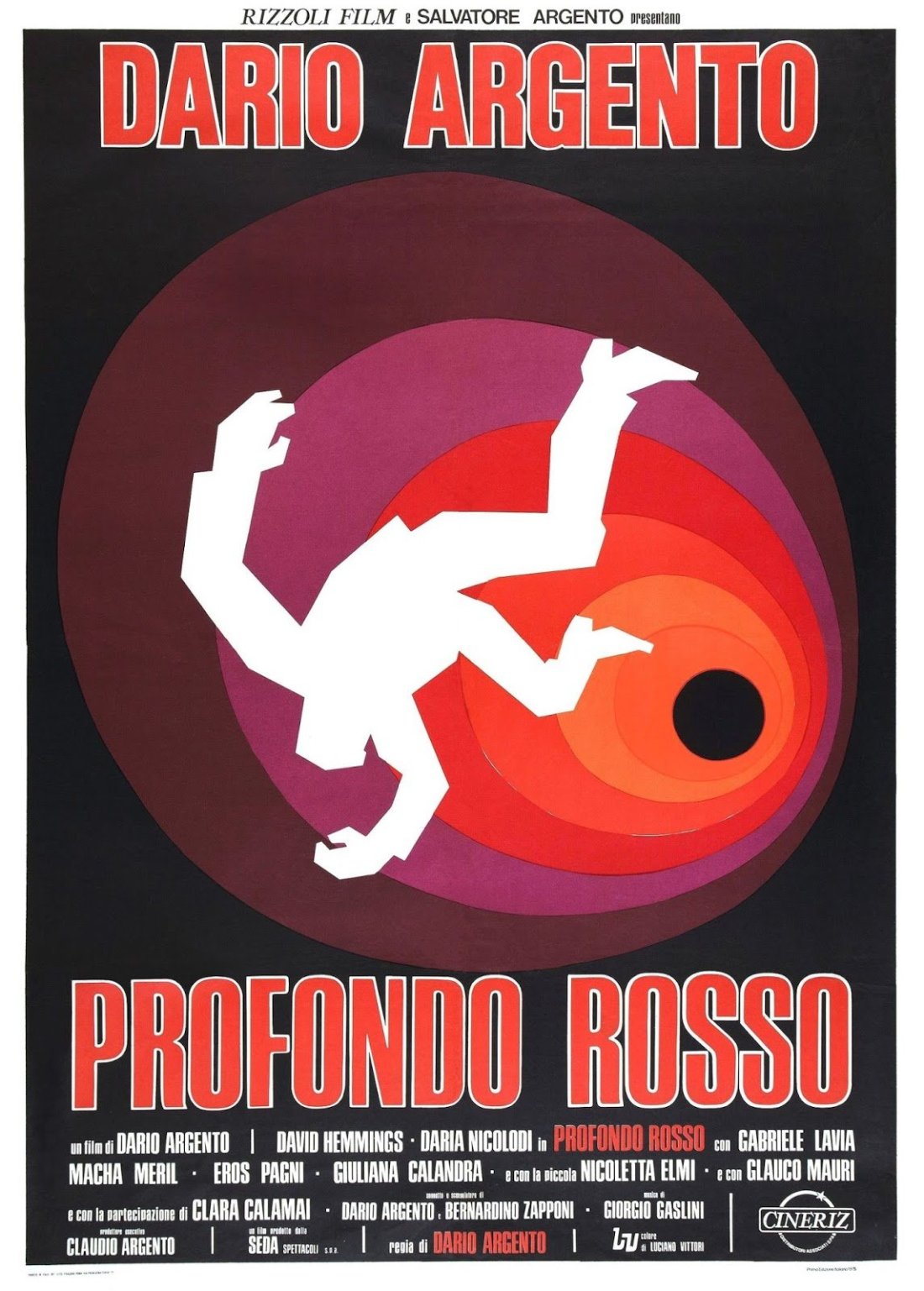
PROFONDO ROSSO (1975) Four stars
Giallo is the Italian word for yellow.
In fiction terms, though, quoting from Wikipedia, giallo means “a 20th century Italian thriller genre of literature and film. Especially outside Italy, giallo refers specifically to a particular Italian thriller-horror genre that has mystery or detective elements and often contains slasher, crime fiction, psychological thriller, psychological horror, exploitation, sexploitation, and, less frequently, supernatural horror elements. In Italy, the term generally denotes thrillers, typically of the crime fiction, mystery, and horror subgenres, regardless of the country of origin.”
An Italian publishing company named Mondadori began releasing crime and mystery novels in 1929 and the series became known as “Il Giallo Mondadori,” distinguished by their heavily yellow front covers. Especially popular were the works of Agatha Christie, Dashiell Hammett, and Raymond Chandler. Mondadori still prints “Il Giallo Mondadori” novels today.
Giallo movies started appearing in the mid-1960s and became a fixture especially in the late 1960s and 1970s through directors like Mario Bava, Dario Argento, and Lucio Fulci, who achieved the greatest international notoriety.
Argento’s PROFONDO ROSSO, also known as DEEP RED or THE HATCHET MURDERS, was the director’s fifth movie and it’s a transitional film, before Argento’s work verged on the fantastical like SUSPIRIA and INFERNO. It and THE BIRD WITH THE CRYSTAL PLUMAGE, his first film, are his best giallos.
Watching PROFONDO ROSSO for the first time, one will be struck by how much you feel like you’ve seen this movie before through later films it influenced such as John Carpenter’s HALLOWEEN and David Cronenberg’s SCANNERS. For example, Goblin’s main theme for PROFONDO ROSSO and Carpenter’s for HALLOWEEN are first cousins. Cronenberg modeled the lead-in to the famous head explosion scene after the early lecture sequence in Argento’s film. Rick Rosenthal’s HALLOWEEN II (produced by Carpenter) featured a death by scalding water scene inspired by Amanda Righetti’s death in PROFONDO ROSSO.
Like the best Argento films, PROFONDO ROSSO sticks with you.
Argento films usually give us a protagonist who’s a writer, a musician, a creative person of some form. In THE BIRD WITH THE CRYSTAL PLUMAGE, it’s American writer Sam Dalmas. In CAT O’NINE TAILS, it’s reporter Carlo Giordani. In FOUR FLIES ON GREY VELVET, it’s rock drummer Roberto Tobias. In PROFONDO ROSSO, it’s pianist Marcus Daly. In SUSPIRIA, it’s American dance student Suzy Bannion. In INFERNO, it’s music student Mark Elliott.
These characters provide us a rooting interest and keep us hanging on through all the convolutions of the plot. They become our surrogate, because they’re normality (just like us) in a mad, mad, mad world. They (and we) are just trying to survive another day. They live out our detective fantasies.
In any mystery, it’s vital that we find that rooting interest.
Argento protagonists normally get in way, way, way over their heads like the ones in Hitchcock films so often do … of course, we see David Hemmings playing Marcus Daly and we cannot help but think of Michelangelo Antonioni’s BLOW-UP, where Hemmings’ very Swinging London photographer believes he may have accidentally photographed a murder in a park. There’s no doubt, though, in PROFONDO ROSSO.
On his way home early in the film, Marcus sees psychic medium Helga Ulmann (Macha Meril) being attacked in her apartment. They live in the same building. He rushes up the stairs and down the hall to her apartment and finds her dead body.
The chief witness becomes the star witness, thanks to female reporter Gianna Brezzi (Daria Nicoladi) and her coverage of the murder, and the reporter and the pianist become partners, both in the romantic and detective sense.
PROFONDO ROSSO is one of those mysteries that rewards our interest to the very end.
 Attack of the Killer Librarian