

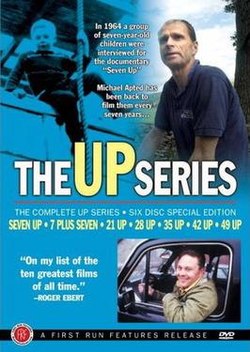
THE UP SERIES (1964- ) Four stars
In his early 20s, researcher and future director Michael Apted picked 14 7-year-old British boys and girls — Bruce Balden, Jackie Bassett, Symon Basterfield, Andrew Brackfield, John Brisby, Peter Davies, Susan Davis, Charles Furneaux, Nicholas Hitchon, Neil Hughes, Lynn Johnson, Paul Kligerman, Suzanne Lusk, and Tony Walker — from either the upper class or working class to participate in a documentary for Granada Television called “Seven Up!”
That was 1964 and the guiding theory behind the documentary was that each child’s social class determined their future or “Give me a child until he is seven and I will give you the man.”
Beginning in 1971 with 7 PLUS SEVEN, Apted (serving as director) has tracked down the original participants and made another film, every seven years. We catch up with them and their lives. We see and hear them at every seven-year interval. We can expect 63 UP in 2019.
Over the course of time, just one participant willingly dropped out completely, Charles Furneaux, who quit after 21 UP (1977). In an irony, Furneaux became a documentarian himself. Three others have missed a combined six installments.
In May 2013, Lynn Johnson became the first participant to die. A librarian, St. Saviour’s School in London honored Johnson with a refurbished library and the plaque read “St. Saviour’s School Library in honour of Lynn Johnson … who was passionate about reading.” Johnson had been the Chair of Governors at the school for 25 years.
Of course, it’s not been easy for the participants.
Nicholas Hitchon touched on this in a 2012 interview with The Independent.
“It’s always very disturbing,” Hitchon said. “It’s the fact that they don’t show you the way you want to be shown — but that’s not the main thing. They ask you some really disturbing questions. They stick a camera under your nose and ask — ‘Why did you choose your wife?’ — and then it’s shown to gazillions of people. I’ve learnt that the stupider the thing I say, the more likely it is to get in. You’re asked to discuss every intimate part of your life. You feel like you’re just a specimen pinned on the board. It’s totally dehumanising.”
Hitchon said that his relationship has been strained with Apted over the years, especially after his portrayal in 28 UP. By that point in his life, he moved to the United States.
“Anyone who knows me knows that I don’t hang out at malls,” Hitchon said. “But [Apted] took me to one and filmed in front of a lot of girls’ punk clothing and said, ‘Nick came to the US for a salary of £30,000.’ Some people in England changed their mind about me as a result, thinking what a jerk he’s become. That was really upsetting.”
Hitchon has participated in each film, concluding “It’s wonderful that someone had this new idea and I feel very privileged to have been part of it — but it’s come at a big cost.”
Hitchon, the farm kid of the bunch, became a nuclear physicist. “Well, if you’ve seen the film, I was furious because at 7 I was just answering questions. But by the time I was 13, I did not like the way they’d portrayed me. It was clear that they were portraying me as a bumpkin. And, I mean, you know, I was mad.” Hitchon said that before he played a game called ’Not My Job’ for NPR.
School teacher (and later lawyer) Peter Davies dropped out for three installments after remarks he made about the Margaret Thatcher government in 28 UP. We did not see him again until 56 UP (2012).
“I pulled out because of the reaction to my participation in the weeks after 28 UP, particularly from the tabloid press,” Davies said in the Telegraph. “They decided they were going to portray me as the angry young Red in Thatcher’s England. I think I was articulating at the time what a lot of young people of my age were thinking. I was absolutely taken aback, genuinely shocked, at the level of malice and ill will directed toward me. Until you’ve experienced it yourself, you can’t begin to appreciate how it feels.”
Davies returned to the series to promote his band The Good Intentions.
In an academic journal, Apted responded to complaints made about the series.
“The UP films are clearly the one project I’ve done that has stayed around the longest and had the most impact,” Apted wrote. “Yet, it’s also the hardest to define and to nail down. Its power is that it means all things to all people. Everybody who has the patience to watch it finds something in it: a character, an event, a thought, a moment that they can relate to. People project themselves onto it and it becomes very personal to the viewer.”
He’s right.
As I started watching the films (they can be discovered online), I found myself flashing back on my own life at 7, 14, 21, 28, and 35, and made some mental notes on my evolution. I remembered home movies from Christmas 1987 and Thanksgiving 1988, as well as numerous neighborhood basketball games from 1997 through 2000. Always thought it was great to have all that documented.
7 years old (1985): first grader at Arma Elementary School. I can remember every single teacher that I had from K through certainly 8. That year, it was Ms. Golob. For some reason, I recall missing recess due to illness and honing up on all 50 states and their capitals (Montpelier, Vermont, baby!), as well as remembering every United States president in order. Nerd alert!
14 years old (1992): eighth grader at Northeast Junior High. Awkward, very awkward time in my life, as ridiculously big glasses and braces dealt a double whammy of even more awkwardness during a time with raging hormones already taking a toll. Some folks look back on their teenage years as the best years of their lives. To hell with that, for many, many reasons. It took years to work through adolescent awkwardness.
21 years old (1999): final semester at Fort Scott Community College. I remember every time walking up to a bar for a drink and every single damn server not believing that I was 21 years old. In fact, every single time, I heard something like “You look 14 years old.” Damn, baby face! Hell, even several years later, while a substitute teacher at alma mater Fort Scott High, I walked first onto a school bus transporting us to the bowling alley and the bus driver was shocked, absolutely shocked that I was the teacher. She thought I was a student.
28 years old (2006): Eight days after my birthday, I wrecked and rolled over. Bye-bye, Enterprise! That day, I planned on attending a job fair at my alma mater Pittsburg State. About halfway to Pittsburg, I said to hell with all that jazz because at that point in my life, I did not want another damn rejection. After graduating with a master’s degree in 2005, I must have endured a few hundred applications and interviews before returning to college and embarking on my current path.
35 years old (2013): At this point, as sports writer at the Morning Sun, I started working 60-70 hours a week, a rate of work that culminated with a 156-hour time sheet in May 2014. Yeah, that’s right, 76 overtime hours. (That’s a long story. I’d rather talk about something else.) At least, I get to love what I love to do and that’s what keeps me going. Back in sixth grade, I wrote that I wanted to be a sports writer when I grow up. You were right, you crazy bastard.
And now for something completely different: I love, absolutely love it every time characters in the UP films say “row” (rhymes with cow).
 Attack of the Killer Librarian