Halloween (2018)

day1242challoween2018

HALLOWEEN (2018) Two stars
Our word for today is “retcon” or “retroactive continuity,” which means to “revise (an aspect of a fictional work) retrospectively, typically by introducing a piece of new information that imposes a different interpretation on previously described events.”

This word often gets filed alongside “Soap Opera Rapid Aging Syndrome.”

Anyway, retconning happens frequently not only in soap operas but also manga, serial dramas, movie sequels, cartoons, professional wrestling, video games, and radio series.

Retconning helps explain HALLOWEEN 2018 — the 11th HALLOWEEN movie, the 10th to feature serial slasher Michael Myers, and the third in the series to use that very same title.

HALLOWEEN 2018 pretends the eight other HALLOWEEN movies featuring Michael Myers before it never existed. As tempting as that might sound, though, especially given the appalling quality of several of those movies, HALLOWEEN 2018 complicates that by recycling plot elements from, let’s see here, HALLOWEEN II (1981) and HALLOWEEN 4, for example.

If you recall HALLOWEEN 4: THE RETURN OF MICHAEL MYERS, idiots make the mistake of transferring Michael Myers from one hospital to another. Convenient, yes. Stupid, yes. Guess it never happened, though, and so I guess we should not have recalled it.

At the end of HALLOWEEN II, Michael Myers burns up real good. For that matter, so does Dr. Loomis. Of course, they both return in HALLOWEEN 4, even if the title only made room for one. Yeah, I know, right, never happened, so let’s move past it. We shall overcome.

HALLOWEEN 2018, why it’s the third occasion for bringing back Michael Myers to multiplexes in a year that ends with ‘8,’ a magic number since John Carpenter’s classic original came out in 1978.

We had first HALLOWEEN 4 (1988) and then HALLOWEEN H20: 20 YEARS LATER, Jamie Lee Curtis’ big return highlighted by a final showdown between cinematic siblings. Well, you guessed it, in HALLOWEEN 2018, that never happened, Laurie Strode did not take on an assumed name or become the dean of a private school in Northern California or have a biological son played by Josh Hartnett. No, instead, HALLOWEEN 2018 Laurie’s a lot like what happened to Linda Hamilton’s Sarah Conner in TERMINATOR 2: JUDGMENT DAY.

I strangely remember seeing H20: 20 YEARS LATER in theaters when it came out. Apparently that never happened. That’s it, I want a refund, but wait, how can I get a refund for a movie I never saw? I feel like a relative of George Orwell should be writing this review.

And, yes, Michael’s not Laurie’s brother, since that plot twist and great big revelation late in a movie never happened in the brave new world created by HALLOWEEN 2018.

Of course, you might also remember or at least you think you remember that Michael killed Laurie early on during HALLOWEEN: RESURRECTION (2002). Well, you guessed it, that’s been retconned and never happened, even though investigators can find the infamous scene on YouTube. Might want to delete that evidence.

See, it’s real knee-slapping funny, Laurie (and we in the audience) thought she beheaded Michael in H20: 20 YEARS LATER, but we’re told in RESURRECTION that she killed a paramedic with whom her brother swapped out clothes. Oops, hate when that happens.

H20: 20 YEARS LATER, you see, it’s a retcon itself that pretended only the first two HALLOWEEN movies existed. Well, hell, guess you can just retcon a retcon if you so desire another sequel in a long assembly line of sequels.

Rob Zombie directed two HALLOWEEN movies, titled HALLOWEEN and HALLOWEEN II. Yes, all that never happened, so Zombie’s reboots are retconned.

Man, I am so confused.

In a 1984 interview, Carpenter touched on HALLOWEEN II and HALLOWEEN III. (Has this interview been retconned?)

“There are two sides to when you work in the movie business,” he said. “One is as an artist. You think of yourself as a creative person, and the other side is the business person. I let my producer’s side come out when they offered me the sequels to HALLOWEEN. They offered a nice sum of money. I also had a lot of hope for giving new directors a chance to make films as I had been given a chance with low-budget films. The directors who did 2 and 3 — Rick Rosenthal and Tommy Wallace — what they were given was a budget and in some cases a script. ‘OK, here are the rules of the game, make your movie, nobody’s going to bother you.’ It doesn’t always work.

“I thought HALLOWEEN III was excellent. I really like that film because it’s different. It has a real nice feel to it. I think he’s a talented director (Wallace). On the other hand, I think HALLOWEEN II is an abomination and a horrible movie. I was really disappointed in it. The director (Rosenthal) has gone on and done some other films and I think his career is launched now. But I don’t think he had a feel for the material. I think that’s the problem, he didn’t have a feeling for what was going on.”

Carpenter took on a role as composer, executive producer, and creative consultant for HALLOWEEN 2018.

HALLOWEEN 2018 director David Gordon Green’s career, especially his first two films, suggests that he would not exactly have a feeling for the material. It’s a long way in nearly two decades from a feature debut like GEORGE WASHINGTON to HALLOWEEN 2018, from an independent release made for $42,000 to a major release for $10-15 million.

HALLOWEEN 2018 became a huge hit, especially for a horror movie, so that must already mean a sequel’s in the works. Will they dare call it HALLOWEEN II?

That brings us kicking and screaming back to the HALLOWEEN muddle. Let’s see, HALLOWEEN 2018 pretends none of the other sequels ever happened and that would make it the second HALLOWEEN movie. Not so fast. Where oh where does HALLOWEEN III: SEASON OF THE WITCH fit in, since it ventured away from Michael, Laurie, and Loomis and exists separately other than using HALLOWEEN as part of its title? That would make HALLOWEEN III really HALLOWEEN II and HALLOWEEN 2018 really HALLOWEEN III. I’ve not been this confused since right before I threw away my Rubik’s Cube.

On a basic level, retconning means that one can just do whatever they want. It seems to reflect a fundamental contempt for the audience: We can get away with murder.

That’s basically what they do in HALLOWEEN 2018.

Just remember that you cannot spell retcon or confusion without “con.”
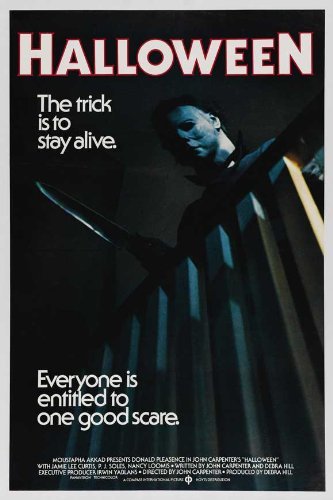
Halloween (1978)

day332challoween

HALLOWEEN (1978) Four stars

There’s one particularly cherished moment from all the years watching HALLOWEEN.

Every time I have showed the film to friends and family, there’s one scene I patiently wait for with devilish anticipation.

I make internal bets with myself that it will work on everybody who’s seeing the movie for the first time, and it will even still work on those return viewers.

It’s a jump scare, one of the best ever filmed.

Every time, I would be taciturn leading up to this scene, not wanting to give a single thing away to my friends and family.

I wanted to see them jump, and I wanted to hear them scream.

It worked every single time.

It’s the scene where Dr. Loomis (Donald Pleasence) and Sheriff Brackett (Charles Cyphers) are discussing matters inside the old Myers house.

I won’t go any further than that.

Like the slasher films that followed, including its own many sequels, HALLOWEEN is a fun one to watch especially with several peers, but for slightly different reasons than the many, many, many followers and imitators.

First and foremost, director John Carpenter (in the words of Alfred Hitchcock) played the audience like a piano in HALLOWEEN. He’s the maestro and we love the music he’s playing, literally. The main theme in HALLOWEEN just stays with the viewer and in fact right now writing this review, I have that song playing over scenes from the first movie playing inside my head. Like other classics PSYCHO and JAWS, the music in HALLOWEEN added immeasurably to the film’s success.

Reportedly, Carpenter composed the theme in one hour, according to an interview he did for Consequence of Sound.

Carpenter discusses the movie and its music at some length on his official site: “HALLOWEEN was written in approximately 10 days by Debra Hill and myself. It was based on an idea by Irwin Yablans about a killer who stalks baby-sitters, tentatively titled ‘The Baby-sitter Murders’ until Yablans suggested that the story could take place on October 31st and HALLOWEEN might not be such a bad title for an exploitation-horror movie.

“I shot HALLOWEEN in the spring of 1978. It was my third feature and my first out-and-out horror film. I had three weeks of pre-production planning, twenty days of principle photography, and then Tommy Lee Wallace spent the rest of the spring and summer cutting the picture, assisted by Charles Bornstein and myself. I screened the final cut minus sound effects and music, for a young executive from 20th Century-Fox (I was interviewing for another possible directing job). She wasn’t scared at all. I then became determined to ‘save it with the music.’

“I had composed and performed the musical scores for my first two features, DARK STAR and ASSAULT ON PRECINCT 13, as well as many student films. I was the fastest and cheapest I could get. My major influences as a composer were Bernard Herrmann and Ennio Morricone (who I had the opportunity to work with on THE THING). Hermann’s ability to create an imposing, powerful score with limited orchestra means, using the basic sound of a particular instrument, high strings or low bass, was impressive. His score for PSYCHO, the film that inspired HALLOWEEN, was primarily all string instruments.

“With Herrmann and Morricone in mind, the scoring for HALLOWEEN began in late June at Sound Arts Studios, then a small brick building in an alley in central Los Angeles. Dan Wyman was my creative consultant. I had worked with him in 1976 on the music for ASSAULT. He programmed the synthesizers, oversaw the recording of my frequently imperfect performances, and often joined me to perform a difficult line or speed-up the seemingly never ending process of overdubbing one instrument at a time. I have to credit Dan as HALLOWEEN’s musical co-producer. His fine taste and musicianship polished up the edges of an already minimalistic, rhythm-inspired score.

“We were working in what I call the ‘double-blind’ mode in 1978, which simply means that the music was composed and performed in the studio, on the spot, without reference or synchronization to the actual picture. recently, my association with Alan Howarth has led me to a synchronized video-tape system, a sort of ‘play it to the TV’ approach. Halloween’s main title theme was the first to go down on tape. The rhythm was inspired by an exercise my father taught me on the bongos in 1961, the beating out of 5-4 time. The themes associated with Laurie (Jamie Lee Curtis) and Dr. Loomis (Donald Pleasence) now seem to be the most Herrmannesque. Finally came the stingers. Emphasizing the visual surprise, they are otherwise known as ‘the cattle prod’: short, percussive sounds placed at opportune moments to startle the audience. I’m now ashamed to admit that I recorded quite so many stingers for this one picture.

“The scoring sessions took two weeks because that’s all the budget would allow. HALLOWEEN was dubbed in late July and I finally saw the picture with an audience in the fall. My plan to ‘save it with the music’ seemed to work. About six months later I ran into the same young executive who had been with 20th Century-Fox (she was now with MGM). Now she too loved the movie and all I had done was add music. But she really was quite justified in her initial reaction.

“There is a point in making a movie when you experience the final result. For me, it’s always when I see an interlock screening of the picture with the music. All of a sudden a new voice is added to the raw, naked-without-effects-or-music footage. The movie takes on it’s final style, and it is on this that the emotional total should be judged. Someone once told me that music, or the lack of it, can make you see better. I believe it.”

HALLOWEEN, unlike its sequels and imitators, works from a minimalist base, with much fewer characters than the run-of-the-mill body count thriller for one prominent example of minimalism. HALLOWEEN gives us time with the characters, especially the three girls Laurie (Curtis), Annie (Nancy Loomis), and Lynda (P.J. Soles) and Dr. Loomis (Pleasence), and this is definitely to the film’s benefit. These characters take on a greater resonance than, for example, the gallery of grotesqueries in FRIDAY THE 13TH: A NEW BEGINNING, who only have a couple minutes of (largely) unpleasant behavior before their gruesome death scenes.

Carpenter and Hill found gold in Curtis: not only the daughter of Janet Leigh (PSYCHO) and Tony Curtis, but a great rooting interest who can be intelligent and resourceful and strong enough that we forgive her for the other moments that are standard in horror films, like (for just one example) her difficulty finding the keys with a madman bearing down on her. She’s pretty, as well, without it being overwhelming.

Annie and especially Lynda are pioneers of the Valley Girl speak, totally, and that might be one of the great sources of annoyance for anybody watching HALLOWEEN. Soles, though, is one of the more likable young actresses from that era, seen to even more effect in ROCK ‘N’ ROLL HIGH SCHOOL and STRIPES.

Likability is a key in the success of both HALLOWEEN and the first NIGHTMARE ON ELM STREET.

Dr. Loomis is the character lacking in any of the FRIDAY THE 13TH movies, for example. He’s just brilliant, brought to the life by the indelible screen presence of the late Pleasence (1919-95). His character commands our attention every time he steps onscreen and definitely every time he delivers that dialogue he keeps that attention, especially about Michael Myers and “pure evil.”

“I met him 15 years ago,” Dr. Loomis said. “I was told there was nothing left: no reason, no conscience, no understanding in even the most rudimentary sense of life or death, of good or evil, right or wrong. I met this … 6-year-old child with this blank, pale, emotionless face, and … the blackest eyes – the Devil’s eyes. I spent eight years trying to reach him, and then another seven trying to keep him locked up, because I realized that what was living behind that boy’s eyes was purely and simply … evil.”

` That’s one of the best monologues in any horror film (or any film period).

Monologues like that can sometimes bring the attached film to a halt, because we don’t want to hear this psychological jive talk recited by some hack actor at just that very moment. Please, shut the fuck up (Donnie).

For example, Simon Oakland’s jive talk late in PSYCHO drags us down a bit.

Honestly, though, I could have listened to Dr. Loomis talk all day.

Pleasence sells this dialogue with the conviction of his craft and I don’t know, I’ve always got the feeling that maybe Dr. Loomis is maybe just maybe a bit mad himself all these years working around Michael Myers.

You see this Dr. Loomis coming, and you just might head to the next city or county or perhaps country, because you know he’s trouble.

In horror films, often times authority figures do not believe the stories of teenage protagonists until it’s too late, but HALLOWEEN applies the slight twist to the formula by having authority figures question the story of another authority figure.

I love the way Carpenter and his team utilize Michael Myers in HALLOWEEN: he’s driving or standing around in the background of many early shots and combined with Dr. Loomis’ dramatic playing up of Myers in dialogue, he takes on mythic proportions. Paraphrasing from Dr. Loomis, this isn’t a man. He’s a shape, and a killing force. But we also get the sense that he’s childlike and in one of the great moments for any screen killer, Myers stands and admires his own craftmanship after one kill.

He’s far more interesting with far less back story, as the sequels beginning with HALLOWEEN II irrefutably proved.

Let’s see here, we have two great protagonists, one great killer (and one great weapon), and great music.

Seems like this is the beginning of a great horror movie.

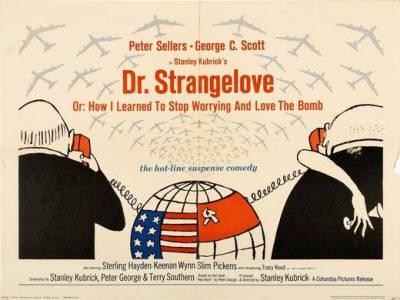
Dr. Strangelove (1964)

day752cdr.strangelove

DR. STRANGELOVE (1964) Four stars
Stanley Kubrick’s DR. STRANGELOVE (abbreviated title) OR: HOW I LEARNED TO STOP WORRYING AND LOVE THE BOMB (long title) contains one of my favorite lines of dialogue in any movie.

President Merkin Muffley, played by Peter Sellers in one of his three roles in the movie, tells the Americans and Commies both, “Gentlemen, you can’t fight in here! This is the War Room!”

I don’t give a damn that it placed No. 64 on the American Film Institute’s 100 Years … 100 Movie Quotes list.

Oh, sorry, “Frankly, my dear, I don’t give a damn” from GONE WITH THE WIND came in at No. 1, followed by quotes from Marlon Brando characters in THE GODFATHER and ON THE WATERFRONT that bums just can’t refuse.

Kansans will be sure thrilled that “Toto, I’ve a feeling we’re not in Kansas anymore” came in at No. 4.

CASABLANCA led that list with six quotes and freaking JERRY MAGUIRE picked up two. Are you kidding?

Anyhoo, DR. STRANGELOVE certainly lives up to such a title: It’s a strange movie about strange people doing and saying the strangest things.

I’ve heard it described as a movie about what could happen if the wrong person pushed the wrong button.

That wrong person would be General Jack D. Ripper (Sterling Hayden), who believes them damn commies have conspired to pollute our “precious bodily fluids.” To say that it’s an obsession for Gen. Ripper would be one of the great understatements.

Gen. Ripper orders a first strike nuclear attack on the Soviet Union.

Then we get a mad gallery of characters that are just slightly less mad than Ripper: Muffley, Group Captain Lionel Mandrake, and Dr. Strangelove played by Sellers; General Buck Turgidson by George C. Scott; Colonel Bat Guano by Keenan Wynn; and Major T.J. “King” Kong by Slim Pickens, for example. Muffley and Turgidson are predominantly inside the War Room, one of the great movie sets.

Sellers originally had been slated to play four roles, including Kong, but it went down to three after he hurt his ankle.

Sellers predominantly improvised most of his dialogue and his ad-libs were retroscripted into the screenplay.

Sellers modeled Muffley after 1952 and 1956 U.S. Presidential candidate Adlai Stevenson and former Nazi scientist Dr. Strangelove after Wernher von Braun. Strangelove’s very reminiscent stylistically of mad scientist Rotwang from Fritz Lang’s METROPOLIS.

Strangelove comes aboard late in the movie as humanity faces nuclear destruction.

Scott, who later won an Oscar for Gen. Patton in the Best Picture-winning PATTON, played Gen. Turgidson a lot differently than he intended and he was apparently tricked by Kubrick into acting ridiculously like in the final film. Scott never worked with Kubrick again. Kubrick and Scott played each other at chess and Kubrick got the edge on Scott, a skilled player, often.

John Wayne and Dan Blocker, of course, turned down Kong because, you know, DR. STRANGELOVE was just way too darn pinko for their persuasions.

The role ended up in the hands of the one-and-only Pickens, whom the makers of DR. STRANGELOVE did not understand was a genuine cowboy.

They did not tell Pickens that it was a black comedy and he played it straight, gloriously straight.

He gets one of the great exit scenes in film history.

There’s a whole lot about DR. STRANGELOVE that I don’t want to talk about in this space, especially for those who have not yet seen the movie.

I believe, however, that you will find it to be one of the great movie experiences.

It’s definitely the satire the Cold War deserved.

It’s an incredibly smart and sneaky movie, truly ahead of its time.

For example, a Cornell University professor Legrace G. Benson wrote Kubrick a fan letter and the professor interpreted DR. STRANGELOVE as being very sexually-layered. (Not sure how people could miss it.)

Kubrick wrote Benson back, “Seriously, you are the first one who seems to have noticed the sexual framework from intromission (the planes going in) to the last spasm (Kong’s ride down and detonation at target).”

And, for sure, after DR. STRANGELOVE you will never hear “We’ll Meet Again” the same way again.

Fist of Fury (1972)

day522cfistoffury

FIST OF FURY (1972) Three-and-a-half stars
I started the month with Bruce Lee’s ENTER THE DRAGON and now I review a fifth Bruce Lee action spectacular, FIST OF FURY, originally called THE CHINESE CONNECTION for many, many years after its 1972 release in America.

FIST OF FURY ranks second in the Lee pantheon and for me it’s the most emotionally resonant of his pictures. ENTER THE DRAGON succeeds more as spectacle, a slambang entertainment, than anything else.

I’ve always responded to the story of Lee’s Chan Zhen in FIST OF FURY, a young man who stands against the Japanese antagonists who belittle their Chinese neighbors in Shanghai at every turn and Chan Zhen also seeks justice for those responsible for his master Huo Yuanja’s death. The other Lee films’ stories do not grip me quite like this one.

This was Lee’s second film, coming hot on the heels of THE BIG BOSS. It’s a far more successful film than its precursor, and it does away with any silly notion or pretense of nonviolence, when we all know that it would never last. I don’t think that withholding strategy worked whatsoever in THE BIG BOSS. I mean, come on, we just want to see Lee fight and waiting half the damn film made no damn sense. That would be like a Gene Kelly musical where he did not dance until the final scene.

FIST OF FURY gives us a couple nifty villains, although not quite as nifty as WAY OF THE DRAGON and ENTER THE DRAGON.

Former professional baseball player Riki Hashimoto portrays Suzuki, the master of the Hongkou dojo that presents so many problems for Chan Zhen and Huo Yuanja.

Hashimoto played for the Mainichi Orions (now the Chiba Lotte Marines) in the 1950s before an injury forced his early retirement. Hashimoto turned to acting and he had 25 credits from 1960 to 1985; FIST OF FURY was his third-to-last acting credit. Hashimoto died in 2017 at the age of 83, of lung cancer.

FIST OF FURY introduces a secondary villain, Suzuki’s translator played by Paul Wei. Yes, another movie where a translator’s rendered redundant by the fact all the characters are dubbed into English. Anyway, Wei returned in WAY OF THE DRAGON for a similar role. He’s an oily bastard in both movies, a weasel of the highest order basically. He’s called “Interpreter Wu” in FIST OF FURY and “Ho” in WAY OF THE DRAGON. Wei died in 1989.

So we have a story that grips us, a martial arts dynamo and all-around charismatic movie star in the lead role, and villains that we love to hate.

Sounds like a good movie.

Okay, now back to the titles. Until 2005, FIST OF FURY was mistakenly called THE CHINESE CONNECTION in America. See, they originally meant to title THE BIG BOSS as THE CHINESE CONNECTION and FIST OF FURY as, well, FIST OF FURY. They wanted to exploit William Friedkin’s THE FRENCH CONNECTION, a big critical and commercial success (and the first R-rated movie to win the Academy Award for Best Picture) that featured drug smuggling, just like THE BIG BOSS. For many years, however, we had the wrong titles.

Guess you could say though, in the case of FIST OF FURY, a good action movie under another name is a good action movie all the same.

On the eve of Thanksgiving, I’d like to say thanks for Lee (1940-73) and the work that he left behind. It’s still inspiring after all these years.

NOTE: This review was part of a series of reviews in November 2018.

Bumblebee (2018)

day 123, bumblebee

BUMBLEBEE (2018) Three-and-a-half stars

To be honest, BUMBLEBEE was a pleasant surprise.

Granted, I knew coming in that it received better reviews than each of the five previous live-action TRANSFORMERS movies directed by the beloved Michael Bay. (TEAM AMERICA: WORLD POLICE paid Bay and his general oeuvre tribute with “Pearl Harbor Sucks.”)

In those reviews, I believe BUMBLEBEE was even recommended many times as being a TRANSFORMERS movie for people who did not like the Bay entries. For the record, I liked the first entry from 2007 and they quickly dropped in quality. (REVENGE OF THE FALLEN, though, gave Roger Ebert a zinger first sentence and book title, “A Horrible Experience of Unbearable Length.”)

Anyway, I walked into Flick Theatre in Anderson, popcorn and healthy skepticism in tow.

Leaving the Flick two hours later, I thought, “Hey, that’s the best TRANSFORMERS movie since the animated film released in 1986.”

I’ll go through a short list of reasons why.

— Length: BUMBLEBEE lasts 114 minutes, the shortest running time for TRANSFORMERS since 1986. The animated version ran 90 minutes, a good length. Bay’s five entries lasted 150 minutes, 150 minutes, 157 minutes, 165 minutes, and 149 minutes. Not only were they long but they were long and loud, very very very loud. They’re the kinds of movies heard throughout the multiplex. BUMBLEBEE, directed by Travis Knight, lacks the bloat of the Bay-directed films. By the way, Bay served as producer, just like he did for A QUIET PLACE and the FRIDAY THE 13TH, AMITYVILLE HORROR, and THE TEXAS CHAINSAW MASSACRE remakes.

— Focus: BUMBLEBEE centers on the human characters far more than any previous live-action TRANSFORMERS, especially through female protagonist Charlie (Hailee Steinfeld). She’s a rock solid entry point into this world and she’s the one who finds and befriends Bumblebee in a relationship that echoes E.T. THE EXTRA-TERRESTRIAL and THE IRON GIANT, as well as KING KONG. I never felt that way during the Bay entries. Charlie also reminds one that had this film been made in the 1980s, her character would have been played by Molly Ringwald, maybe Ally Sheedy.

We’re swept up in the emotion of the film, just like E.T., THE IRON GIANT, and KING KONG.

— Humor: Ah, a delicate balance. Do you go too far and become camp like BATMAN & ROBIN or do you lack humor and become a rather grim affair like the Christopher Nolan BATMAN films? I laughed at several points throughout BUMBLEBEE, where I was obviously intended to laugh, like when Charlie and her possible future boyfriend / adoring sidekick Memo have Bumblebee egg and toilet paper the house and car of somebody who’s been cruel and mean to Charlie at every turn … of course, Bumblebee takes it to another level. Or Bumblebee’s priceless reaction to Rick Astley. (Maybe it’s unfortunate that Mojo Nixon’s “Debbie Gibson is Pregnant with My Two-Headed Love Child” did not come out until 1989, given its subject matter, including a Rick Astley insult. Believe Mojo called Astley “a pantywaist.”)

— Soundtrack: Tears for Fears’ “Everybody Wants to Rule the World,” the Simple Minds’ “Don’t You (Forget About Me),” Astley’s “Never Gonna Give You Up,” Steve Winwood’s “Higher Love,” A-Ha’s “Take On Me,” Sam Cooke’s “Unchained Melody,” the Smiths’ “Girlfriend in a Coma,” Sammy Hagar’s “I Can’t Drive 55,” Stan Bush’s “The Touch,” and DJ EZ Rock and Rob Base’s “It Takes Two” are some of the nostalgic buttons pushed by this prequel.

No doubt that a teenage girl in the late 1980s would have favored such songs. Charlie’s a major Smiths fan — I seem to also remember hearing “Bigmouth Strikes Again” — and she wears T-shirts of Elvis Costello, the Damned, and the Rolling Stones, I do believe.

I found a couple anachronisms.

“Never Gonna Give You Up” was released in the UK in July 1987 and later became a hit in America in early 1988.

“It Takes Two” did not appear until August 1988. BUMBLEBEE takes place during 1987.

However, though, I grinned from ear to ear when Bumblebee cued up “The Touch,” a hard rock anthem from the 1986 TRANSFORMERS later covered by Dirk Digger (Mark Wahlberg) during his cocaine would-be rock star phase.

— Little moments like that are scattered throughout BUMBLEBEE.

First-time live-action director Knight is the 45-year-old son of Nike co-founder and Chairman Emeritus Phil Knight. The younger Knight worked in animation (namely stop-motion) before BUMBLEBEE — his works include CORALINE and his directorial debut KUBO AND THE TWO STRINGS (2016) for Laika Entertainment; Travis Knight serves as Laika’s president and CEO (he’s also on Nike’s Board of Directors) and the company employs nearly 400 people in Hillsboro, Oregon.

Will future TRANSFORMERS movies follow the direction taken by Knight and British screenwriter Christina Hodson or go back to the Bay-ten path, if you will?

BUMBLEBEE does not lack action movie spectacle, of course, with shit blowing up real good especially in the opening and closing scenes, but the heart and humor displayed over the balance of the movie takes BUMBLEBEE to a higher level.

Munro (1960)

day 74, munro

MUNRO (1960) Four stars
I’ll make the review of this 1960 Czechoslovak-American animated short directed by Gene Deitch a short one, I promise.

It centers on a basic premise: The army drafts a 4-year-old boy.

Munro starts out your average little boy and then just a minute into the film, his life changes when he receives something in the mail. He can’t read, so a bigger person reads it to him. Cue that military music.

“At the age of 4, he’d been drafted.”

Then we join Munro for his physical. He’s the runt of the litter, for sure, and he’s the only one not talking about all his physical ailments, like a bad back.

Munro gets classified as “1A” or “eligible for military service.”

Munro goes to war.

It’s a foreign world for the little man with foreign words flying at him. This Sgt. couldn’t speak English very well, according Munro.

“Tenhoot,” “Foorit hoo,” “Hup haw hee haw hip hee haw hip,” et cetera.

Munro becomes a full-blown soldier and he plays all the games that soldiers play, like “Face.” Let’s see, there’s “Ri’,” “Lef’,” “Up,” “Down,” “In,” “Out,” and “Face” variances in “Face.”

Munro eventually becomes very tired.

Why?

“I’m only 4.”

They do not believe him.

Go back out and march in the rain.

They believe Munro’s faking that he’s only 4.

The experts think he’s a malinger.

The Colonel wants to shove him in the stockade.

They still won’t believe that he’s only 4.

Munro decides that he will be the best soldier.

Recruits pass by Munro and they’re told, “See that man, that’s a soldier. That’s what we’re gonna train you to be. We’re gonna separate the men from the boys.”

Munro then begins to cry.

They’re all embarrassed.

The General finally gets to the bottom of it, “You’re nothing but a baby boy.”

Munro signs his release form, and he gets a big parade in his honor with a message from the President himself.

American syndicated cartoonist and author Jules Feiffer, who’s considered the most widely read satirist in the country, wrote MUNRO. Feiffer won a Pulitzer Prize in 1986 and he was inducted into the Comic Book Hall of Fame in 2004. MUNRO won the 1961 Academy Award for Best Animated Short.

Feiffer wrote MUNRO when he was in the U.S. Army from January 1951 to January 1953.

“Every day I was enraged,” Feiffer said in an interview with Bookslut. “Every day I hated it. So much so that when they tried to promote me just as an automatic gesture to getting out, to raise your pay scale so you could get more, I refused to accept the raise in rank from private to PFC.”

Feiffer wrote MUNRO at his desk.

“With the full support of the man who supervised me,” Feiffer said, “who was this lllustrator who had a career that never took off in magazine illustration and this was his way of supporting the family. And his name was Perc Couse, who looked a very daunting, formidable man. He had a deep voice and scary, but he turned out to be a very warm, lovely, generous-hearted fellow who thought I and another G.I. there named Harvey Dinnerstein were much too talented to waste our time on Army stuff. So he let Harvey paint and he let me do my subversive satire. And I’m not sure he understood what I was doing, but after the war (Korea) he certainly did. After we were out, he took great pride, because we remained great friends until his death.”

MUNRO beat out some prestigious films and filmmakers for that Academy Award: Walt Disney Studios’ GOLIATH II, Warner Bros. cartoons HIGH NOTE and MOUSE AND GARDEN (the former directed by Chuck Jones and the latter by Friz Freleng, two of the legendary animators), and A PLACE IN THE SUN (not much info on this one).

George S. Kaufman said the famous words “Satire is what closes on Saturday night” after his play closed in Philadelphia and failed to make it to Broadway.

Though, in the 1960s, we had MUNRO and more prominently Stanley Kubrick’s dark Cold War satire DR. STRANGELOVE OR: HOW I LEARNED TO STOP WORRYING AND LOVE THE BOMB, one that still holds up rather well today.

MUNRO holds up rather well today, as well.

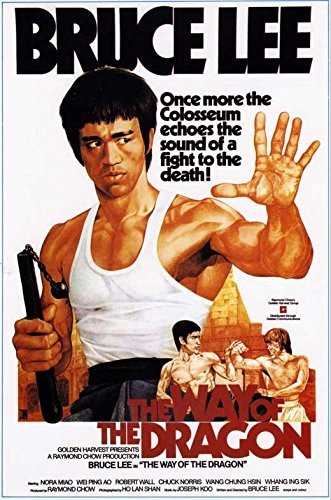
Way of the Dragon (1972)

day 51, way of the dragon

WAY OF THE DRAGON (1972) Three stars
Foreign movies have always faced challenges in America. Always have, most likely always will.

I can remember selecting PAN’S LABYRINTH at the video store and the concerned clerk attempted warning me that it had subtitles.

I was at first amused and then quickly frustrated by this warning, and mumbled back “OK” in a way that communicates far more than just two letters.

Next time I hear something like that, I’ll pipe back, “I can read” and “Well, I hope so, I’m not that fluent in … ”

Some people just have an irrational fear of subtitles, apparently they are the chopsticks of cinema. Come on, suck it up buttercup and don’t be a candy ass, reading won’t kill you.

Another memorable foreign movie experience was CROUCHING TIGER, HIDDEN DRAGON at the Pittsburg 8 Cinema, where two airheads kept snickering throughout the picture and they accounted for more laughter than I heard that year during so-called comedies THE LADIES MAN and NEXT FRIDAY. I laughed most that year at DRACULA 2000, followed by THE SKULLS and ROMEO MUST DIE, although I have been informed that I should not have been laughing.

The challenges faced by foreign movies always come to mind every time I watch Bruce Lee’s WAY OF THE DRAGON, titled RETURN OF THE DRAGON in America because it was released after ENTER OF THE DRAGON. Lee’s movies, by the way, often had title issues.

I always hate it when characters are supposed to be speaking different languages (in WAY OF THE DRAGON, I am betting on Chinese, Italian, and English) and there’s obviously a translator in a scene. Instead, they’re all dubbed awkwardly into English and the translator merely repeats what’s already been said just moments ago. Scenes are (needlessly) rendered redundant.

This situation happened years ago during a version of Jean-Luc Godard’s CONTEMPT that played on Turner Classic Movies, where I was only left with contempt for the English dub. Apparently, only the French received a multilingual (French, English, Italian, and German) release while the American and Italian releases were dubbed entirely into their respective languages. Still a great movie, but the French version would have been superior because I’d rather have multiple languages all subtitled rather than everybody reduced to one dubbed language.

Thankfully, for WAY OF THE DRAGON, it’s a martial arts picture and Bruce Lee’s dynamism cannot be lost in translation.

Howard Hawks once called a good movie “three good scenes and no bad scenes,” and the director of SCARFACE, BRINGING UP BABY, and THE BIG SLEEP would know.

WAY OF THE DRAGON has the three good scenes down pat. Unfortunately, it’s got a few bad scenes, largely because of the dodgy dubbing, but we’ll cover two great scenes in this space.

WAY OF THE DRAGON features arguably the best cinematic display of Lee’s nunchakus, as he takes on a whole gang of buffoonish henchmen.

Lee was introduced to the weapon by Dan Inosanto, who battled against Lee with nunchakus in one of the best scenes in GAME OF DEATH.

Legend has it Lee played ping pong and lit cigarettes with nunchakus. Apparently, the part about ping pong, that’s false. The video was just a promotional spot with digital trickery and a Lee look-alike highlighting the shenanigans, a promo by the way for the Nokia N96 Limited Edition Bruce Lee cell phone that was produced in 2008. Doesn’t sound any more nefarious than any of the other Lee exploitation after his 1973 death.

The crime boss in WAY OF THE DRAGON hires American karate champion Colt and the legendary Chuck Norris makes his motion picture debut.

Lee’s Tang Lung and Colt have one of the great movie fights at the Colosseum and it’s quite possibly the best fight the Colosseum’s seen for at least a few hundred years, a 10-minute spectacle that never gets old to watch.

Indelible images like Norris’ chest hair (enough for a bear skin rug), that damn cute little cat (it gets more close-ups than Norma Desmond and Daffy Duck combined), and Lee’s touching gesture of final respect toward his worthy opponent after an epic battle make it more than just another fight.

Norris makes for a great villain, but it’s unfortunately a vein that he never tapped again, preferring to play square heroes.

Norris fans and fact hunters might deny the existence of WAY OF THE DRAGON. I found some alternative “facts” on the Internets.

Q: Why are there more Chuck Norris Jokes than Bruce Lee?

A: Because Bruce Lee is no joke.

FACT: Monsters look under the bed for Chuck Norris. Chuck Norris checks his closet and looks under the bed in fear of Bruce Lee.

FACT (using John Goodman’s piece-pulling Walter from THE BIG LEBOWSKI in the meme): “Am I the only one around here that thinks Bruce Lee is way more badass than Chuck Norris?”

Q: Want to know Chuck Norris fact?!

A: I (Bruce Lee smiling in the meme) kicked his ass.

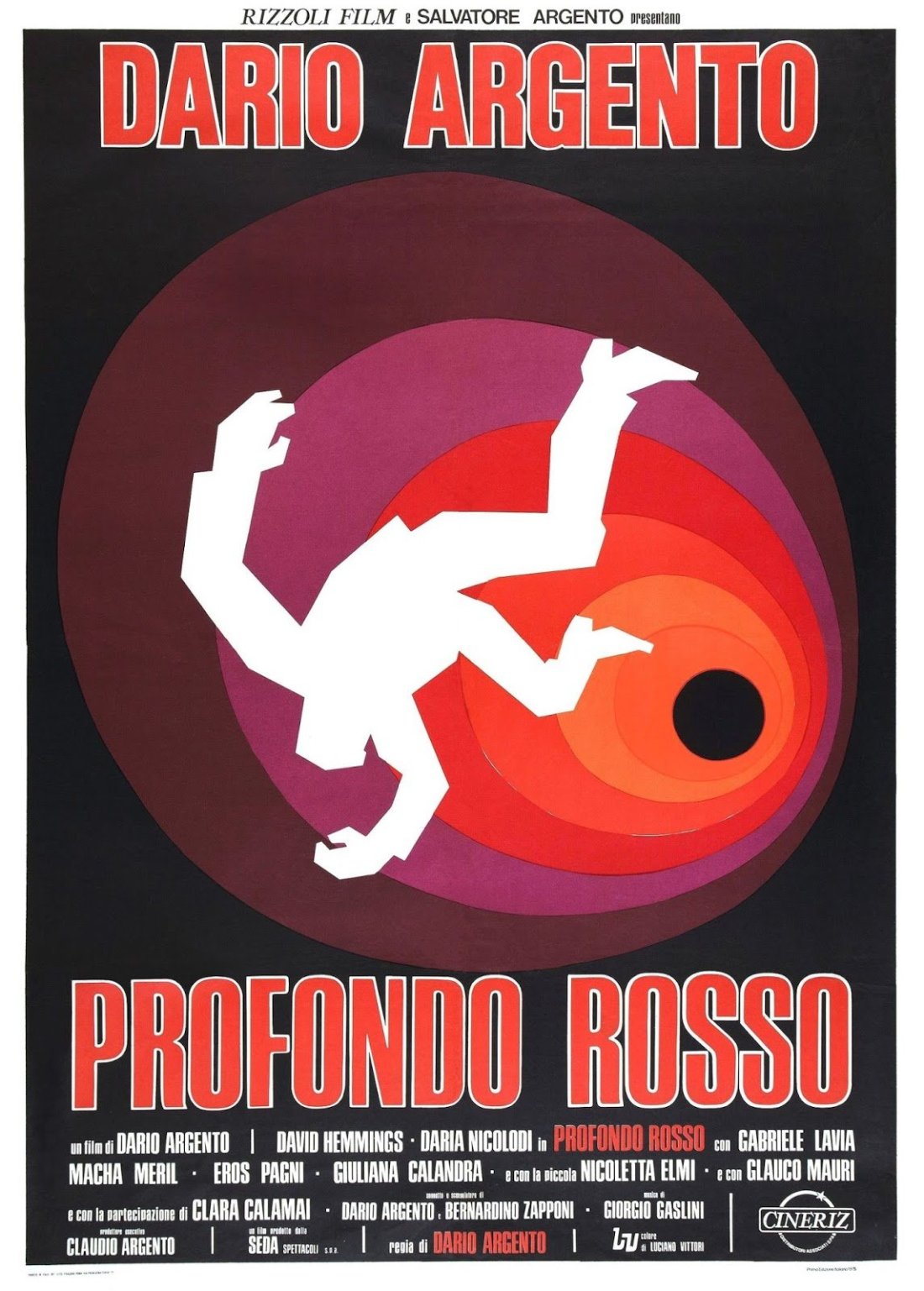
Profondo Rosso (1975)

DAY 25, DEEP RED.jpg

PROFONDO ROSSO (1975) Four stars
Giallo is the Italian word for yellow.

In fiction terms, though, quoting from Wikipedia, giallo means “a 20th century Italian thriller genre of literature and film. Especially outside Italy, giallo refers specifically to a particular Italian thriller-horror genre that has mystery or detective elements and often contains slasher, crime fiction, psychological thriller, psychological horror, exploitation, sexploitation, and, less frequently, supernatural horror elements. In Italy, the term generally denotes thrillers, typically of the crime fiction, mystery, and horror subgenres, regardless of the country of origin.”

An Italian publishing company named Mondadori began releasing crime and mystery novels in 1929 and the series became known as “Il Giallo Mondadori,” distinguished by their heavily yellow front covers. Especially popular were the works of Agatha Christie, Dashiell Hammett, and Raymond Chandler. Mondadori still prints “Il Giallo Mondadori” novels today.

Giallo movies started appearing in the mid-1960s and became a fixture especially in the late 1960s and 1970s through directors like Mario Bava, Dario Argento, and Lucio Fulci, who achieved the greatest international notoriety.

Argento’s PROFONDO ROSSO, also known as DEEP RED or THE HATCHET MURDERS, was the director’s fifth movie and it’s a transitional film, before Argento’s work verged on the fantastical like SUSPIRIA and INFERNO. It and THE BIRD WITH THE CRYSTAL PLUMAGE, his first film, are his best giallos.

Watching PROFONDO ROSSO for the first time, one will be struck by how much you feel like you’ve seen this movie before through later films it influenced such as John Carpenter’s HALLOWEEN and David Cronenberg’s SCANNERS. For example, Goblin’s main theme for PROFONDO ROSSO and Carpenter’s for HALLOWEEN are first cousins. Cronenberg modeled the lead-in to the famous head explosion scene after the early lecture sequence in Argento’s film. Rick Rosenthal’s HALLOWEEN II (produced by Carpenter) featured a death by scalding water scene inspired by Amanda Righetti’s death in PROFONDO ROSSO.

Like the best Argento films, PROFONDO ROSSO sticks with you.

Argento films usually give us a protagonist who’s a writer, a musician, a creative person of some form. In THE BIRD WITH THE CRYSTAL PLUMAGE, it’s American writer Sam Dalmas. In CAT O’NINE TAILS, it’s reporter Carlo Giordani. In FOUR FLIES ON GREY VELVET, it’s rock drummer Roberto Tobias. In PROFONDO ROSSO, it’s pianist Marcus Daly. In SUSPIRIA, it’s American dance student Suzy Bannion. In INFERNO, it’s music student Mark Elliott.

These characters provide us a rooting interest and keep us hanging on through all the convolutions of the plot. They become our surrogate, because they’re normality (just like us) in a mad, mad, mad world. They (and we) are just trying to survive another day. They live out our detective fantasies.

In any mystery, it’s vital that we find that rooting interest.

Argento protagonists normally get in way, way, way over their heads like the ones in Hitchcock films so often do … of course, we see David Hemmings playing Marcus Daly and we cannot help but think of Michelangelo Antonioni’s BLOW-UP, where Hemmings’ very Swinging London photographer believes he may have accidentally photographed a murder in a park. There’s no doubt, though, in PROFONDO ROSSO.

On his way home early in the film, Marcus sees psychic medium Helga Ulmann (Macha Meril) being attacked in her apartment. They live in the same building. He rushes up the stairs and down the hall to her apartment and finds her dead body.

The chief witness becomes the star witness, thanks to female reporter Gianna Brezzi (Daria Nicoladi) and her coverage of the murder, and the reporter and the pianist become partners, both in the romantic and detective sense.

PROFONDO ROSSO is one of those mysteries that rewards our interest to the very end.

Duel (1971)

duel

DUEL (1971) Three-and-a-half stars

24-year-old Steven Spielberg’s first feature film premiered November 13, 1971 on ABC.

Richard Matheson (1926-2013) wrote the script, based on his nightmarish experience on November 22, 1963 (the date of JFK’s assassination). A trucker tailgated Matheson on his return home following a golf match against friend and fellow writer Jerry Sohl. Matheson turned his experience into a short story that originally ran in Playboy.

Spielberg directed on a $450,000 budget and production ran 13 days, three days over schedule, and it played as the “ABC Movie of the Week” lasting 74 minutes. A later theatrical release covered nearly 90 minutes.

Spielberg wanted and got character actor Dennis Weaver (1924-2006). Of course, most of us know the Joplin-born actor for his work on TV series “Gunsmoke” and “McCloud,” but Spielberg admired Weaver for his work in Orson Welles’ TOUCH OF EVIL and in DUEL, Weaver’s character repeats a bit of verbal business from TOUCH OF EVIL. You got another think coming, indeed.

It’s a very basic premise at the center of DUEL: An unnamed truck driver stalks our protagonist David Mann (Weaver), a middle-aged salesman returning home from a business trip.

Mann passes the truck early on and that begins his 90-minute nightmare.

Oh sure, I bet you believe that driver sure as hell gets bent over being passed.

You might even say to yourself that it’s preposterous, but then again, in this day and rage, you might not.

I definitely believe that it’s not and I recall my own bizarre experience from November 2016.

“Driving home from work last night/this morning around 2 a.m., this car began following me from about the Highway 43/96 roundabout. It would creep up, then fall back and never pass despite multiple opportunities. There was no tailgating or attempt to run me off the road. A couple times, I looked back and the car swerved all over the place. At some point, I figured out it was definitely not a cop. That some point had already been reached when I turned on to Highway H toward Jasper, a destination 11 miles from Highway 43. I took a real slow, hesitant turn with a stop at the end and the creeper car behind me matched that slow, hesitant turn with a stop at the end. OK, it’s a creeper. We’re about halfway to Jasper when I turn into a random driveway. I sit in my car for a couple minutes, debating my next move. The car following me backs up a little bit and leaves me room to reverse and turn around. I see that it’s a dude driving the car. He’s alone. I back out, turn around, drive toward him, and engage him in what turned out to be one of the weirdest conversations I’ve ever known. But just like a character said to Inspector Harry Callahan in DIRTY HARRY, ‘I gots to know.’

“Anyway, I now know for sure what it’s like to have a conversation with someone orbiting Planet X. I could only understand bits and pieces of his stammered mutterings, something ‘bout him being from Wichita and then wanting to know if I wanted to make a contribution. No, sorry, I gave at the office.

“The Creepy Crawler: Thought we could talk for 10 minutes.

“Me: No, and we’ve already talked for 5.

“TCC: No, we haven’t.

“Me: It’s late and I just want to get home from working all night.

“(voice tails off quickly)

“TCC: So you don’t want to have a conversation?

“[I drive off into the sunset. No, wait, it’s 2 a.m. There’s no sunset. The sun rises in the opposite direction. Ah, hell, we’re not getting anywhere with this digression into stage direction.]

“Back on the road and that holy quest to make it home safe, I drove about 85 over those crazy little hills of Highway H until I reached Highway 43. No creeper. Very little active human life of any kind. Very few lights. I felt like saying, ‘It’s 30 miles to Arcadia, I’ve got a three-quarters full tank of gas, half a reporter’s notebook, it’s dark out and I am wearing a Star Wars T-shirt.’”

Watching it for the first time in full the other day, DUEL brought on a flashback to that 2016 incident and I certainly felt all the sympathy in the world for the plight of David Mann.

DUEL represented a test run for JAWS, Spielberg’s third feature. Both productions often masterfully exploit our fear of the unknown, but I’ll say that DUEL scares me more than JAWS because I drive a whole helluva lot more than I swim in the ocean.

The Big Boss (1971)

day 50, the big boss

THE BIG BOSS (1971) Two stars
Glad that I didn’t watch THE BIG BOSS (a.k.a. FISTS OF FURY) first among Bruce Lee films; ENTER THE DRAGON, RETURN OF THE DRAGON, and FIST OF FURY (a.k.a. THE CHINESE CONNECTION) each came before and that’s a groovy thing because I could definitely understand what the furor over Lee is about.

First time I watched THE BIG BOSS, I did not know what quite to make of it, other than I didn’t like it very much. I thought, let me get this straight, this is Lee’s first martial arts feature and his character has sworn an oath of nonviolence. Ridiculous. Absolutely ridiculous. I know, I know, they wanted a dramatic build-up to the inevitable moment when that nonviolence goes straight out the damn window and Hell (in the form of Lee) breaks loose. That’s just not how it works, though, for me and I have always found the moments leading up to the later fight scenes a genuine snoozer. Cue to the good parts, please. I’ve watched it several times and I’ve never been able to connect with it like many others have.

Lee’s character taking a pledge to nonviolence, why that’s about the equivalent of strapping a piano on Fred Astaire’s back during one of his musicals or it’s like making a great singer play a mute character for half the movie. This is not quite as frustrating as the script for JAWS 2 that delayed the inevitable for Sheriff Brody to go and kill the damn shark with some truly idiotic plot gyrations … but it’s close, real close. How many characters have to die before it’s set right?

No offense to Lee, but he was no Gandhi or Martin Luther King.

I don’t care what anybody says, but we go to a Lee movie for the fight scenes and there’s just not enough of them in THE BIG BOSS (nearly 120 minutes in length) for it to qualify as one of Lee’s better efforts. It’s a grade above GAME OF DEATH or at least the bastardized posthumous version conjured up by Robert Clouse of what could have been Lee’s masterpiece had the man been able to complete it.

There’s still moments, though, in THE BIG BOSS when you realize what’s so special about Lee. He’s truly one of a kind, even in dreck. This flick made Lee famous throughout Asia, and it became the highest-grossing film of all-time in Hong Kong in 1971, beating out THE SOUND OF MUSIC and TORA! TORA! TORA! That’s all because of Lee, who commands the screen like only a select few have in motion picture history.

Like GAME OF DEATH and its fight scenes late in that movie, viewers have to wade through a lot of crap just to get to the high points; we’re knee deep. There’s a 4-5 minute fight sequence in the ice factory in THE BIG BOSS that gets at the heart of Lee’s appeal, though Lee memorably made his own criticism of his own movies in ENTER THE DRAGON, “Why doesn’t somebody pull out a .45 and, bang, settle it?”

Of course, that would not be within the basic spirit of a martial arts picture. The genre exists as an alternative to the Western and it’s based on a lot of the same themes, such as integrity and honor, as what was once the quintessential American movie genre. Martial artists, though, use their fists and feet rather than guns.

The graphic violence, though, in THE BIG BOSS belongs more to a Spaghetti Western than anything directed by John Ford or Anthony Mann.

THE BIG BOSS is a poorly made exploitation film that features one great aspect (two if you count that poster; all Lee’s films have incredible posters) and reportedly director Lo Wei (1918-96) was more interested in the racetracks than the film. Wei’s known for launching both Lee and Jackie Chan, directing Lee in THE BIG BOSS and FIST OF FURY and Chan in NEW FIST OF FURY. Wei can be seen in FIST OF FURY as the police inspector Lo.