Enter the Dragon (1973)

DAY 34, ENTER THE DRAGON

ENTER THE DRAGON (1973) Four stars
There’s a line in BLADE RUNNER that makes me think about Bruce Lee (1940-73), “The light that burns twice as bright burns half as long, and you have burned so very very brightly.”

Lee made his screen debut as an infant in GOLDEN GATE GIRL, a.k.a. TEARS IN SAN FRANCISCO.

He appeared in several films throughout the ’50s and ’60s, and played the role of Kato on “The Green Hornet” during that show’s 1966-67 run.

Lee made his legend, though, on five martial arts films that were filmed over a period of two years in the early ’70s, where his light burned twice as bright half as long: THE BIG BOSS, FIST OF FURY, THE WAY OF THE DRAGON, ENTER THE DRAGON, and THE GAME OF DEATH (a new, different plot filmed after his death around Lee’s completed fight scenes; Lee postponed finishing THE GAME OF DEATH to make ETD).

ENTER THE DRAGON was the groundbreaker, known as the first martial arts film produced by a major American studio and for a whopping $850,000. The film made $21,483,063 in North America and coupled with the success of the English dub of FIVE FINGERS OF DEATH earlier in 1973, martial arts exploded. (Lee’s earlier films FIST OF FURY and THE WAY OF THE DRAGON fared much better financially in Hong Kong.)

Unfortunately, Lee died of a cerebral edema on July 20, 1973, just six days before ENTER THE DRAGON premiered in Hong Kong. One month later, it premiered in the United States at Grauman’s Chinese Theatre on the Hollywood Walk of Fame.

It’s been said that Lee was very nervous before making ENTER THE DRAGON. Lee’s wife, Linda Lee Cadwell, countered that in the Q&A session for the film’s 40th anniversary Blu-ray.

“I think it’s been portrayed that (Bruce) was very nervous before filming began,” she said. “I think it’s been misrepresented to the point that some people say he was having a nervous breakdown he was so paralyzed by fear. That is false. He was a professional actor. He’d been acting his whole life. And he was a professional martial artist as well. So he had no butterflies about that kind of thing. But what he wanted was to make this film very special. And he had ideas he would like to see added to the script. He was very adamant about it.

“He really put a lot of work into studying how to improve this film. To make it the best product that it could be because this was an important film for Bruce. It was going to be his first introduction to the American market. There was some reticence on the side of the people making the film. They wanted Bruce to get on the set and get going but he didn’t want to show up and get going on the film until the things he wanted — namely all the philosophy ­— in the film were done.”

ENTER THE DRAGON has been described as James Bond meets Fu Manchu, a fact some reviewers have lamented.

For example this one from Time Out, “A sorry mixture of James Bond and Fu Manchu, it tacks together the exploits of a multi-national crew of martial artists converging on Hong Kong for a tournament, infiltrated by Lee — fresh from his Shaolin temple — on an assignment to bust an opium racket. Worth seeing for Lee, but still unforgivably wasteful of his talents.”

Paul Bramhall wrote “Enter the Dragon: The Most Overrated Kung Fu Movie Ever?” in July 2018 and here’s his take on the Bond element: “The influence of Bond drifts in and out of ENTER THE DRAGON like spliced footage in a Godfrey Ho movie, making it come across as shoehorned in rather than a natural part of the narrative. … Released the same year as Roger Moore’s debut as Ian Fleming’s most famous creation, the secret agent styled shenanigans on display in ENTER THE DRAGON were dated even before it hit cinema screens. Casting Geoffrey Weeks a poor man’s M, and a head scratching plot of a rogue Shaolin student using a martial arts tournament as a front to his opium smuggling operation, (director) Robert Clouse and co. should have taken a page out of the ‘less is more’ manual of filmmaking.”

Nigel Tufnel had the answer for all that, “That’s just nitpicking, isn’t it?”

ENTER THE DRAGON downplays the sex angle, the double entendres, and the gadgets, and this low-budget “Bond movie” can stand head-to-head with any of the best Bond films like FROM RUSSIA WHITH LOVE, GOLDFINGER, ON HER MAJESTY’S SECRET SERVICE, and SKYFALL, for example.

Like how those early Bond films gather a lot of their appeal from the star power of Sean Connery, ENTER THE DRAGON draws heavily on Lee.

He’s a movie star, yes, tried and true with charisma and electricity that can transcend a low budget, a dodgy or dopey plot, awkward and awful voice dubbing, and other production lapses.

Lee ranks with Humphrey Bogart, Marilyn Monroe, James Dean, et cetera, all the great stars of the screen.

Not only that, watching Lee in action is like watching great athletes Barry Sanders, Jerry Rice, Michael Jordan, and Mike Tyson, for example.

You know you’re watching the very best, a grand master at his or her craft and somebody in the greatest physical (and mental) shape.

George C. Scott said that he looked for a “joy of performing” quality in judging actors, that the great ones separated themselves from the good with their joy. Scott named James Cagney.

You can say all these actors and athletes named in the last few paragraphs all have this “joy of performing.”

Lee definitely had that joy, and it’s apparent throughout even his worst movies.

Unlike the other Lee martial arts movies released in America, though, we hear Lee’s actual speaking voice in ENTER THE DRAGON.

He’s very, very quotable and my friends and I loved to do our best Lee impression with lines such as “Don’t think. FEEEEEEEEL! It’s like a finger pointing away to the moon. Do not concentrate on the finger or you miss all of the heavenly glory,” “You can call it the art of fighting without fighting,” and “Why doesn’t somebody pull out a .45 and, bang, settle it?”

In addition to Lee at the center, we have John Saxon and Jim Kelly as Roper and Williams, respectively, who also end up on Han’s Island (not to be confused with the small, uninhabited island that Canada and Denmark are in dispute over) because they were designed to give the film a wider appeal to maximize profits. Unlike Lee, who transcends fads and fashions, Saxon and Kelly and their characters are a bit more prisoner of the times. Fortunately, the two Americans both have enough personality and martial arts skill to justify their presences, and they’re fun.

Then we have the arch villain Han, just like a Bond picture, but please try and picture Gert Frobe or Telly Savalas do martial arts battle with Lee and the other protagonists and their fists and feet of fury.

Shin Kein (his speaking voice dubbed by Keye Luke, since he did not speak English) received acting credits in 272 films from 1940-95 and he’s most identified with Han. Like the best of the Bond films, Han contributes to the success of ENTER THE DRAGON with his villainy, a great foil to the good guys.

I love this blurb from his profile on the Villains Wiki, “Han is a heroin drug lord who runs his heroin cooking business from a secluded island. He also lost a hand, though how he lost it is never explained. He keeps the bones of the severed hand on display in a museum of torture and weapons. In place of the missing hand he has a variety of weapon hands to use like a iron hand, claw hand and a bladed hand. He is also an expert in martial arts.”

ENTER THE DRAGON ends in slambang fashion with the final fight between Lee and Han — a scene that could be played right alongside THE LADY FROM SHANGHAI and DUCK SOUP, three of the best usages of mirrors in motion picture history.

I would love to have seen ENTER THE DRAGON at its American premiere, just for the response to Lee alone.

NOTE: Raymond Chow, the producer behind Lee and Jackie Chan, died Friday, November 2, 2018 at the age of 91.

The Omen (1976)

DAY 7, THE OMEN

THE OMEN (1976) One-and-a-half stars
The British have a great word to describe all THE OMEN movies: “bollocks.”

We can also substitute “poppycock,” “hogwash,” and “balderdash,” some of the best words in the English language.

THE OMEN movies are nothing more than an excuse to watch familiar and sometimes big-name performers be systematically eliminated in bizarre, gruesome ways. Sounds great, eh?

Not when the audience gets bludgeoned with the great significance of it all, unlike the average exploitation movie. We have some frenzied overacting, a whole lot of pretension, a relentless musical score, and a ridiculous storyline that’s like a Satanist soap opera.

Sometimes I like all of those elements in a movie but THE OMEN movies lay it on so damn thick with them all that I just balk and become an unrepentant nonbeliever.

Off the top of my old noggin, only THE AMITYVILLE HORROR movies compete with THE OMEN series for my least favorite horror series.

I’ll quote from the IMDb for a handy plot summary: “Robert and Katherine Thorn seem to have it all. They are happily married and he is the U.S. Ambassador to Great Britain, but they want nothing more than to have children. When Katherine has a stillborn child, Robert is approached by a priest at the hospital who suggests that they take a healthy newborn whose mother has just died in childbirth. Without telling his wife he agrees. After relocating to London, strange events (and the ominous warnings of a priest) lead him to believe that the child he took from that Italian hospital is evil incarnate.”

Robert and Katherine Thorn are played by Gregory Peck and Lee Remick, respectively, and they’re our leading big names. Peck naturally plays the great reluctant believer and every OMEN and AMITYVILLE HORROR movie needs one main character to constantly postpone the inevitable. What will it take to convince Peck’s Robert Thorn that his son’s the Antichrist? Unfortunately for us and the movie, it will take a whole helluva lot to convince Robert Thorn. I lost patience with Thorn (and the movie) long, long before he takes action down the home stretch.

Mainly it’s because THE OMEN and its sequels gave birth to what I call “The Omen Syndrome” or any time any character figures out a dread secret and either spills the beans or merely plans to, you can just bet your bottom dollar that in the next few minutes that character will be killed in the most unpleasant way possible. THE OMEN movies all played on this basic scenario time and time again. That makes them deadly predictable, and that’s when you earn a syndrome named after you.

To be fair, THE OMEN does have a few effective moments, but they all probably add up to 10-15 minutes of screen time and we’re talking about a movie that lasts nearly two hours. Those 10-15 minutes amount to the death scenes and the moments of danger, but the rest of the movie irritated me to no end unlike, for example, THE EXORCIST, a film that involved me from beginning to end. Because of the few effective moments, I have awarded the first OMEN movie 1/2 star more than its sequels.

At this point, I’d rather talk about the actors who played Damien in the first three OMEN movies.

English actor Harvey Stephens played the devil child and it was his first role. I mean, wow, where the Hell do you go from playing the Antichrist? Stephens only took on two more film roles: Young Emil in the 1980 TV movie “Gauguin the Savage” and Tabloid Reporter No. 3 in THE OMEN remake (2006). In 2017, Stephens received a suspended prison sentence for his 2016 road rage attack on a pair of cyclists; Mr. Stephens knocked one cyclist unconscious with a punch and punched the other cyclist several times in the face. Stephens received sentences of 14 months, suspended for two years.

Brazilian-born English actor Jonathan Scott-Taylor played a teenage Damien in the first sequel that’s set in Chicago (before John Hughes) and stars William Holden and Lee Grant in the Peck and Remick parts. Scott-Taylor’s career peaked with Damien and his last film performance came in a 1985 movie named SHADEY.

New Zealand actor Sam Neill took on Damien for THE FINAL CONFLICT and he’s the only one of the three actors to sustain a film career. We’ve seen Neill in everything from DEAD CALM and THE PIANO to THE HUNT FOR RED OCTOBER and JURASSIC PARK.

By the way, isn’t anybody who names their child Damien just asking for it?

Godzilla vs. Hedorah (1971)

DAY 6, GODZILLA VS. THE SMOG MONSTER

GODZILLA VS. HEDORAH (1971) Three-and-a-half stars
Greg Kihn’s “The Breakup Song” posited that they don’t write ’em like that anymore.

Well, they don’t make movies like GODZILLA VS. HEDORAH (Toho Company title and version in 1971) or GODZILLA VS. THE SMOG MONSTER (American International title and version in 1972) or, for that matter, movies like INVASION OF THE BEE GIRLS and INFRA-MAN anymore. Where do you start with movies like that? Where do you end?

GODZILLA VS. THE SMOG MONSTER must be seen to be or not to be believed. It’s ridiculous, absolutely and sublimely ridiculous, in ways that only a truly great “bad” movie can be.

Honestly, though, I don’t think it’s bad at all and it’s definitely infinitely better than the 1998 American GODZILLA starring Matthew Broderick. I mean, come on, Roland Emmerich and Dean Devlin, you create a pair of characters based on Siskel & Ebert after their negative reviews of your previous movies and then you don’t have the testicular fortitude to kill them off. Wusses!

This is the 11th GODZILLA movie in the series and it honestly features just a little bit of everything.

No, seriously.

The IMDb plot summary: “From Earth’s pollution a new monster is spawned. Hedorah, the smog monster, destroys Japan and fights Godzilla while spewing his poisonous gas to further the damage.”

That only barely scratches the surface of GODZILLA VS. THE SMOG MONSTER. Even if the movie only revolved around that plot summary, I would be interested, but this flick goes the extra mile to entertain us.

Just yesterday I wrote about how I love it when a horror movie takes on more than just being a horror movie and gives us more.

That applies to Godzilla movies or any genre for that matter.

In this 11th Godzilla movie, we have a pro-environmental message replete with a song titled “Save the Earth,” we have a psychedelic freakout in a club with a tripping dude conjuring up partiers adorned with fish heads, we have weird animated interludes, we have little scientific lessons on nebulas and the like, we have a smog monster who looks more like a shit monster, and, last but definitely not least, a flying Godzilla, yes, a flying Godzilla using his atomic breath for jet propulsion. Was the similar scene in ROBOCOP 3 a tribute?

Those are simply the highlights.

Thankfully, the Save-the-Earth message doesn’t get too preachy or smug (it’s not ripe to be mocked by “South Park”) because of everything else surrounding it.

It’s a dark movie overall and genuinely scary in a few parts, because, let’s face it, none of us want to be killed by a shit monster.

Godzilla and Hedorah go 15 rounds in a heavyweight fight.

Godzilla vs. The Smog Monster could have been paired with Ali vs. Frazier, a creature feature before or after the boxing match.

The geniuses at American International ran GODZILLA VS. THE SMOG MONSTER together with FROGS. What a pair! Best pair since Marilyn Monroe, right?

I’ve long been fascinated by what movies are titled in country from country. We’ve already covered a pair of titles for the 11th Godzilla movie and here’s four more. How about HEDORAH, LA BURBUJA TOXICA (Spain) or HEDORAH, THE TOXIC BUBBLE.

GODZILLA CONTRA MONSTRUOS DEL SMOG (Mexico) or GODZILLA AGAINST MONSTERS OF SMOG.

FRANKENSTEIN’S BATTLE AGAINST THE DEVIL’S MONSTER or FRANKSTEINS KAMPF GEGEN DIE TEUFELMONSTER in German.

GODZILLA CONTRE LE MONSTRE DU BROUILLARD (French) or GODZILLA AGAINST THE MONSTER OF FOG.

That’s just a brief international title sampler.

The Fly (1986)

DAY 5, THE FLY

THE FLY (1986) Four stars
I absolutely love it when a horror movie takes on more than just merely being a horror movie. These movies rank among the most pleasurable viewing experiences.

For example, George Romero’s DAWN OF THE DEAD (1978), a horror movie or a zombie picture that also passes through action and adventure, black comedy, silent and slapstick comedy, drama, gore galore, cinematic and social satire, surrealism, survivalism, and melodrama in addition to being great at the basic level of being a horror movie. All those extra traits put DAWN OF THE DEAD in the upper echelon.

Another example is David Cronenberg’s THE FLY (1986). It works on the most basic horror movie level but reaches greatness because it’s also a few other things it didn’t have to be. It grosses us out at times (rather, make that many times) but it also zaps us straight in the heart with its central storyline.

We’ve seen lots and lots of scientists over the years in loads and loads of pictures, but Jeff Goldblum’s Seth Brundle is one of those that sticks with you and stays in your mind. He’s not Colin Clive’s Dr. Frankenstein and he’s not Jeffrey Combs’ Herbert West, two other great cinematic scientists who embody more of the mad scientist archetype than Brundle. Brundle is more of the lovable eccentric that puts you in mind of what Albert Einstein must have been like in real life. We come to know this cinematic scientist more than just about any that spring to mind.

Brundle invents a teleportation device and he’s inspired to teleport himself one night after having successfully tried everything from Geena Davis’ stocking to a baboon. Of course, unbeknowst to him, a darn pesky housefly joins Brundle in the pod and throws a monkey wrench variable into this grand scientific experiment. Over the rest of the movie, Brundle transforms into Brundlefly.

Some viewers took what happened to Brundle as a metaphor for AIDS, but director Cronenberg said that his original intent was for an analogy for disease itself, terminal conditions such as cancer, and aging. This is one of the main sources for the emotional heft of THE FLY, because most of us grow old and die from a disease. Most of us are afraid, very afraid, indeed, it seems, and THE FLY plays on our fears.

On top of that, there’s a great tragic love story between Goldblum’s Brundle and Davis’ Veronica Quaife.

I highly doubt anybody expected such a moving love story coming in, especially considering Cronenberg’s previous films like SCANNERS and VIDEODROME.

And, let’s face a fact: Horror movies have not always been a great source for love stories.

Chris Walas deserved his Academy Award for Best Special Effects Make-up, but it’s the pleasant surprise love story and Brundle himself that elevate THE FLY.

Goldblum and Davis were a real-life couple, boyfriend and girlfriend during the making of THE FLY, and they were married from 1987 to 1990. They met during TRANSYLVANIA 6-5000 and later made a third movie together, EARTH GIRLS ARE EASY. For both actors, THE FLY would be their break into the mainstream and honestly, neither performer has ever done anything better.

Goldblum would play variations on scientists in seemingly every appearance for the next 30 years, in everything from JURASSIC PARK and INDEPENDENCE DAY to POWDER and THE LIFE AQUATIC WITH STEVE ZISSOU. It’s a role that fits him well and we can say that it’s become the Jeff Goldblum role just as we can say that Dabney Coleman (think NINE TO FIVE) and Hal Holbrook (think ALL THE PRESIDENT’S MEN) have come to develop their own respective roles.

Davis moved on to director Renny Harlin in both her personal and professional life, and her career never quite recovered after such flops as SPEECHLESS, CUTTHROAT ISLAND, and THE LONG KISS GOODNIGHT, the latter pair directed by Harlin. Davis’ career took off for a few years after THE FLY with hits like BEETLEJUICE, THELMA & LOUISE, and A LEAGUE OF THEIR OWN and an Academy Award for Best Supporting Actress for THE ACCIDENTAL TOURIST.

This is the rare remake that has obscured the original, which was made in 1958, directed by Kurt Neumann, and starred Vincent Price.

Goldblum wrote Price a letter telling one of the great hams in history, “I hope you like it as much as I liked yours.” Price, touched by the letter, went to see the remake and unfortunately, he did not quite return Goldblum’s affection for the original and called the remake “wonderful right up to a certain point … it went a little too far.”

In addition to both FLY movies, there’s been a lot of great fly moments throughout history, both screen and sound.

I’ll briefly guide you through three of them.

Norman Bates (Anthony Perkins), his stare, his voiceover, and a fly in the final moments of PSYCHO (1960): “They’re probably watching me. Well, let them. Let them see what kind of a person I am. I’m not even going to swat that fly. I hope they are watching. They’ll see. They’ll see and they’ll know, and they’ll say, ‘Why she wouldn’t even harm a fly.'”

Hungarian animator Ferenc Rofusz’s THE FLY (1980) won the 1981 Academy Award for Best Animated Short and it follows a fly on its journey from the woods to a house and finally on death’s end of a fly swatter. Oh, sorry, did I spoil that for you or the fly? Since it’s only three minutes long, this animated short might be a replacement if you have no desire to sit through 96 minutes of THE FLY (1986). In fact, you can watch the animated one 32 times in a row to substitute for the experience of the live-action flick.

English rock band Wire released the song “I Am the Fly” on its 1978 album CHAIRS MISSING and it features the great lines “I am the fly in the ointment / I can spread more disease than the fleas which nibble away at your window display / Yes, I am the fly in the ointment / I shake you down to say please as you accept the next dose of disease.”

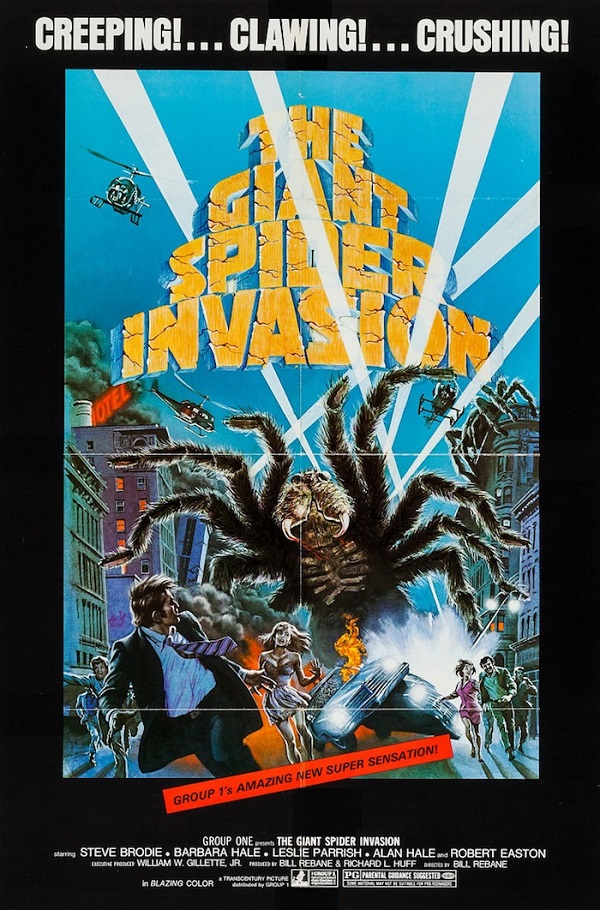
The Giant Spider Invasion (1975)

DAY 4, THE GIANT SPIDER INVASION

GIANT SPIDER INVASION (1975) One star
Alan Hale’s opening line informs us we’re dealing with a bad movie: HI, LITTLE BUDDY.

Amazingly, THE GIANT SPIDER INVASION did not credit Sherwood Schwartz, the writer-producer responsible for both “Gilligan’s Island” and “The Brady Bunch,” for that line. Hale played the Skipper on “Gilligan” and I kept looking for Bob Denver as the Skipper’s local hick deputy or a drunk in a bar presided over by a bartender named Dutch. Denver never showed up, but did Hale show up in Denver’s “The Wackiest Wagon Train in the West.” This is a tough question.

Hale’s first line references his old TV show and one of his last lines references JAWS. His character’s all quips in this movie, asking the visiting NASA scientist if he’s seen JAWS and when our resident intellectual answers in the affirmative, Hale says “[This giant spider] makes that shark look like a goldfish.”

Well, I’ll quip right back: JAWS makes THE GIANT SPIDER INVASION look like a bad home movie or a film student’s very first production.

Bill Rebane films certain scenes in ways that approximate good old Roger Corman. The camera loves this absolutely precious little nymphet. We get tight shots of her cleavage and her crack barely seeping out of her scant panties. There are two dirty old men who make passes at her. She lists her measurements at 35-24-35. Turner Classic Movies did not dub in the Commodores’ “Brickhouse,” although the precise body measurements are different. The opening credits list her as “introducing Dianne Lee Hart.” Bet she never shows her grandkids this film. However, she manages to survive a 50-foot spider’s attack. Bet Rebane wanted her back for the sequel.

Her older sister (Leslie Parrish) did not luck out. First and foremost, she’s a lush. She outdrinks Ken Curtis in THE KILLER SHREWS and competes with Carolyn Brandt from THE INCREDIBLY STRANGE CREATURES WHO STOPPED LIVING AND BECAME MIXED-UP ZOMBIES for the crown of B-Movie Drinking Champion. She’s made a mutant spider’s snack. This was obvious from her first scene. She drinks straight from the bottle, makes a pass at her younger sister’s date, and displays the first hint of any nudity. This is why her character obviously deserved to die.

The film has its dubious charms. Dutch rounds up a local good old boy and good old girl brigade that will take on a 50 ft. spider and fail miserably – amazingly, this mob did not cry out THEY’RE TAKING OUR JOBS! How often do citizen action brigades succeed in the movies? There’s a carnival scene and my first thought was WILL THE SPIDER ATTACK THE CARNIVAL? A follow-up question: ARE THERE STARS IN THE SKY? There’s a lot of scientific jargon read with a straight face . . . “unpredecented phenomena” . . . gamma ray shower . . . decreased barometric pressure . . . 600 gram charge . . . 360 degrees . . . “shower it with neutrons.” And nine, wait, thirteen dead cattle (where’s PETA?) and three explosions, no, wait, it may have been four. I obviously lost track. Oh, there’s a revivalist preacher intoning “hellfire and brimstone,” “locusts,” and “abominations.” I thought his last proclamation came after he caught a sneak preview of this film. The Sheriff reads a book titled FLYING SAUCERS WANT YOU. The giant spider here may have made the shark in JAWS look like a goldfish but the film JAWS made THE GIANT SPIDER INVASION (again) look like a bad home movie. You win some, you lose some.

Matinee (1993)

DAY 3, MATINEE

MATINEE (1993) Four stars
I still cannot believe, Mr. Sisney, that it took you until 2018 to finally see MATINEE. Better late than never, though.

I know, right, especially since Joe Dante’s one of my favorite directors and I cannot think of a single time when he’s let me down.

Just rattle off the titles to prove the case that Dante’s an American cinematic treasure of the highest degree.

We have PIRANHA (1978), THE HOWLING, GREMLINS, INNERSPACE, THE ‘BURBS, GREMLINS 2: THE NEW BATCH, SMALL SOLDIERS, and LOONEY TUNES: BACK IN ACTION.

Please don’t forget “It’s A Good Life,” his segment from the highly uneven TWILIGHT ZONE: THE MOVIE or that Dante was pursued to direct a third JAWS film planned as a horror spoof titled JAWS 3, PEOPLE 0.

Oh, if only that would have been made rather than what turned out to be JAWS 3.

Or just imagine Dante’s remake of Dario Argento’s INFERNO.

Yeah, you’re right, Dante’s INFERNO just rolls straight off the tongue.

Oh, Dante also directed an early dance sequence in ROCK ‘N’ ROLL HIGH SCHOOL, the one when Mary Woronov’s fascist Principal Togar meets P.J. Soles’ Riff Randell for the first time, I do believe. Apparently Dante helped out fellow director Allan Arkush when the latter suffered from exhaustion.

I generally prefer Dante over both Steven Spielberg and Robert Zemeckis, who often strayed too far over into strained seriousness for their (and our) own good.

Few directors have been as explicit as Dante about being an unabashed film buff with a steady stream of references and that’s just one of the many joys found within his films. Granted, you don’t have to be a film buff to enjoy a Dante movie, but the pleasures can be limitless if you are one.

MATINEE expresses that more than any other Dante film.

It gives us an independent film producer named Lawrence Woolsey (John Goodman), visiting Key West, Florida, to promote his latest greatest monster movie named MANT!, a half-man, half-ant epic in “Atomo-Vision and Rumble-Rama!”

It also gives us Gene Loomis, our resident teenage film buff who knows just about everything there is to know about the movies. You can just bet your bottom dollar that Dante was like that growing up.

Woolsey’s latest masterwork comes in the middle of the Cuban Missile Crisis and why, of course, you can’t have a frivolous entertainment like “Mant!” in the middle of the Cold War, the Red Scare, and, of course, nothing less than the End of the World.

That’s why you have concerned citizens (a.k.a. busybodies, killjoys, spoilsports) like the members of Citizens for Decent Entertainment milling around. Of course, there’s more to it than meets the eye.

Woolsey initially calls to mind Alfred Hitchcock, but there’s also William Castle (inspiration for Woolsey), Samuel Z. Arkoff, Roger Corman, and other figures of a bygone era evoked throughout MATINEE.

Castle perpetuated enough gags for a lifetime and he filmed HOUSE ON HAUNTED HILL in “Emergo,” THE TINGLER in “Percepto,” and 13 GHOSTS in “Illusion-O.”

Film director John Waters touched on Castle, the director who made Waters want to make films (yes, blame it on Castle, lol): “William Castle simply went nuts. He came up with ‘Coward’s Corner,’ a yellow cardboard booth, manned by a bewildered theater employee in the lobby. When the Fright Break was announced, and you found that you couldn’t take it anymore, you had to leave your seat and, in front of the entire audience, follow yellow footsteps up the aisle, bathed in a yellow light. Before you reached Coward’s Corner, you crossed yellow lines with the stenciled message: ‘Cowards Keep Walking.’ You passed a nurse (in a yellow uniform?…I wonder), who would offer a blood-pressure test. All the while a recording was blaring, ‘Watch the chicken! Watch him shiver in Coward’s Corner!’ As the audience howled, you had to go through one final indignity – at Coward’s Corner you were forced to sign a yellow card stating, ‘I am a bona fide coward.'”

Meanwhile, Arkoff, through American International Pictures, produced everything from the Beach Party movies to biker films to Pam Grier to Ralph Bakshi to C.H.O.M.P.S. Arkoff created his own formula, The Arkoff Formula: Action, Revolution, Killing, Oratory, Fantasy, Fornication.

Corman, through both AIP and New World Pictures, directed or produced such notables as ATTACK OF THE CRAB MONSTERS, A BUCKET OF BLOOD, THE WASP WOMAN, THE LITTLE SHOP OF HORRORS, TARGETS, DEATH RACE 2000, GRAND THEFT AUTO, PIRANHA, and ROCK ‘N’ ROLL HIGH SCHOOL. Martin Scorsese, Peter Bogdanovich, Jack Nicholson, Ron Howard, Sylvester Stallone, James Cameron and, of course, Dante are just a few of the famous names who got their start or big break working for Corman behind or in front of the camera.

You might say that they don’t make ’em like they used to, back in the glory days of Castle, Arkoff, Corman, et cetera.

That’s not true and Dante’s films are exhibits for good “B” movies still being made.

Dante cast regulars Robert Picardo, Kevin McCarthy, Belinda Balaski, and, of course, “that guy” Dick Miller are in MATINEE. Miller has appeared in every one of Dante’s films, and he’s one of the main links with the cinematic past and present. I’m always glad to see Miller.

Both the main story of MATINEE and the film-within-the-film work, and I’ve largely touched on just the film buff aspect of the production.

Bottom line: MATINEE gets straight to the heart of why we love movies both good and bad. Just look at that beautiful advertising poster.

Christine (1983)

DAY 2, CHRISTINE

CHRISTINE (1983) Three-and-a-half stars
Back in college, during my first assignment for the school paper, I wrote a section about how Americans love their cars, from Route 66 and Jack Kerouac to James Dean and back. The summer editor took out the Americans love their cars section and now, it’s a suitable introduction for John Carpenter’s CHRISTINE, an adaptation of a Stephen King novel that does put a novel spin on some American fiction tropes.

We’ve seen many, many (arguably too many) films where boy meets girl and it’s love at first sight, but this is a film where it’s boy meets car and they meet cute with the car in shambles and up for sale by a codger who’s suspiciously quick to accept any price for the car. The boy’s arguably not in any better shape than the car.

The boy in love is Arnie Cunningham, a nerd supreme, and the car is a 1958 Plymouth Fury named Christine that’s definitely “bad to the bone” or at least bad to the bumper. Arnie, who dwells in 1978 California, might have liked to seen the 1957 Detroit prologue where an assembly line worker’s killed by the devil car, but Arnie and Christine are definitely meant for each other.

True love at first sight for both parties, and it will not be denied.

Yeah, you might say the film’s ridiculous, but most horror films are ridiculous, of course, and CHRISTINE works partly because it’s a love story with a twist in the main premise that we can appreciate. We love our cars, of course, but our love thankfully never reaches Arnie and Christine levels. It’s undeniable, though, to watch it happen to somebody else in a movie.

CHRISTINE also works because of the lead performance by Keith Gordon as the super nerd Arnie, who might be the cousin of Terry the Toad. He’s transformed by his love for his car into somebody foreign to his parents and his best friend Dennis, a football jock who sticks up for Arnie in the face of relentless school bullies and who questions Arnie’s purchase of the car right from the start. With this special car in his life, Arnie becomes a new young man by discarding his old taped-up horn-rimmed glasses, dressing like a latter day James Dean (ideal since Christine only plays ’50s rock ‘n’ roll), and becoming first arrogant and later belligerent, especially whenever any one comes between him and Christine. Fools they are, several individuals mess with the boy and car or just the car alone and they usually face gruesome consequences for their reprehensible actions.

We like this Arnie character and Gordon performance even more when Arnie starts taking a walk (or drive) on the mean side.

Anyway, the new brimming-with-confidence Arnie begins seeing the hot new girl in school, Leigh Cabot, and their relationship needless to say is complicated by Christine. Romantic triangles are frequent in the movies, but CHRISTINE might be the first and only one with a boy, a girl, and a killer car.

The girl and the car are both jealous of each other and that leads to the classic moment at the drive-in when the car attempts to kill the girl. Serves her right.

Needless to say, the girl wants very little to do with the boy after surviving this moment and the boy and the car become even closer, all leading us to a thrilling duel-to-the-death climax between machines in a garage.

John Rockwell and Alexandra Paul are just fine in their roles as best friend Dennis and would-be girlfriend Leigh, respectively, and if Columbia Pictures had its way, casting would have been disastrous with Scott Baio in the Arnie role and Brooke Shields as Leigh. Egads! Thankfully, the filmmakers insisted on lesser known actors. Kevin Bacon auditioned for Arnie, but he went off to do FOOTLOOSE instead and that obviously worked out best for all parties involved.

Gordon, who had previously appeared in JAWS 2 and DRESSED TO KILL, gives the defining performance of his career and his Arnie Cunningham rates with the greats in screen nerddom.

Veteran character actors Robert Prosky, Harry Dean Stanton, and Roberts Blossom (three of the best) are on hand and their old-fashioned grit and grime mesh well with the teeny boppers and the possessed car.

We talked about the subtle twists CHRISTINE puts on formula material. Well, the final line reading gives us Leigh declaring “God, I hate rock ‘n’ roll.” Probably the first teenager to ever say that in a film.

Frogs (1972)

DAY 1, FROGS

FROGS (1972) Three-and-a-half stars
“Today the pond . . . tomorrow the world.”
— FROGS tagline

FROGS is a creepy, malevolent little thriller with one of the best taglines in the history of promotion. Writer and satirist Fran Lebowitz called FROGS “the best bad movie I have ever seen in my life.” Yours truly calls it a damn good time at the movies.

We have a remote island ’round the Florida Everglades owned and operated by a crotchety old wheelchair bound millionaire named Jason Crockett (Ray Milland). See, Crockett’s a miserable old coot akin to both Dickens’ Scrooge and Disney’s Scrooge McDuck. Crockett bosses around everybody in his orbit and it’s a joy to behold. Bet this old man wishes that he could have been in A CHRISTMAS CAROL rather than FROGS. Seeing Milland in a wheelchair created recollections of Jimmy Stewart in REAR WINDOW. Yeah, Stewart and his character got a better deal.

Crockett throws himself a major shindig (family and their friends) celebrating both our nation’s birthday and the patriarch’s birthday. By the way, both John Adams and Thomas Jefferson died July 4, 1826, our country’s 50th anniversary. Mass amphibians and reptiles play the role of the ultimate party crashers here, taking over the Crockett mansion and isle. Bet this never happened to the Rockefellers and the Vanderbilts and the Waltons.

There are frogs, toads, snakes (both land and water), lizards, turtles, alligators, spiders, and leeches, an impressive unwanted guest list and cast. They’re not mutated in size, only numbers. Apparently. Like Hitchcock’s THE BIRDS, nobody explains this phenomenon in clinical detail. We do not require an explanation. An explanation would only cheapen the effect. Interesting tidbit: 500 Florida frogs and 100 giant South American toads made a great escape during the production of FROGS.

Aesthetically, we get extended close-ups of frogs and toads. Even the frog statues owned by Crockett are ominous. All these close-ups reminded yours truly of both DUCK AMUCK and SUNSET BOULEVARD, where Daffy Duck and Gloria Swanson demanded close-ups. Daffy and Gloria should have been in FROGS. Would Ms. Swanson have played a frog? You can bet Daffy would have.

On top of that, the massed amphibians and reptiles pick off the Crockett family and friends one-by-one as if they have studied horror film killing techniques. They are smooth and systematic operators, and they give Milland one of the great telephone scenes in movie history. Bet they Dial M for Murder! It’s all a whole lot of fun.

I believe all the way back in the BAT PEOPLE review we covered how snakes and spiders are creepy, although usually more so in real life than movies. Yes, indeed, they are creepy, especially in a film where Les Baxter’s musical score sounds like it was affected by radioactive waste. Here we have a claustrophobic wheelchair bound old man on an island of his own design,who believes in spraying every living intruder dead with pesticides and finally all these pests are his uninvited guests at his funeral. This is a film that crowds in on its characters and we get a legitimate sense of the suffocating Southern Gothic atmosphere of this island and how some of these characters have already lost their damn minds after centuries of incest and years of pesticides. Eat the rich, indeed. What a great little bad movie.